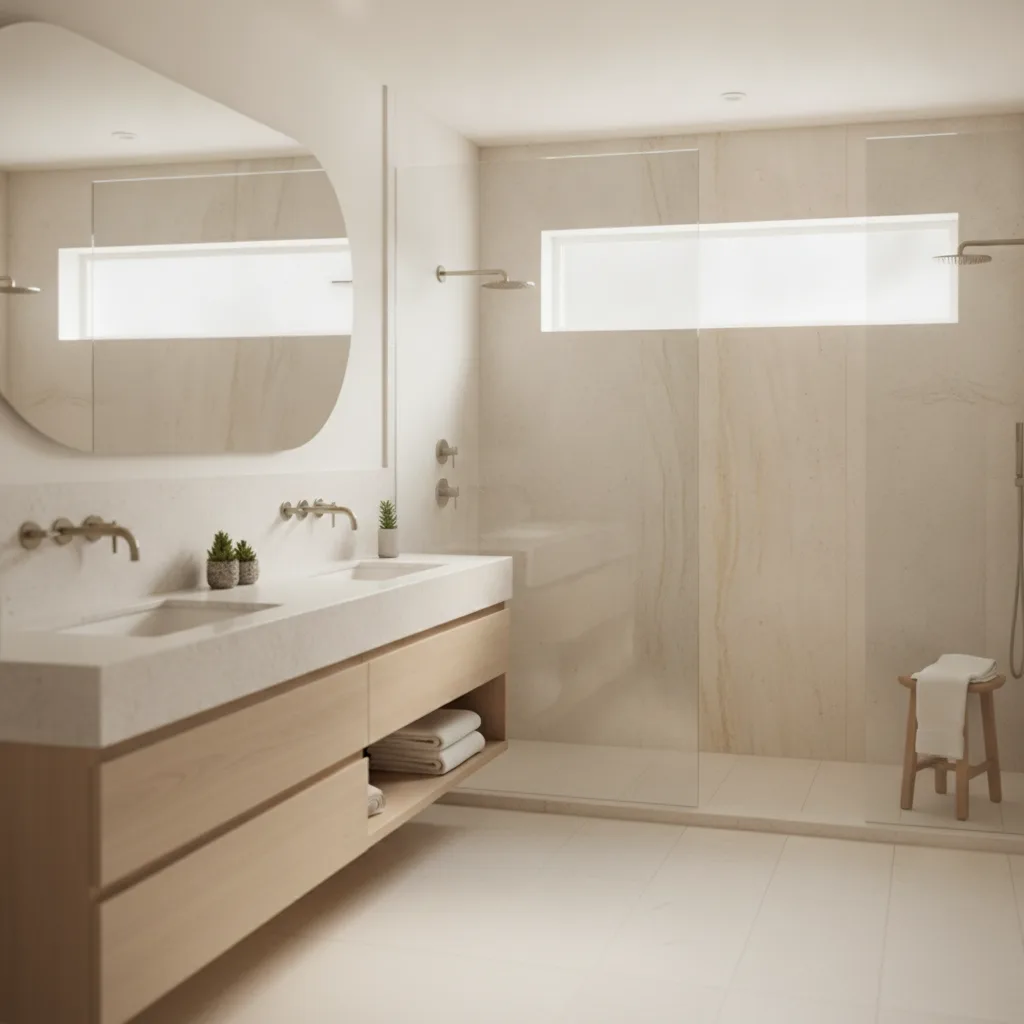
Vanity sink tops and shower surrounds do not have to match, but they need a deliberate relationship. As of 2026, design guidance from fabricators and the NKBA points to three workable approaches: exact match (same slab on both surfaces for a spa-like look), coordinated palette (shared undertones with intentional texture variation), and deliberate contrast (vanity as anchor, shower as accent). The vanity top should drive the selection — it sets the style category, dominant color tone, and finish family. Start there, then choose the shower surround to complement or intentionally contrast it. Undertone alignment is the one rule that applies across all three tiers: warm-to-warm and cool-to-cool prevents surfaces from reading as mismatched even when the materials differ.
Vanity sink tops and shower surrounds are the two largest stone surfaces in most bathrooms, and the question of how they relate drives more second-guessing than almost any other design decision in a bathroom remodel. The short answer: they do not have to match, but they do need a plan. Homeowners who skip the planning step and pick each surface independently almost always create a finish mismatch — the most common design mistake in bathroom renovations, according to design specialists at Bathify. This guide walks you through a practical three-tier framework so you can decide how your bathroom vanity tops and shower surround should relate, choose the right material for each surface, and walk into a fabricator consultation with real questions instead of vague preferences. Budget 30–45 minutes to work through the steps and prepare your material shortlist.
The binary match-or-don't-match question is the wrong starting point. As of 2026, design guidance from fabricators and the National Kitchen and Bath Association consistently points to three workable approaches — exact match, coordinated palette, or deliberate contrast — and each produces a finished, professional bathroom when executed correctly. Choosing the right tier depends on your budget, the size of the bathroom, and how much visual drama you want.
Exact match means the same slab material appears on both the bathroom vanity tops and the shower surround. Cambria's design team pairs the same quartz pattern on vanity countertops and shower walls specifically to ground the overall aesthetic and create a spa-like, seamless look. This approach works best in smaller bathrooms where visual continuity makes the space feel larger, or in a master bath where you want a luxury feel without competing focal points. Coordinated palette means the two surfaces share a color family and undertone but differ in texture, finish, or movement — a light gray vanity top with subtle speckling beside a slightly darker shower panel in the same tone family. The slight variation prevents the design from feeling flat.
Deliberate contrast goes further: the vanity and shower use clearly different materials that are intentionally balanced, with the vanity acting as the anchor and the shower as the accent. All three tiers work. The goal is to make a conscious choice before you start selecting slabs, not after — reversing that decision once you've templated the vanity is expensive and time-consuming.
The NKBA recommends establishing a unified design vision before selecting individual fixtures. Lock in your tier — match, coordinate, or contrast — first. Reversing that decision after you've templated the vanity is expensive.
The vanity top determines the style category for the entire bathroom — modern, transitional, or traditional — sets the dominant color tone, and establishes the finish family everything else should complement. Finish mismatch is the most common design mistake in bathroom renovations, and it almost always happens when someone picks the shower first and then tries to find a vanity top that fits. Start with the vanity and work outward.
The vanity is also where your eye goes first when you walk into the room. It holds the sink, sits at countertop height, and often fills most of one wall. The shower surround, by contrast, is typically viewed through glass or a curtain. That visibility hierarchy matters: a bold, veined vanity top with dramatic movement can carry the room on its own, with a calmer shower stone supporting it. Flip that hierarchy only when the shower is a true design centerpiece — a floor-to-ceiling tiled wet room with no glass partition, for instance.
One practical reason to anchor on the bathroom vanity top first: fabricators can often cut your vanity top from remnant slab at 30–50% off standard pricing, since the pieces are small. If you select the vanity stone first, you can then source the shower surround slab from the same lot or color family, maintaining continuity without paying full price on both.
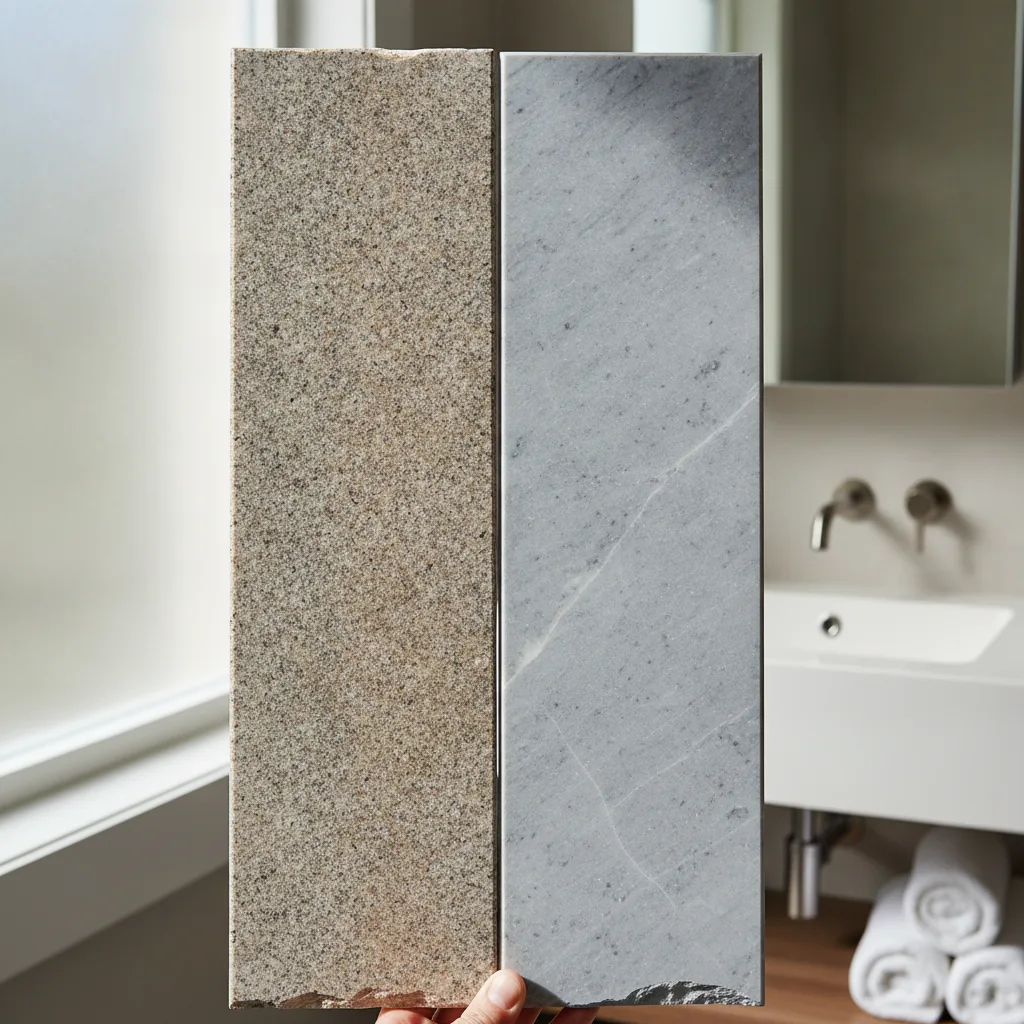
Undertone alignment is the single most practical rule for bathroom surface coordination: warm-to-warm and cool-to-cool. If the vanity top has a warm beige or cream undertone — think cream quartzite or a tan-flecked granite — and the shower surround runs cool gray or blue-white, the two surfaces will read as a mismatch even if the finishes and materials are otherwise beautiful. This applies regardless of which design tier you chose in step one.
Earthy warm tones like beige, taupe, and soft cream connect a vanity top to a shower wall without flattening either surface. Cool tones like soft gray, blue-gray, and white with silver veining work together by the same logic. The tricky cases are stones with complex undertones — a Calacatta marble, for example, can read warm (gold veining) or cool (gray veining) depending on the slab. Pull samples into the actual bathroom light before committing. Central Texas daylight reads differently from a showroom's artificial lighting, and the difference between a warm-reading and a cool-reading slab is most visible in natural light.
When using natural stone across the whole bathroom, let one surface with dramatic veining act as the focal point and choose calmer materials around it. A marble vanity top with prominent movement pairs best with a quieter shower stone and a subtly textured floor. Trying to give every surface equal drama overwhelms the eye and makes the room feel busy rather than cohesive.
Comparing samples flat on a table under showroom lighting is not enough. Hold the vanity top sample vertically next to the shower surround sample in your actual bathroom. Undertone shifts are most visible in vertical orientation under natural light.
Not every stone is equally suited to both a vanity top and a shower surround — the two surfaces face very different conditions. The vanity sees daily use: faucet splashes, soap, cosmetics, scratches from razors and bottles. The shower surround lives in a continuously wet, high-humidity environment with potential for soap film, mildew, and temperature swings. Choosing a material that handles both environments well is essential for lasting beauty without constant maintenance.
Quartz is non-porous and needs no sealing, making it practical for both shower surrounds and bathroom vanity tops in busy bathrooms. It's scratch-resistant, easy to wipe clean, and available in enough color options to support all three design tiers. Granite is a strong, scratch-resistant choice for vanity tops and can work as a shower surround with periodic sealing; its natural variation makes coordinating two slabs from the same color family straightforward. Quartzite offers marble-like aesthetics with greater durability — it bridges the gap between a decorative focal-point top and a hardworking countertop, and it holds up in a shower better than marble does. Natural marble is best reserved for lower-traffic bathrooms or vanity-only applications where you can maintain it properly; in a high-use shower, it etches and stains more readily than the other options.
Large-format solid surface slab shower surrounds — whether quartz or quartzite — reduce grout lines compared to tile, leaving fewer places for soap film and mildew to settle. When carefully planned, the natural veining across a slab surround can connect the vanity, shower walls, and even a tub surround into one cohesive design. That connection is easiest to achieve when you treat the vanity top and shower surround as a single material selection rather than two separate choices, ensuring the veining direction and tone read consistently across both surfaces.
Free to visit
View full slab selections in granite, quartz, quartzite, and marble side by side before committing to a material pairing for your vanity and shower.
Free
A Fox team member brings samples to your bathroom so you can compare undertones in your actual lighting before you template.
Vanity sink tops come in four main configurations: integrated (the sink is molded in one piece with the countertop surface), undermount (the sink mounts below the stone with a visible rim cutout), vessel (a bowl that sits on top of the stone), and drop-in (the sink drops through a cutout with a visible rim). Integrated tops offer the easiest maintenance because there's no seam for water to penetrate — they're crafted as a single continuous piece. Undermount sinks are the most popular choice with stone bathroom vanity tops because they create a sleek, continuous countertop surface that's easy to wipe and enhancing to the overall look of the stone.
You can replace just the vanity top without replacing the base cabinet. Prefabricated granite, quartz, and marble tops with pre-installed undermount sinks are designed in standard widths — 31", 37", 49", and 61" — with a standard 22" depth and pre-drilled faucet holes in centerset or widespread configurations. As of 2026, prefabricated tops run roughly $150–$600 depending on material and size, with a 3–5 day lead time (SlabWise, 2026). Custom fabrication expands your options to any slab, any size, any sink placement, and any edge profile, with lead times of 5–15 business days and prices ranging from $400 to $3,000+ for complex double sink configurations.
Faucet holes are drilled during fabrication, so decide on your faucet spread — centerset (4-inch), widespread (8-inch), or single-hole — before the template appointment, not after. For a double sink vanity top, confirm whether you want one faucet per bowl or a bridge faucet. Edge profile also gets decided at this stage: an eased edge runs $5–$8 per linear foot, a bullnose runs $10–$15, and an ogee adds $15–$25 per linear foot (SlabWise, 2026). The shape of the sink bowl — rectangle, oval, or square — also affects the cutout and should be selected before templating.
A sink that is molded in one piece with the countertop is called an integrated or integral sink top. It's the easiest to clean because there's no seam at the bowl edge. Undermount is the most popular choice with stone tops because it keeps the countertop surface uninterrupted and easy to wipe down.
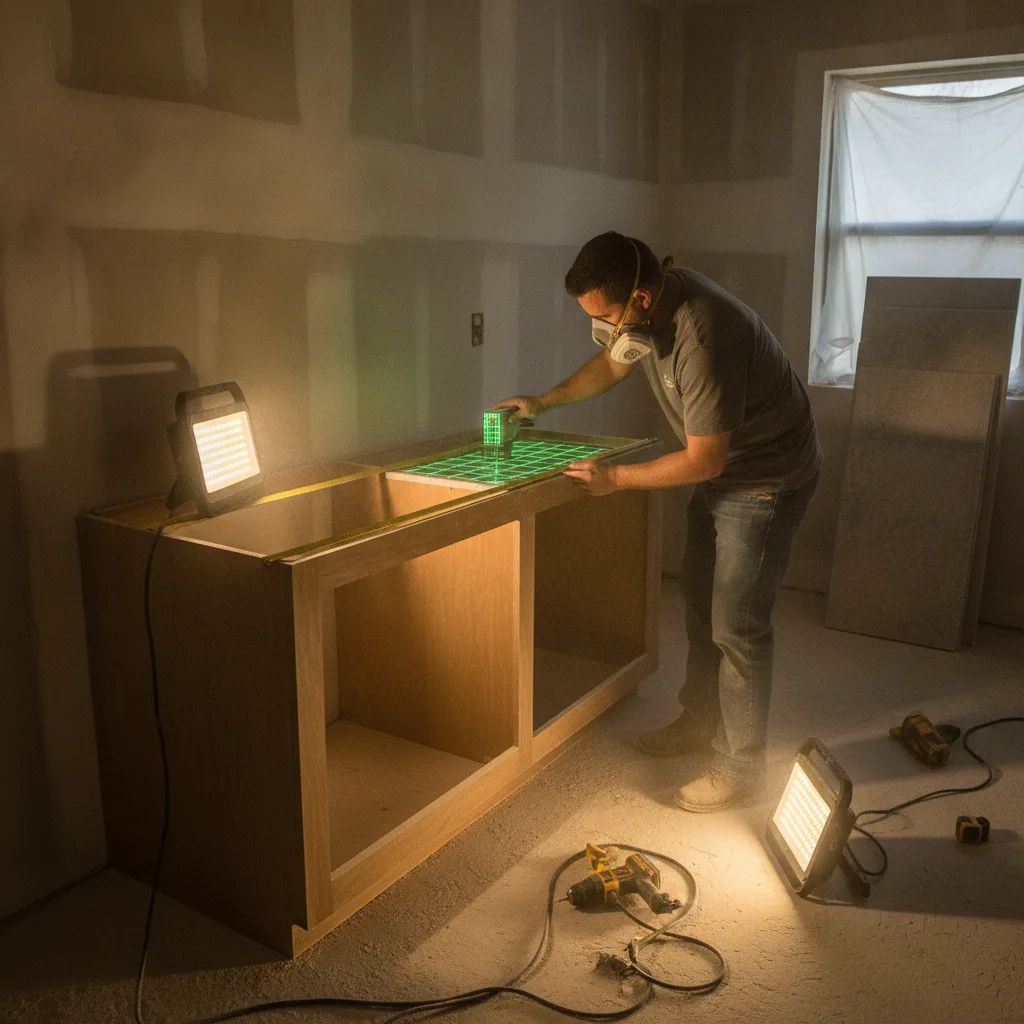
The order of operations matters. Template the vanity top and shower surround together in the same appointment if possible — this lets the fabricator confirm that veining direction and tone will read consistently across both surfaces before any cutting begins. Fox Granite uses a precision overlay template method that captures exact dimensions, sink cutout placement, faucet hole positions, and edge profile for every surface in one visit, making it easier to find the perfect vanity top and shower surround fit without a second trip.
In-house fabrication means the same team that templates your surfaces also cuts them, so there's no handoff between a template crew and a separate shop. That continuity reduces measurement errors, especially on a double sink vanity top where the two bowl cutouts need to be centered and spaced correctly for the cabinet below. Ask your fabricator to confirm the slab lot number for both the vanity top and shower surround so you know they're from the same production run — this keeps color and veining consistent, which is especially important for the coordinated-palette and exact-match design tiers. It's also the step where you personalize every detail: edge profile, finish, and sink configuration are all locked in here.
Professional sealing at installation is the final step for granite and quartzite surfaces. Quartz needs no sealing. Marble needs sealing and periodic reapplication, with frequency depending on use and bathroom traffic. For Central Texas bathrooms where humidity runs high, a quality penetrating sealer applied at installation gives granite and quartzite vanity tops and shower surrounds a solid starting point for years of daily use — and helps preserve the quality and beauty of the stone well beyond the first few years.
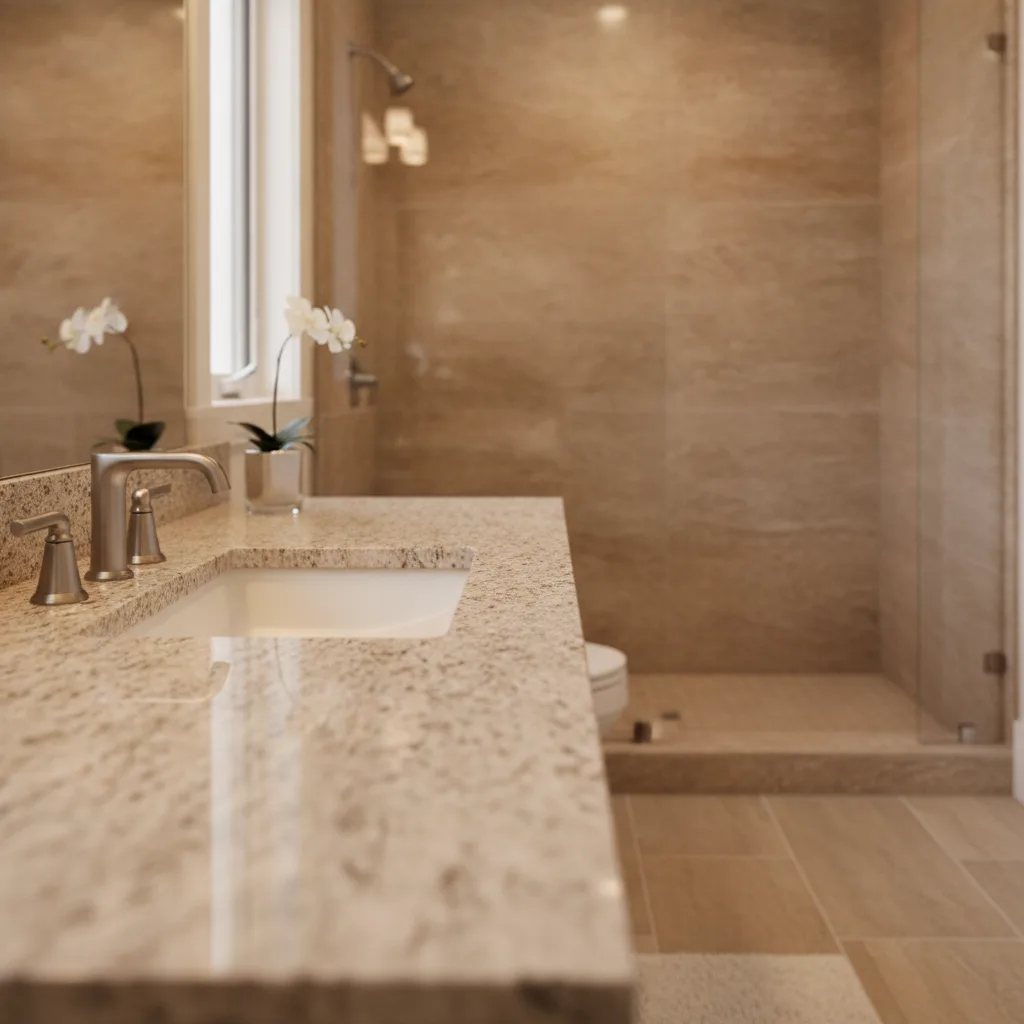
Showroom lighting and bathroom lighting are rarely the same. A quartz or quartzite slab that reads warm white under track lighting can shift noticeably cooler in a north-facing bathroom. Before you finalize any material for your vanity top or shower surround, get a physical sample into the actual space. Fox Granite's free in-home consultations exist precisely for this reason — a team member brings samples to you so you're making the decision in the right light, not under the wrong one.
For bathroom vanity tops and shower surrounds in Austin, San Antonio, New Braunfels, and across the Central Texas corridor, Fox Granite fabricates and installs every surface in-house, brings samples to your home at no charge, and guides you through material and design decisions from first consultation through final install. Use this guide to explore your options, narrow your material choices, and arrive at your consultation ready to make confident decisions. Contact Fox Granite today to schedule your free in-home estimate and find the perfect vanity top and shower surround combination for your bathroom.
Ready to get started? Contact Fox Granite today.


BY APPOINTMENT ONLY
1379 Wald Road
New Braunfels, TX 78132
Austin, San Antonio, Cedar Park, Kyle, New Braunfels, Del Valle, Elgin, Lago Vista, Shady Hollow, Onion Creek, Buda, San Marcos, Lockhart, Temple, Wimberley, Dripping Springs, Bee Cave, Lakeway, Leander, Anderson Mill, Jollyville, Spicewood Springs, Round Rock, Georgetown, Pflugerville, Manor, Taylor, Manchaca, Mountain City, Hutto, West Lake Hills, Bastrop, Liberty Hill, Driftwood, Sun City, Steiner Ranch.