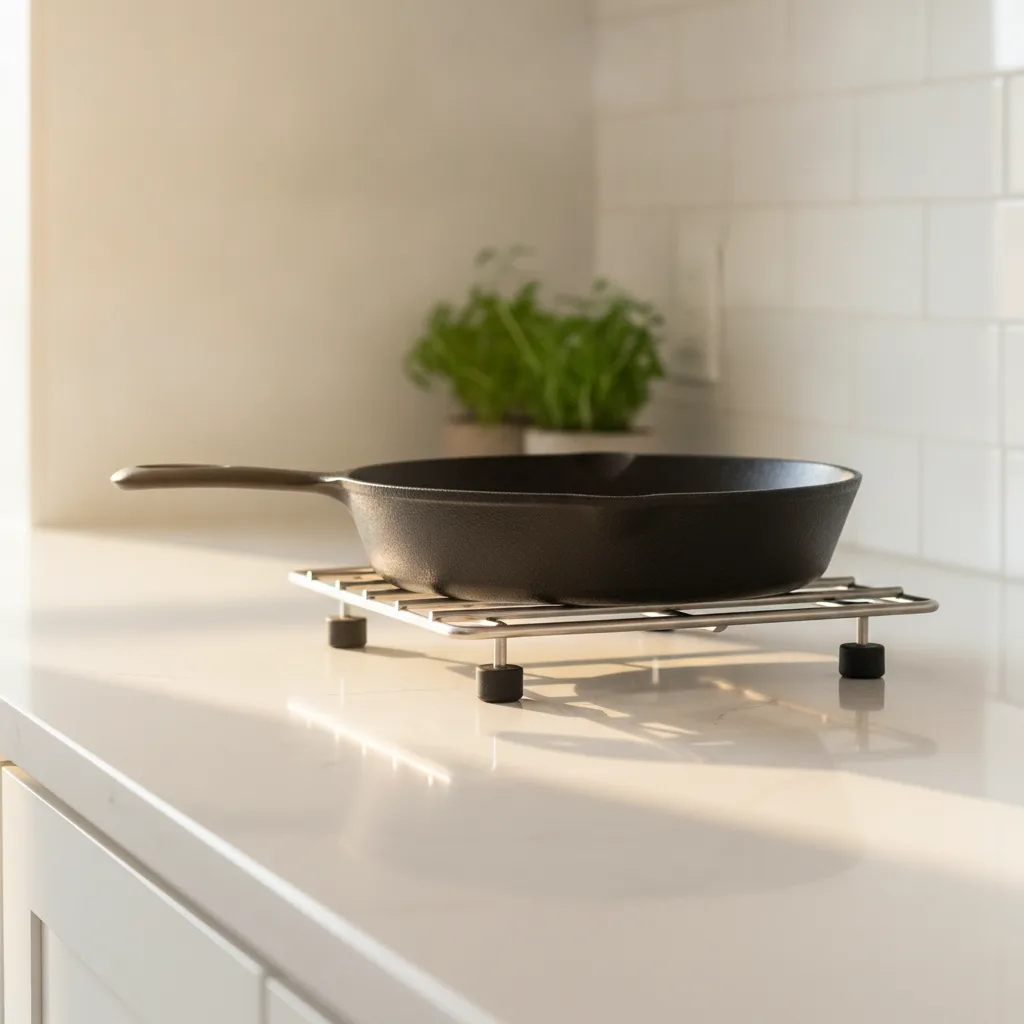
You do not need a trivet to protect quartzite stone — the stone itself formed at well above 1,000°F, so a cast-iron skillet at 400–500°F poses no physical threat. What you are protecting is the impregnating sealer on top of the stone, which is typically rated to only 200–400°F depending on the product. Direct, sustained contact from a blazing pan can scorch that sealer and leave a dull, hazy ring on the surface. The fix usually requires professional refinishing. A stainless steel trivet with rubber feet (around $24 for a 2-pack) or a quality silicone trivet ($8–$28) is the cheapest insurance you can buy for a countertop that cost a lot more. Keep one next to the cooktop, within reach, and use it every time.
Here is the honest answer most articles bury: you do not need trivets for quartzite countertops to protect the stone. Quartzite is a metamorphic rock formed under intense geological pressure at temperatures well above 1,000°F — a cast-iron skillet coming off a gas burner is not a threat to it. What you do need a trivet to protect is the sealer on top of the stone, and that distinction changes everything about how you shop for one and how seriously you take the habit. This guide walks through what actually gets damaged, which trivet materials hold up under a hot pan, and how to size and position them so the habit sticks — no guesswork, no fluff.
The stone itself is not what's at risk. Quartzite forms deep in the earth under temperatures well above 1,000°F, so a cast-iron skillet at 400–500°F poses no threat to the stone. A pan straight from your oven won't crack, scorch, or discolor quartzite — the material can handle it, and no review or report from any fabricator disputes that.
What can't handle it is the sealer. Every quartzite countertop has an impregnating sealer applied on top, and most sealers are only rated to 200–400°F depending on the product. Sustained contact with a blazing cast-iron pan can scorch that sealer, leaving a dull, hazy ring on the surface. The stone underneath is fine. The finish is not — and fixing it usually means calling a professional to refinish or re-seal the area. Customers who live with that ring before addressing it often find the staining becomes harder to remove over time as the unprotected stone absorbs oils and debris through the compromised layer.
This is the distinction most articles skip: a trivet for quartzite is a sealer-protection tool, not a stone-protection tool. That matters because it changes how seriously you take the habit. A scorched sealer ring is real, it looks bad, and it costs money to fix. The good news is that a 30-second habit of reaching for a trivet prevents the whole situation — and the products that do the job well cost less than a dinner out.
Engineered quartz contains resin binders — roughly 7–10% of the slab by weight — that soften and discolor around 300°F. That's why trivets are always required for quartz and only recommended for quartzite. If you have quartz countertops, there is no flexibility: a trivet is non-negotiable every single time. Many homeowners confuse the two and over-worry about quartzite while under-protecting quartz, so it's worth confirming which material you actually have before reading further.
Thermal shock is the legitimate physical risk with any natural stone, including quartzite. It happens when a sudden, extreme temperature change hits a small area of the slab. In everyday kitchen use, normal cooking heat doesn't cause thermal shock in quartzite — but one scenario comes close: placing a blazing cast-iron skillet directly on a cold quartzite countertop in winter. The stone surface can sit at 50–60°F, and the pan can be 500°F or hotter. That's a sharp gradient across a small contact point, and it's the kind of thing that gets reported in comment threads and fabricator callbacks.
Existing micro-cracks in the slab are the real vulnerability. A brand-new slab with no stress fractures handles that gradient better than one that's been in service for years or was cut from a section with natural veining inclusions. You can't see micro-cracks with the naked eye, which is exactly why the 'just set it on the counter' habit carries more risk than it looks on the surface.
The practical takeaway: a trivet next to the stove costs nothing once you own it. Keeping one within arm's reach makes the right habit the easy habit, and that matters more than any spec on the product label.
Stainless steel trivets are the best all-around choice for quartzite and granite. An independent 142-hour test across seven trivets — using cast iron heated to 580–640°F — found the Modern Innovations Stainless Steel Trivet Set (around $24 for a 2-pack on Amazon) to be the top overall performer. It's manufacturer-rated to 800°F, verified to 640°F in testing with zero countertop heat transfer, doesn't scratch polished stone, and is dishwasher safe. If you cook with cast iron or pull large Dutch ovens from a hot oven regularly, this is the product to reach for — the quality and heat ceiling justify the price without question.
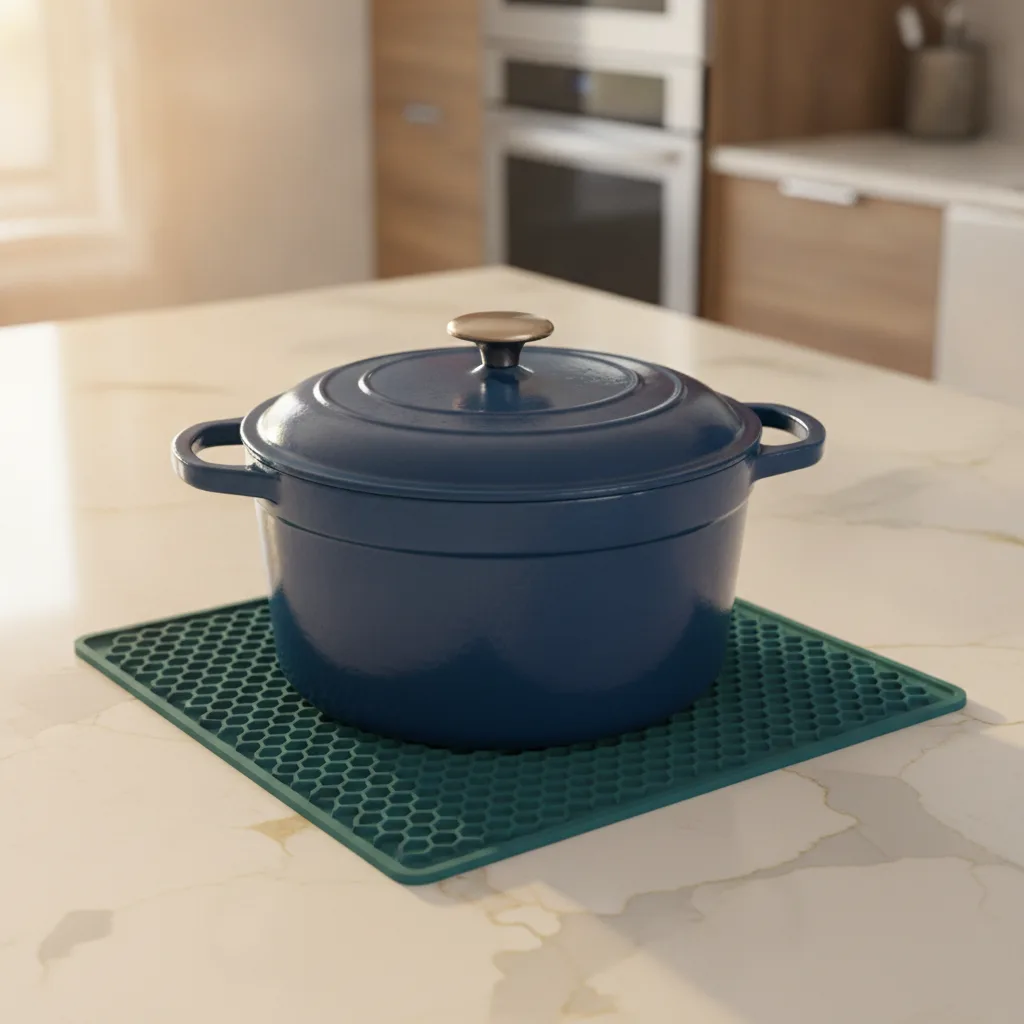
Silicone trivets are the right call for everyday, non-slip use with hot dishes and moderate cookware. Food-grade silicone is softer than quartzite, so scratch risk is essentially zero. The non-slip texture grips the countertop and holds hot pots and pans in place without sliding. The key spec to check is thickness: a trivet thinner than about 4mm may conduct enough heat to cause sealer damage even if the silicone itself survives. Most quality silicone trivets are rated 428–482°F — enough for pots off the stove or baking dishes from a moderate oven, but not a cast-iron skillet coming off high heat. The Le Creuset Silicone Trivet ($28) earned the best splurge pick in the same independent test: rated to 500°F, comes in a wide color selection (19 options), and grips countertops and hot dishes well. It is BPA-free and dishwasher safe.
Cork trivets look attractive and are easy to find at any home goods table display, but independent testing found scorch marks on three different cork products at temperatures well below their claimed limits — most list around 250°F. Cork is fine under a warm teapot or a plate of food. It is not the right product under a cast-iron skillet, a Dutch oven, or any pan that came directly from a 400°F-plus oven. Bare metal rod trivets without rubber feet carry a different risk: they can scratch polished quartzite if dragged across the surface. If you use a metal trivet, make sure it has silicone or rubber feet — that one detail is what separates a safe product from one that leaves a trail of scratches across a countertop you paid a lot of money to protect.
$24 (2-pack)
Top performer in 142-hour independent testing — rated 800°F, verified zero heat transfer to countertop at 640°F, dishwasher safe, and safe on polished stone with no scratching.
$28 (single)
Best everyday non-slip pick — 500°F rated, BPA-free, wide color selection across 19 options, grips countertops and hot dishes without sliding. Not for cast iron off high heat above 500°F.
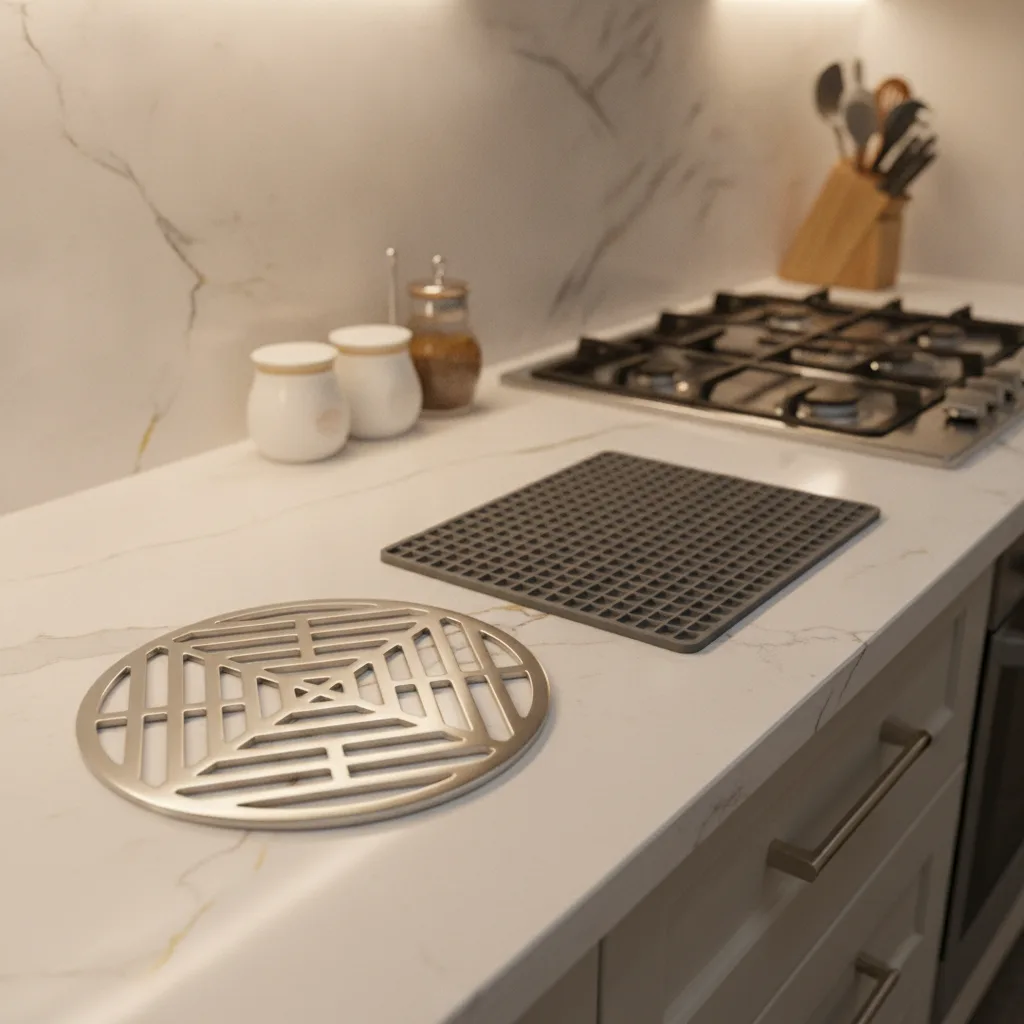
Stainless steel with rubber feet: highest heat ceiling, dishwasher safe, best for cast iron and Dutch ovens. Silicone at 4mm or thicker: best non-slip everyday use, wide color options, BPA-free, fine for most cookware. Cork: decorative use only — avoid under any pan from a hot oven. Bare cast iron trivets: scratch risk on polished quartzite, skip them.
A trivet only works if the hot surface is fully supported. The trivet should be at least as wide as the base of the largest pot or pan you plan to set on it — overhang means the unprotected countertop surface is in direct contact with radiant heat, which defeats the purpose. A standard 8-inch round trivet covers most skillets and saucepans, but it won't cover a 12-inch cast-iron pan, a baking sheet, or a large Dutch oven. That overhang transfers heat directly to your sealer.
For air fryers, sheet pans, or large Dutch ovens, look for an extra-large silicone trivet in the 16x12-inch range. Having two trivets near the stove — one standard and one large — covers nearly every home cooking scenario without having to shuffle things around mid-cook. That two-trivet setup runs $15–$40 depending on material, and it removes the excuse of 'I only had one hand free.' Check the base dimensions of your largest items before you add anything to your cart — that's the measurement that matters.
Air fryers run hot and have a small footprint that concentrates heat on a tight area of the countertop. An extra-large silicone trivet (16x12 inches) under an air fryer is one of the most practical uses of a trivet in a modern kitchen — the standard round products won't cut it here. This is especially worth noting because air fryer use has grown sharply, and a lot of homeowners don't think about the countertop contact point until they see a dull patch under the appliance.
The best trivet in your cabinet is useless. Keep one or two trivets on the counter next to your cooktop — in plain sight, within reach — so the habit doesn't require a decision. That's the whole system. A trivet you have to open a drawer to find gets skipped on a busy Tuesday night, and that's exactly when a cast-iron skillet lands directly on a cold quartzite slab. Happy customers who report zero countertop issues after years of heavy cooking almost always describe the same setup: trivets stored on the counter, not inside it.
Even with a consistent trivet habit, quartzite sealers need maintenance. Most fabricators recommend resealing roughly twice a year to keep the heat and stain protection working properly. A DIY reseal costs approximately $25–$60 per application depending on the product you use. If you notice water no longer beads on your countertop surface, that's a reliable sign the sealer has thinned and it's time to remove and reapply. Catching it early is much cheaper than dealing with staining or a refinishing call after the fact — and it's one of the things worth asking your fabricator about at the time of installation.
Trivets are a small habit with a real payoff. Your quartzite stone is tough — it was formed under conditions no kitchen will ever replicate. But the finish on top of it deserves a little care, and a $24 stainless steel set or a quality silicone trivet is the easiest money you'll spend protecting a countertop that cost a lot more. Read the reviews on any product before you buy, check that the items are dishwasher safe if that matters to you, and prioritize thickness and foot material over color — though with 19 options on a product like the Le Creuset, you don't have to compromise on that front either.
Quartzite is heat-resistant — the stone itself won't burn at kitchen temperatures. But heat-resistant is not the same as maintenance-free. The sealer on your countertop is the layer that takes the hit, and once it scorches, you're looking at professional refinishing, not a quick wipe-down. A trivet is the simplest, cheapest way to protect that layer. Keep one next to the stove and use it every time — not just for cast iron, but for any hot pan that came off a burner or out of a hot oven.
When you've built the trivet habit and your sealer is on a consistent maintenance schedule, your quartzite countertop will look as good in ten years as it does today. For quartzite countertop fabrication and installation in Austin, San Antonio, New Braunfels, and across the Central Texas corridor, trust Fox Granite. We've completed over 10,000 countertop projects since 2010, and we walk every homeowner through how to care for their specific material — no guesswork, no surprise maintenance calls. Contact us today to schedule your free in-home consultation, or visit our New Braunfels showroom to see our quartzite slab selection in person.
Ready to get started? Contact Fox Granite today.


BY APPOINTMENT ONLY
1379 Wald Road
New Braunfels, TX 78132
Austin, San Antonio, Cedar Park, Kyle, New Braunfels, Del Valle, Elgin, Lago Vista, Shady Hollow, Onion Creek, Buda, San Marcos, Lockhart, Temple, Wimberley, Dripping Springs, Bee Cave, Lakeway, Leander, Anderson Mill, Jollyville, Spicewood Springs, Round Rock, Georgetown, Pflugerville, Manor, Taylor, Manchaca, Mountain City, Hutto, West Lake Hills, Bastrop, Liberty Hill, Driftwood, Sun City, Steiner Ranch.