5 Questions to Ask Before Removing Your Old Countertop Yourself (2026)
💡 Quick Answer
Homeowners planning to remove old countertops before granite installation should ask five questions: Do you know the actual weight? Have you disconnected every plumbing line? Are you protected from silica dust? Have you confirmed removal timing with your fabricator? And do you have a real disposal plan? A standard 30-square-foot granite slab weighs 540 to 600 pounds, quartz countertops contain up to 95% crystalline silica, and professional removal in 2026 averages $300 for a standard kitchen — a cost that almost always beats the damage, disposal, and time expenses of doing it yourself.
📊 Key Takeaways
The five questions every Central Texas homeowner should answer before touching an old countertop — ranked by risk severity and real cost exposure.
540–600 lbs
Weight of a standard 30 sq ft granite section — the most underestimated physical risk in DIY countertop removal
3–4 people minimum
Crew size needed to safely lift and remove a standard granite countertop section without slab damage
Up to 95% crystalline silica
Silica content in some quartz countertops per the OSHA/NIOSH joint alert updated February 2026
$150–$600
Repair cost range for chip or crack damage caused by a bad DIY countertop removal lift
7–10 days
Typical fabrication window from template to installation — removing countertops too early extends kitchen downtime
$300 average
Professional countertop removal cost for a standard kitchen in 2026, including labor and haul-away
Plenty of homeowners want to remove old countertops themselves before granite goes in. The logic makes sense on paper: skip the labor charge, save a few hundred dollars, and hand the installers a clean slate. But countertop removal is one of those jobs where the gap between 'looks straightforward' and 'went sideways fast' is surprisingly small. A 30-square-foot granite slab weighs up to 600 pounds. Failing to disconnect plumbing before the lift causes most of the preventable damage on countertop removal jobs. And as of 2026, OSHA and NIOSH have updated their joint silica hazard alert to confirm that disturbing quartz countertops without proper protection creates serious, documented health risks. Before you decide to remove old countertop before granite installation, ask yourself these five questions. The answers may change your plan — or at least keep your cabinets, your back, and your lungs intact.
1
Question 1: Do You Know What Your Countertop Actually Weighs?
Risk level: High — injury and slab damage
Key number: 540–600 lbs for a 30 sq ft granite section
Crew needed: 3–4 people minimum
Tools required: Suction cups, pry bar, putty knife
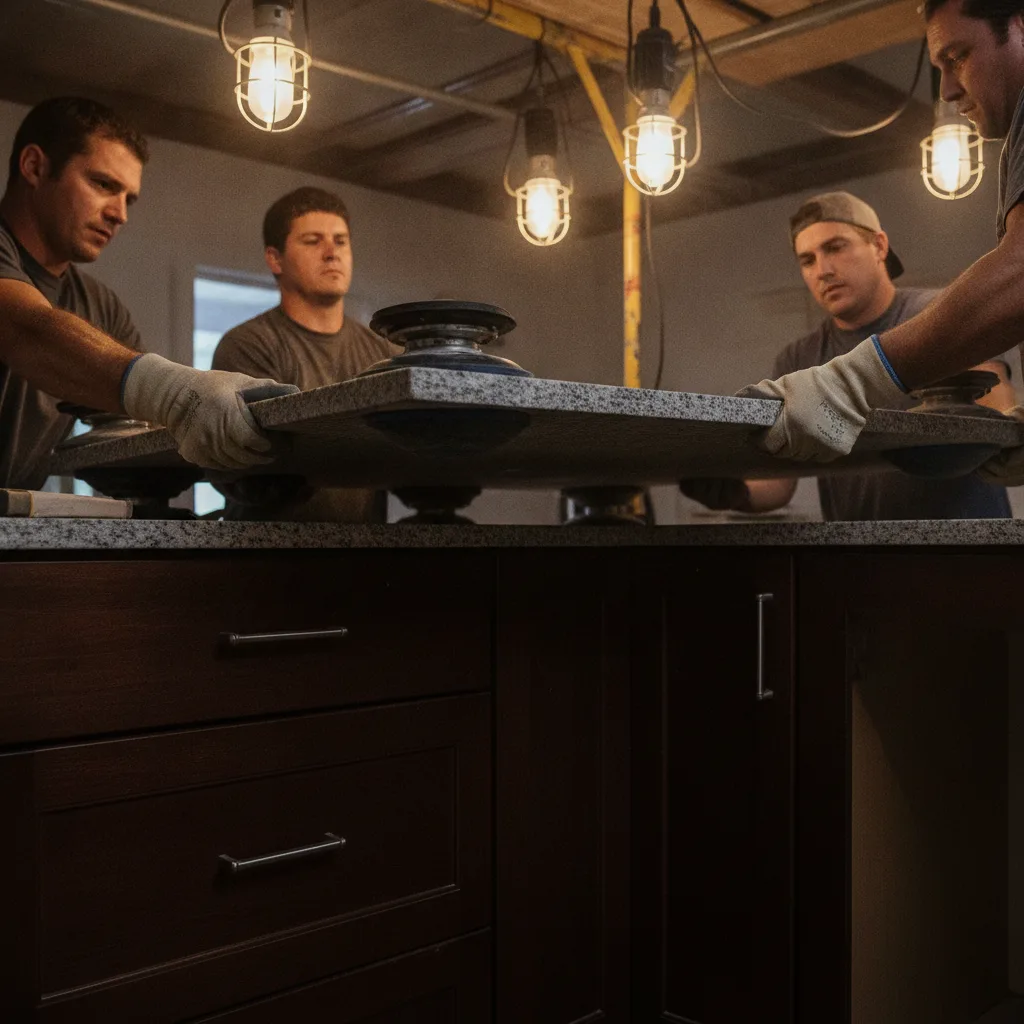
A standard 3cm granite slab weighs 18–20 pounds per square foot, meaning a 30-square-foot kitchen section tops 540–600 pounds before adhesive and fixtures are factored in. Granite has high compressive strength but low tensile strength — if a long section twists during removal, torsional stress concentrates at cutouts and seams and can snap the slab in two. You need at least one person per 3–4 feet of granite length, suction cups rated for the load, and a clear path to set the slab down flat. Most homeowners underestimate this by a wide margin, and that underestimation is the root cause of the majority of DIY removal injuries and broken slabs.
What DIYers miss
Granite's low flexural strength makes it fragile under twisting force, even though it feels rock-solid at the surface
A pry bar applied at the wrong point concentrates stress at the sink cutout and can crack the slab before it leaves the cabinets
Suction cups must be rated for wet, polished stone surfaces — standard shop cups fail on granite and can drop the slab mid-lift
The back edge is often bonded with construction adhesive and screws through cabinet plywood — both must be fully released before any lifting begins
An L-shaped or U-shaped kitchen can require half a day just for removal, with multiple heavy lifts and a coordinated crew throughout
What Fox Granite's crew handles
Trained installers know exactly where adhesive bonds and screws attach old countertops to existing cabinets
Proper suction cup equipment and coordinated multi-person lift techniques protect both the slab and the cabinet boxes
Removal is paced so drawers, cabinet frames, and surrounding finishes stay undamaged throughout the process
No surprise mid-job stops — the right proper tools and the right number of people are already on site from the start
Bottom line
A 600-pound lift with the wrong crew and no suction cups is a back injury, a broken slab, or a damaged cabinet — sometimes all three on the same job, and this is the single most physically dangerous step in countertop replacement.
2
Question 2: Have You Disconnected Every Plumbing Line and Fixture First?
Risk level: High — water damage and cabinet destruction
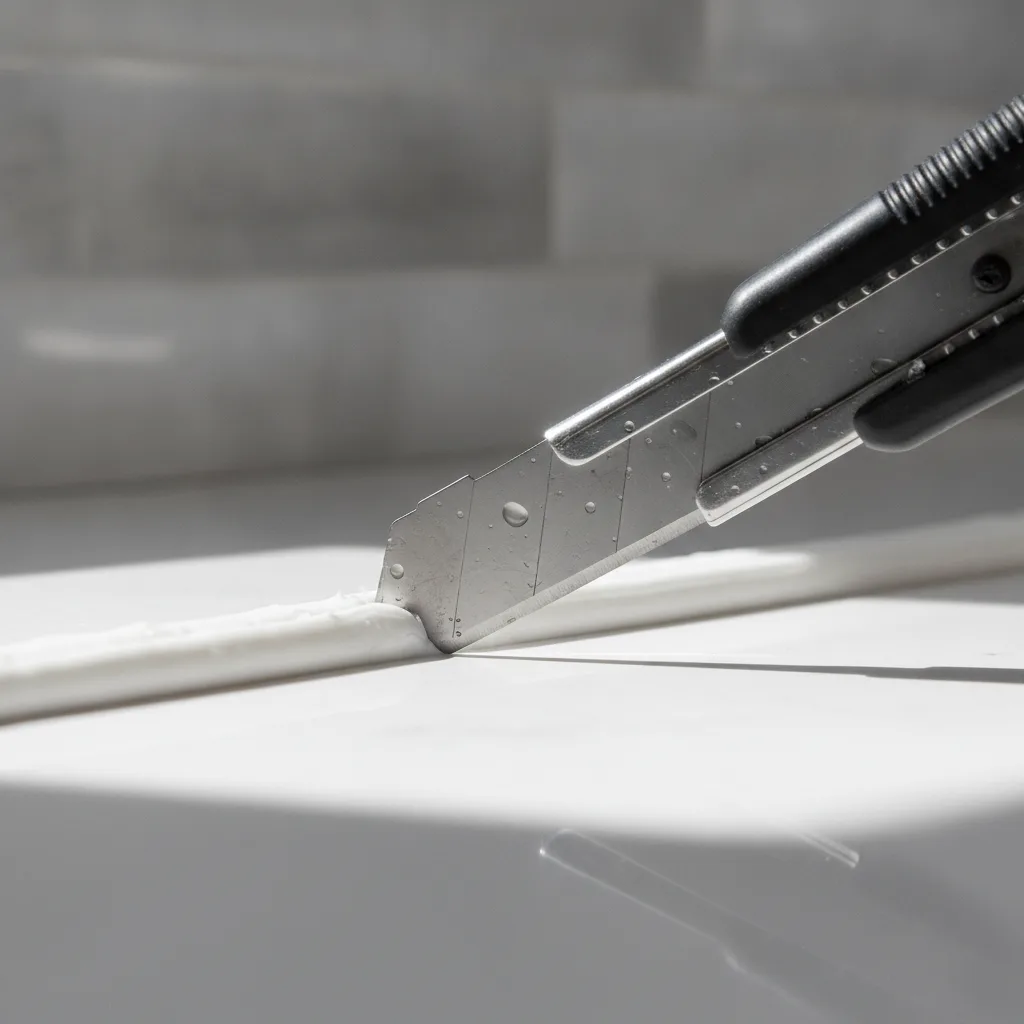
Failing to disconnect plumbing before lifting causes most of the preventable damage on countertop removal jobs — and the sequence matters as much as the disconnection itself. Shut off the water supply, disconnect faucets and the sink drain, remove the garbage disposal, then score every caulk line with a utility knife before any lifting begins. Skipping the caulk cut alone can tear out backsplash tile and the drywall behind it when the countertop pulls away from the wall. Existing countertops are typically bonded to cabinets with screws through plywood from below and construction adhesive along the top edge — both need full release before the stone will move cleanly.
Steps homeowners skip
Scoring caulk at the wall, backsplash, and cabinet joint with a utility knife before any prying starts
Fully disconnecting faucets, the undermount sink, and the garbage disposal before the lift
Locating all screws in the cabinet plywood beneath the countertop and removing them — missing one screw pulls the cabinet face frame off
Checking for hidden adhesive at the back edge where the countertop meets the wall
Clearing appliances and the microwave out of the work path before the slab comes off the cabinets
What Fox Granite's crew handles
Full pre-removal checklist covers plumbing disconnection, caulk scoring, and fastener removal in the correct order
Backsplash tile and drywall are protected during the caulk-cutting step — no collateral surface damage
Sink and fixtures are removed cleanly without damaging the cabinet box or the existing plumbing connections
Disposal and haul-away of old countertops is included — no separate trip to the landfill or transfer station needed
Bottom line
Chip repairs run $150–$300 and crack repairs $200–$600 — a cracked slab from a connected-plumbing lift can push into full section replacement at $1,500 or more, which wipes out every dollar the DIY removal was supposed to save.
OSHA and NIOSH jointly updated their countertop silica hazard alert in February 2026, confirming that cutting, grinding, or disturbing stone countertops releases respirable crystalline silica dust linked to silicosis, lung cancer, COPD, and kidney disease. This applies to removal, not just fabrication. Some engineered stone quartz products contain up to 95% crystalline silica — any dry-cutting or grinding during DIY removal without wet methods or a respirator rated N95 or higher creates a documented, serious health risk. Laminate removal is lower risk, but any countertop material with stone content demands proper respiratory protection and wet-process technique.
What DIYers underestimate
Silica dust particles are invisible to the naked eye — a standard paper dust mask provides no meaningful protection against respirable crystalline silica
A single high-exposure event during removal can cause permanent lung damage; silicosis is irreversible and progresses after exposure ends
Quartz countertops are the highest-risk countertop material due to up to 95% crystalline silica content — far higher than natural granite
Dry prying or cutting releases far more dust than wet methods; most homeowners work dry without realizing the risk
Old granite countertops disturbed during removal also release silica — it is not limited to cutting or grinding operations
What Fox Granite's crew handles
Professional installers are trained on OSHA/NIOSH silica hazard protocols as of 2026 — the crew knows which countertop materials pose the highest risk
Wet methods and proper respiratory equipment are used whenever stone is cut or disturbed during the removal process
Homeowners and household members are not present during the removal process, eliminating exposure entirely
No guesswork on protection levels — the crew arrives with the right equipment for every countertop material type
Bottom line
This is the question most homeowners never think to ask: the health risk from silica dust during stone countertop removal is real, documented by federal agencies as of 2026, and entirely avoidable when professionals handle the removal process.
4
Question 4: Have You Confirmed the Removal Timing with Your Fabricator?
Risk level: Medium — extends kitchen downtime and can force a re-template
Typical fabrication window: 7–10 days from template to installation
Key rule: Confirm fabricator procedure before removing existing countertops
Consequence of early removal: Exposed cabinet conditions may require resolution before templating can proceed
Fabricators require old countertops to stay in place until final measurements are confirmed — and removing existing countertops before that conversation is one of the most common and most avoidable mistakes homeowners make. Tearing out old counters too early can expose wall conditions, cabinet damage, or leveling issues that must be resolved before the template appointment, extending kitchen downtime by days or weeks. Cabinets must be level, sturdy, and properly reinforced before new countertops go in; any unevenness discovered after old counters come off can cause cracks in granite or quartz after installation. Confirm the fabricator's procedure first, then remove on their schedule.
Sequencing mistakes homeowners make
Removing old countertops days before the template appointment, then discovering the cabinets need shimming or structural repair before accurate templates can be taken
Assuming the fabricator can template over existing countertops — some require removal first, others do not, and the answer varies by company
Not accounting for the 7–10 day fabrication window between template and new countertop installation, leaving the kitchen non-functional longer than necessary
Removing too early and creating cabinet exposure issues that require a general contractor or carpenter before fabrication can proceed
Missing that level, stable cabinet conditions are a prerequisite for new stone — not just a nice-to-have before new installation day
What Fox Granite's crew handles
Fox Granite coordinates removal timing with the template appointment so nothing happens out of sequence and kitchen downtime is minimized
Our overlay template method captures accurate measurements efficiently, with removal timed to protect the fabrication process
If cabinet leveling or reinforcement is needed after old counters come off, we flag it before fabrication starts — not after the slab is cut
Homeowners get a clear timeline from consultation through installation, with no guessing and no surprises on sequencing
Bottom line
Removing your old countertop before confirming the fabricator's procedure is one of the most common and most avoidable sequencing mistakes in countertop replacement — a single phone call saves days of kitchen downtime and protects the accuracy of your new installation.
5
Question 5: Do You Have a Real Plan for Disposal?
Risk level: Medium — hidden cost that erases DIY savings
DIY tool and supply cost: $50–$150
Professional removal cost: $150–$500 (national average $300 for a standard kitchen)
Disposal reality: Stone countertops cannot go in standard curbside trash
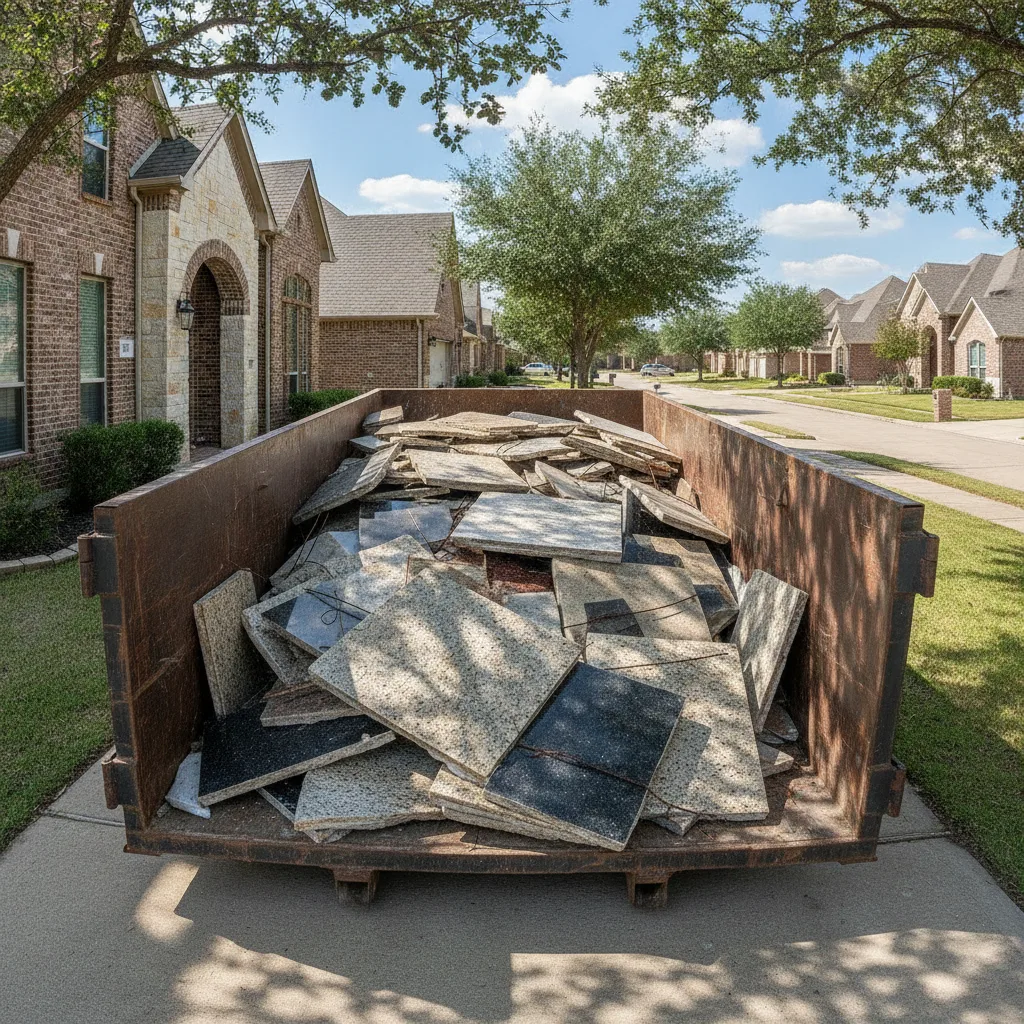
Professional granite countertop removal costs $150–$500 in 2026, with a standard kitchen averaging $300 — including labor to detach, remove, and haul away existing tops. DIY removal costs $50–$150 in tools and materials, but that gap closes the moment disposal becomes your problem. Stone countertop materials — granite, quartz, quartzite, marble — cannot go in a standard curbside bin. You are looking at a dumpster rental, a junk hauler charging by weight, or multiple trips to a transfer station. Factor in time: a standard removal takes 2–6 hours; an L-shaped or U-shaped kitchen runs half a day or more, and that is before you load and haul a single piece of stone.
What the DIY math misses
Dumpster rentals in Central Texas typically run $250–$400 for a project-sized bin — already more than the average professional removal fee
Junk haulers charge by weight for stone countertop materials, and granite and quartz are among the heaviest countertop materials available
A second vehicle trip to a transfer station adds hours and fuel costs that do not show up in the initial savings estimate
If cabinet, plumbing, or floor damage occurs during removal, repair costs of $200–$600 or more wipe out any money saved instantly
Time is a real cost: half a day of removal plus a separate disposal trip is a full day out of your schedule for a job professionals complete efficiently in a single visit
What Fox Granite's crew handles
Removal and haul-away of old countertops is included in our installation service — no separate disposal logistics or dumpster rental on your end
No junk hauler scheduling, no transfer station trips, no curbside confusion over whether stone can go in the bin
Cabinets, walls, plumbing, and surrounding finishes are protected throughout the entire removal process
All-in, transparent pricing means no surprise disposal fees appear after the job is done and the crew is gone
Bottom line
The realistic DIY savings on countertop removal land between $50 and $300 — and that is before a single thing goes wrong; when Fox Granite handles removal as part of your new countertop installation, the math almost always favors letting professionals take it from here.
Fox Granite Includes Countertop Removal — No Extra Step Needed
When you book a countertop installation with Fox Granite, our in-house crew handles removal and haul-away of your old countertops as part of the process. No separate contractor to schedule. No disposal logistics to manage. No risk of cabinet damage, plumbing mistakes, or silica exposure on your end. We have completed over 10,000 projects across Austin, San Antonio, and Central Texas — and we have seen every removal scenario there is. Contact us today to schedule your free in-home consultation, or call (512) 653-5541 to talk through your project.
For countertop removal and new countertop installation in Austin, San Antonio, New Braunfels, Round Rock, San Marcos, and across the Central Texas corridor, trust Fox Granite. If your primary concern is physical safety and slab protection, Question 1 and Question 2 make the case on their own — a 600-pound lift with untrained crew and improper tools is a preventable disaster. If you are dealing with a quartz surface, Question 3 is the one to take most seriously: the silica hazard is federally documented as of 2026, and no DIY savings justify that exposure. If you are coordinating your own removal with a fabricator you hired separately, anchor on Question 4 — removing old counters before confirming the template procedure is the fastest way to add weeks to your kitchen downtime. And if you are comparing DIY vs. pro purely on cost, Question 5 closes the argument: once you price dumpster rental, time, and the cost of a single mistake, professional removal at $300 average is almost always the better value. Fox Granite's family-owned team handles every step in-house — from removal of your old countertops through precision templating, fabrication, and professional installation — with transparent, all-in pricing and no surprise fees. Contact us today to schedule your free consultation, or visit our New Braunfels showroom to see the stone selection in person.
Frequently Asked Questions
How hard is it to remove old countertops yourself?
Laminate countertops are genuinely manageable for a prepared DIYer with a utility knife, putty knife, and pry bar. Stone countertops — granite, quartz, quartzite, marble — are a different job entirely. A 30-square-foot granite section weighs 540 to 600 pounds, requires 3 to 4 people, suction cups rated for polished stone, and a coordinated lift plan. Silica dust exposure during any grinding or dry-cutting creates a documented health hazard per the OSHA/NIOSH 2026 joint alert. Most homeowners underestimate every one of those factors before they start.
How much does it cost to have countertops professionally removed?
Professional countertop removal costs $150 to $500 in 2026, with the national average running $300 for a standard kitchen — including labor to detach, remove, and haul away existing tops. When Fox Granite handles your installation, removal and haul-away are included in the project scope, so there is no separate removal fee or disposal logistics to manage on your end.
Is granite outdated in 2026?
Granite countertops remain one of the most requested countertop materials in Central Texas as of 2026. The variety of edge profiles, finishes, and natural stone patterns available keeps granite competitive with quartz and quartzite. Buyers in Austin and San Antonio still cite granite as a value-add feature in resale listings. Trends shift, but natural stone does not go stale the way painted laminate does.
Do countertop installers remove old countertops?
Most professional countertop installers include removal of existing countertops as part of the installation service, though practices vary by company. Fox Granite includes removal and haul-away of old countertops in every installation project — no separate contractor, no disposal trip on your end. Confirm this with any fabricator before signing, because some charge removal as a separate line item or require the homeowner to handle it independently.
What happens to the sink during countertop removal?
The sink must be fully disconnected before any countertop lift begins. That means shutting off the water supply lines, disconnecting the drain, detaching the garbage disposal if present, and removing faucets from the deck. Undermount sinks are bonded directly to the stone with adhesive and mounting clips — the connection must be fully released before the slab moves. Lifting before disconnection is the single most common cause of preventable plumbing and cabinet damage on DIY countertop removal jobs.
Is professional countertop removal worth the cost when I could save money doing it myself?
The realistic DIY savings on countertop removal land between $50 and $300 — and that margin disappears the moment a single thing goes wrong. Chip repairs cost $150 to $300; crack repairs run $200 to $600; a full slab section replacement can exceed $1,500. Add dumpster rental ($250 to $400 in Central Texas), half a day of your time, and the silica exposure risk, and the professional removal fee of $300 is almost always the better value. When Fox Granite handles removal as part of your new countertop installation, the all-in price is transparent and there are no surprise fees.