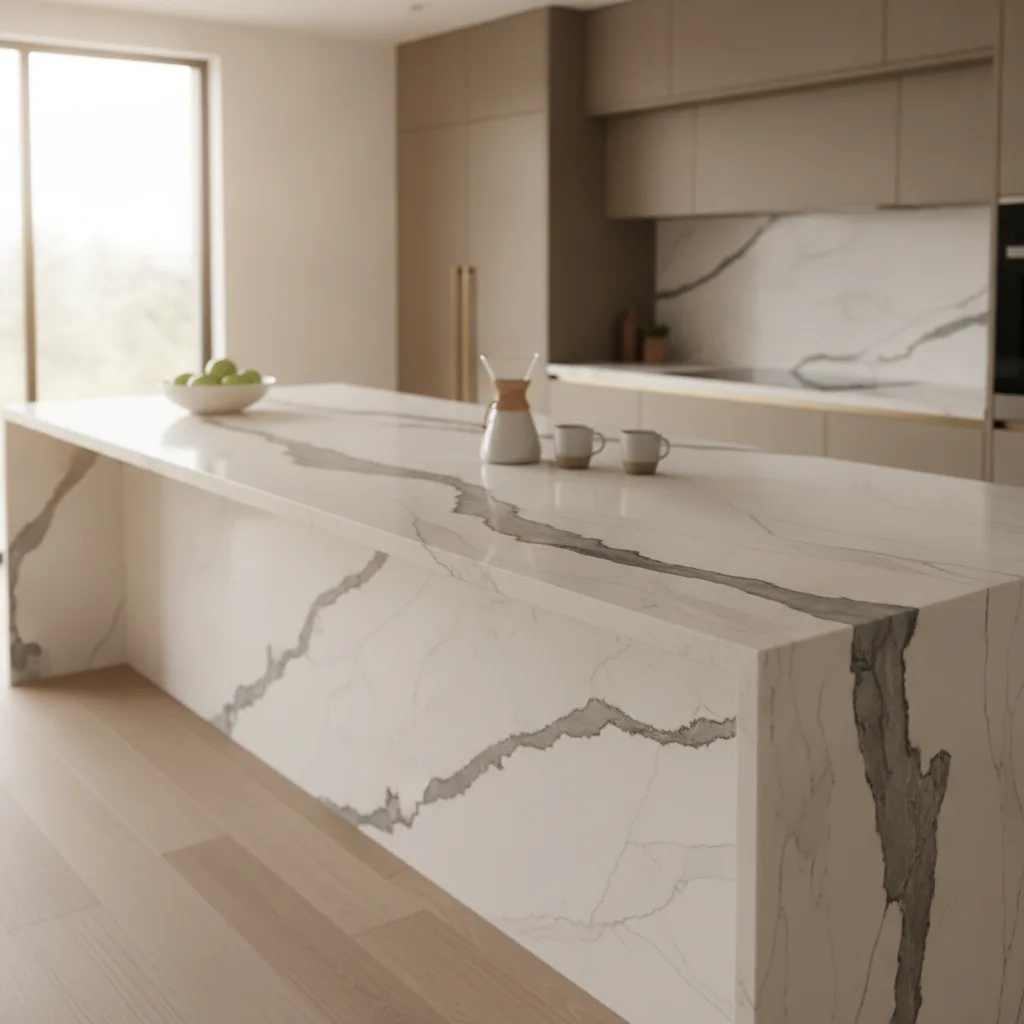
Quartzite countertops cost $80–$200 per square foot installed nationally in 2026, with most kitchens landing at $100–$140 per square foot. A typical 40-square-foot kitchen runs $4,000–$5,600 installed. Lowe's lists quartzite at $55–$120 per square foot installed — lower at the entry level, but Lowe's outsources fabrication and installation to contracted local shops you cannot choose. A local fabricator in Central Texas lets you hand-select your slab, delivers in 1–3 weeks versus Lowe's 3–5 weeks, and offers 6–12+ edge profiles. Lowe's strongest advantage is financing: 0% interest for 6–18 months. For premium quartzite like Taj Mahal, a local in-house fabricator wins on every dimension except financing.
Quartzite countertops cost $80–$200 per square foot installed in 2026, with the national average landing at $100–$140 per square foot for most kitchen projects. Lowe's lists quartzite at $55–$120 per square foot installed — which looks like a clear win until you understand what that price includes and what it does not. This guide walks Central Texas homeowners through the real quartzite countertops cost, the honest Lowe's versus local fabricator comparison, and a clear decision framework so you know which path fits your project before you sign anything.
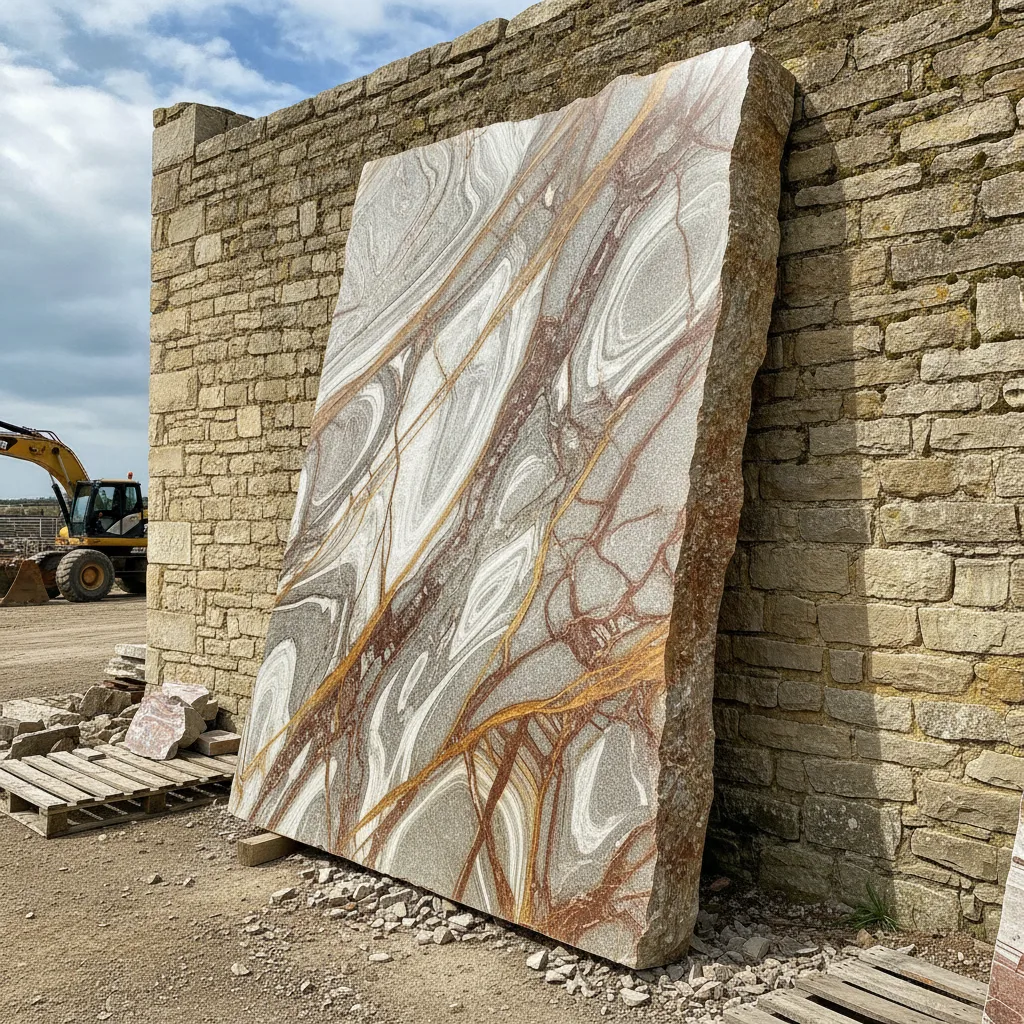
Quartzite is a 100% natural metamorphic stone formed when sandstone is subjected to extreme heat and pressure deep in the earth — and it is not the same material as engineered quartz countertops. This distinction matters more than almost any other piece of countertop knowledge, because sales reps at big-box stores routinely use 'quartz' and 'quartzite' interchangeably. If you place a hot pan on engineered quartz thinking it's heat-resistant quartzite, you can permanently damage a surface that cost you $4,000 or more.
True quartzite ranks 7–8 on the Mohs hardness scale — making it a genuinely hard stone that outranks granite (6–7 Mohs), marble (3–5 Mohs), and engineered quartz (5–7 Mohs). That exceptional hardness makes quartzite scratch-resistant and highly durable for a busy kitchen. Heat resistance is the other key differentiator: engineered quartz contains polymer resins that can scorch or discolor under direct heat, while quartzite handles it without issue. This is one of the most important factors separating the two countertop materials in real daily use.
There is a second identity problem worth knowing: some slabs sold as 'quartzite' in showrooms are actually marble or dolomitic marble, mislabeled through confusion or misrepresentation. Fantasy Brown is one widely cited example — sold as quartzite in many showrooms, it is actually dolomitic marble. A quick field test settles the question: drop a few drops of lemon juice or vinegar on the surface. If the stone etches (dulls or pits), it is not true quartzite. A knowledgeable fabricator will tell you this upfront. A retail program may not.
If you are not certain you are buying true quartzite, every other comparison in this guide — quartzite countertops cost, maintenance requirements, heat resistance — applies to the wrong material. Confirm the stone's identity before you sign anything.
Quartzite countertops cost $80–$200 per square foot installed nationally in 2026, with most kitchens landing in the $100–$140 per square foot range according to current pricing data from Angi, HomeGuide, and SlabWise. A typical 40-square-foot kitchen runs $4,000–$5,600 installed. That cost range is wide because four key factors drive the final number: the quartzite variety, slab grade, edge profile complexity, and whether you need cutouts for a sink or cooktop.
Variety drives the biggest price difference across all countertop materials. Common white quartzites like White Macaubas start near $60 per square foot installed and typically average $65–$85 per square foot. Mid-tier options like Super White run $80–$120 per square foot installed. Taj Mahal quartzite and other exotic Brazilian varieties reach $100–$220 per square foot for materials alone — before fabrication and installation fees are added. Knowing which variety you want narrows your real budget fast and makes any quote comparison meaningful.
Cutouts and edge profiles add real money to any quartzite project, and they are important factors that retail quotes sometimes bury. Sink cutouts at a local fabricator run $150–$350 each; cooktop cutouts are similar. Faucet holes add $50–$80 per hole. Edge profile upgrades range from $10–$40 per linear foot at a local fabricator — an ogee or waterfall edge on a 30-linear-foot kitchen can add $300–$2,000 to the total. Thicker slabs (3 cm vs. 2 cm) also push prices higher due to added material weight and fabrication complexity.
Free
Gives a fast installed price range based on square footage and quartzite variety — useful for a sanity check before you request quotes.
Free
Detailed breakdown of installed cost per square foot by quartzite variety, including exotic Brazilian slabs and common white options.
Lowe's lists quartzite countertops at $55–$120 per square foot installed in 2026, which appears cheaper than the local fabricator average of $80–$200 per square foot. The price difference is real at the low end — but only for the most common, entry-level slabs. Once you want a specific variety, a particular veining pattern, or any customization beyond the basics, the gap narrows fast. When you factor in what you give up for that lower cost, the value calculation shifts considerably.
The most important thing to know about Lowe's countertop program: Lowe's does not fabricate or install countertops in-house. They coordinate through a network of contracted local fabrication shops, and you have no say in which shop handles your job. That shop's skill, equipment, and communication practices are entirely outside your control. Lowe's earns a 7.0/10 overall rating from SlabWise in their 2026 review, with fabrication quality rated just 6.5/10 — because quality varies significantly by ZIP code and contractor assignment. For a natural stone project with a higher price tag, that variability is a genuine risk.
Buying the slab directly from a regional stone distributor and having a local fabricator source it can save 15–25% on material cost alone versus going through a retail program. On a Taj Mahal quartzite project where materials alone run $100–$220 per square foot, a 20% material savings on a 40-square-foot kitchen is $800–$1,760 back in your pocket. That is a price difference worth calculating before you assume Lowe's is cheaper for your specific project.
Financing is Lowe's strongest advantage: the Lowe's Advantage Card offers 6–12 months of 0% interest, with periodic 18–24 month promotional periods. Most local fabricators offer little or no financing. If cash flow is the constraint and the slab variety does not matter much, Lowe's financing program is a real benefit worth weighing.
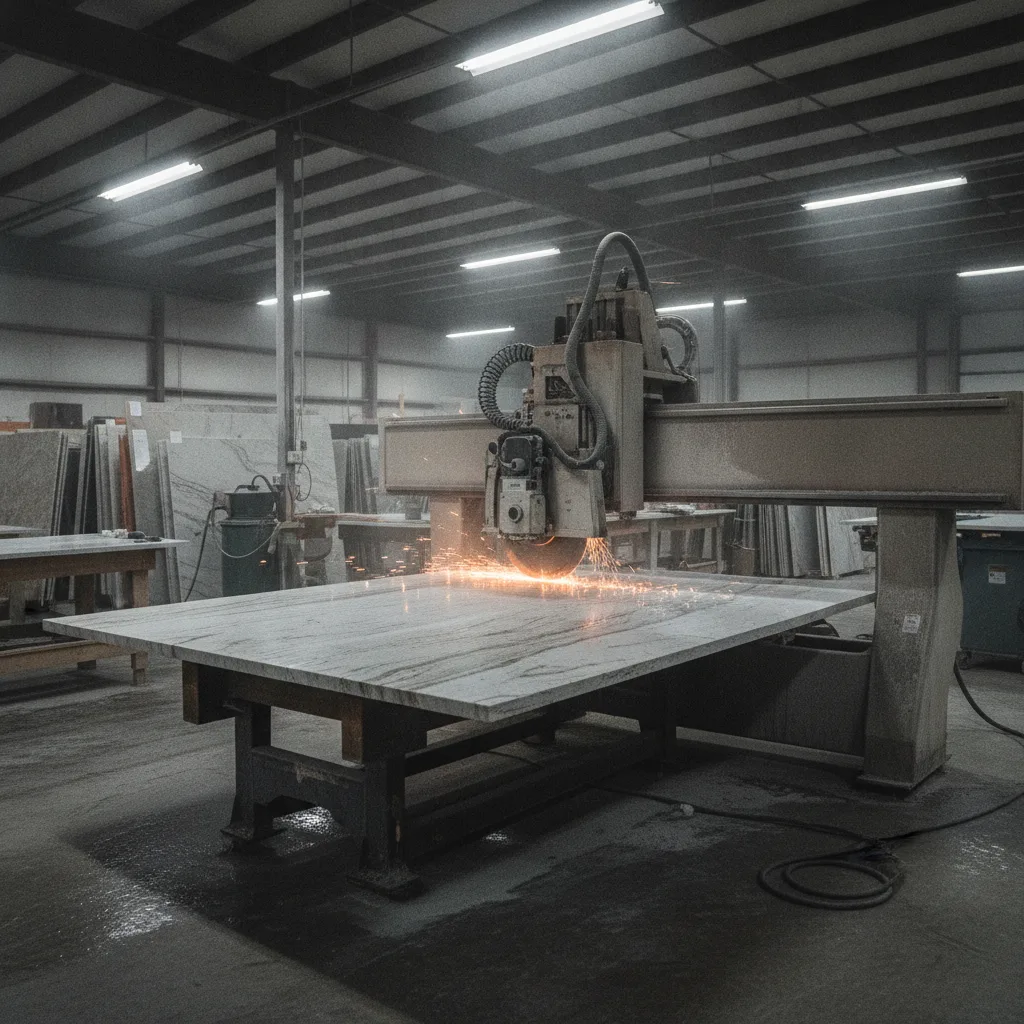
Slab selection is the highest-stakes tradeoff for quartzite specifically. Quartzite slabs vary more than almost any other countertop material — two slabs of the same variety can look dramatically different in color, veining, and unique patterns. Lowe's countertop program does not include a slab yard visit: you pick from a sample chip, and the contracted fabricator sources whatever slab is available in their market. For a material where the visual difference between a beautiful slab and a mediocre one can represent $2,000–$4,000 of perceived value, skipping the slab yard visit is a costly mistake. A local fabricator lets you hand-select your specific stone before fabrication begins — and for premium quartzite, that visibility into what you are actually buying is essential.
Timeline and fabrication accountability are the next two key tradeoffs. Lowe's runs 3–5 weeks from order to installation in 2026; most local fabricators working direct complete quartzite projects in 1–3 weeks. On accountability: when something goes wrong with a big-box subcontractor install — a chip, a shoddy seam, a measurement error — your complaint goes to a retail customer service desk, not the fabricator. With a local shop, you talk directly to the team that measured, fabricated, and installed your new countertops. That direct line of accountability matters when you are spending $4,000–$8,000+ on premium natural stone.
Edge profile options and the quartz/quartzite confusion risk round out the five tradeoffs. Lowe's typically offers 2–4 edge profiles at $8–$22 per linear foot for upgrades. A local fabricator offers 6–12 or more profiles — including eased, beveled, bullnose, half-bullnose, and ogee — at $10–$40 per linear foot, with full visibility into how each profile looks on your actual slab for maximum aesthetic appeal. The confusion risk is real: at a retail counter, there is a genuine chance the person selling you 'quartzite' does not know how different materials perform and cannot distinguish engineered quartz countertops from natural quartzite. A dedicated stone fabricator knows the difference and will not confuse them.
Quartzite is a porous natural stone and requires sealing every 1–2 years to prevent staining from wine, oil, coffee, and other liquids. This is a maintenance requirement that engineered quartz countertops do not have — quartz is non-porous by design because polymer resins fill the voids in the surface. Annual sealing for quartzite countertops costs $0.50–$2.00 per square foot as a DIY project, or roughly $75–$200 professionally for a standard kitchen. Build that into your long-term value calculation when comparing countertop materials.
Sealing frequency varies based on slab porosity and daily use intensity — important factors that depend on your specific stone. A honed or leathered finish is more porous than a polished finish and requires sealing more often; annually is a safe baseline for a busy kitchen. A properly sealed quartzite countertop resists stains well and maintains its timeless elegance for decades. The risk is skipping the resealing and letting red wine or cooking oil soak into an unsealed surface. A local fabricator who works regularly with quartzite will walk you through the resealing process and recommend exactly the right product for your specific slab's porosity level.
Quartzite is UV-stable, which makes it one of the few natural stone materials suited for outdoor applications in Austin and Central Texas. Unlike engineered quartz — whose polymer resins degrade under prolonged sun exposure — quartzite maintains its color, patterns, and structural integrity in outdoor kitchens and bar tops. This durability in the sun is a genuine advantage quartzite holds over engineered quartz and one that adds to its long-term value for homeowners planning outdoor countertop space.
Seal every 1–2 years with a penetrating stone sealer rated for quartzite. Use pH-neutral cleaners daily — avoid vinegar, citrus, or bleach-based products, which can etch the surface over time. Wipe spills quickly, especially wine and oil. A local fabricator can recommend the right sealer for your specific slab's porosity level.
Choose Lowe's if financing is the primary constraint and the specific quartzite slab does not matter to you. The Lowe's 0% interest program is a genuine benefit for homeowners who need to spread payments over 6–18 months. If you are replacing a bathroom vanity top with a common white quartzite and you are not particular about veining or unique patterns, the Lowe's program can deliver an acceptable result at a lower upfront cost. Understand that fabrication quality is not guaranteed and installation fees may carry add-ons that close the price gap.
Choose a local fabricator for almost every other scenario. If the slab variety matters, if you want to hand-select your specific stone and its color and movement, if you need a specialty edge profile for your kitchen's aesthetic appeal, if your timeline is under three weeks, or if you are investing in premium quartzite like Taj Mahal at $100–$220 per square foot for materials alone — a local in-house fabricator is the right choice. You get direct accountability, faster install quartzite countertops timelines, and the expertise of a team that works with natural stone every day. The long-term value of getting the slab, the fabrication, and the installation right from the start outweighs a marginal lower cost that may not survive the first set of add-ons.
In Austin, San Antonio, and across Central Texas, Fox Granite offers free in-home consultations with samples, in-house fabrication (not subcontracted), and a guided slab-selection process so you know exactly what stone is going on your counters before fabrication begins. For quartzite projects that need to be done right the first time — with resale value, durability, and craftsmanship all on the line — that combination of transparency and direct accountability is hard to match. Making an informed decision starts with seeing real slabs at full scale, not a 2-inch chip.
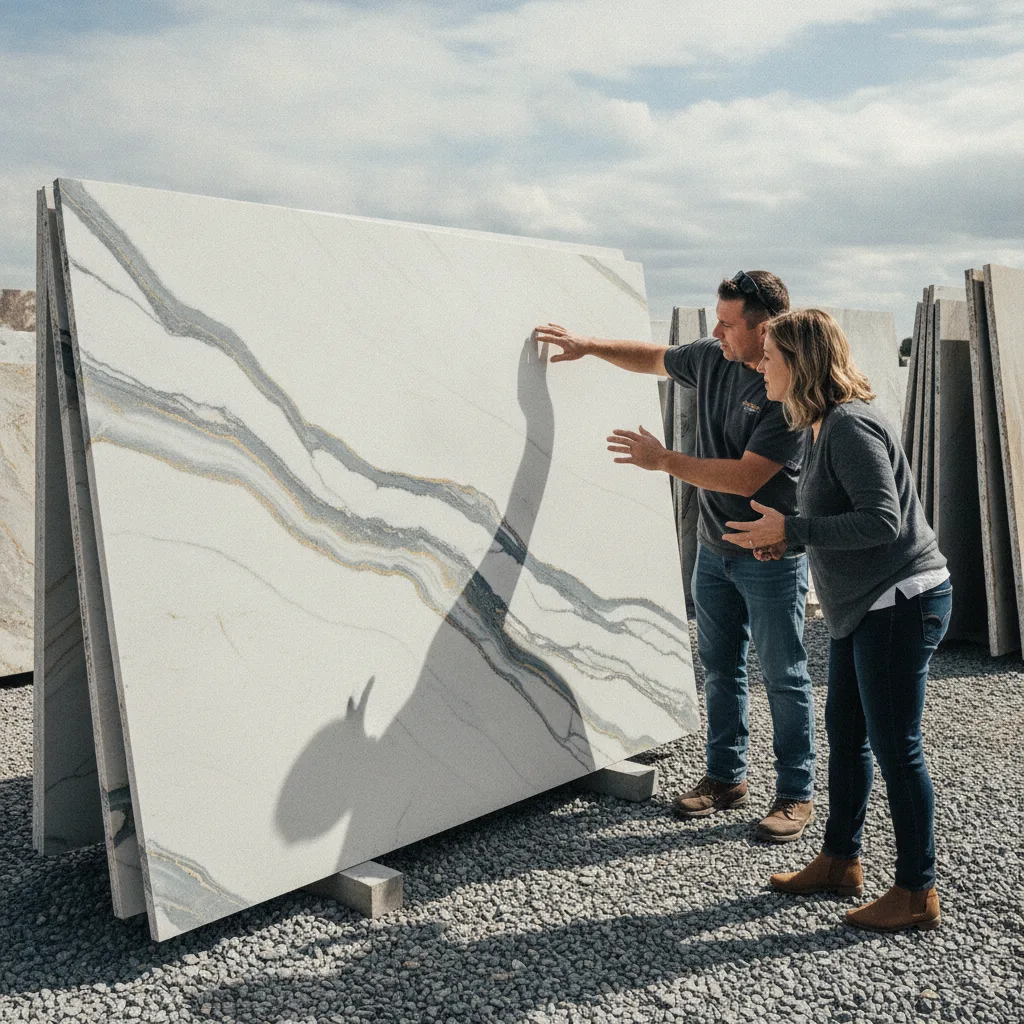
The single most costly mistake in quartzite countertop buying is committing to a material you have never seen at full slab scale. A 2-inch sample chip cannot show you the full veining, movement, or color variation of the 40-square-foot slab that will cover your kitchen. Before you sign any contract — with Lowe's or anyone else — ask whether you can visit the slab yard and hand-select your specific stone. If the answer is no, that is important information about what you are actually buying.
When your quartzite countertops are installed right — the correct slab hand-selected, cut by skilled fabricators, and set by the same team that built it — you get a surface that adds resale value, handles a busy kitchen with daily durability, and maintains its beauty for decades with straightforward annual sealing. For quartzite countertops in Austin, San Antonio, New Braunfels, and the surrounding Central Texas areas, Fox Granite brings in-house fabrication, transparent all-in pricing, and a free in-home consultation so you can see real samples before you commit. Contact us to schedule your free consultation and get your estimate.
Ready to get started? Contact Fox Granite today.

BY APPOINTMENT ONLY
1379 Wald Road
New Braunfels, TX 78132
Austin, San Antonio, Cedar Park, Kyle, New Braunfels, Del Valle, Elgin, Lago Vista, Shady Hollow, Onion Creek, Buda, San Marcos, Lockhart, Temple, Wimberley, Dripping Springs, Bee Cave, Lakeway, Leander, Anderson Mill, Jollyville, Spicewood Springs, Round Rock, Georgetown, Pflugerville, Manor, Taylor, Manchaca, Mountain City, Hutto, West Lake Hills, Bastrop, Liberty Hill, Driftwood, Sun City, Steiner Ranch.