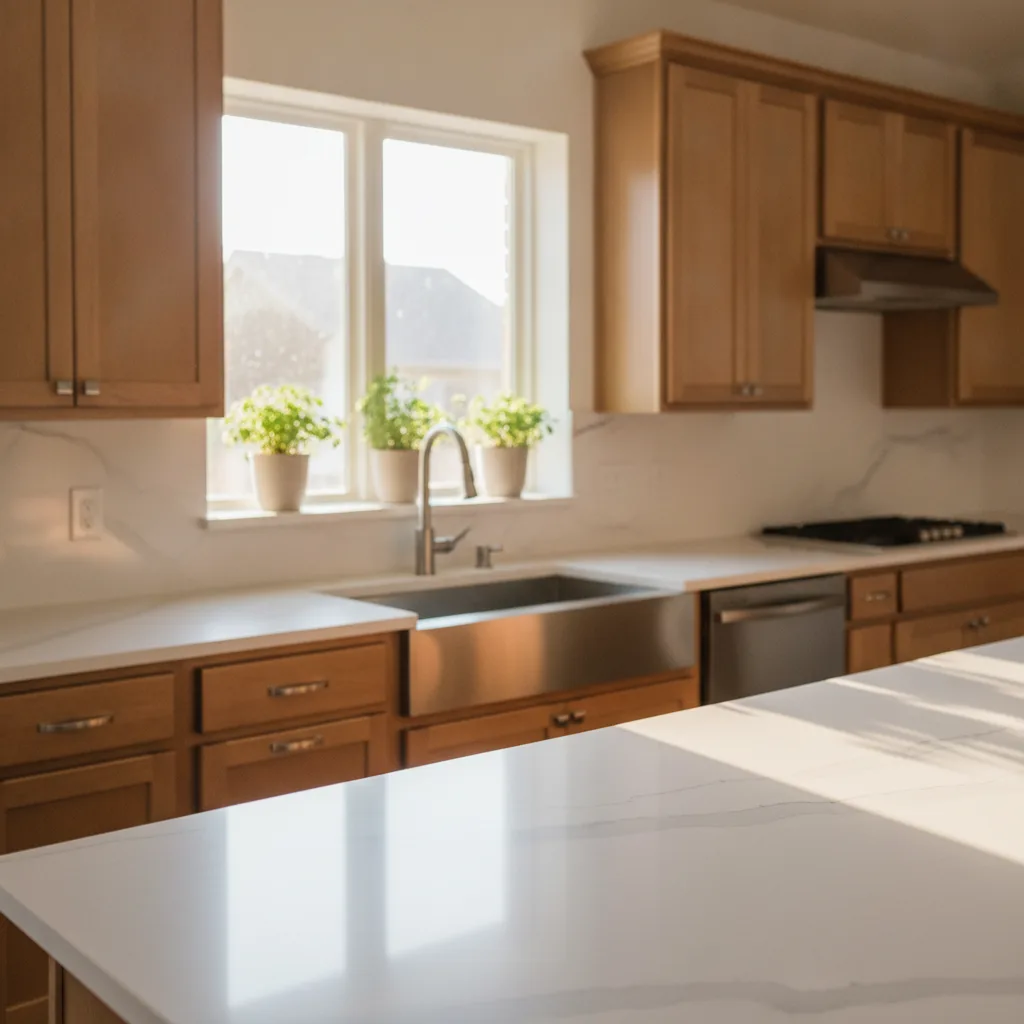
Quartz countertops are the better long-term investment for primary kitchens: non-porous throughout, scratch-resistant, low maintenance, and worth 60–80% ROI at resale. Laminate is the smart call for rental properties, secondary spaces, tight primary budgets, or any stepping-stone remodel where countertops will likely be swapped again anyway. The installed cost gap runs roughly $2,000–$4,400 on a typical 40-square-foot kitchen. Neither material is heat-proof — both require trivets. The honest decision comes down to how heavily you cook, how long you plan to stay, and whether buyers in your price range expect stone.
Quartz vs. laminate countertops comes down to one honest question: how long are you keeping this kitchen, and how hard will you use it? The installed cost gap is real — roughly $2,000–$4,400 on a typical 40-square-foot kitchen — and that gap is worth paying when the investment horizon supports it. When it doesn't, modern laminate is a legitimate countertop choice, not a failure. Here's how to decide which side of that line you're on.
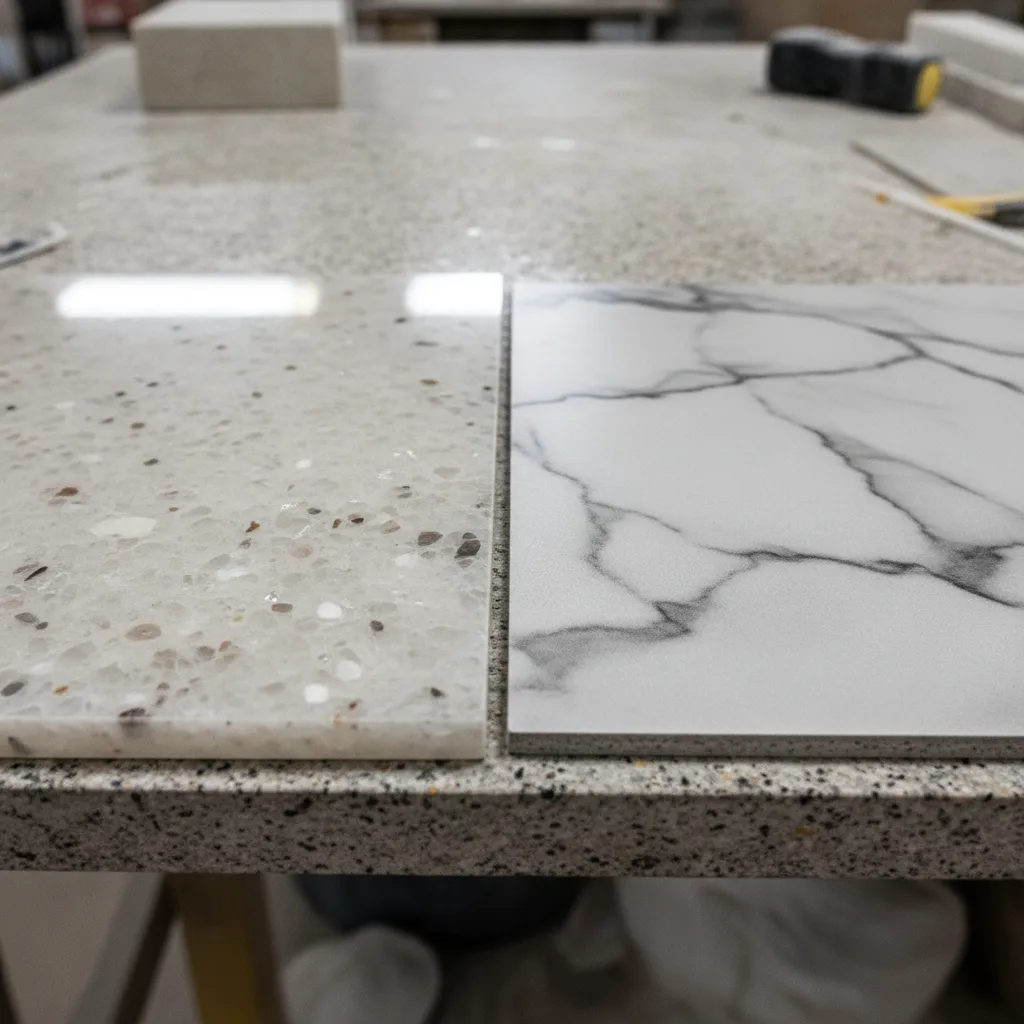
Durable, non-porous engineered stone — built to last 25+ years with minimal maintenance
Budget-friendly, DIY-ready surface — the right call in more situations than you might expect
Quartz countertops are engineered slabs made from 90–93% crushed natural quartz aggregate bound with 7–10% polymer resins and pigments. That resin binder is what makes quartz non-porous throughout — no sealing required, ever — and extremely durable against stains and scratches. It's also why quartz is not heat-proof: the durable resins that give it strength can crack or discolor under sudden high heat from a hot pan above approximately 300°F.
Because quartz is a manufactured product rather than a quarried natural stone, its pattern is consistent and color is controlled across the slab. That consistency is a design advantage — unlike granite or marble, there are no surprise veining variations when you template a large kitchen. It also means the countertop design options are broader, with hundreds of colors and styles available from fabricators.
Professional installation is not optional with quartz. The slabs are heavy, require precision templating, in-house fabrication with stone-cutting software, and experienced installers. That professional installation cost is built into every quartz quote — typically making up $10–$30 per square foot of the total installed price — and there's no DIY path around it. When you're comparing price, you're comparing installed cost, full stop.
Maintenance is genuinely minimal: wipe with mild soap and water, avoid abrasive cleaners, use trivets for high heat. No annual sealing schedule, no surface treatments. That low-maintenance reality is one of the reasons quartz has become the most popular countertop material for primary kitchens as of 2026.
High-pressure laminate (HPL) is built from layers of kraft paper soaked in phenolic resin, topped with a decorative paper layer — the printed pattern you see — and fused under heat and pressure exceeding 1,000 psi. That laminate sheet is then bonded to a particleboard or MDF substrate. The result is non-porous at the surface layer, stain-resistant with mild soap, and genuinely durable for most everyday kitchen tasks.
The two dominant HPL brands in North America are Formica and Wilsonart. Their premium tiers — Formica 180fx and Wilsonart HD — are a significant step above the laminate of two decades ago. Formica's 180fx uses oversized digital prints that don't repeat across a counter, solving the classic pattern problem. Wilsonart HD claims up to 5x more scratch resistance than traditional laminate using its AEON technology. These premium laminates use embossing to mimic real slab depth and offer convincing marble, stone, and wood patterns from several feet away.
One limitation remains visible at close range: the exposed edge shows the layered construction — kraft paper, decorative paper, and substrate. A mitered edge that reveals continuous patterning requires custom fabrication and adds cost. Standard postform laminate edges show the tell-tale dark line that separates the material visually from a full stone slab.
Laminate's real vulnerability is not the surface — it's the seams and edges. The laminate sheet itself is non-porous and stain resistant. The particleboard substrate beneath it is not. Water that gets under the laminate sheet or into a seam will swell the substrate, causing the counter to warp or bubble. Keep moisture away from seams and laminate counters hold up for 15–20 years without complaint. Let it sit in a wet seam and the damage is permanent — requiring full countertop replacement, not spot repair.
| Dimension | Quartz | Laminate |
|---|---|---|
| Installed Cost | $50–$120/sq ft; ~$2,800–$6,000 for a 40 sq ft kitchen | $15–$40/sq ft; ~$600–$1,600 for a 40 sq ft kitchen |
| Scratch Resistance | High — scratch-resistant surface; chips can be filled with epoxy | Moderate — knives leave permanent marks; scratches expose substrate |
| Heat Resistance | Safe below ~300°F; resin can crack from sudden high heat — trivets required | Safe below ~150°F sustained; above 275°F separates from substrate — trivets required |
| Stain Resistance | Non-porous throughout — no sealing ever required; stain-resistant at edges and near sink | Non-porous at surface only — stain-resistant with mild soap; vulnerable at seams and edges |
| Repairability | Chips can be filled; full refinishing not possible — repairs stay visible on most patterns | Burns, deep scratches, and delamination require full replacement, not spot repair |
| Professional Installation | Required — heavy slabs need precision templating, fabrication, and experienced installers | DIY-friendly for straight runs; postform laminate is lightweight and cuts without stone tools |
| Lifespan | 25–50+ years; maintains appearance consistently throughout | 10–20 years typical; scratches and seam yellowing accumulate visibly over time |
| Resale Value | 60–80% ROI at resale; homes receive offers 3–7% higher vs. laminate comparables | No measurable resale premium; can slow a sale in homes priced above ~$500K |
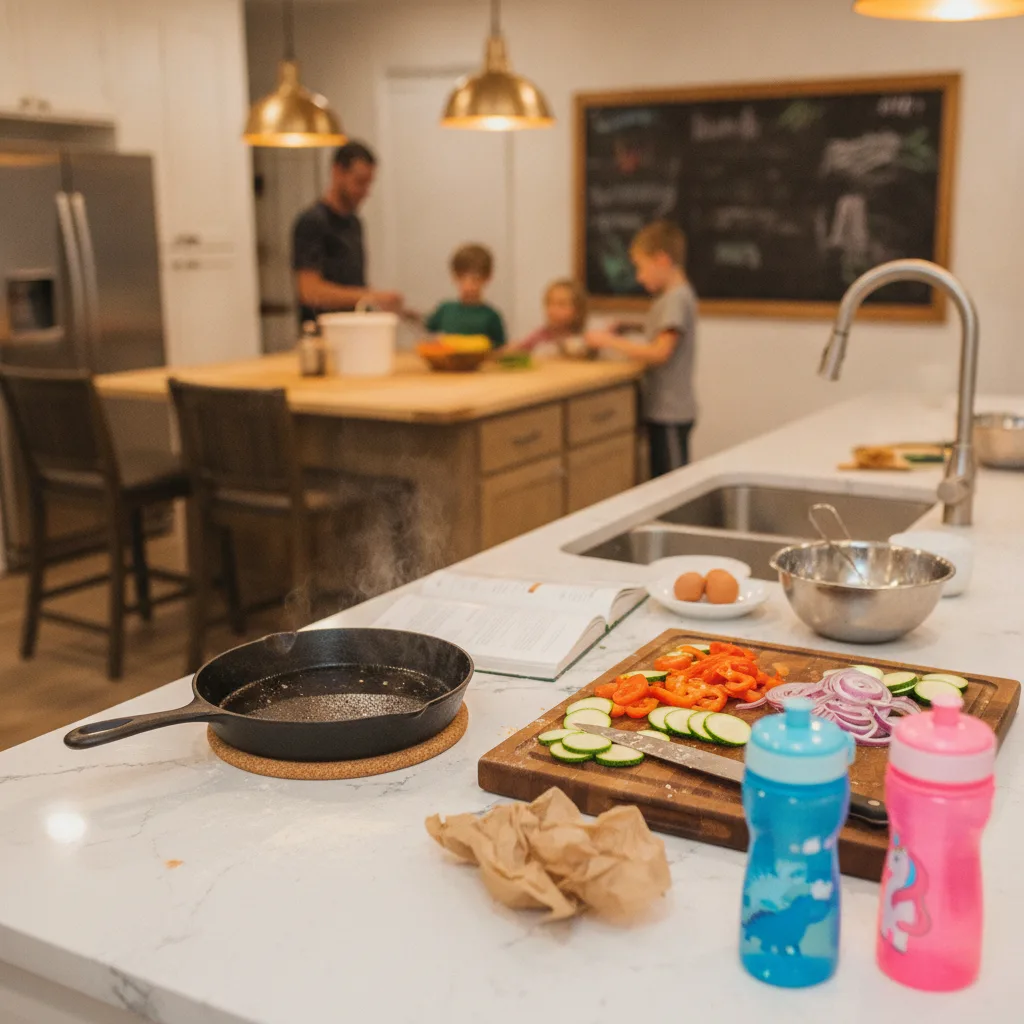
One of the most common misconceptions in the quartz vs. laminate countertops debate is that quartz handles high heat in a way that laminate does not. The reality is more nuanced. Laminate's industry standard (NEMA LD 3) rates its heat resistance as high — but warns that prolonged exposure above 150°F can separate the laminate sheet from its particleboard substrate, and nothing above 275°F should ever touch it. Quartz shares a similar vulnerability: the polymer resins that make it so durable can crack or discolor under sudden high heat. Both surfaces require trivets. The practical difference is that quartz tolerates a brief accidental contact better than laminate does — but neither material is a trivet stand-in.
Quartz is the clear winner for homeowners who cook heavily, plan to stay long-term, or are selling into a market where buyers expect stone. The durability gap is real, the maintenance advantage is real, and the resale math favors quartz clearly over laminate for primary kitchens.
Quartz is a long-term investment that makes the most sense when the investment horizon is long enough to capture its return. For a primary kitchen in a home you're keeping, it's hard to argue against it.
Laminate is not a compromise — it's the right countertop material in a specific set of situations. For rentals, secondary spaces, tight primary budgets, or stepping-stone remodels, laminate delivers a clean, functional, stain-resistant surface at a price that makes sense for the investment horizon.
The key caveat with laminate is moisture management. Keep water away from seams and edges, use trivets without exception, and skip the knives-directly-on-the-surface habit. Do those three things and laminate is a great option that holds up well through its full lifespan.
Quartz and laminate don't have to be an either/or decision across a whole house. Many homeowners spec quartz for the primary kitchen — where daily cooking, resale optics, and long-term durability all point toward stone — and use laminate in secondary spaces where the investment doesn't need to match. A basement kitchenette, a laundry room counter, a guest bath vanity: these are areas where laminate delivers everything you need and quartz would be a clear overinvestment.
This split approach is also practical from a budget standpoint. Prioritizing quartz in the room buyers actually evaluate during a showing — the primary kitchen — while keeping laminate in rooms that rarely appear in listing photos lets you allocate your countertop budget where it has the most impact. The materials don't need to match across unrelated rooms, and no buyer will penalize you for laminate in a utility space when the kitchen has stone.
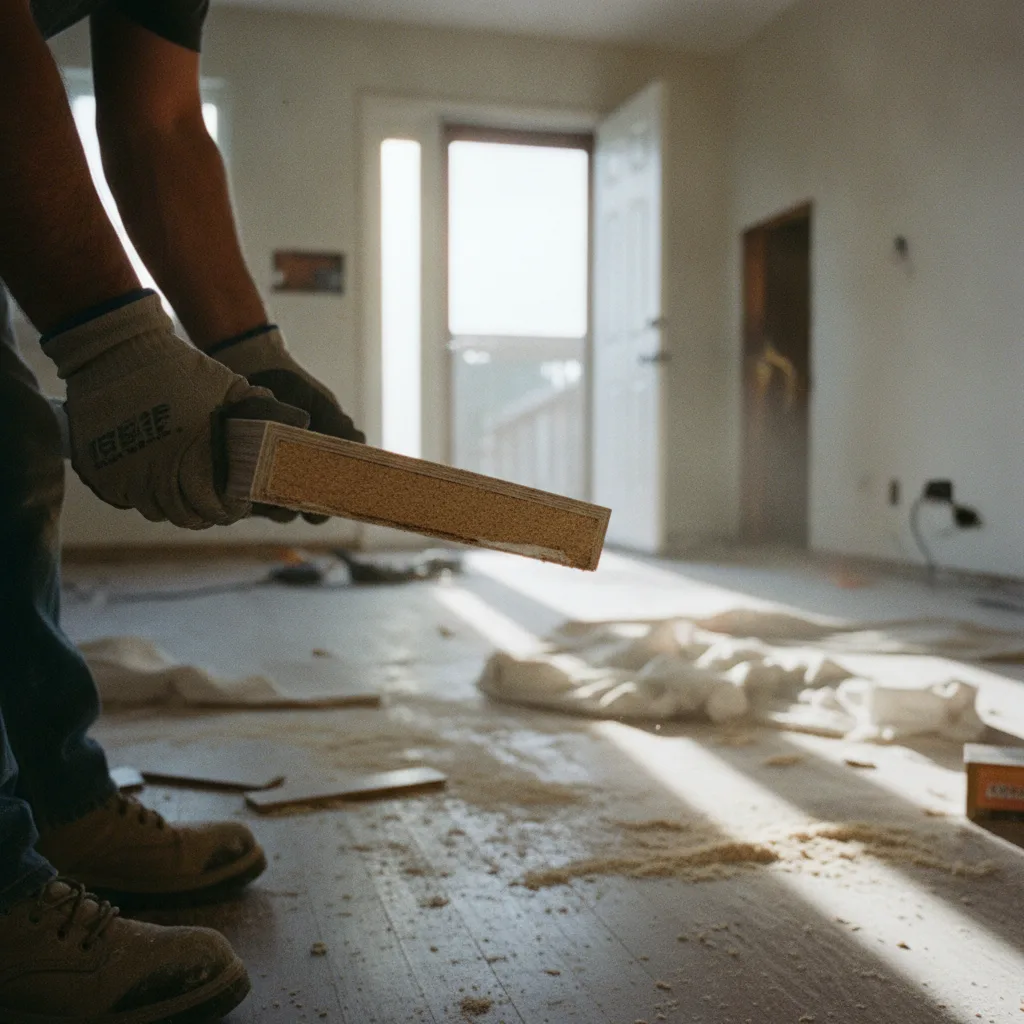
Laminate is the right countertop material — not a compromise — when the goal is a clean, functional surface at a price that makes sense for the investment horizon. For a rental property in New Braunfels or a house-flip in Kyle, spending $2,800–$6,000 on quartz when laminate delivers a sharp-looking kitchen at $600–$1,600 is simply poor allocation.
Modern laminate counters, especially Formica 180fx and Wilsonart HD, now print realistic stone and wood patterns at large format without the old pattern-repeat problem. From a few feet away, the stone look is convincing — and in a rental, that's enough.
The same logic applies to secondary spaces: a basement kitchenette, a laundry room counter, a bathroom vanity in a guest bath. These are areas where you want a durable, stain-resistant surface that wipes clean — and laminate delivers exactly that at a fraction of the cost. The one real care requirement: keep water away from seams and edges. The laminate sheet itself is non-porous, but the particleboard substrate beneath it is not. Manage moisture at the seams and laminate counters hold up for 15–20 years without complaint.
Some homeowners are genuinely in between: the kitchen needs new countertops now, the budget doesn't stretch to quartz, and the plan is to remodel more seriously in the next five to eight years anyway. In that scenario, laminate is not a consolation prize — it's the practical choice. A well-installed postform laminate counter in a neutral stone pattern holds up fine through a medium-term remodel cycle, and switching to quartz or granite later doesn't require structural changes.
The important caveat: be honest with yourself about the timeline. If you're likely to stay in this home for 15+ years and the kitchen is the primary cooking space, stretching the budget to entry-level quartz is worth the conversation. Level 1 slabs start around $50–$70 per square foot installed — that's the realistic bottom of the quartz range, not the premium tier.
At Fox Granite, we can show you exactly what that price range looks like in person at our New Braunfels showroom — real slabs, real numbers, no pressure. If the budget genuinely isn't there yet, we'll tell you that too. The stepping-stone strategy works, but it works best when the timeline is real and not an indefinite delay.
Quartz countertops are the right call for a primary kitchen where multiple people cook, kids set down backpacks, and sharp objects land on the counter before anyone reaches for a cutting board. The surface is extremely durable — engineered from 90–93% crushed natural quartz bound with durable resins — and scratch-resistant in a way that laminate simply is not. A knife dragged across laminate leaves a permanent mark. On quartz, the same knife passes without a trace.
For Central Texas homeowners planning to stay put 10 or more years, the math also shifts. Quartz maintains its look consistently through its lifespan; laminate accumulates visible wear — scratches, seam yellowing, and edge degradation — that makes the surface look dated well before it fails structurally.
Add the resale picture: as of 2026, buyers in markets like Austin and San Antonio specifically seek stone countertops, and comparable homes with quartz or granite receive offers 3–7% higher than those with laminate. For a home priced at $450,000, that gap is real money — and it makes quartz a long-term investment that pays back a substantial portion of its cost when you eventually sell.
The quartz vs. laminate countertops decision is not about which material is objectively better. It's about which one is right for your situation. Quartz wins on durability, long-term value, and resale appeal — full stop. Laminate wins on price, installation flexibility, and return on investment for shorter horizons. Both are non-porous at the surface, both require trivets, and both wipe clean with mild soap. The differences that actually move your decision are scratch resistance, lifespan, and what your buyers will expect when you sell.
For quartz countertop fabrication and installation in Austin, San Antonio, New Braunfels, and throughout Central Texas, Fox Granite has completed over 10,000 projects since 2010. We fabricate in-house, use precision templating, and price transparently — no lowball quotes with add-ons later. If you're weighing new countertops and want to see real slabs at real prices before you decide, contact us to schedule your free in-home consultation or visit our showroom in New Braunfels.
Ready to get started? Contact Fox Granite today.


BY APPOINTMENT ONLY
1379 Wald Road
New Braunfels, TX 78132
Austin, San Antonio, Cedar Park, Kyle, New Braunfels, Del Valle, Elgin, Lago Vista, Shady Hollow, Onion Creek, Buda, San Marcos, Lockhart, Temple, Wimberley, Dripping Springs, Bee Cave, Lakeway, Leander, Anderson Mill, Jollyville, Spicewood Springs, Round Rock, Georgetown, Pflugerville, Manor, Taylor, Manchaca, Mountain City, Hutto, West Lake Hills, Bastrop, Liberty Hill, Driftwood, Sun City, Steiner Ranch.