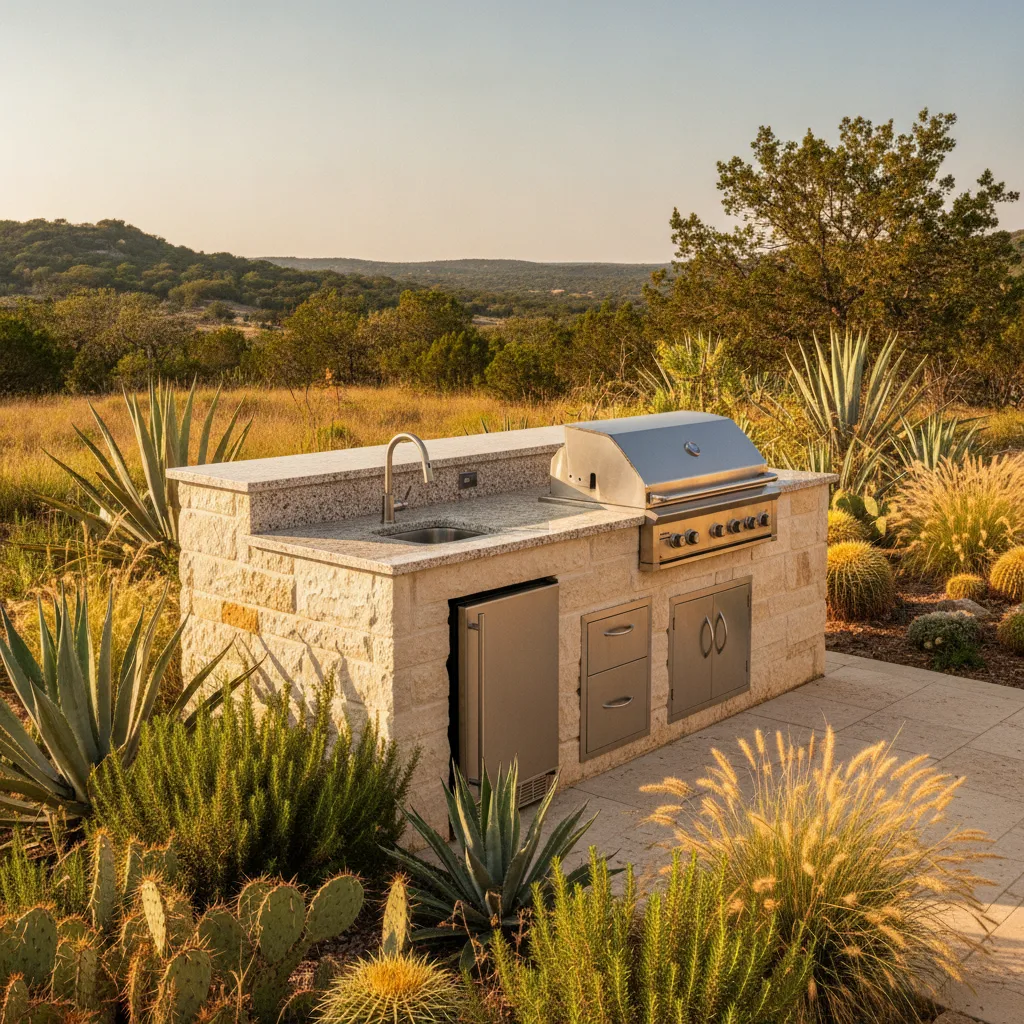
Quartz for outdoor kitchen use is a structural mismatch in Central Texas. Engineered quartz contains 6–10% polymer resin binders that UV radiation breaks down permanently, causing yellowing or fading within 1–2 years of direct sun exposure. Austin's outdoor cooking season runs 10–11 months per year, compounding that damage across hundreds of cook days annually. As of 2026, zero major quartz brands — Cambria, Silestone, Caesarstone, MSI — warranty their products for outdoor use. The three materials outdoor kitchen fabricators in Central Texas actually stand behind are granite ($60–$100/sq ft installed), quartzite ($100–$140/sq ft), and porcelain slabs ($50–$120/sq ft). All three are UV-stable, non-porous, and built to handle Texas weather year-round without voiding a warranty.
Quartz for outdoor kitchen countertops fails in Central Texas — not because it is a bad product, but because its resin binder and direct Texas sunlight are a structural mismatch. Austin's outdoor cooking season runs 10–11 months per year. Choosing the wrong countertop material compounds that mistake across hundreds of cook days annually, until the surface yellows permanently, cracks, or warps, and every major manufacturer declines your warranty claim. Read this guide before you start selecting slabs: it walks through exactly why the failure happens, what the full damage sequence looks like, and which three materials — granite, quartzite, and porcelain slabs — outdoor kitchen fabricators in Central Texas actually stand behind. Choosing the right surface from the start saves you a full tear-out a couple of years down the road.
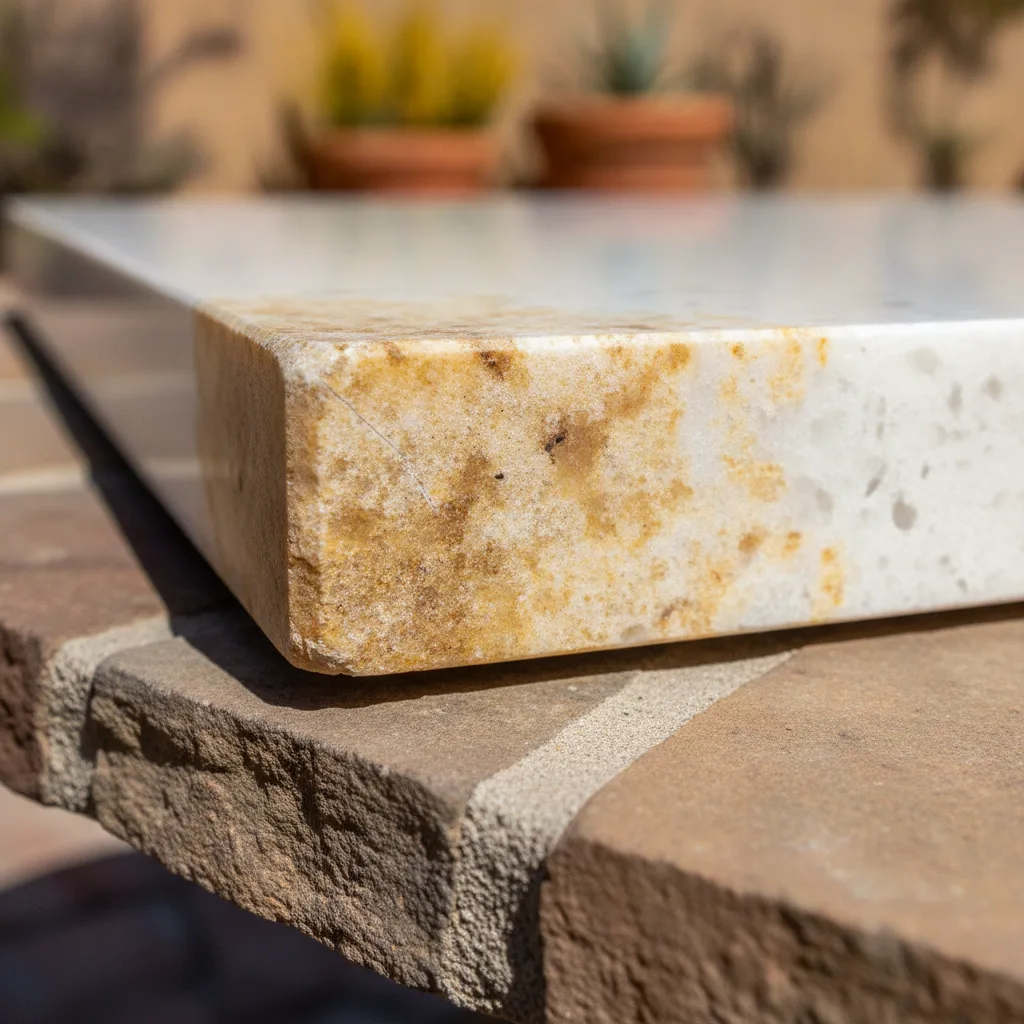
Quartz countertops are engineered stone, not natural stone — and that distinction is exactly why quartz for outdoor kitchen installations fails. Every quartz slab is roughly 90–94% ground quartz crystals held together by 6–10% polymer resin binders. The quartz crystals are UV-stable. The resin is not. UV radiation breaks down the resin at a molecular level, causing permanent discoloration: white and light-color quartz yellows visibly, while darker slabs fade to a washed-out version of their original color. Neither change is cosmetic in a recoverable sense — you cannot polish or treat UV resin damage away. The damage is in the material itself, and it only deepens with time.
In a hot-sun climate like Austin or San Antonio, UV degradation becomes visibly apparent within 1–2 years of direct sun exposure. Austin's outdoor cooking season runs 10–11 months per year, leaving only a few weeks in January and February that are generally too cold for comfortable outdoor cooking. That means your outdoor countertops are subjected to hundreds of hours of direct Texas sun annually — across multiple seasons. A surface that starts yellowing and fading within a couple of summers is not a practical outdoor option for Central Texas homeowners.
The key distinction to establish upfront: quartz is an outstanding indoor countertop material — scratch-resistant, non-porous, low maintenance, and consistent in color. This guide is not a critique of engineered quartz indoors. It is a specific warning about putting engineered stone in an outdoor space where UV exposure and extreme heat are constant conditions, not occasional ones. If you love the look of quartz, find a great indoor application for it and use natural stone where the sun hits.
Quartz and quartzite are two completely different materials. Quartz is engineered stone — ground crystals plus polymer resin. Quartzite is 100% natural stone, with no resin content. This matters enormously for outdoor use. Quartzite is UV-stable and an excellent outdoor countertop material. Engineered quartz is not. The naming similarity creates real confusion at the showroom — always confirm which material you are looking at before you commit.
Before purchasing any quartz countertop for an outdoor kitchen, read the manufacturer warranty carefully — this single step is important enough to do before you even start choosing a slab color. As of 2026, zero major quartz brands warranty their products for outdoor use. Cambria, Silestone, Caesarstone, and MSI all explicitly exclude outdoor installations from coverage. If your quartz countertop yellows, cracks, or warps outdoors, every one of those brands will decline your claim. That means a $4,000–$8,000 countertop install has no manufacturer support from day one.
The one partial exception worth examining is Caesarstone, which has tested a limited outdoor-rated line across a temperature range of -13°F to 122°F. That ceiling sounds reasonable until you account for Austin summers. Heat index values push above 110°F in Central Texas, and an outdoor countertop surface absorbing direct summer sun can reach 150°F or higher. That surface temperature exceeds Caesarstone's own outdoor rating by nearly 30 degrees. The warranty protection that exists on paper evaporates the moment a Texas July arrives.
No quartz manufacturer currently offers a product designed and rated for the UV exposure levels and surface temperatures common in an uncovered Central Texas outdoor kitchen. A voided warranty is not a theoretical risk — it is the guaranteed outcome if something goes wrong. Confirm outdoor exclusions in writing before you commit to any slab.
Free (download from brand websites)
Confirm outdoor exclusions in writing before you commit to any quartz slab for an outdoor space — surprises after installation are expensive and have no remedy
The failure of outdoor quartz countertops follows a predictable three-stage sequence. First, UV radiation degrades the resin binder over months to years, causing yellowing or fading. Second, Texas summer heat pushes outdoor surfaces into the thermal danger zone for the resin itself. The polymer begins to soften and discolor at around 300°F, and a hot pan straight from a 400°F grill side burner exceeds that threshold immediately. Hot pots and pans set directly on an outdoor quartz surface can cause permanent marks, cracks, or delamination — and that damage is not covered by any manufacturer. Quartz simply is not designed to handle outdoor cooking conditions.
Third, and often overlooked, is temperature cycling. Central Texas summers push outdoor surface temps above 150°F. Winter nights can drop below freezing. That daily and seasonal expansion and contraction across seasons stresses the resin bond in ways that natural stone handles more gracefully, because natural stone has no resin matrix to fail. Micro-cracks can form at the boundary between quartz crystals and the resin over time. Once those cracks start, moisture and water work their way in, accelerating the damage from the inside.
The end state of outdoor quartz after a few Texas summers is a surface that has yellowed or faded, possibly warped or delaminated, cracked in spots, with a voided warranty and no path to repair. The only fix is full tear-out and replacement, at full cost, with no manufacturer support. Experienced outdoor kitchen fabricators in Central Texas do not recommend engineered quartz for exposed outdoor countertops precisely because they have seen this failure sequence perform its full course too many times to count.
Temperature cycling is the failure mode most homeowners do not anticipate. It is not just the peak summer heat that damages outdoor quartz — it is the repeated expansion and contraction across seasons. Each cycle stresses the resin bond a little more. After enough cycles, micro-cracks appear, moisture infiltrates, and the damage accelerates. Natural stone expands and contracts too, but without a resin matrix to fracture, it handles freeze-thaw cycles far more gracefully than engineered stone.
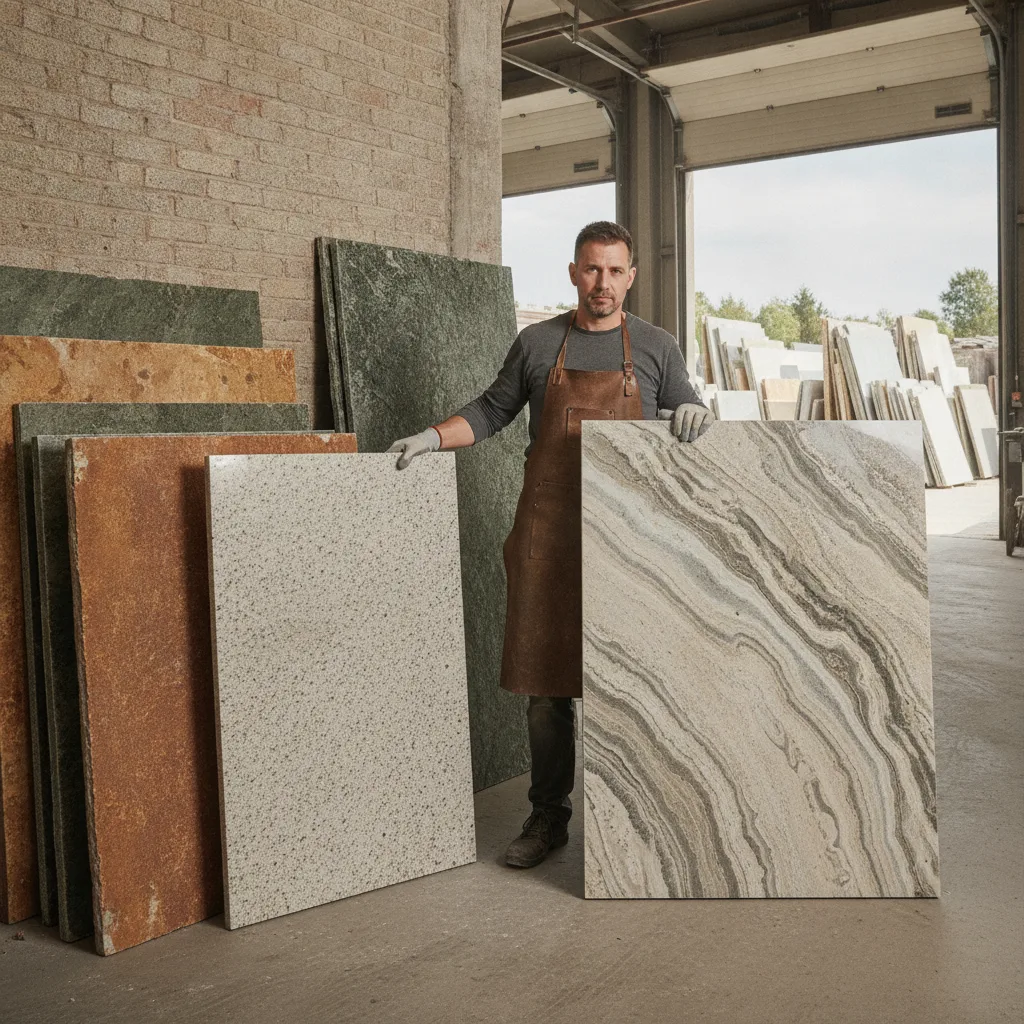
Granite is the most reliable outdoor kitchen countertop material for a Central Texas build, covered or fully exposed. It contains no resin binder — its color comes from natural minerals locked into the stone, so UV radiation has virtually no visible effect year after year. Granite is heat-resistant, handles grill heat and hot pots and pans without damage, and manages the temperature swings from Texas summers to cool winter nights without micro-cracking. Its weather resistance and durability over long years of use are what make it the recommended choice from fabricators who specialize in Texas outdoor kitchens. For homeowners selecting a surface they want to look beautiful a decade from now, granite holds up.
Granite is also non-porous when properly sealed, resisting stains from grilling oils, marinades, water, and rain without deteriorating. Outdoors, plan to reseal granite once per year — a 15-minute process with a penetrating stone sealer. That ease of maintenance is a big part of its appeal. Installed cost for granite outdoor countertops runs $40–$150/sq ft, with most mid-range outdoor kitchen projects landing $60–$100/sq ft all-in. That is a practical price point for a material that genuinely withstands constant exposure to the elements and holds its strength across all seasons.
One color note specific to Central Texas: dark granite in direct sun can reach 140–160°F — hot enough to burn bare skin on contact. For fully exposed outdoor spaces in Austin, San Antonio, Georgetown, or New Braunfels, light color granite slabs are the ideal choice. They stay cooler to the touch, show less surface heat stress over time, and maintain their visual appeal across years of direct sunlight.
Free
We bring slab samples to your outdoor space so you can see how light color granite looks in your actual yard before you commit — no showroom trip required, no pressure
Light color granite and quartzite slabs are strongly preferred for uncovered outdoor kitchens in Central Texas. Dark stone absorbs significantly more solar heat, reaching surface temperatures that are uncomfortable and potentially hazardous in direct summer sun. If you love the look of a darker slab, a covered structure with overhead shade is the setup that makes it workable.
Quartzite countertops are natural stone — not to be confused with engineered quartz — and they are one of the hardest, densest surface materials available for outdoor kitchens. Quartzite is UV-stable, highly resistant to scratches, heat, and moisture, and handles freeze-thaw cycles without issue. It also delivers a marble-like beauty that many homeowners are interested in for an outdoor space, without the porosity and maintenance burden that actual marble carries. The strength of quartzite makes it an ideal surface for heavy outdoor cooking use — grills, side burners, prep work, and bar areas alike. Installed cost for outdoor quartzite runs $80–$200/sq ft, with most Central Texas outdoor kitchen projects averaging $100–$140/sq ft. For homeowners who want exceptional durability alongside a high-end aesthetic, quartzite is the material to explore.
Porcelain slabs are the third strong option, and arguably the lowest maintenance of the three. Porcelain contains no resin and no pores. Lab testing per ISO 105-B02 shows a color delta E of less than 1 after 500 hours of UV exposure — meaning essentially no visible color shift, even under constant direct sunlight. It never needs sealing, resists stains from oils and sauces without any treatment, and is fully rated for exterior use in all climate zones. Porcelain is also easy to clean with water and mild soap, making it a great fit for outdoor bars and prep surfaces that see frequent spills. Brands like Dekton and Neolith are well-established for outdoor applications. Installed cost runs $50–$120/sq ft, with an average outdoor kitchen project coming in at $3,000–$6,500.
Both quartzite and porcelain slabs are non-porous or near-non-porous, withstand constant exposure to rain and direct sunlight, and perform reliably across Austin's wide seasonal temperature range. Neither material carries the resin failure risk of engineered stone. They are genuinely low maintenance options for outdoor countertops — no annual sealing required for porcelain, once-a-year sealing for quartzite in most cases. These are the materials that hold up not just for two summers, but for a decade or more of outdoor cooking.
The right outdoor countertop material depends partly on how much direct sunlight your outdoor kitchen actually receives. A fully covered outdoor kitchen — solid roof or deep pergola — reduces UV exposure and peak surface temps significantly. In that setup, some homeowners ask whether quartz is acceptable. The honest answer: even with a covered structure, manufacturers still void warranties for outdoor installations, and the humidity, indirect UV, and temperature swings in Central Texas still stress the resin over time. Making the safer choice means always going with natural stone or porcelain for any outdoor space, covered or not. Determine your exposure level first, then start selecting your material.
For a fully exposed outdoor kitchen with no overhead cover, granite is your best all-around value at $60–$100/sq ft installed. It is the perfect choice for the functionality of a working outdoor kitchen: heat resistance, stain resistance, weather resistance, and long-term durability all in one material. Quartzite adds exceptional durability and beautiful marble-like aesthetics at a step up in cost. Porcelain slabs offer the lowest long-term maintenance at a competitive price point. All three handle direct sunlight, rain, and Texas temperature swings without the failure modes that come with engineered stone. All three are materials a great fabricator will stand behind for your outdoor space.
If you are ready to plan an outdoor kitchen in Austin, San Antonio, Round Rock, New Braunfels, or anywhere across Central Texas, start with a free in-home consult. Our team will bring samples of granite, quartzite, and porcelain slabs to your yard, assess your sun exposure, and walk you through pricing with no surprise fees. You will know exactly what you are getting — and exactly why we are not recommending quartz — before a template is ever cut.
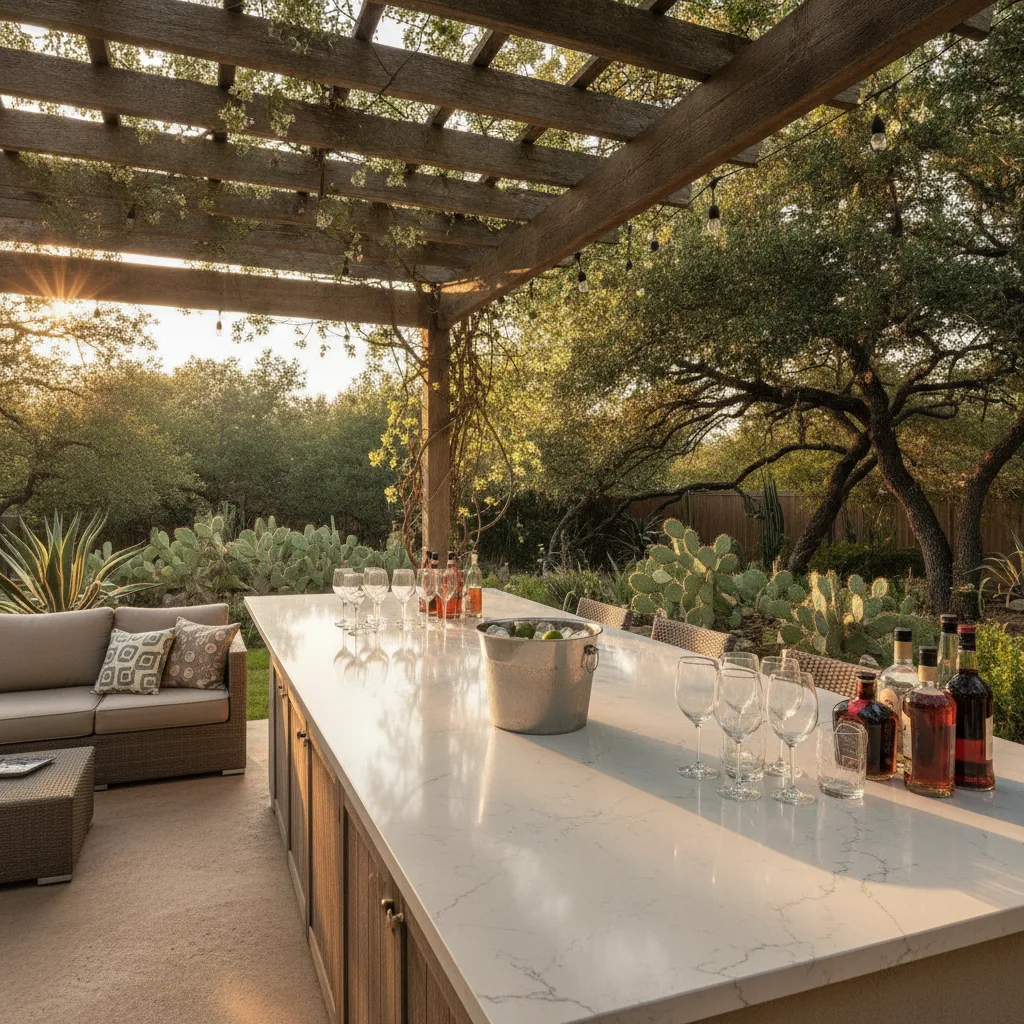
Every major quartz manufacturer — Cambria, Silestone, Caesarstone, MSI — explicitly excludes outdoor use from their warranties. If you install quartz outdoors and the resin yellows, warps, or discolors within two summers, you have no recourse. The fix is a full tear-out and replacement, at full cost, with no manufacturer support. Granite, quartzite, and porcelain slabs don't carry this risk. They are the materials outdoor kitchen fabricators in Central Texas actually stand behind for exposed outdoor countertops.
For outdoor kitchen countertops in Austin, San Antonio, New Braunfels, Round Rock, and across Central Texas, trust Fox Granite. We have completed over 10,000 countertop projects since 2010, and we fabricate and install granite, quartzite, and porcelain slabs in-house — no subcontractors, no surprise fees, and no pressure to use the wrong material for your outdoor space. Contact us today to schedule your free in-home consultation and get your free estimate.
Ready to get started? Contact Fox Granite today.


BY APPOINTMENT ONLY
1379 Wald Road
New Braunfels, TX 78132
Austin, San Antonio, Cedar Park, Kyle, New Braunfels, Del Valle, Elgin, Lago Vista, Shady Hollow, Onion Creek, Buda, San Marcos, Lockhart, Temple, Wimberley, Dripping Springs, Bee Cave, Lakeway, Leander, Anderson Mill, Jollyville, Spicewood Springs, Round Rock, Georgetown, Pflugerville, Manor, Taylor, Manchaca, Mountain City, Hutto, West Lake Hills, Bastrop, Liberty Hill, Driftwood, Sun City, Steiner Ranch.