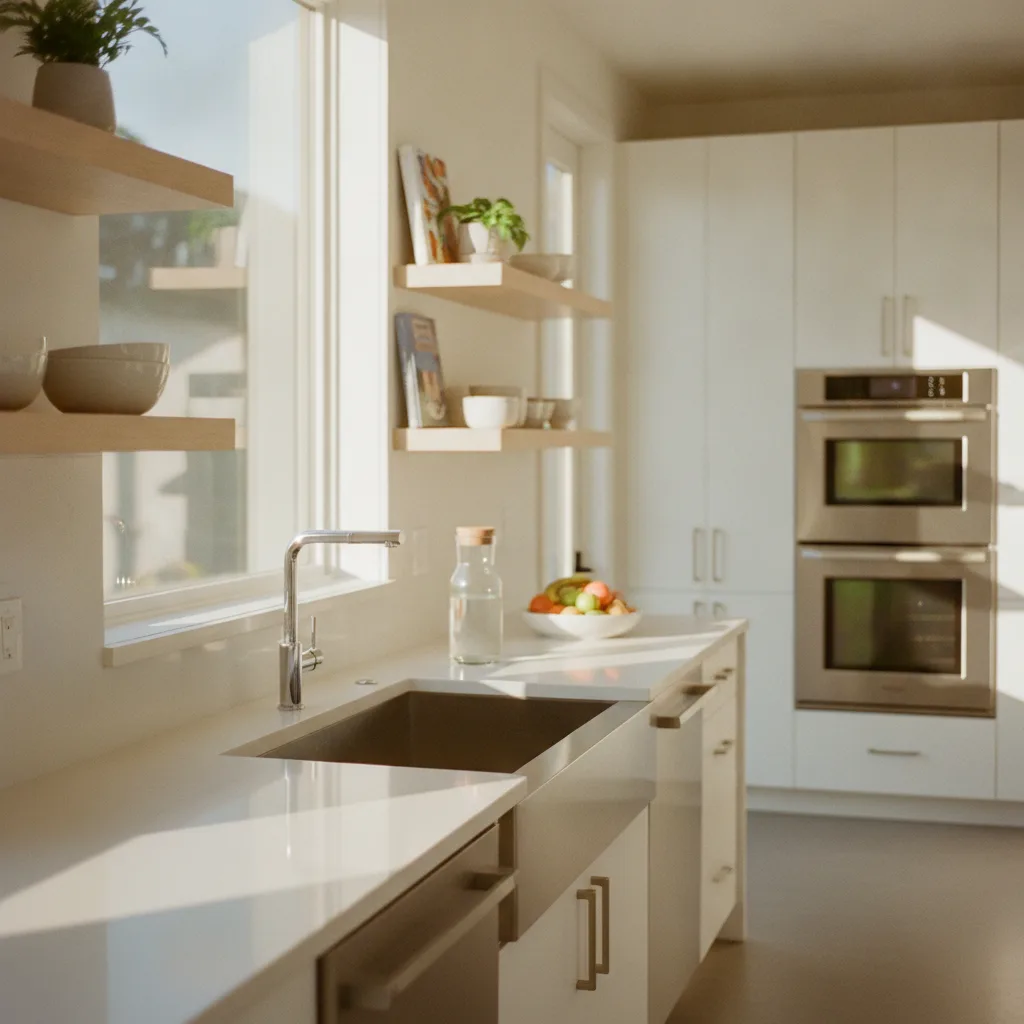
Austin quartz countertops cost $50–$150 per square foot installed in 2026, with most homeowners landing between $70 and $100 per sq ft for a mid-grade slab, a standard edge profile, and one or two cutouts. A typical 40–50 sq ft kitchen runs $3,500–$7,500 all-in. The slab is only 40–50% of that total — fabrication and labor make up the other 50–60%. Brand choice is the biggest single lever on cost: entry-level MSI runs $50–$80 installed, Caesarstone and Silestone land $60–$100, and Cambria premium quartz reaches $100–$250. Quartz is non-porous and never needs sealing — unlike granite, which requires resealing every 1–3 years. One firm rule for Austin TX homeowners: quartz belongs inside only. The polymer resin degrades under UV, and every major manufacturer voids the warranty on outdoor installations.
Austin quartz countertops cost $50–$150 per square foot installed in 2026, and where you land in that range comes down to four decisions: slab tier, edge profile, cutout count, and whether you hire a direct in-house fabricator or route the job through a general contractor. Most Austin TX homeowners remodeling a primary kitchen pay $70–$100 per sq ft and spend $3,500–$7,500 all-in on a standard 40–50 sq ft kitchen. This guide gives you the local price breakdowns, the brand comparison, the add-on costs that inflate final invoices, the outdoor rule that too many buyers find out about after signing, and the right questions to ask before you commit to any fabricator. Read through every step before you book your first appointment — the information here will help you understand exactly what to expect and begin the process with real confidence.
Austin quartz countertops cost $50–$150 per sq ft installed in 2026, with most homeowners landing between $70 and $100 per sq ft for a mid-grade slab, a standard eased or beveled edge profile, and one or two cutouts. That range is wider than most online calculators admit — and the tier you land in depends on four decisions covered in the steps below. Use this guide to understand every line item before you select a fabricator, so the final invoice matches what you expect.
A standard 40–50 sq ft kitchen runs $3,500–$7,500 all-in once you add fabrication, delivery, and installation. Here is the number most buyers miss: the slab itself is only 40–50% of what you will pay. Fabrication and labor account for the other 50–60%. That is why two quotes with the same slab price can produce invoices $1,000 apart — the difference is always in the fabrication and installation line. When you browse quotes, compare fabrication costs as hard as you compare the stone price. Generally, any quote that leads with a single number rather than a line-item breakdown is a sign to ask more questions before you move forward.
Austin TX pricing runs 15–20% above San Antonio for the same quartz material, driven by higher labor costs and heavy demand from new construction across neighborhoods from Cedar Park to Steiner Ranch. If your project is in Dripping Springs, Bee Cave, or Lakeway, expect Austin-tier pricing. San Marcos, Kyle, and New Braunfels homeowners often land closer to the middle of the range. Central Texas is one of the fastest-growing markets for countertop installation in the country, and fabrication shops here are running full schedules — plan four to six weeks out for a standard project. Mon–Fri scheduling is standard for most in-house fabricators, with some offering Saturday appointments for consultations.
If a quote looks unusually low, ask the fabricator to confirm whether edge profile upgrades, sink cutouts, and old countertop removal are included. Those three add-ons alone can push a $65/sq ft quote past $95/sq ft by the time the invoice arrives.
Quartz countertops in Austin TX split into three clear tiers in 2026, and your brand choice is the single biggest lever on final cost. Entry-level quartz — MSI and comparable brands — runs $50–$80 per sq ft installed and covers solid colors and simple patterns. It is a strong choice for rental properties, bath remodels on a tight budget, or laundry rooms. Colors are consistent and maintenance is nil, but the pattern depth and texture are simpler than higher-tier slabs. MSI also carries a broad selection of tile and flooring surfaces if you want to bundle materials and simplify your order. Their Austin showroom locations carry live inventory you can view in person before committing to any slab.
Mid-range quartz — Caesarstone and Silestone — lands at $60–$100 per sq ft installed. Caesarstone uses 93% quartz content in its core lines and carries a lifetime limited warranty; some budget brands manufactured in China or India use as little as 85% quartz, a meaningful quality gap. Silestone adds N-Boost, a permanent factory-applied stain-resistant seal, and a 25-year transferable warranty. Both brands offer enough color and variety of movement to complement nearly any kitchen or bathroom design direction. These are the right stone for most Austin homeowners remodeling a primary kitchen — the kind of material designers choose when they want elegance without the maintenance demands of marble. Infinity Surfaces, a regional distribution partner available through select Austin showrooms, also carries a curated mid-range quartz selection worth exploring if you want to see more variety during your visit.
Premium quartz is Cambria territory: $100–$250 per sq ft installed. Cambria is the only major quartz brand manufactured entirely in the US, out of Jordan, Minnesota, and it backs every slab with a transferable lifetime warranty. The designs carry more visual depth and timeless character than standard mid-range patterns. For a master bath suite, a high-visibility island, or a home where resale value is part of the calculation, Cambria is worth the premium. One practical note on quartz versus natural stone: quartz surfaces offer consistent colors and pattern repeatability that natural stone cannot. If you need a kitchen island to match perimeter counters — a common request in South Austin open-plan kitchens — quartz makes that match straightforward. Granite and quartzite slabs carry natural variation that adds timeless character and one-of-a-kind beauty, but makes exact matching harder. Budget brands manufactured in China or India sometimes use as little as 85% quartz content — a meaningful quality gap versus Cambria's and Caesarstone's documented formulas.
$60–$85/sq ft installed
93% quartz content, lifetime limited warranty, wide color selection — strong mid-range value for Austin kitchens and bathrooms.
$65–$100/sq ft installed
N-Boost permanent stain-resistant seal and 25-year transferable warranty — a top pick for high-use family kitchens.
$100–$250/sq ft installed
Only major quartz brand made entirely in the US; transferable lifetime warranty; deepest visual designs in the premium quartz tier.
The three add-ons that routinely inflate an Austin quartz countertop invoice are edge profile upgrades, sink and appliance cutouts, and old countertop removal — and fabricators sometimes leave all three off the first quote. Get line-item pricing on each before you agree to anything. A request for a written, itemized estimate is a basic professional standard. Any fabricator who resists is making it harder for you to compare bids, not easier for them to provide good service. This step is the single best way to find out what you are really paying before the work begins.
Edge profiles matter more to cost than most buyers expect. A standard eased or half-bullnose edge is typically included in the base price. Upgrade to an ogee or dupont profile and you will add $15–$30 per linear foot. A 40 sq ft kitchen with 25 linear feet of exposed edge adds $375–$750 to your total just for that choice. Waterfall edges — popular on islands in Cedar Park and Georgetown new construction — run $500–$1,500 per section. An island with two waterfall ends adds $1,000–$3,000 to the project. Decide on your edge profile before you request quotes so every fabricator prices the same scope. If you are not sure which edge finish you prefer, our staff can walk you through the full selection at the showroom — bring photos of your kitchen so they can work with your existing design and help you find the right look.
Cutouts are the other common surprise. Sink, faucet, and cooktop cutouts combined run $450–$1,200 for a typical kitchen. Slab thickness is a subtler cost driver: 3cm quartz is the standard for kitchen countertops, but some fabricators quote 2cm by default — the upgrade from 2cm to 3cm adds $10–$20 per sq ft, meaning $400–$800 more on a 40 sq ft kitchen. Old countertop removal adds $200–$400 and is frequently omitted from first estimates. Ask every fabricator you contact to include it or explicitly exclude it so you are comparing the same scope. These costs are real; the craftsmanship and precision required to cut stone cleanly around a sink or cooktop is one reason in-house fabrication matters. Do not leave any of these terms off the table when you sit down to review a quote.
Request a written, itemized estimate that lists slab cost, fabrication, edge profile, number of cutouts, slab thickness, delivery, installation, and old countertop removal as separate line items. Any fabricator quoting a single number for the whole project is making it harder for you to compare bids accurately.
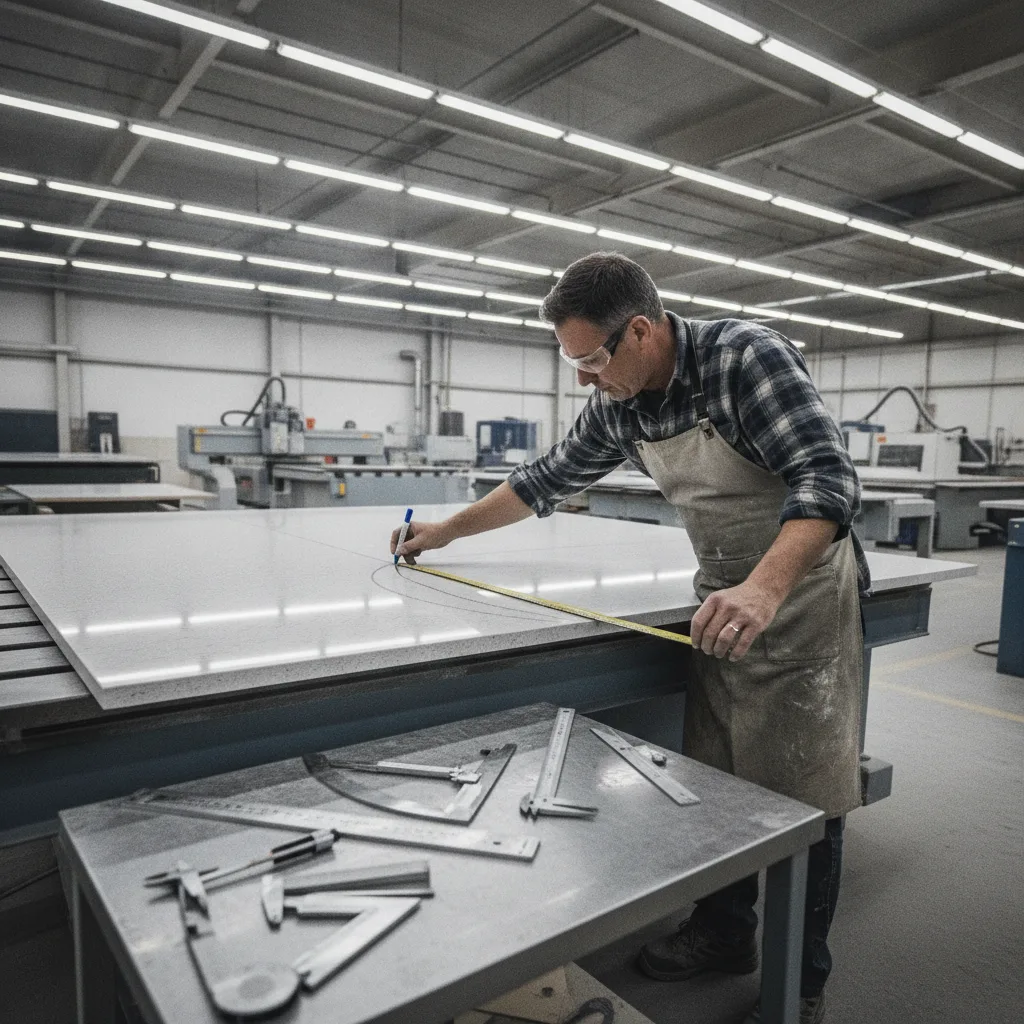
Routing your Austin quartz countertop installation through a general contractor instead of an in-house fabricator adds a 13–22% markup to your total project cost. On a $6,000 project, that markup is $780–$1,320 in fees that go to the GC, not to your countertop or the craftsmanship behind it. For a straightforward countertop replacement — one of the most standard stone installation projects a residential team handles — there is no reason to pay that premium. Ready to move forward? Start by calling fabricators directly and asking the two questions below.
An in-house fabricator handles templating, fabrication, and installation with their own team, using their own tools and equipment. There is no handoff, no subcontract, and no markup chain. Fox Granite's team does every step — template, cut, finish, deliver, and install — in-house using precision overlay templating and state-of-the-art stone-cutting software. That single-team process is how a one-week turnaround from measure to install is possible. Our specialists have completed more than 10,000 projects across Austin TX and the surrounding Central Texas areas, and every project gets the same direct team from first visit to final install. Our clients consistently point to this single-team approach as the experience that sets us apart from shops that subcontract the work.
When you contact any fabricator, ask two questions directly: Do you fabricate in-house, or do you outsource cutting? Does your quote include professional installation by your own team? If the answer to either is no, you are likely paying GC-tier prices for a subcontracted result. Visit the showroom and ask the staff to describe what the fabrication floor looks like — a shop that does real in-house work will have a clear, specific answer. That one conversation can save you more than $1,000 on a mid-size kitchen project. Mon–Fri, our team is ready to take your call at (512) 653-5541 and walk you through every detail.
Quartz countertops should never be used in outdoor spaces in Austin TX. The polymer resin binder — 5–10% of quartz's composition — degrades under UV radiation, causing yellowing and fading that no sealer can reverse. Every major quartz manufacturer explicitly voids the warranty for outdoor installations. Central Texas averages more than 220 sunny days per year; an outdoor quartz surface in Round Rock or Pflugerville will not last a full summer before the resin begins to break down. If a salesperson tells you a specific quartz product is rated for outdoor use, ask to see the manufacturer's written warranty language. As of 2026, no major quartz brand — not Cambria, Caesarstone, or Silestone — covers outdoor installations. This is a point where the written terms matter, so get them in hand before you sign anything.
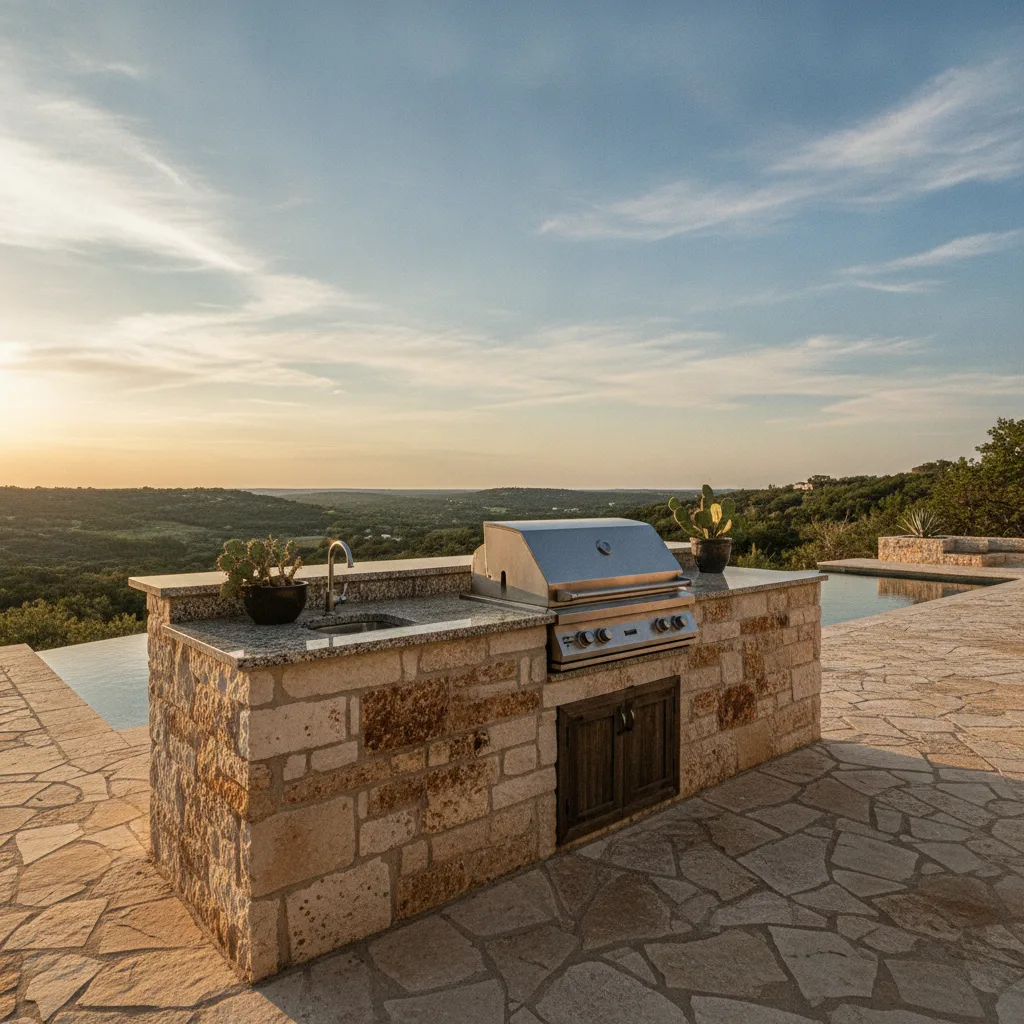
For Austin outdoor kitchens, patio bars, and outdoor spaces, granite countertops and quartzite are the right natural stone. Both are fully UV-stable and built to handle thermal cycling — the expansion and contraction from Austin's hot days and cool nights that causes quartz resin to crack over time. Granite carries the same scratch-resistant, heat-resistant durability it brings to indoor kitchens, with zero UV risk. Quartzite import value grew 47% in 2025, with about four-fifths of supply originating from Brazil — it is the fastest-growing natural stone countertop material in 2026 and a strong choice for outdoor bar tops and outdoor kitchen countertops in the Austin area. Its natural beauty and one-of-a-kind variation enhance any outdoor space in a way no engineered surface can replicate.
The same UV sensitivity applies near large south- or west-facing windows inside the house. If a countertop run sits in direct sun for several hours a day, discuss that exposure with your fabricator before selecting a slab color. It is a manageable interior installation, but worth noting so you choose a finish that will not show early fading. For fully exposed outdoor spaces, plan on granite countertops or quartzite from the start. Porcelain slab countertops are also UV-stable and resin-free, making them a viable alternative for outdoor surfaces — an option your fabricator can introduce you to if granite and quartzite do not fit your design direction.
If a salesperson tells you a specific quartz product is rated for outdoor use, ask to see the manufacturer's written warranty language. As of 2026, no major quartz brand — not Cambria, Caesarstone, or Silestone — covers outdoor installations.
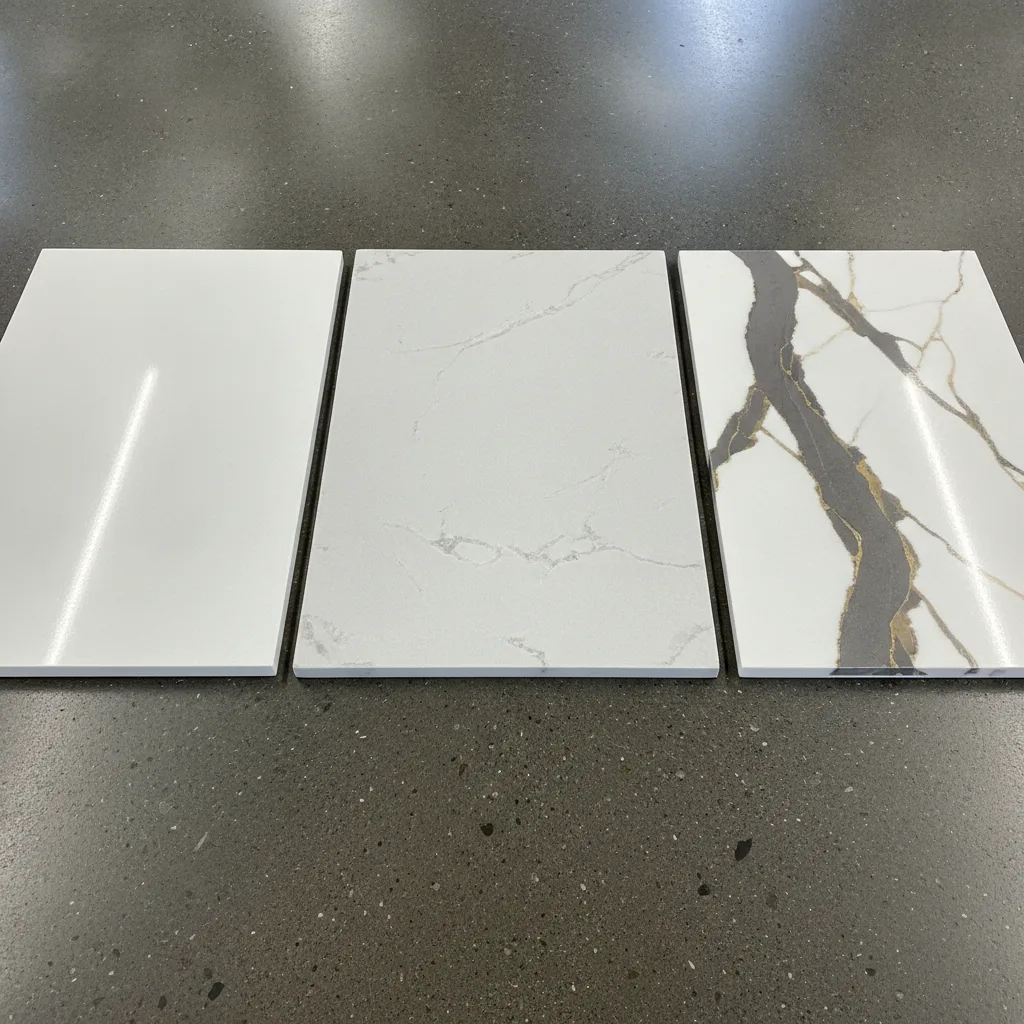
Screen colors online, but always view full slabs in person before you commit. Quartz photography on brand websites and distributor gallery pages is shot under controlled studio lighting — colors and patterns read differently under the actual lighting conditions in your kitchen or bathroom. Bring a cabinet door, a floor tile sample, or a flooring plank to the showroom so you can see how the slab colors complement your existing finishes. Our New Braunfels showroom carries live inventory across our full selection, and our team brings physical samples to your home during the free in-home consultation so you can view them in your actual space under your actual light. Videos of completed projects on our website can also help you preview how certain slabs look in finished kitchens before you visit. Seeing the stone in person is the single step that prevents the most buyer's regret — browse our gallery online first, then come in ready to choose.
Once you have narrowed to two or three slabs, the next step is a free in-home estimate. A thorough estimator will measure your countertop runs precisely, document your sink and cooktop cutout locations, discuss edge profile options with you in person, and deliver a written all-in quote covering every line item. Fox Granite provides this free estimate for homeowners across Austin TX, San Antonio, Round Rock, Georgetown, Cedar Park, Leander, New Braunfels, Kyle, Buda, Dripping Springs, San Marcos, and the surrounding Central Texas areas. Our staff are ready to help you find the right stone for your kitchen, bathroom, fireplace surround, or any other space where natural stone and quartz surfaces create lasting elegance. Contact us by phone at (512) 653-5541 Mon–Fri or send a message through our website to request your appointment and get started. We promise to provide a fully itemized, no-surprise estimate every time.
Kitchen countertop upgrades in Austin return 60–80% ROI on average, and the countertop is consistently the surface home buyers notice first. The NKBA's 2026 Kitchen Trends Report found that 78% of design professionals expect quartz to be the preferred countertop surface going forward — ahead of granite at 43%. Quartz holds about 35–36% of the U.S. countertop market as of 2026, the largest share of any single material. It earned that position by being genuinely low-maintenance: non-porous by design, never needs sealing, and resistant to the stains and daily use that wear down other surfaces. Granite requires resealing every 1–3 years; quartz does not. That is a real, practical difference for a busy Austin kitchen or a high-use family bathroom. Love the look of marble but prefer a surface that stays cleaner with less work? Quartz slabs that carry marble-inspired patterns let you create that aesthetic without the upkeep — one of the top reasons clients choose quartz for master bath and kitchen remodels.
The most common complaint Austin homeowners have after a quartz installation is not the product — it is the final invoice. Edge profile upgrades, sink cutouts, slab thickness, and removal fees are all real costs that legitimate fabricators disclose upfront. If a first quote is a single number with no line items, ask for the breakdown before you give a deposit. Fox Granite's free in-home estimates include every cost in writing before any work is scheduled. That is the standard to hold every fabricator to. Call (512) 653-5541 or send us a message today to get your free, fully itemized estimate — our staff will respond Mon–Fri and get you started right away.
For quartz countertops in Austin TX, San Antonio, Round Rock, Georgetown, Cedar Park, New Braunfels, and the surrounding Central Texas areas, Fox Granite is a family-owned, in-house fabrication team with over 15 years of experience and more than 10,000 completed projects. We bring samples to your home during a free in-home consultation so you can select the right stone in your actual space — in your light, against your floors and cabinets — before you decide anything. Visit our Austin showroom to view live inventory, explore our full selection of quartz, granite, quartzite, porcelain, and tile, and work hand-in-hand with our team to find the surface that fits your vision, your kitchen, and your reality. Contact us today to schedule your free estimate and begin.
Ready to get started? Contact Fox Granite today.


BY APPOINTMENT ONLY
1379 Wald Road
New Braunfels, TX 78132
Austin, San Antonio, Cedar Park, Kyle, New Braunfels, Del Valle, Elgin, Lago Vista, Shady Hollow, Onion Creek, Buda, San Marcos, Lockhart, Temple, Wimberley, Dripping Springs, Bee Cave, Lakeway, Leander, Anderson Mill, Jollyville, Spicewood Springs, Round Rock, Georgetown, Pflugerville, Manor, Taylor, Manchaca, Mountain City, Hutto, West Lake Hills, Bastrop, Liberty Hill, Driftwood, Sun City, Steiner Ranch.