9 Quartz Countertop Myths Homeowners Still Believe (Ranked by Cost of the Mistake)
💡 Quick Answer
The most costly quartz countertop myths in 2026 are: believing quartz is 100% natural stone (it's engineered — 90–95% crushed quartz crystals plus polymer resins), thinking it's indestructible (extreme heat above 150°F causes permanent resin discoloration), and assuming it needs sealing (it never does). Quartz is not suitable for outdoor kitchens — UV radiation breaks down the resin binders and every major manufacturer excludes outdoor use from their warranty. It comes in 200-plus patterns, not just white and gray. Quartz and quartzite are completely different materials with different care requirements. And quartz lasts 15–25 years — major brands back it with lifetime warranties. Understanding these facts before you buy protects a $3,000–$8,000 investment.
📊 Key Takeaways
Nine myths, nine straight facts — here are the numbers that matter most before you spend $3,000–$8,000 on countertops.
90–95% natural quartz crystals
What every quartz slab is actually made of — plus resin
~150°F heat threshold
Above this, resin binders discolor permanently — no repair possible
$0 sealing cost over the countertop's lifespan
Quartz never requires sealing; granite and marble need it every 1–3 years
200+ patterns available from major manufacturers as of 2026
Quartz color range goes far beyond white and gray slabs
0 major quartz manufacturers cover outdoor use in their warranty
UV photodegradation of polymer resins is irreversible — granite is the right outdoor choice
15 years to lifetime warranty from Silestone, Cambria, Caesarstone, and MSI
Quartz lasts 15–25 years with proper care; rarely fails structurally
$50–$150/sq ft installed (quartz) vs. $40–$175/sq ft (granite)
Significant price overlap — quartz isn't always the more expensive option
36% of all US countertop installations in 2026
Quartz is the single most popular countertop material in the country
Quartz accounts for roughly 36% of all countertop installations in the US as of 2026, making it the single most popular countertop material in the country. But popularity doesn't equal understanding. At Fox Granite, we hear the same misconceptions week after week in our New Braunfels showroom and during free in-home consultations across Austin, San Antonio, and the Central Texas corridor. Some of these myths lead homeowners to skip smart habits that would protect a $3,000–$8,000 investment. Others steer buyers away from quartz entirely — or toward the wrong material for their kitchen and lifestyle. We've completed over 10,000 projects in Central Texas since 2010. Here are the 9 quartz countertop myths we bust most often, each paired with the straight truth so you can make a confident, informed decision before you buy.
1
Myth 1: Quartz Is 100% Natural Stone
Verdict: Busted — quartz is engineered stone, not pure natural stoneComposition: 90–95% crushed natural quartz crystals + 5–10% polymer resins and pigmentsWhy it matters: The resin content is what makes quartz non-porous — and what creates its heat and UV limits
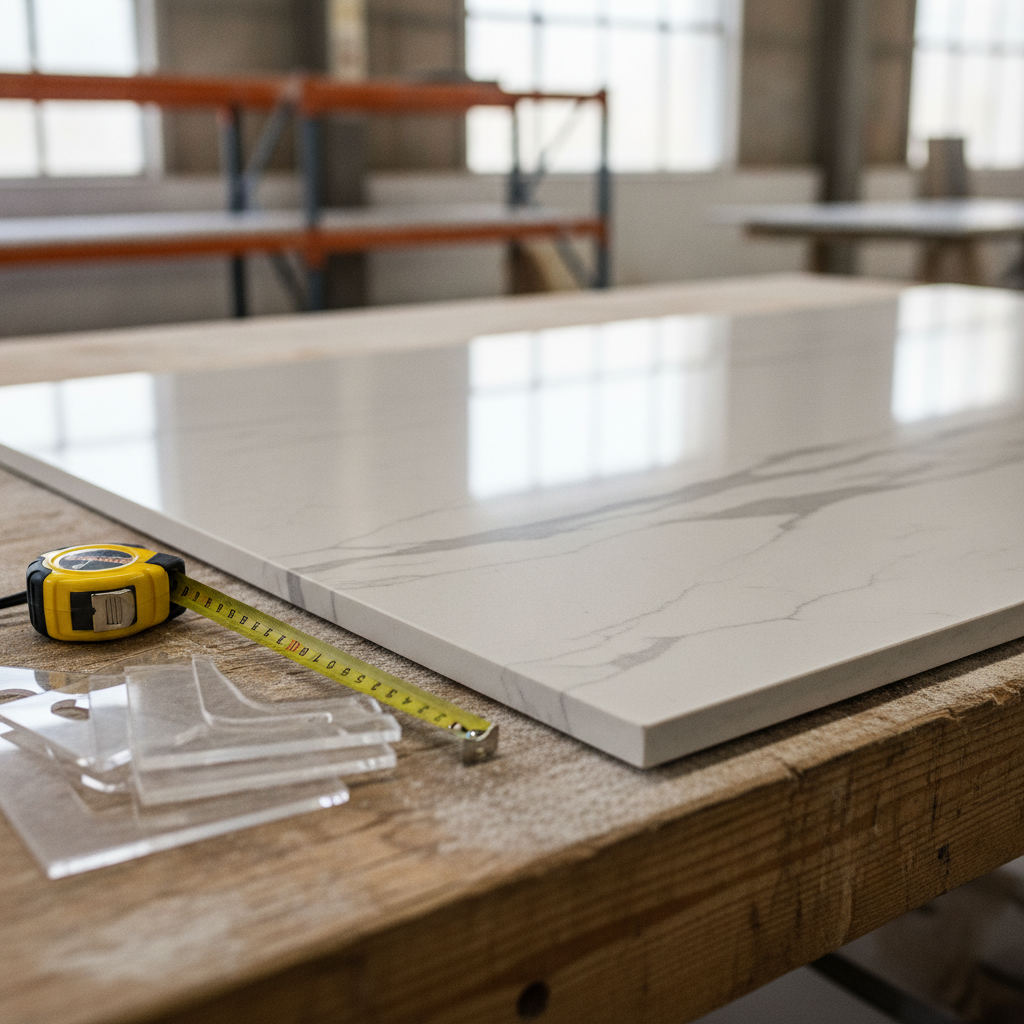
Quartz countertops are engineered stone — not purely natural stone pulled from the earth. Manufacturers combine 90–95% crushed natural quartz crystals with polymer resins and pigments under high pressure to create a consistent, non-porous slab. That engineered process is what gives quartz its low-maintenance, highly stain resistant surface. But it also means quartz has limits that pure natural stone doesn't — specifically around heat and UV exposure. Knowing that distinction upfront makes every other fact on this list make sense.
What's true
Natural quartz crystals (a real mineral) make up 90–95% of every slab
The material is quarried from the earth — then engineered in a factory
The non-porous surface comes directly from the resin binding process
Engineered stone construction creates consistent color and pattern across a slab
What trips homeowners up
Confusing 'contains natural quartz' with '100% natural stone' like granite or quartzite
Assuming quartz has the same heat tolerance as pure stone — it doesn't
Shopping for quartz slabs expecting the one-of-a-kind variation found in granite
Overlooking that pigments and resins are what create the wide range of quartz colors
Bottom line
Quartz is real mineral content shaped by an engineered process — that process is its biggest strength and its one real limitation, and buyers who understand it make better choices.
2
Myth 2: Quartz Is Indestructible
Verdict: Busted — quartz is extremely durable but not indestructibleHeat threshold: ~150°F before resin binders risk permanent discolorationScratch risk: Sharp knives and ceramic cookware can leave permanent scratches
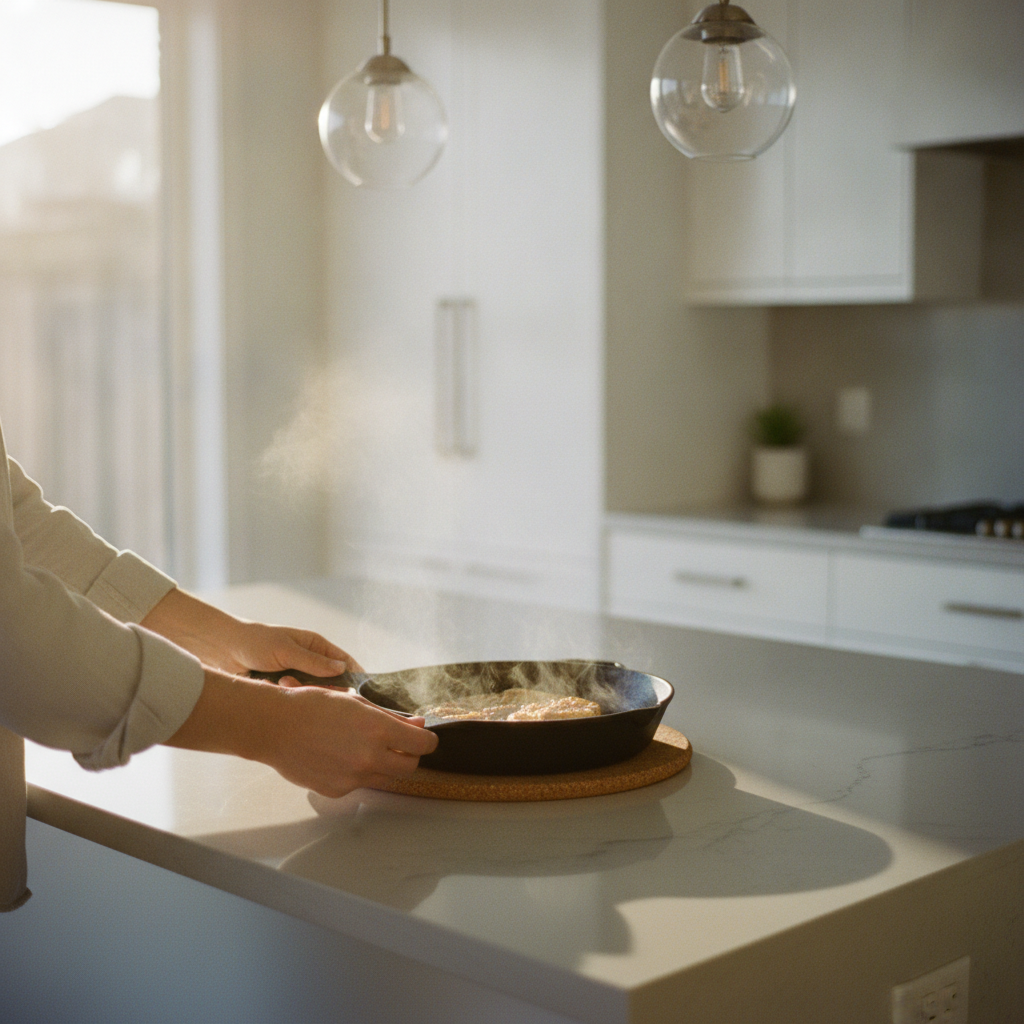
Quartz is one of the most durable surfaces you can put in a kitchen — scratch-resistant, highly stain resistant, and extremely durable under normal daily use. But durable is not the same as indestructible quartz. The polymer resin binders that create the non-porous surface can discolor permanently from extreme heat. Sharp knives dragged across the surface leave scratches that cannot be repaired. Treating quartz like it's invincible is the fastest way to cause damage that voids your warranty and shortens the life of a $4,000-plus investment.
Real strengths
Scratch-resistant against everyday wear — keys, pots, dishes
Highly stain resistant when spills are wiped up promptly
Resists chips and cracks far better than marble countertops
Extremely durable for busy households with kids and heavy cooking
Real limits
Hot pots and hot pans placed directly on the surface can cause permanent resin discoloration
Knives and ceramic cookware can scratch the surface — a cutting board is essential
Damage from extreme heat or deep scratches is not reversible or patchable
Quartz is not chip-proof — hard impacts at edges can cause cracks
Bottom line
Always use trivets for hot pots and a cutting board for prep work — those two habits protect the durable surface that makes quartz worth the investment.
3
Myth 3: Quartz Needs Regular Sealing
Verdict: Busted — quartz never requires sealingSealing cost avoided: $100–$300 per sealing service, every 1–3 years for granite or marbleWhy quartz skips sealing: Non-porous surface has no pores for liquids or bacteria to penetrate
Quartz does not need sealing — ever. Its non-porous nature means there are no pores or channels for liquids, stains, or bacteria to penetrate. Unlike granite or marble countertops, which are porous natural stones that require sealing every one to three years to maintain their protective qualities, quartz's engineered construction makes periodic sealing completely unnecessary. Regular cleaning requires only mild soap and water. That low-maintenance reality is one of the biggest reasons quartz has become the dominant countertop material in modern kitchens.
Why sealing is skipped
Non-porous surface blocks liquids at the molecular level — no sealer needed
Resin binders permanently fill all potential pore space during manufacturing
No sealing means zero annual maintenance cost for this task
Mild soap and water handles regular cleaning — no specialty products required
What to watch out for instead
Harsh chemicals like bleach or abrasive cleaners can dull the surface finish over time
Prolonged exposure to acidic liquids — lemon juice, vinegar — can damage the finish if not wiped up
Quartz does not need sealers, but it benefits from prompt spill cleanup
Don't confuse quartz with quartzite — quartzite IS a natural stone and DOES require sealing
Bottom line
Skip the sealer budget entirely for quartz — put it toward a better edge profile or an upgraded sink instead, because you'll actually use those.
4
Myth 4: Quartz Can Handle Any Amount of Heat
Verdict: Busted — quartz is heat resistant, not heat-proofSafe threshold: ~150°F; higher temperatures risk permanent resin discolorationDamage type: Irreversible discoloration of polymer resin binders — not covered by most warranties
Quartz is heat resistant, but that phrase has a hard limit. The polymer resin binders that make up 5–10% of every quartz slab begin to discolor and break down when exposed to sudden high temperatures above approximately 150°F. A pan pulled directly from a 400°F oven can cause permanent, irreversible discoloration in seconds. Every major quartz manufacturer — Silestone, Cambria, Caesarstone, MSI — covers this in their warranty terms: thermal shock damage is excluded. Trivets and hot pads aren't optional accessories. They're required.
What heat resistant actually means
Handles warm dishes, hot mugs, and brief warm contact without damage
Resists heat far better than laminate or solid surface countertops
Safe for typical food prep — steam, boiling water splashes, warm cookware
What causes irreversible damage
Hot pots and hot pans placed directly from the stove or oven — even briefly
Slow cookers, electric griddles, and instant pots without protective pads underneath
Thermal shock: extreme heat transferred suddenly to a cool slab surface
Damage appears as permanent yellowing or white discoloration in the resin
Bottom line
Trivets cost $15. Replacing a heat-damaged quartz section costs hundreds — or means living with a permanent yellow spot in the middle of your kitchen.
5
Myth 5: Quartz Is Only Available in White or Gray
Verdict: Busted — 200+ patterns available from major manufacturers as of 2026Style range: Marble-look veining, concrete textures, earth tones, terrazzo, bold solid colors, gemstone-inspired designsDesign flexibility: Far greater than granite for consistent, repeatable color matching
The idea that quartz colors are limited to white or gray slabs is one of the most outdated myths about quartz countertops. As of 2026, major manufacturers offer 200-plus patterns and finishes — from bold veining that mimics the look of marble countertops, to concrete textures, warm earth tones, terrazzo-inspired designs, and deep charcoal and navy shades. Because quartz is engineered, manufacturers can produce consistent color across full production runs. That design flexibility is something natural stone slabs simply cannot match for large or multi-room projects.
Quartz color and style options
Marble-look veining in white, cream, gold, and gray on a single slab
Subtle veining patterns for a calmer, more uniform look
Solid colors from crisp white to deep charcoal and warm beige
Concrete and terrazzo-inspired textures for modern kitchens
Earth tones and warm neutrals for transitional and farmhouse styles
Where quartz does have limits
Patterns repeat at seams on large countertop runs — less visible than critics suggest, but worth knowing
No two-of-a-kind slabs: the one-of-a-kind variation of natural granite isn't replicated
Very bold or unusual colorways may have limited availability at local suppliers
Color matching across different production batches can vary slightly — order extra for future repairs
Bottom line
If you've only seen white and gray quartz slabs, you haven't seen the current catalog — visit the Fox Granite showroom in New Braunfels and you'll leave with a very different picture.
6
Myth 6: Quartz and Quartzite Are the Same Thing
Verdict: Busted — completely different materials with different care, price, and performance profilesQuartz: Engineered stone — non-porous, no sealing needed, resin-boundQuartzite: Natural metamorphic rock — porous, requires sealing, formed from sandstone under heat and pressure
Quartz and quartzite sound nearly identical, and many natural stone countertop myths trace back to this single naming confusion. Quartz is engineered stone made from crushed natural quartz crystals and resin — non-porous, never needing sealing. Quartzite is a natural metamorphic rock formed when sandstone is subjected to intense heat and pressure underground. Quartzite is porous, requires periodic sealing like granite or marble, and has a completely different price point and performance profile. Mixing up these two materials leads homeowners to skip necessary maintenance on quartzite — or waste money on sealing services for quartz.
Quartz (engineered stone)
Made from crushed quartz crystals bound with polymer resins and pigments
Non-porous — bacteria, moisture, and stains cannot penetrate
Never requires sealing
Consistent color and pattern across production runs
Vulnerable to UV fading and extreme heat due to resin content
Quartzite (natural stone)
Natural metamorphic rock — 100% mined from the earth, zero resins
Porous — requires sealing every 1–3 years to resist stains
Harder than granite and more heat-resistant than quartz
Unique, one-of-a-kind slab variation like granite
Generally costs more per square foot at the premium end than quartz
Bottom line
Ask your fabricator to confirm in writing which material you're getting — quartz or quartzite — because the care requirements and warranties are completely different, and we see this confusion every single week.
7
Myth 7: Quartz Is Fine for Outdoor Kitchens
Verdict: Busted — every major quartz manufacturer excludes outdoor use from their warrantyDamage cause: UV radiation breaks down polymer resin binders through photodegradation — causing irreversible yellowing and fadingBetter outdoor options: Granite, quartzite, or porcelain — all UV-stable without resin content
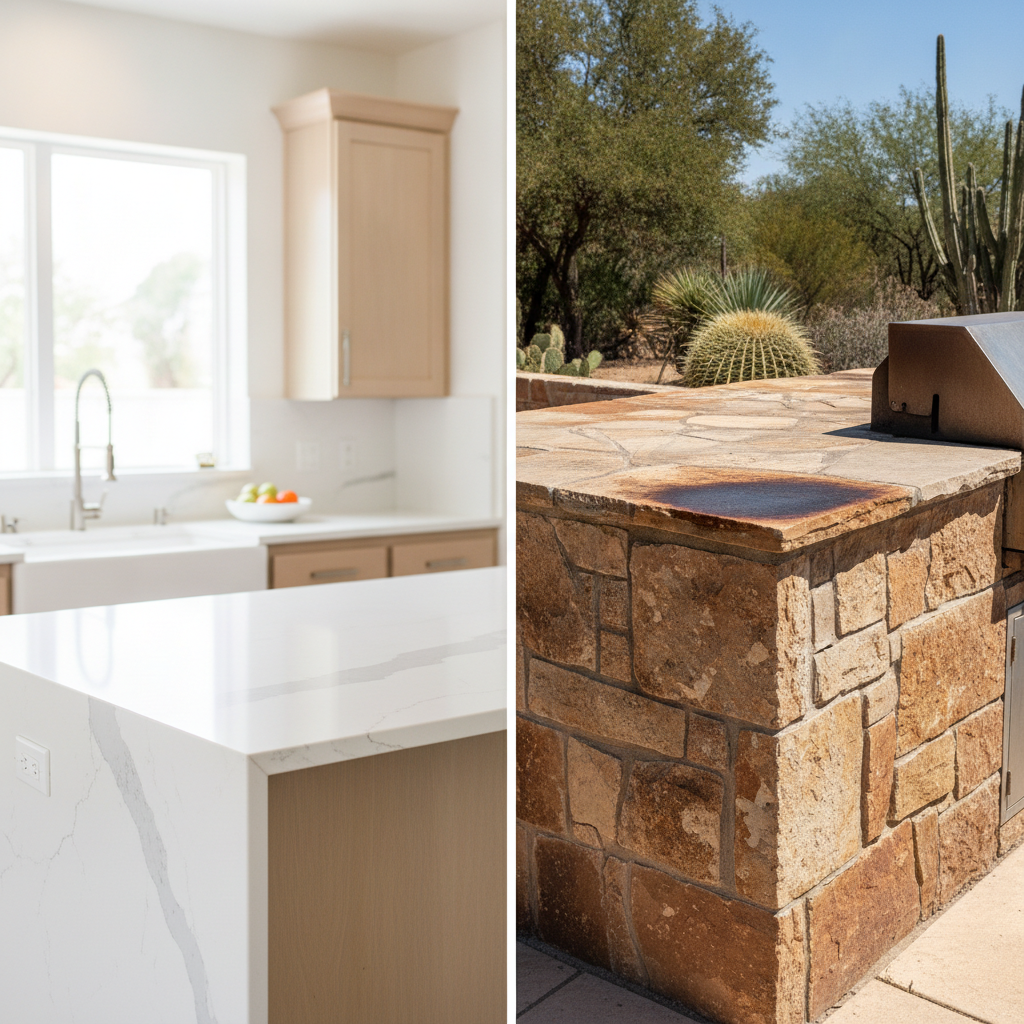
Quartz is not suitable for outdoor installation. UV radiation from direct sunlight degrades the polymer resin binders in quartz slabs through a process called photodegradation, causing irreversible yellowing, fading, and discoloration over time. Thermal cycling — the expansion and contraction caused by Texas heat swings — compounds that damage. Every major quartz manufacturer explicitly excludes outdoor use from their warranties. For outdoor countertops in Austin, San Antonio, and Central Texas, granite and quartzite are the correct choices — they contain no resin and are UV resistant by nature.
Why quartz fails outdoors
UV radiation breaks down the polymer resins that hold the slab together
Yellowing and fading appear over months to years — and cannot be reversed
Texas summer heat amplifies thermal cycling stress on resin-bound material
Zero outdoor warranty coverage from Silestone, Cambria, Caesarstone, or MSI
What works for outdoor countertops instead
Granite — natural stone, no resins, fully UV resistant, proven in Texas outdoor kitchens
Quartzite — harder than granite, UV stable, excellent for high-heat outdoor environments
Porcelain — engineered but UV-stable, low maintenance for outdoor spaces
Fox Granite installs granite and quartzite for outdoor countertops across Central Texas
Bottom line
If you're building an outdoor kitchen in Austin or San Antonio, choose granite or quartzite — quartz will fade and yellow under direct sunlight, and no manufacturer warranty will cover it.
8
Myth 8: Quartz Always Costs More Than Granite
Verdict: Busted — significant pricing overlap exists at mid-range quality levelsQuartz installed cost (2026): $50–$150/sq ft installed; typical 30 sq ft kitchen: $2,100–$4,500Granite installed cost (2026): $40–$175/sq ft installed; most kitchens: $2,400–$6,000
The idea that quartz is always the more expensive option isn't accurate as of 2026. Quartz runs $50–$150 per square foot installed; granite runs $40–$175 per square foot installed. Entry-level granite can cost less upfront, but premium granite slabs regularly exceed premium quartz pricing. The bigger financial picture: quartz requires zero sealing maintenance over its 15–25 year lifespan, while granite and marble need sealing every one to three years — a recurring cost that narrows the gap. The right material depends on your kitchen layout, style, and how you cook — not a blanket price assumption.
Where quartz saves money
No sealing costs over the life of the countertop — $100–$300 saved per service cycle
Warranties from 15 years to lifetime reduce long-term replacement risk
Consistent slab production means fewer surprises during fabrication and installation
Mid-range quartz and mid-range granite are priced nearly identically at most fabricators
Where granite wins on price
Entry-level granite slabs can start below entry-level quartz in some markets
A wider price ceiling on granite means more options at the very high end
Locally sourced granite can reduce material costs in some Central Texas projects
Granite's natural uniqueness adds perceived value some buyers factor into their budget
Bottom line
Get quotes on both materials for your specific square footage — at Fox Granite, we give you all-in pricing upfront with no guessing and no add-ons at installation.
9
Myth 9: Quartz Won't Last as Long as Natural Stone
Verdict: Busted — quartz lasts 15–25 years with proper care; major brands back it with lifetime warrantiesWarranty range: 15 years to lifetime (Silestone, Cambria, Caesarstone, MSI)Failure mode: Quartz rarely fails structurally — cosmetic damage is the more common replacement driver
Quartz countertops last 15–25 years with proper care — and the natural quartz crystal component itself is far more durable than that. Leading quartz manufacturers offer warranties ranging from 15 years to a full lifetime: Silestone, Cambria, Caesarstone, and MSI all publish clear warranty terms because they're confident in the material's durability. In practice, quartz rarely fails structurally. Most replacements happen because homeowners want an updated style, not because the surface gave out. That's a strong performance record for a durable surface that requires no sealing and minimal maintenance.
Longevity factors working in quartz's favor
Non-porous surface resists the moisture penetration that degrades many natural stones over decades
No sealing means no risk of improper sealer application shortening the slab's life
15-year to lifetime warranties from major quartz manufacturers signal real manufacturer confidence
Extremely durable against the daily impacts, stains, and wear that affect busy households
What can shorten quartz's lifespan
Repeated exposure to extreme heat without trivets — irreversible resin damage accumulates
Harsh chemical cleaners — bleach, abrasive powders — that dull the surface finish over time
UV exposure near large windows or skylights — direct sunlight can cause gradual fading over several years
Deep scratches from knives or heavy impact chips at exposed edges — not repairable
Bottom line
A well-maintained quartz countertop in a Central Texas kitchen will outlast most of the other materials in that room — protect it from extreme heat and direct sunlight, and it'll look great for decades.
Quartz vs. Granite vs. Quartzite: Not Sure Which Is Right for Your Kitchen?
These myths make one thing clear: the right countertop material depends on how you cook, where it's going, and what your real budget looks like over time — not on what your neighbor chose or what a big-box store has in stock. At Fox Granite, we do free in-home consultations across Austin, San Antonio, Round Rock, New Braunfels, and the entire Central Texas corridor. We bring samples to your kitchen, walk you through real pricing, and give you a straight answer on which material fits your life. No pressure, no surprise fees. Call (512) 653-5541 or contact us today to schedule your free consultation.
Which quartz countertop myth causes the most expensive mistakes for Central Texas homeowners?
Believing quartz is indestructible ranks as the costliest myth. Homeowners who skip trivets place hot pots and pans directly on the surface, causing permanent resin discoloration that cannot be repaired or patched. Replacing a damaged quartz section costs hundreds of dollars and is not covered by any major manufacturer's warranty. The fix costs $15 — a trivet. The damage costs far more.
Is quartz or granite cheaper for a Central Texas kitchen remodel in 2026?
Neither material is consistently cheaper — there is significant pricing overlap at mid-range quality levels. As of 2026, quartz runs $50–$150 per square foot installed and granite runs $40–$175 per square foot installed. Entry-level granite can cost less upfront, but quartz eliminates sealing costs entirely over its lifespan ($100–$300 per service cycle, every 1–3 years for granite). For a 30-square-foot kitchen, quartz typically runs $2,100–$4,500 installed and granite runs $2,400–$6,000. Get quotes on both for your specific square footage before assuming one is cheaper.
What is the most premium quartz brand available in Central Texas in 2026?
Cambria is generally considered the most premium domestic quartz brand available in 2026. It is made entirely in the US, offers a full lifetime warranty, and its slabs trend toward the higher end of the $80–$150 per square foot installed price range. Silestone and Caesarstone are strong mid-to-premium options. At Fox Granite, we carry multiple lines and can walk you through which brand fits your project budget and style goals during a free in-home consultation.
What should homeowners on a tight budget skip when buying quartz countertops?
Skip the specialty stone sealing products — quartz never needs them and spending money on sealers is pure waste. Also skip premium edge profiles if budget is tight; a standard eased or beveled edge looks clean, costs less, and performs identically. Put any savings toward a larger slab footprint or a better sink. What you should not skip: trivets and cutting boards. Those two $15–$30 purchases protect the entire investment.
How did Fox Granite determine the ranking order for these 9 quartz countertop myths?
The ranking reflects how frequently each myth leads homeowners to make costly or irreversible mistakes, based on over 10,000 countertop fabrication and installation projects completed by Fox Granite across Austin, San Antonio, and the Central Texas corridor since 2010. Myths ranked higher are ones that result in permanent damage (heat, outdoor use), wasted money (unnecessary sealing products), or a completely wrong material choice (confusing quartz with quartzite). Myths ranked lower involve misconceptions that are easy to correct before purchase with no financial consequence.
Is Cambria quartz worth the higher price tag compared to mid-range quartz brands?
Cambria is worth the premium for homeowners who want domestic manufacturing, a full lifetime warranty, and exclusive patterns not available in lower-cost lines. The price difference over Caesarstone or MSI typically runs $10–$30 per square foot — on a 30-square-foot kitchen, that's $300–$900 more. Whether that delta is worth it depends on how long you plan to stay in the home and how much the specific pattern matters to your design. For resale value in Central Texas, Cambria's brand recognition does carry some weight with buyers. If the budget is tight, mid-range Caesarstone or Silestone performs nearly identically in daily use.
Installing Quartz, Granite & Marble Countertops in Central Texas