Quartz Countertop Installation Costs in 2026: Full Price Breakdown
💡 Quick Answer
Quartz countertop installation costs $50 to $150 per square foot installed in 2026, with most Central Texas kitchen remodels landing between $3,000 and $8,500 total. A standard 35 sq ft kitchen runs $2,800 to $4,800 at mid-range, while large kitchens with an island (70 sq ft) can hit $8,400 to $10,500 at the premium tier. The per-square-foot quote you get from a fabricator almost never includes old countertop removal ($150 to $300), sink or cooktop cutouts ($150 to $300 each), plumbing reconnect ($150 to $400), seam fees ($50 to $200 per seam), or edge profile upcharges ($10 to $60 per linear foot). Add those in, and your real project cost can run $800 to $2,000 higher than the number on the first quote.
📊 Key Takeaways
Here are the price stats and rules of thumb every Central Texas homeowner needs before getting a quartz countertop quote in 2026.
$50–$150+ per sq ft installed
Full installed range for quartz countertops in 2026
$3,000–$8,500 total
Most Central Texas kitchen projects land here
$800–$2,000 in hidden fees
What the base quote routinely leaves out
30%–50% of total cost
Labor and fabrication share of every project
10%–20% savings
Choosing in-stock slabs over special-order colors
$10–$60 per linear foot
Edge profile upcharge above a standard eased edge
Quartz countertop installation costs $50 to $150 per square foot installed in 2026, and most Central Texas kitchen remodels land between $3,000 and $8,500 total once every line item is counted. The problem is that the number on a first quote almost never reflects the final invoice. Sink cutouts, old countertop removal, plumbing reconnect, seam fees, and edge profile upcharges collectively add $800 to $2,000 to a project that looked affordable at first glance. This guide breaks down quartz countertops cost by slab tier, lists every hidden fee by dollar amount, and gives you a step-by-step framework for building an accurate budget before you call a single fabricator.
Quartz Countertop Installation Costs in 2026: What You'll Pay by Tier
Tier
Price range
What's included
Best for
Entry-Level Quartz (Builder-Grade)
$50 – $80 per sq ft installed
Solid colors, standard eased edge, basic fabrication and installation
Rental properties, flips, or tight budgets that need durability without a premium look
Mid-Range Quartz (Marble-Look and Commercial Grade)
$80 – $120 per sq ft installed
Marble-look or veined patterns (Silestone, Caesarstone), standard edge upgrade, fabrication and installation
Primary kitchen remodels where aesthetics and durability both matter
High-end kitchen remodels, showpiece islands, or homeowners comparing quartz to quartzite and marble
Complex Layout Premium (Waterfall, Custom Island, Difficult Access)
$150 – $200+ per sq ft installed
Waterfall edges, multiple seams, difficult site access surcharges, custom fabrication, all add-ons
Large open-concept kitchens with islands, high-design builds, or projects with stairs or tight delivery access
What You Get at Each Countertop Price Tier
Entry-Level Quartz (Builder-Grade)
Entry-level quartz countertops use solid-color engineered stone slabs with consistent coloring throughout and no veining or exotic granite-style patterns. Material-only cost runs $40 to $65 per square foot; fabrication plus installation adds $10 to $35 per square foot on top. A standard 35 sq ft kitchen project lands between $1,750 and $2,800 at this tier. You get a stain-resistant, low-maintenance surface with real durability, but don't expect marble-look movement or showroom-worthy patterns.
One consistent caution at this tier: entry-level quotes often strip out sink cutouts, old countertop removal, and plumbing reconnect to stay price-competitive. Always confirm what the quote actually includes before signing. For a rental property or a flip where countertop prices need to stay lean without sacrificing function, entry quartz is the right countertop material category.
Mid-Range Quartz (Marble-Look and Commercial Grade)
This is where most Central Texas homeowners land in 2026. Mid-range quartz countertops from brands like Silestone ($60 to $140 per sq ft installed) and Caesarstone ($50 to $100 per sq ft installed) deliver the marble-look movement and consistent patterning that natural stone like quartzite or marble cannot guarantee slab to slab. For a 35 to 40 sq ft kitchen, expect a total project cost of $2,800 to $4,800 with a standard undermount sink cutout and one decorative edge profile. In Austin specifically, the typical range for this tier runs $55 to $120 per square foot installed.
The manufacturing process at this tier binds ground quartz aggregate with resin and pigments under high pressure, producing large slabs with tight, repeatable patterns. Mid-range quartz surfaces are heat resistant for everyday countertop use, though direct contact with hot pans can scorch the resin over time. Use a trivet. The low-maintenance routine, no sealing required, no special stone cleaners, is what makes this tier the default choice for primary kitchen remodels in Central Texas.
Premium Quartz (Luxury Brands, Complex Veining)
Premium quartz countertops, led by brands like Cambria ($85 to $150 or more per sq ft installed), use proprietary manufacturing processes to replicate exotic granite and marble patterns with consistent coloring across three slabs or more. Jumbo slab sizes reduce seams in large kitchen layouts. At this tier, mitered edges and waterfall profiles are common add-ons that push per-linear-foot edge costs above $60. A large kitchen with an island (70 sq ft) at the premium tier can run $8,400 to $10,500 all-in once you add cutouts, seams, old countertop removal, and plumbing reconnect.
Premium quartz surfaces are polished to a high-gloss finish and carry manufacturer warranties that entry-level options don't include. If you're weighing premium quartz against natural quartzite or marble, the deciding factors are sealing requirements (quartzite and marble require sealing; quartz does not), budget, and pattern consistency. With natural stone, each slab is unique. With premium quartz, the pattern you see on material samples in the showroom matches what lands in your kitchen.
Complex Layout Premium (Waterfall, Custom Island, Difficult Access)
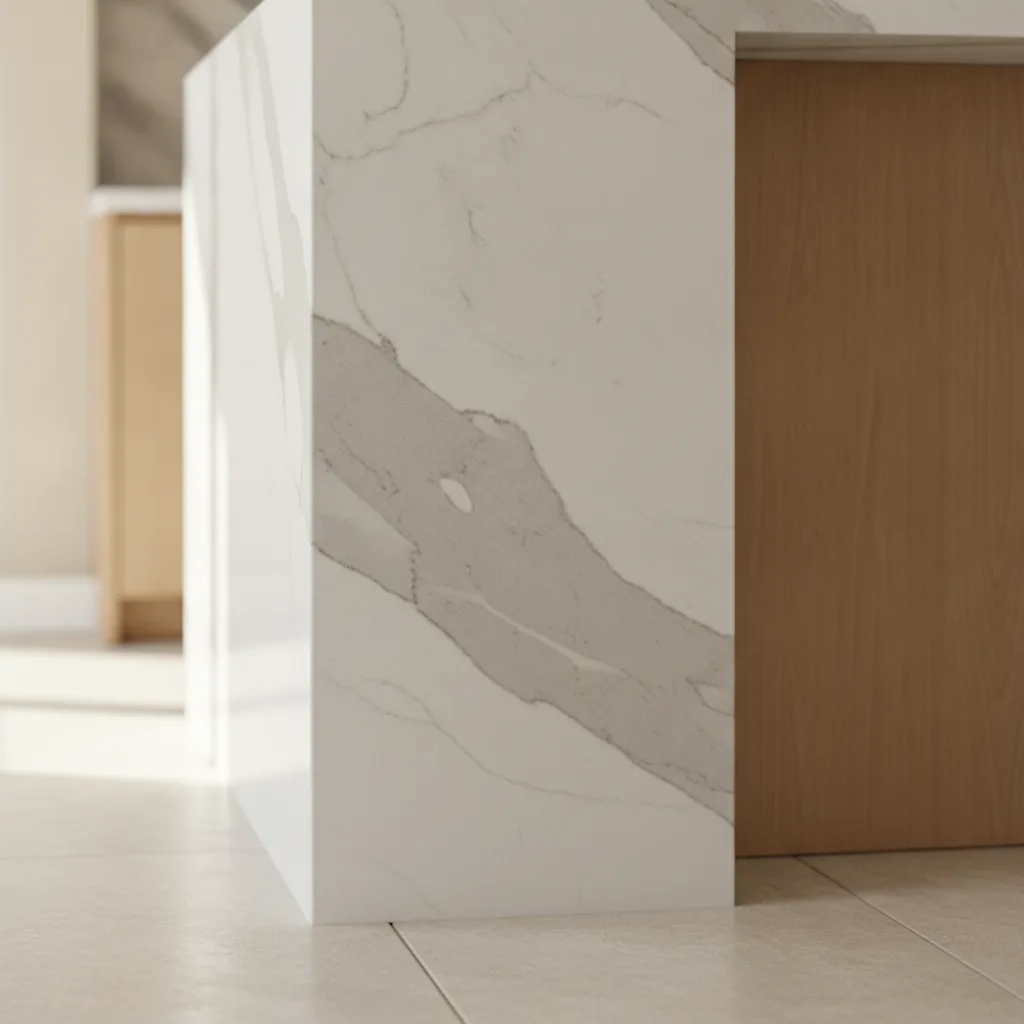
When a project requires a waterfall edge, multiple cooktop cutouts, support brackets for overhangs exceeding 12 inches, and a second-floor or difficult-access installation, per-square-foot costs climb fast. Support brackets alone run $50 to $150 per bracket installed. Each seam adds $50 to $200 in labor and color-matched epoxy. A waterfall edge on an island requires additional slab material and precise mitered edge cuts that drive fabrication time up significantly.
Projects at this tier often involve three or more visible seams, two or more sink or cooktop cutouts, and at least one decorative edge profile upcharge. Budget $150 to $200 per square foot as a realistic floor for these kitchen layouts, not a ceiling. Cabinet levelness is especially critical here: stone set on an unlevel surface can crack over time, and fixing structural issues after templating costs $500 to $1,500 or more.
Pros and Cons of Quartz as Your Kitchen Countertop Material
No sealing required. Quartz is engineered stone made with resin binders that fill every pore during the manufacturing process, making it non-porous. Unlike granite countertops, quartzite, or marble, it does not require sealing at installation or annually afterward. That is one maintenance task permanently removed from your list.
Stain-resistant surface holds up to cooking oils, wine, and coffee without absorbing them. Natural stone like marble etches from acidic liquids and resists staining poorly by comparison. Quartz resists staining in the same scenario because the resin leaves no open pores for liquids to penetrate.
Consistent coloring across slabs means the pattern you see on material samples in the showroom matches what lands on your counters. With natural quartzite or granite, each slab is unique, which creates visible variation across large kitchen layouts. Quartz eliminates that risk.
Scratch-resistant surface rates a 7 on the Mohs scale, harder than most kitchen tools. Everyday cutting and prep work won't damage a polished quartz surface under normal use. Granite countertops rate similarly, but quartz delivers this durability with more consistent coloring.
Low-maintenance for families. Wipe with soap and water. No special stone cleaners, no annual resealing, no worry about acidic foods. For high-traffic kitchens, the low-maintenance routine is a measurable daily benefit that granite and quartzite owners don't fully share.
Wide price range fits most budgets, from $50 per sq ft for builder-grade solid colors up to $150 or more for Cambria luxury patterns. That spread means quartz works for a rental property remodel and a high-end primary kitchen remodel without switching countertop material categories entirely.
Not heat-proof. Quartz is heat resistant but the resin in engineered stone can scorch or discolor under direct high heat. Set hot pans on a trivet. Granite countertops and quartzite handle direct heat better because they are solid natural stone with no resin component.
Hidden fees add $600 to $2,000 to the final invoice beyond the per-square-foot quote. Sink cutouts ($150 to $300 each), old countertop removal ($150 to $300 for stone), plumbing reconnect ($150 to $400), seam fees ($50 to $200 per seam), and edge profile upcharges ($10 to $60 per linear foot) are the most commonly missed additional costs.
Visible seams in large kitchens. Quartz slabs have standard size limits. An L-shaped kitchen or large island often requires two or three slabs, meaning visible seams. Skilled fabricators minimize seam placement, but they cannot eliminate seams entirely on complex kitchen layouts.
Higher upfront cost than granite countertops at the entry level. Basic granite countertops start below $40 per sq ft installed, undercutting entry quartz at $50. Exotic granite patterns can still undercut mid-range quartz from Caesarstone or Silestone at the mid tier.
Outdoor use is not recommended. UV exposure from direct sunlight causes quartz resin to discolor and break down over time. For outdoor surfaces, granite and quartzite are better countertop material choices because natural stone handles UV and temperature swings without fading. Solid surface countertops also lack outdoor durability for the same resin-based reason.
How to Set Your Kitchen Countertops Budget: 6 Steps
Measure your actual square footage before calling for quotes Multiply the length by the depth of each countertop run in inches, add them together, and divide by 144 to get square feet: a standard Austin kitchen comes in at 30 to 40 sq ft, and that number anchors every line item in your budget.
Pick your countertop material tier first, then choose a pattern Entry quartz ($50 to $80 per sq ft), mid-range quartz ($80 to $120 per sq ft), and premium brands like Cambria ($120 to $150-plus per sq ft) have non-overlapping price ranges, so settling on a tier before visiting a showroom keeps your kitchen remodel budget from drifting.
Add every hidden fee to your quote before comparing bids A complete apples-to-apples comparison requires you to confirm whether each quote includes old countertop removal ($150 to $300), sink and cooktop cutouts ($150 to $300 each), seam fees ($50 to $200 per seam), plumbing reconnect ($150 to $400), templating ($75 to $200), and support brackets for any overhang over 12 inches ($50 to $150 each).
Choose your edge profile before fabrication begins A standard eased edge costs nothing extra, but upgrading to a half-bullnose, full bullnose, beveled, or ogee profile adds $10 to $60 per linear foot: on a 30-linear-foot kitchen, that is $300 to $1,800 in additional costs that are easy to overlook until the invoice arrives.
Select from in-stock slab inventory to save 10% to 20% Choosing a color from your fabricator's existing slab inventory instead of special-ordering a specific pattern cuts material cost by 10% to 20% and often shortens the project timeline by one to two weeks.
Confirm cabinet levelness before templating day If your cabinets are not level or structurally sound enough to support stone, you will pay $150 to $500 for minor shimming or $500 to $1,500 or more for structural reinforcement: costs that surface after the template visit, not before, if you don't check first.
The Low-Quote Trap: What That Per-Square-Foot Number Leaves Out
A fabricator's base quote covers the slab and basic installation. It almost never includes old countertop removal, plumbing disconnect and reconnect, sink or cooktop cutouts, seam fees, or edge profile upcharges. On a standard Austin kitchen remodel, those additional costs routinely add $800 to $2,000 to a quote that looked competitive at first glance. Always ask for a fully itemized estimate that lists every line item, and confirm that templating is included before you compare bids side by side.
For quartz countertop installation in Austin, San Antonio, New Braunfels, and the surrounding Central Texas areas, Fox Granite brings over 10,000 completed projects since 2010, transparent all-in pricing, in-house fabrication, and professional installation. The number on your estimate is the number on your final invoice. Contact us today to schedule your free in-home consultation and get your free estimate.
Frequently Asked Questions
What is the typical price range for quartz countertop installation in 2026?
Quartz countertops cost $50 to $150 per square foot installed nationally in 2026, with the Austin market running $55 to $120 per square foot. For a standard Central Texas kitchen with 35 to 40 square feet of countertop surface, total project cost lands between $2,800 and $4,800 at mid-range. Large kitchens with an island (70 sq ft) at the premium tier can reach $8,400 to $10,500 once seams, cutouts, edge upgrades, old countertop removal, and plumbing reconnect are included.
What hidden fees do quartz countertop quotes commonly leave out?
A fabricator's base quote covers the slab and basic installation. It almost never includes: old countertop removal ($150 to $300 for stone; $100 to $300 for laminate), sink or cooktop cutouts ($150 to $300 each), plumbing disconnect and reconnect ($150 to $400, always a separate licensed plumber), seam fees ($50 to $200 per seam), edge profile upcharges ($10 to $60 per linear foot above a standard eased edge), templating ($75 to $200 if charged separately), and support brackets for overhangs over 12 inches ($50 to $150 per bracket). On a standard Austin kitchen, these add-ons routinely total $800 to $2,000.
What factors affect quartz countertop installation costs the most?
Five factors move the price most significantly. First, slab tier: entry-level solid-color quartz runs $50 to $80 per sq ft installed while premium brands like Cambria run $120 to $150 or more. Second, kitchen square footage: more surface area means more slab, more fabrication time, and more seams. Third, layout complexity: L-shapes, islands, and waterfall edges all add fabrication hours and additional slab material. Fourth, edge profile choice: a standard eased edge is free; an ogee or mitered waterfall profile adds $10 to $60 per linear foot. Fifth, site conditions: second-floor installations, tight delivery access, and unlevel cabinets all add labor cost.
When do quartz countertop prices spike above the standard range?
Prices climb above $150 per square foot when a project combines multiple complexity factors: a waterfall edge (which requires extra slab material and precise mitered edge cuts), two or more cooktop or sink cutouts, support brackets for overhangs exceeding 12 inches ($50 to $150 each), difficult site access such as a second-floor delivery, and three or more visible seams. Supply chain disruptions affecting imported quartz slabs have also pushed mid-range and premium slab prices higher as of 2026. Budget $150 to $200 per square foot as a realistic floor for these complex layouts, not a ceiling.
What are the best ways to save money on quartz countertop installation?
Three strategies cut real dollars from the final invoice. First, choose from the fabricator's in-stock slab inventory instead of special-ordering a specific color or pattern: that alone saves 10% to 20% and shortens the timeline by one to two weeks. Second, bundle fabrication and installation with a single contractor rather than hiring a separate slab yard and installer, which eliminates the markup layer between trades. Third, confirm cabinets are level before the template visit: fixing unlevel cabinets after templating costs $150 to $500 for minor shimming or $500 to $1,500 for structural reinforcement, costs that arrive as a surprise if you don't check first.
Is quartz worth the cost compared to granite or quartzite for a Central Texas kitchen remodel?
For most Central Texas homeowners remodeling a primary kitchen, quartz is worth paying $10 to $30 more per square foot than entry-level granite countertops. The reasons are practical: quartz does not require sealing (quartzite and marble require sealing at installation and annually), it delivers consistent coloring across slabs so large kitchen layouts match without visible variation, and its stain-resistant surface resists staining from cooking oils, wine, and coffee that would etch marble. The tradeoff is heat resistance: quartz resin can scorch from direct contact with hot pans, where granite and quartzite handle direct heat better as solid natural stone. For rental property projects where maintenance is a constant cost, quartz's low-maintenance routine pays for the price premium over time.
Is quartz cheaper to install than granite?
Not always. Basic granite countertops start below $40 per sq ft installed, undercutting entry-level quartz at $50 per sq ft. At mid-range, exotic granite patterns can still come in below mid-range quartz from brands like Caesarstone or Silestone. At the premium tier, rare granite and quartzite slabs often exceed quartz pricing. The material cost gap narrows when you factor in that quartz never requires sealing, which saves $100 to $300 every one to three years that natural stone owners pay for professional sealing.