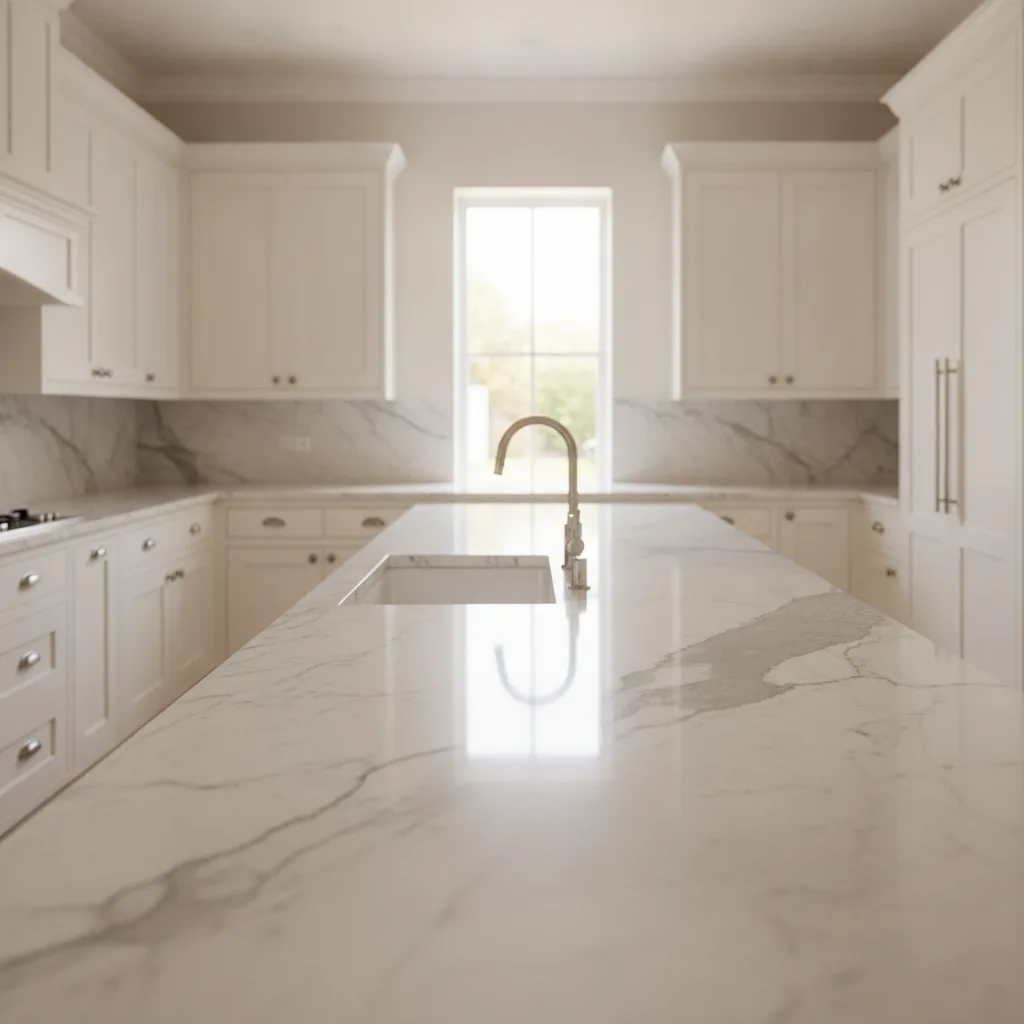
Marble countertops cost $65–$250 per square foot installed in 2026, with a standard 40-square-foot kitchen landing between $4,000 and $6,000 for mid-range slabs. Carrara is the most affordable Italian variety at $75–$120 per square foot; Calacatta runs $150–$250. To find the best local fabricator, confirm they cut and install in-house, ask to approve your slab layout before any cuts are made, and get an all-in quote that includes templating, edge profiles, sink cutouts, and old countertop removal. Vein-matching quality at seams is the clearest signal of expert craftsmanship in any portfolio.
When you search for marble countertops near me, you're not just looking for stone — you're trying to find a fabricator you can trust with a $4,000–$6,000 project, a kitchen you use every day, and cabinets and flooring you already love. Most homeowners don't get burned by the marble itself. They get burned by incomplete quotes, subcontracted installs, and fabricators who skip the slab approval step. This guide covers what marble countertops actually cost in 2026, how to tell a true in-house fabricator from a middleman dealer, and the exact questions to ask before you sign anything. Read it once and you'll walk into every quote conversation with confidence.
Marble countertops cost $65–$250 per square foot installed in 2026, with a standard 40-square-foot kitchen landing between $4,000 and $6,000 for most mid-range slabs. That range is wide because marble variety, slab thickness, edge profile complexity, and whether the fabricator works in-house or subcontracts all move the number significantly. Knowing the breakdown before your first call stops sticker shock from derailing an otherwise good project.
Carrara is the most affordable Italian marble at $75–$120 per square foot installed. It has a soft white-to-light-gray background with subtle gray veining — the classic look most homeowners picture when they think of elegant natural stone countertops. Calacatta runs $150–$250 per square foot installed because it's rarer, with a brighter white background and bold, dramatic veining patterns. Statuario sits in between at $130–$220 per square foot, offering a brighter white than Carrara with more pronounced veining, without the full rarity premium of Calacatta. For bathroom countertops and vanities, where square footage is smaller — typically 15 sq ft — total installed cost usually falls between $1,125 and $2,250. That's a much easier entry point than a full kitchen project.
Marble also costs more than entry-level granite. Granite starts at $40–$65 per square foot installed, making it the more affordable natural stone for budget-first buyers. Edge profiles add $15–$60 per linear foot depending on complexity. A basic eased edge is usually included in quotes, but an ogee or waterfall edge carries a real upcharge. Sink cutouts, old countertop removal ($100–$300), and the template visit ($50–$150 if charged separately) can add several hundred dollars that a lowball quote leaves out. Always ask for an all-in number before comparing quotes from different fabricators.
A quote missing removal, sink cutouts, and edge profile details is incomplete. Always ask for an all-in number before comparing quotes from different fabricators — otherwise you're comparing apples to lumber.
The three Italian white marble varieties — Carrara, Calacatta, and Statuario — look similar in photos but behave identically on the hardness scale: all three rank 3–4 on the Mohs scale. That means all marble scratches more easily than granite (6–6.5 Mohs) and quartzite (approximately 7 Mohs). The differences between these varieties are visual, not structural. When you're choosing a slab, you're choosing a look and a price point — the maintenance expectations are the same across all three.
Carrara marble slabs are the right call for homeowners who want the lasting beauty of natural stone at a controlled price. The veining patterns are softer and more consistent across the slab, which makes vein-matching at seams more forgiving and keeps the look elegant without demanding the highest material budget. Calacatta slabs have bolder, more dramatic veining — each slab is unique, which is part of the appeal but also why they cost more and require a fabricator with real experience matching veins across seams. Statuario offers a solid middle ground: brighter white than Carrara with more pronounced veining, without the rarity premium that Calacatta commands. Onyx and other premium materials are available for fireplace surrounds and accent applications, though they're far less common in kitchen countertop projects.
For kitchen countertops in high-traffic Central Texas homes, the finish choice matters as much as the variety. Honed marble has a matte surface texture that hides etching far better than polished marble. On a polished slab, the contrast between the glossy stone and a dull etch spot from lemon juice or a citrus-based cleaner is immediately obvious. On a honed slab, that same etch is barely visible. If your kitchen sees daily cooking with acidic ingredients, ask your fabricator about honed Carrara before defaulting to polished Calacatta — the difference in daily maintenance is real.
Free to visit
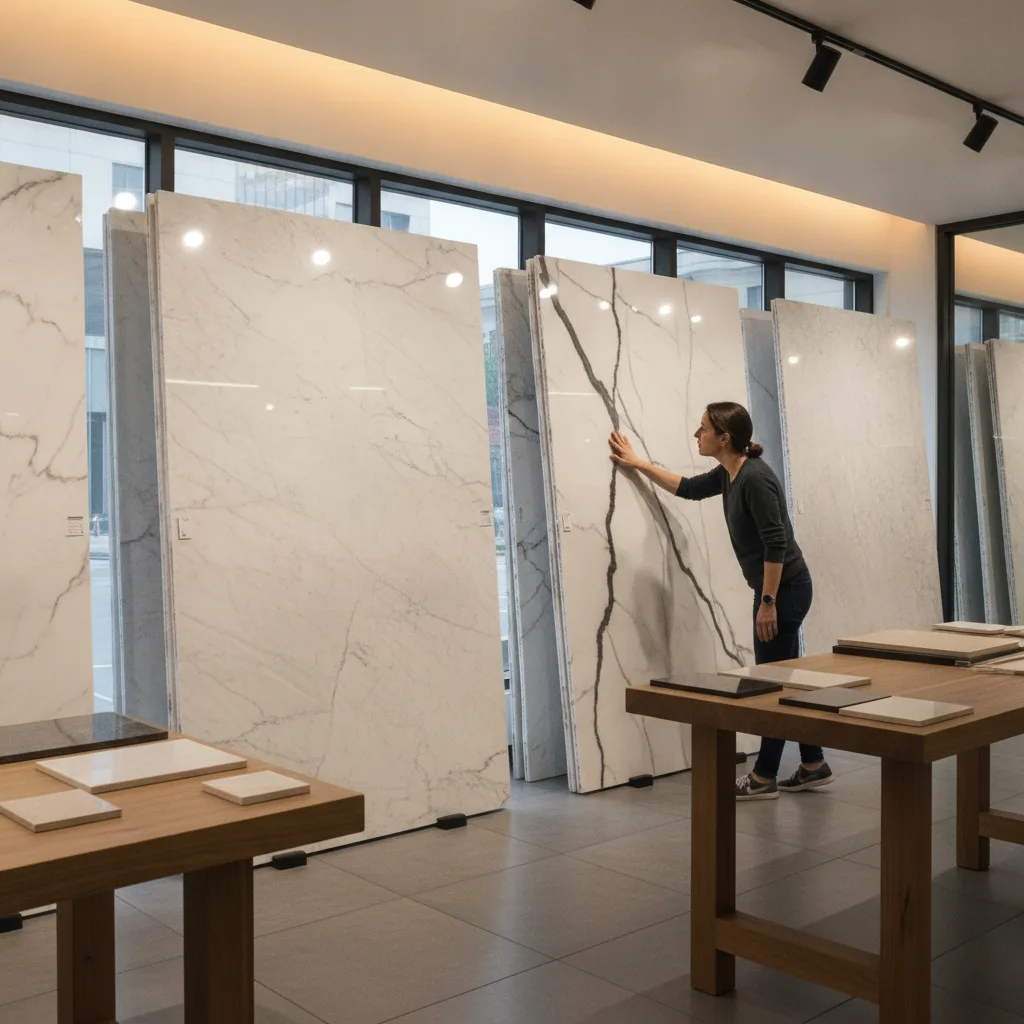
View full marble slabs in person — photos and small samples don't capture how veining reads at full countertop scale against your cabinets and flooring colors
Free
Bring actual material samples into your kitchen lighting before committing to a slab purchase or fabrication contract
A true in-house fabricator cuts, finishes, and installs your marble countertops with their own equipment and crew. A dealer or middleman sells you the stone slab and contracts out the actual fabrication and installation to a third party. The distinction matters because once a handoff happens, quality control and warranty responsibility get murky. If your marble countertops arrive with a chipped edge or a seam gap, knowing who's accountable — and getting them to fix it — becomes a much harder conversation when two or three companies are involved.
Ask directly: 'Do you fabricate in-house, or do you send slabs to a third-party shop?' and 'Do your own employees install, or do you subcontract installation?' A fabricator who does everything in-house can answer both questions with a clear yes. One who hedges or says 'we work with trusted partners' is describing a subcontracted model. That's not automatically disqualifying, but you need to know who's accountable if something goes wrong with your marble slab after install — and you need that answer in writing before you sign.
In-house fabrication also means faster turnaround and tighter quality at every step. When the shop cutting your stone is the same team templating and installing it, the process moves without scheduling gaps between separate companies. Fox Granite has operated as a fully in-house fabricator in Central Texas since 2010 — that means one team from the first template measurement to the final polish, with no handoffs and direct accountability for customer satisfaction on every project. Expert craftsmanship is easier to guarantee when the same crew handles the slab from start to finish.
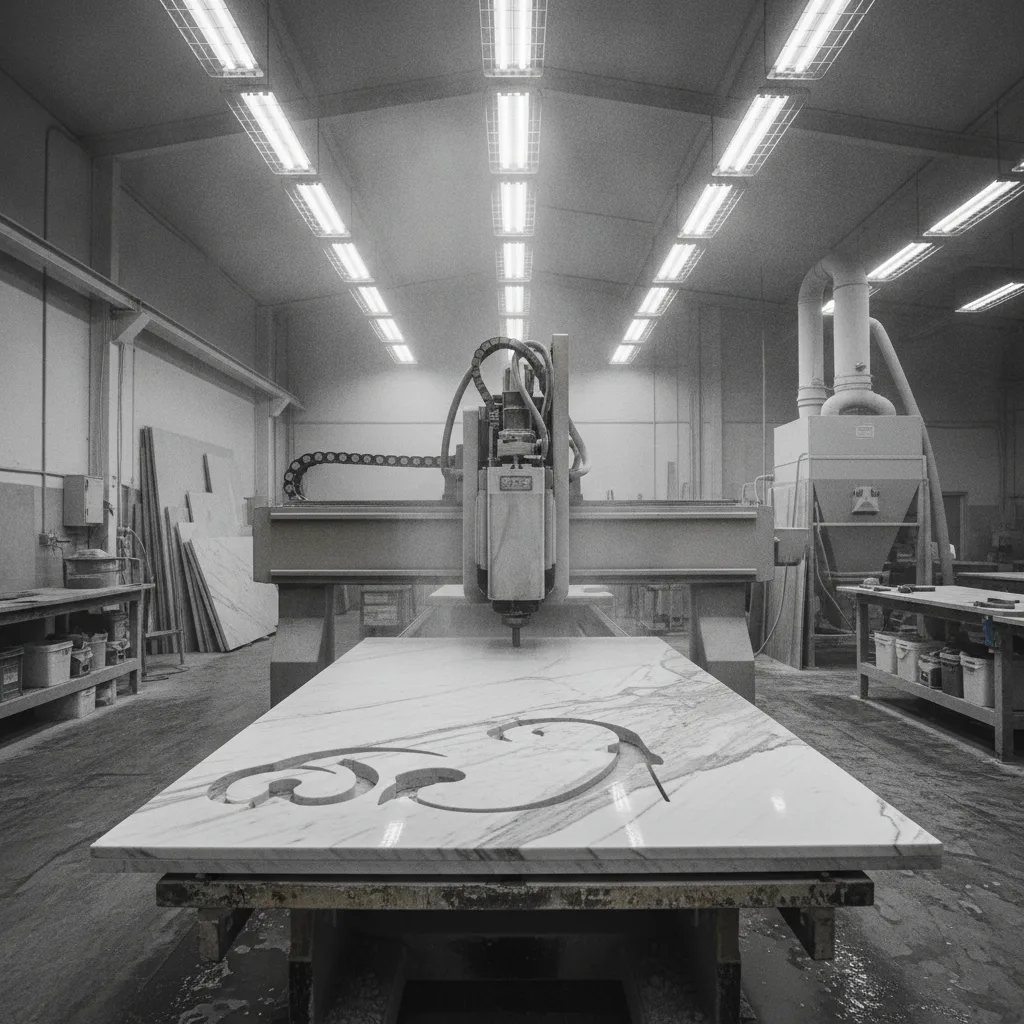
Ask to see the fabrication shop or ask whether the company owns its own CNC cutting equipment. A fabricator with state-of-the-art stone-cutting software on-site is not a middleman — and that equipment matters for precision marble work where seam gaps and edge consistency are visible at arm's length every day.
Vein-matching across seams is the single best quality indicator in any marble fabricator's portfolio. When a fabricator lays out two marble slab pieces so the veining flows naturally from one piece to the next, the seam nearly disappears into the stone's natural patterns. When they don't match veins — or don't bother — the seam looks like a hard stop. It interrupts the elegance the stone is supposed to create in the space. You'll notice it every time you walk into the room.
Ask to see photos of completed kitchen countertop projects specifically, not just bathroom vanity tops. Kitchens typically have longer runs and more seams, which is where vein-matching skill — or the lack of it — becomes obvious. Zoom in on seam areas in the photos. If the veining is disjointed at the seam, that fabricator didn't take the time to honor the natural flow of the stone. That's a workmanship choice, not a material limitation, and it reflects how they'll handle your marble slab.
Digital templating is non-negotiable for precision marble work in 2026, especially in older Central Texas homes where walls are rarely perfectly square. Manual measurements produce fitting errors. A fabricator using digital templating tools can map your exact wall geometry and plan slab cuts before anything is cut from the stone — which means seams land where they should, and waste is minimized on a premium-priced material. Ask specifically whether they use digital templating or manual measurements. The answer tells you a lot about the precision they bring to your project.
Five questions will tell you everything you need to know about a fabricator before you commit. Write them down and bring them to every quote conversation: (1) Do you fabricate in-house? (2) Do you install with your own crew? (3) Can I approve the slab layout before cutting? (4) Where will my seams fall? (5) What does this quote actually include — template visit, edge profiles, sink cutout, removal of my old countertops? A fabricator who answers all five clearly and confidently is a fabricator worth booking.
Question three matters more than most homeowners realize. A fabricator who lets you approve the slab layout before cutting lets you see exactly which part of the natural stone will become your countertop surface — where the bold veining runs, how seams will align, and whether the section you loved in the showroom is the section you're actually getting. One who skips this step makes those decisions for you. For Calacatta or Statuario marble where every slab looks different, this approval step is the difference between getting the stone you chose and getting the leftover section.
Question five protects your budget directly. Quotes that exclude removal, template fees, and edge profiles consistently come in hundreds of dollars lower than all-in quotes from honest fabricators. That gap isn't a deal — it's a deferred cost that will appear on your final invoice. Fox Granite's pricing is all-in with transparent line items: no surprise add-ons after you've already signed. When you get an all-in quote from a reputable in-house fabricator and compare it to an incomplete quote from a dealer, the real price difference is often much smaller than it first appears.
If a fabricator can't tell you exactly where your seams will fall before templating, that's acceptable — final seam placement is determined by precise measurements of your space. But they should explain their general approach: seams typically land in low-visibility areas away from sink cutouts, and you should be informed of final placement before any cuts are made on your slab.
Marble requires sealing every 6–12 months in kitchen use, and every 1–3 years on bathroom vanities with lighter daily use. Regular sealing fills the microscopic pores in the stone with a penetrating impregnator, slowing liquid absorption and reducing staining risk. Professional sealing runs $50–$150 per year. But here's what sealer does not do: it does not prevent acid etching. That distinction matters for proper care of your countertops.
Etching is a chemical reaction between acidic substances — lemon juice, vinegar, wine, tomato — and the calcium carbonate in the marble's surface. It doesn't stain the stone; it dulls it. Even a single application of a citrus-based cleaner can etch a polished marble surface. For daily cleaning, use warm water with a few drops of pH-neutral dish soap applied with soft cloths or a microfiber cloth. Never use vinegar, bleach, ammonia, or citrus-based cleaners. Blot spills within 30 seconds instead of wiping, which spreads the liquid across a wider surface area.
When etching happens — and in an active kitchen, it will — professional honing and repolishing costs $300–$800 per service. Realistic households with acidic cooking habits should budget for this every 3–5 years on top of base installation costs. That ongoing maintenance cost is the honest tradeoff for choosing marble over granite or quartz countertops. Deep etch repair from a stone restoration specialist runs $3–$8 per square foot for spot treatment. Regular maintenance extends the intervals between full services and keeps your countertops looking their best for decades.
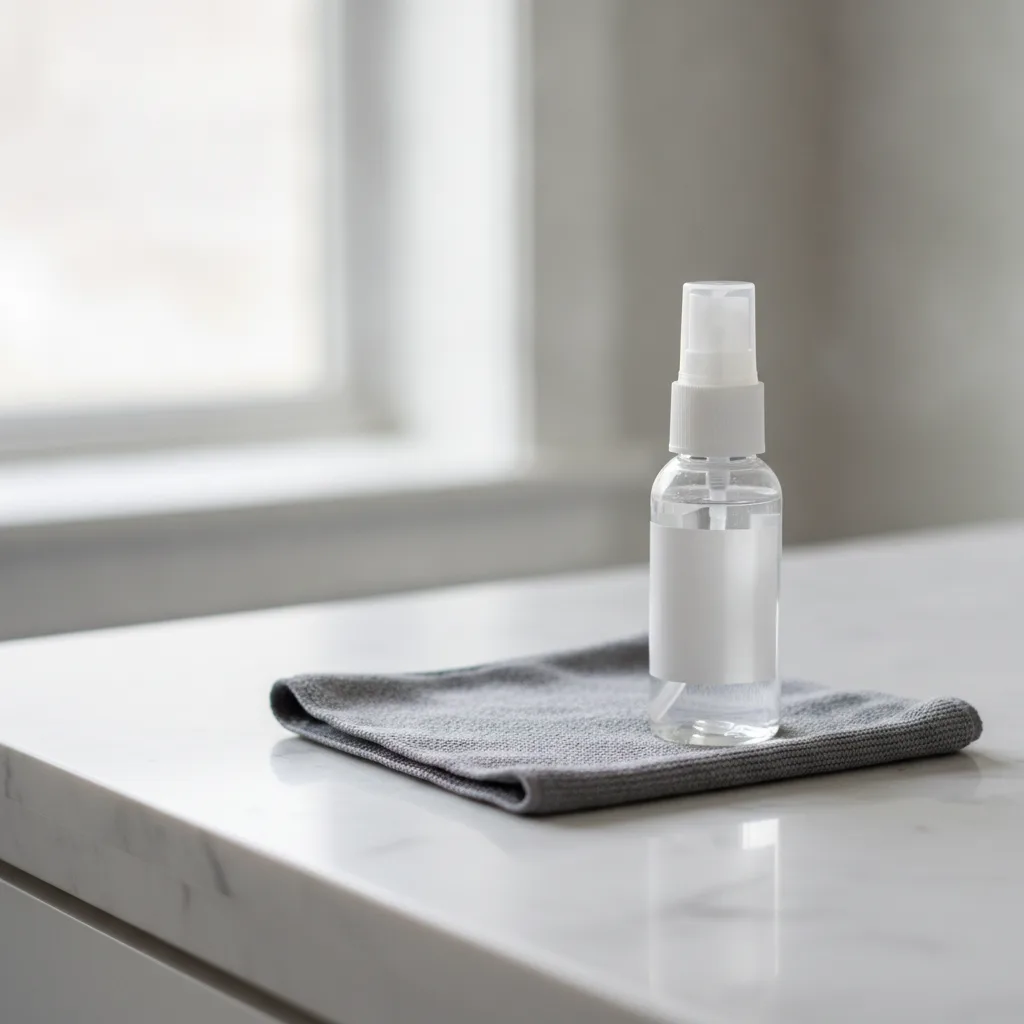
$10–$15 per bottle
Safe for marble surfaces — won't etch or strip sealer the way household cleaners do during daily cleaning
$25–$60 per bottle
Professional-grade penetrating sealer for DIY resealing between professional service visits — one bottle covers a standard 40 sq ft kitchen
Quartzite is the most popular marble alternative for Central Texas homeowners who want marble-like veining without the etching and scratching risk. Quartzite ranks approximately 7 on the Mohs hardness scale — comparable to granite — while offering the white-and-gray veining patterns that make marble so visually appealing. It's a durable natural stone, heat resistant, and requires less frequent regular sealing than marble. From across a kitchen, the visual difference between a quartzite and a marble countertop is subtle. Up close, the texture and pattern vary, but both deliver the natural beauty homeowners are after.
For busy kitchen countertops where hot pots and hot pans are part of daily life, quartzite is scratch-resistant, heat resistant, and far more forgiving of occasional acidic spills than marble. Fox Granite carries a wide selection of quartzite slabs alongside marble slabs — if you're torn between the look you love and the maintenance level your household can realistically handle, seeing both natural stone options side by side in the showroom makes the decision straightforward. The natural elegance of both materials complements a wide range of cabinetry colors, flooring styles, and interior design directions.
Quartz countertops — engineered stone, not to be confused with quartzite — are another option worth understanding. They're non-porous, require no sealing, and resist stains well. They don't have the natural veining character of a real marble or quartzite slab, and they're not heat resistant in the same way natural stone is — hot pans set directly on quartz can damage the resin binders in the material. In such cases, trivets are required. Each material carries honest tradeoffs. The right choice depends on how your household actually uses the kitchen every day, not on which stone looks best in a photo or on a showroom sample tile. Explore all your stone countertops options before committing.
Quartzite is sometimes mislabeled at slab yards as marble because the veining looks similar. Ask your fabricator to confirm the material with a technical spec sheet or hardness test before you commit to a slab. A reputable in-house fabricator will know the difference immediately — and will tell you without being asked.
A marble countertop quote missing edge profiles, sink cutouts, removal, and a template fee can look $400–$800 cheaper than an all-in quote — and end up costing more once those line items appear after you've signed. Before you compare any two quotes side by side, confirm every quote covers: templating, fabrication, edge profile (specify which one), sink cutout(s), old countertop removal, and professional installation by the fabricator's own crew. Apples-to-apples comparison is the only kind that protects your budget and your project.
For marble countertops near me searches across Austin, San Antonio, New Braunfels, Round Rock, Georgetown, Cedar Park, Leander, San Marcos, Kyle, Buda, Dripping Springs, and the surrounding Central Texas areas, Fox Granite is the in-house fabricator that has been doing this work since 2010. One team from template to final install, our own CNC equipment, transparent all-in pricing, and a free in-home consultation to walk you through slab selection, seam placement, and edge profiles before anything is cut. When your next project is marble, quartzite, granite, or quartz countertops — and you want it done right the first time — call (512) 653-5541 or visit our showroom in New Braunfels to see marble slabs in person and get your free estimate.
Ready to get started? Contact Fox Granite today.


BY APPOINTMENT ONLY
1379 Wald Road
New Braunfels, TX 78132
Austin, San Antonio, Cedar Park, Kyle, New Braunfels, Del Valle, Elgin, Lago Vista, Shady Hollow, Onion Creek, Buda, San Marcos, Lockhart, Temple, Wimberley, Dripping Springs, Bee Cave, Lakeway, Leander, Anderson Mill, Jollyville, Spicewood Springs, Round Rock, Georgetown, Pflugerville, Manor, Taylor, Manchaca, Mountain City, Hutto, West Lake Hills, Bastrop, Liberty Hill, Driftwood, Sun City, Steiner Ranch.