Most marble countertop myths collapse on contact with how the material actually behaves. Marble stains when liquid sits — not on contact. Etching and staining are two different problems with different solutions. Honed marble hides etch marks better than polished marble in busy kitchens. Sealing makes marble more stain-resistant but cannot prevent etching. Marble is a metamorphic rock that handles heat structurally better than engineered stone. Light damage is frequently repairable, not permanent. Marble comes in dozens of colors and varieties, not just white. And daily care collapses into three habits: wipe spills promptly, use cutting boards, skip the vinegar. That's it.
📊 Key Takeaways
Here is what the research and real-world fabrication experience behind these 8 myths actually show.
Staining requires sitting liquid
Red wine wiped promptly has ~99% chance of leaving no true stain
Etching and staining need different fixes
Scrubbing a dull etch mark won't remove it — polishing powder will
Honed finish is smarter for busy kitchen counters
Matte surface conceals etch marks polished marble makes visible
$300–$800
Professional honing and repolishing cost when etching accumulates
Marble outlasts engineered stone on heat resistance
Quartz resin binders scorch; marble is a metamorphic rock formed under extreme heat
Three habits cover 90% of marble care
Wipe spills promptly, use cutting boards, skip the vinegar
30–50+ year lifespan
Marble countertops with proper care; refinishable, not replaceable
Marble is not one material
Carrara, Calacatta, Statuario, dolomitic varieties — each performs differently
Marble countertops have been installed in homes, bakeries, and grand buildings for centuries. Yet more homeowners talk themselves out of marble than any other natural stone — usually based on things they heard second-hand, read in a quick search, or assumed from one bad experience someone else had. Several myths circulating about marble countertop maintenance have a a real kernel of truth. Most don't. This post goes through 8 marble countertop myths we hear regularly at Fox Granite, gives you the honest version of each one, and tells you the one real thing to watch for along with the simple habit that handles it. If marble turns out to be the right fit for how you actually cook and live, we'll help you pick the specific slab and finish that makes sense. If it isn't the right fit, we'll tell you that too — and show you quartzite options that give you the marble look with added durability.
1
Myth #1: Marble Stains the Second Anything Spills on It
Fear level: Very high — this one stops more decisions than any other
Truth level: Mostly false — staining requires sitting liquid, not just contact
Real risk: Etching (a separate problem entirely — see Myth #2)
Source: Use Natural Stone / Natural Stone Institute
Marble stains get their reputation from liquids left sitting — not from normal cooking contact. Restoration professionals quoted by Use Natural Stone note that red wine wiped up immediately has roughly a 99% chance of leaving no stain at all. Marble is porous, so absorption takes time. Wipe spills promptly and you remove the conditions for a true stain. What you may still see after an acid spill is etching — a dull spot where the surface sheen was dissolved — which is a completely different problem with a different solution.
What's actually true
Staining requires liquid to sit and absorb — prompt wiping prevents most true marble stains
Red wine wiped up immediately has ~99% chance of not staining, per restoration experts cited by Use Natural Stone
A sealer slows absorption further, buying you more time before acidic spills can penetrate
The dull spots most people call stains are usually etch marks — a chemical reaction, not absorption
The real thing to watch for
Oily substances like cooking oil or butter left overnight can cause true stains
Turmeric and strongly pigmented foods need fast attention — blot with a paper towel immediately
Marble stains are frequently repairable with a poultice — they're not always permanent
The habit that handles it: wipe spills promptly, every time, without exception
Bottom line
Marble doesn't stain the moment liquid touches it. It stains when liquid sits. That's a habit problem, not a material problem — and it's one most households already practice without thinking about it.
2
Myth #2: Etching and Staining Are the Same Thing
Confusion level: Extremely common — most homeowners use the terms interchangeably
Why it matters: Different problems require completely different solutions
Etching is a chemical reaction, not absorption. Acids — including lemon juice, vinegar, wine, and tomato sauce — dissolve a microscopic layer of marble's calcium carbonate surface, leaving a dull spot where the polish used to be. That dull spot isn't a stain and can't be removed like one. A sealer guards against staining but cannot stop etching. Understanding which you're dealing with completely changes how you respond and what products you reach for.
Etching: what it actually is
A chemical reaction where acid dissolves the calcite surface — not absorption of pigment
Caused by lemon juice, vinegar, wine, tomato sauce, citrus-based cleaners, and harsh chemicals
Leaves a dull patch on polished marble — the reflective sheen is gone in that spot
Cannot be prevented by sealing — no sealer can stop a chemical reaction
Light etch marks on polished marble can often be buffed out with marble polishing powder
Staining: what it actually is
Absorption of a pigmented liquid into the marble's pores over time
Prevented by proper sealing and by wiping spills promptly before absorption occurs
Appears as a colored discoloration — coffee, oil, or ink that soaked into the slab
Can sometimes be drawn out with a stone poultice applied over 24–48 hours
Sealer is effective here — it slows absorption and buys you time to wipe spills
Bottom line
Etch marks and marble stains need completely different responses. Knowing which you're dealing with means you won't waste time scrubbing a dull spot that needs polishing, or polishing a stain that needs a poultice.
3
Myth #3: Honed Marble Is Less Durable Than Polished Marble
Common assumption: Polish = protection; matte = fragile
Truth: Honed finish hides etch marks far better in busy kitchen counters
Best application: Honed marble for kitchens; polished for lower-traffic areas
Source: Stone Valley Countertops / Use Natural Stone
Honed and polished marble start from the same slab — the difference is finish depth, not material hardness. A honed finish has a matte surface that lacks the reflective sheen of polished marble. Because etch marks show up as dull patches against a shiny background, polished marble makes every acid contact noticeable. The matte finish absorbs that visual contrast, so minor etching from everyday acidic spills is far less visible. Many fabricators recommend honed marble specifically for kitchen countertops where acid contact from cooking is routine.
Why honed works better in busy kitchens
Matte finish hides etch marks — no shiny baseline for dull spots to contrast against
Minor etching from lemon juice or wine is barely noticeable on a honed surface
Same hardness as polished marble — the stone underneath is identical
Easier to live with where acidic foods are part of everyday cooking
Still seals the same way — proper sealing applies equally to both finishes
When polished marble makes sense
Bathroom vanity tops with lower acid exposure and lighter daily use
Fireplace surrounds, backsplash accents, and decorative applications
Homeowners who cook gently and want the classic high-gloss marble look
Light etch marks on polished marble can be buffed out with polishing powder — it's repairable, not permanent
Bottom line
Honed marble isn't the compromise finish — it's frequently the smarter choice for kitchen counters. It's the same stone with a finish that forgives real daily cooking habits.
4
Myth #4: Sealing Makes Marble Completely Stain-Proof
Who says this: Often homeowners who've been oversold on sealer products
Official position: Natural Stone Institute: sealers are impregnators — repellents, not barriers
Resealing frequency: Every 6–12 months for kitchen use; quality sealers can last 10–15 years
Proper sealing makes marble more stain-resistant — not completely stain proof, and not etch-proof. The Natural Stone Institute is explicit: sealing products act as impregnators that slow liquid absorption, but they don't create an impermeable barrier and they do nothing to prevent etching. A well-sealed slab gives you more time to wipe spills before absorption occurs. That's genuinely valuable. It just isn't a force field. Quality sealers applied at installation can last 10–15 years per NSI guidance; most kitchen marble needs resealing every 6–12 months with standard products.
What regular sealing actually does
Slows liquid absorption — buys you time to wipe spills before they stain
Reduces the frequency and severity of true stains from oily or pigmented liquids
Quality fabricator-applied sealers at installation can last 10–15 years (Natural Stone Institute)
Standard kitchen resealing runs every 6–12 months — a simple annual task costing $50–$150
What sealing cannot do
Cannot stop etching — that's a chemical reaction, not absorption, and no sealer changes that
Does not make marble non-porous or completely stain proof
Won't protect against harsh chemicals, vinegar, or lemon juice cleaners
Doesn't eliminate the need to wipe spills promptly every time
Bottom line
Sealing is worth doing and makes a real difference for stain resistance. Just don't treat it as permission to leave tomato sauce sitting overnight. It's a layer of protection, not a full replacement for prompt wiping.
5
Myth #5: Marble Can't Handle Heat — Hot Pans Will Crack It
Fear: Setting a hot pan down will crack or damage marble
Truth: Marble is a metamorphic rock — it handles heat structurally better than engineered stone
Real risk: Acidic residue on hot pans etching the surface — not thermal cracking
Marble forms under extreme heat and pressure deep underground — it's heat-resistant by nature and won't melt, burn, or crack from a hot pan set on the countertop surface. The real kitchen risk isn't thermal cracking — it's the acidic residue on the pan (tomato sauce, citrus drippings) contacting the calcite surface and causing etching. For comparison, quartz countertops contain resin binders that can scorch or crack under sudden high heat. Marble handles the heat itself better than engineered stone; the concern is the chemistry, not the temperature. Pastry chefs choose marble specifically because it stays naturally cool, which is an asset, not a liability.
What marble can handle
Extreme heat structurally — it's a metamorphic rock formed under intense pressure and temperature
Won't crack, melt, or emit fumes from a hot pan placed on the surface
Outperforms engineered quartz on heat resistance — quartz resin binders can scorch under sudden high heat
Pastry chefs choose marble specifically because it stays naturally cool — a working kitchen asset
The real caution with hot pans
Acidic substances on a pan's bottom (tomato sauce, citrus) can etch the marble surface on contact
Trivets protect against that chemistry — not against heat cracking
Sudden extreme thermal shock from a 500-degree oven is best avoided on any stone countertop
Use trivets as a consistent habit regardless of countertop material — it's good practice across the board
Bottom line
Marble is heat-resistant. Use trivets anyway — not because marble can't handle heat, but because the acidic drippings on the bottom of a pan can etch the surface. Protect against the chemistry, not the temperature.
6
Myth #6: Marble Damage Is Permanent
Fear: One bad spill or etch mark ruins the countertop forever
Truth: Light etch marks are frequently buffable; deeper damage is professionally restorable
Repair cost: $300–$800 for professional honing and repolishing when needed
Marble is refinishable — that's one of the most important things many homeowners don't realize going in. Light etch marks on polished marble can often be buffed out with a marble polishing powder that restores the shine to that spot. Deeper or widespread etching may need professional honing and repolishing, which runs $300–$800. Installed marble countertops commonly last 30 to 50 years or more with proper care, and some historic homes have marble kitchen surfaces well over 100 years old — still in use, still beautiful. The fact that you can refinish rather than replace is what separates marble from many engineered surfaces.
How marble damage is repaired
Light etch marks on polished marble: marble polishing powder applied by hand restores the sheen
Widespread or deep etching: professional honing and repolishing ($300–$800) can restore the full surface
True stains: poultice application draws pigment out of the pores over 24–48 hours
Chips and cracks: professional stone repair using color-matched epoxy filler
The slab itself lasts 30–50 years or more — refinishing extends life, it doesn't replace the stone
What patina actually means in practice
Marble that develops minor etch marks and soft wear over time is said to develop patina
Many homeowners choose marble knowing it will evolve — the character is part of the appeal
Carrara marble's soft feathery gray veining conceals minor marks naturally over time
Patina isn't failure — it's what real marble looks like in a loved, well-used kitchen
Bottom line
Marble damage is frequently repairable, not permanent. The natural stone that intimidates homeowners most is actually one of the few countertop surfaces that can be professionally refinished rather than replaced.
7
Myth #7: All Marble Is White or Gray — and All Marble Slabs Are the Same
Reality: Marble comes in green, black, gold, red, pink, and more
Within white marble alone: Carrara, Calacatta, and Statuario each have distinct veining and backgrounds
Durability varies too: Dolomitic marble varieties are denser and need less maintenance
Source: Granite Empire Huntsville / Clean Image of Orlando
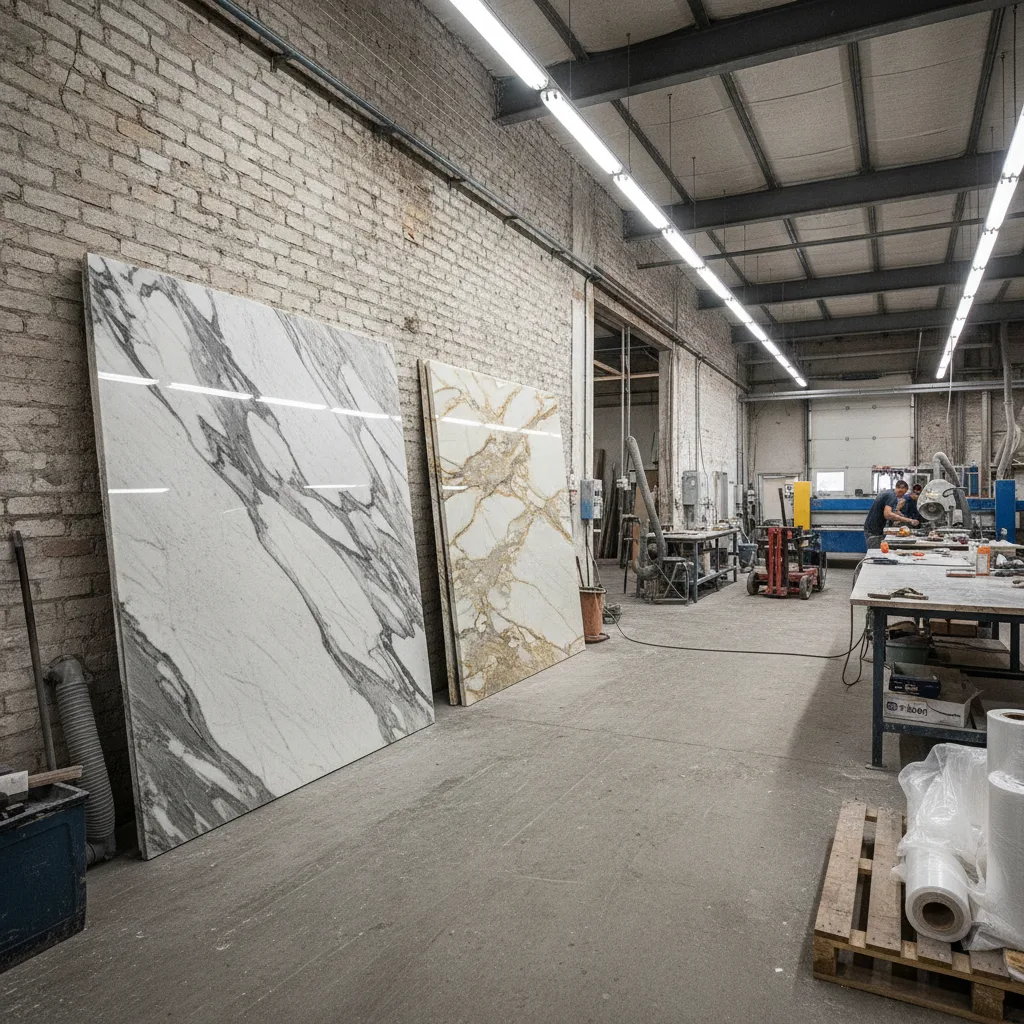
The marble look homeowners picture is usually Carrara marble — soft white with feathery gray veining. That's one variety among dozens. Marble slabs come in green, black, gold, red, pink, and deep blue. Within white marble alone, Carrara, Calacatta, and Statuario each have distinct vein patterns, background tones, and price points. Marble variety also affects how the stone performs: dolomitic marble is denser than classic Carrara and more resistant to acid etching, making it better suited to lower-maintenance applications. Treating all marble as a single material with identical behavior is one of several myths that leads to poor selection decisions.
Color and variety options in marble slabs
White marble: Carrara (soft gray veining), Calacatta (bold dramatic veining), Statuario (fine gray veining on bright white)
Black: Nero Marquina with white veining — a dramatic full slab statement
Green: Verde Guatemala and similar forest-toned varieties
Gold and cream: Crema Marfil and Emperador Light for warmer kitchen palettes
Cost ranges widely — Carrara runs $65–$120/sq ft installed; Calacatta $130–$220/sq ft
Darker marble hides minor marks more easily than bright white marble varieties
Denser slabs need less frequent resealing in lower-traffic or bathroom applications
Matching two slabs from the same block matters for large kitchens — natural stone veining varies slab to slab
Bottom line
The marble look covers a wide spectrum of colors, veining patterns, and performance characteristics. Picking the right marble variety for your kitchen is as important as deciding to use marble at all — and that's exactly what a slab selection conversation is for.
8
Myth #8: Marble Is a High Maintenance Material That Requires a Lifestyle Overhaul
The meta-myth: Marble demands constant vigilance and complicated routines
Reality: Three habits handle 90% of marble care
Annual maintenance cost: $50–$150/year for resealing; $0 for daily cleaning with mild dish soap
Daily marble care is simpler than the reputation suggests. Clean with mild dish soap or a pH-neutral stone cleaner and a soft cloth, wipe spills promptly, and use cutting boards and trivets. That's the full routine. The complexity most homeowners fear is front-loaded: you learn what not to use — no vinegar, no lemon juice, no harsh chemicals — and then you don't use them. The ongoing upkeep is a once-a-year resealing that costs $50–$150 and 30 minutes. Marble is a high maintenance material only if you skip those three habits consistently.
The three habits that handle marble care
Wipe spills promptly — acidic spills like lemon juice, wine, and tomato sauce should be blotted with a paper towel, not left to sit
Use cutting boards for food prep and trivets under hot pans — protects both the surface and the edge profile
Clean daily with mild dish soap or a pH-neutral stone cleaner and a soft cloth — no vinegar, no lemon juice, no harsh chemicals
The annual task list
Reseal every 6–12 months with a quality stone sealer ($50–$150 DIY or professional)
Check for etch marks — light ones can be buffed with marble polishing powder at home
Call a professional if widespread etching has accumulated — honing and repolishing runs $300–$800 and can restore the surface
That's it. No special weekly routine, no exotic products, no daily anxiety about warm water on the counter
Bottom line
Marble isn't high-maintenance — it's habit-dependent. Three habits (wipe spills promptly, use cutting boards, skip the vinegar) handle almost everything. That's not a lifestyle overhaul. That's what most careful homeowners already do.
Not Sure If Marble Is Right for Your Kitchen? Here's How We Help You Decide.
At Fox Granite, we don't push one material over another — we help you match the right stone to how you actually cook and live. If marble fits, we'll help you pick the specific slab (Carrara vs. Calacatta), the right finish (honed vs. polished), and handle fabrication and installation in-house from start to finish. If marble isn't the right fit — maybe your kitchen gets heavy acid use or you want something more forgiving near the sink and stove — we'll tell you that honestly and show you quartzite options that give you the marble look with added durability. Come see the slabs in person at our New Braunfels showroom, or schedule a free in-home consultation and we'll bring samples to you. Call (512) 653-5541 or contact us today to get started.
If you cook gently and love natural stone beauty, polished Carrara marble countertops are a proven choice — installed marble slabs in that style have been in continuous use for generations, and the timeless beauty holds up. If your kitchen sees heavy daily cooking with acidic foods, honed marble or a dolomitic variety makes the same material far more forgiving. If you want the marble look but prefer stone countertops with more resistance to acidic spills, quartzite is the honest recommendation — it's a natural material with similar veining character and meaningfully better acid tolerance. For marble countertops, quartzite countertops, and honest guidance on which natural stone fits your kitchen in Austin, San Antonio, New Braunfels, and across Central Texas, trust Fox Granite. We've completed over 10,000 countertop projects with in-house fabrication, transparent pricing, and no surprise fees. Contact us today to schedule your free consultation — or visit our showroom and see the marble slabs for yourself.
Not on contact. Marble stains when a pigmented liquid — coffee, oil, wine, turmeric — is left sitting long enough to absorb into the pores. A restoration expert cited by Use Natural Stone puts red wine wiped promptly at roughly a 99% chance of no true stain. Proper sealing slows absorption further, buying you more time. The dull spots people commonly call stains are usually etch marks — a separate chemical reaction caused by acid, not absorption — and they need a different solution entirely.
What ruins marble countertops?
The two main culprits are acids and pigmented liquids left sitting. Acids — lemon juice, vinegar, wine, tomato sauce, citrus-based cleaners, and harsh chemicals — cause etching by dissolving a microscopic layer of the calcite surface. Oily or strongly pigmented liquids (cooking oil, turmeric, coffee) cause true staining when left to absorb. Using harsh chemicals or abrasive scrubbers also damages the finish over time. The fix is straightforward: wipe spills promptly, skip the vinegar cleaners, and use mild dish soap or a pH-neutral stone cleaner daily.
Honed marble is generally the better choice for kitchen countertops where acid contact is likely. Etch marks show up as dull patches against polished marble's reflective sheen, making every acid contact visible. A honed finish has a matte surface that lacks that contrast baseline, so minor etching from lemon juice or wine is far less noticeable in everyday use. Polished marble makes more sense in bathrooms, on fireplace surrounds, or for homeowners who cook gently and want the classic high-gloss look. Both finishes seal the same way and have identical hardness — it's purely a surface treatment difference.
What is the average lifespan of a marble countertop?
With proper care, marble countertops commonly last 30 to 50 years or more. Some historic homes have marble kitchen surfaces that are over 100 years old and still in use. The material is also refinishable: light etch marks can be buffed with polishing powder, and widespread etching can be professionally honed and repolished for $300–$800, restoring the surface rather than replacing the slab. That refinishability is one of the most important distinctions between marble and engineered surfaces — damage extends the conversation, not the disposal timeline.
Is sealing marble worth the effort?
Yes, but with realistic expectations. The Natural Stone Institute is explicit that sealers are impregnators — they slow liquid absorption, which reduces the risk of true staining. They do not prevent etching and do not make marble completely stain proof or non-porous. Quality sealers applied by a fabricator at installation can last 10–15 years per NSI guidance. Standard kitchen marble typically needs resealing every 6–12 months with consumer-grade products, which runs $50–$150 and about 30 minutes of work. It's worth doing. Just don't treat it as a reason to leave tomato sauce sitting overnight.
Can marble handle hot pans?
Marble is a metamorphic rock formed under extreme heat and pressure — it won't crack, melt, or scorch from a hot pan set on the surface. It actually handles heat structurally better than quartz countertops, which contain resin binders that can discolor or crack under sudden high heat. The real caution with hot pans isn't thermal cracking — it's the acidic residue on the bottom of a pan (tomato sauce, citrus drippings) that can etch the calcite surface on contact. Use trivets as a habit regardless, not because marble can't handle heat, but to protect against the chemistry on the pan's bottom.
What is the closest low-maintenance alternative to marble?
Quartzite is the most direct comparison. It's a natural stone that delivers the veining and beauty of the marble look but is denser, harder, and more resistant to acid etching because it's primarily silica rather than calcium carbonate. Many quartzite varieties don't require the same level of acid vigilance that marble does. It's not identical to marble in appearance — quartzite tends toward sharper, more linear veining — but for homeowners who love natural stone beauty and want more forgiveness near the sink and stove, it's the honest recommendation. Fox Granite fabricates and installs both.