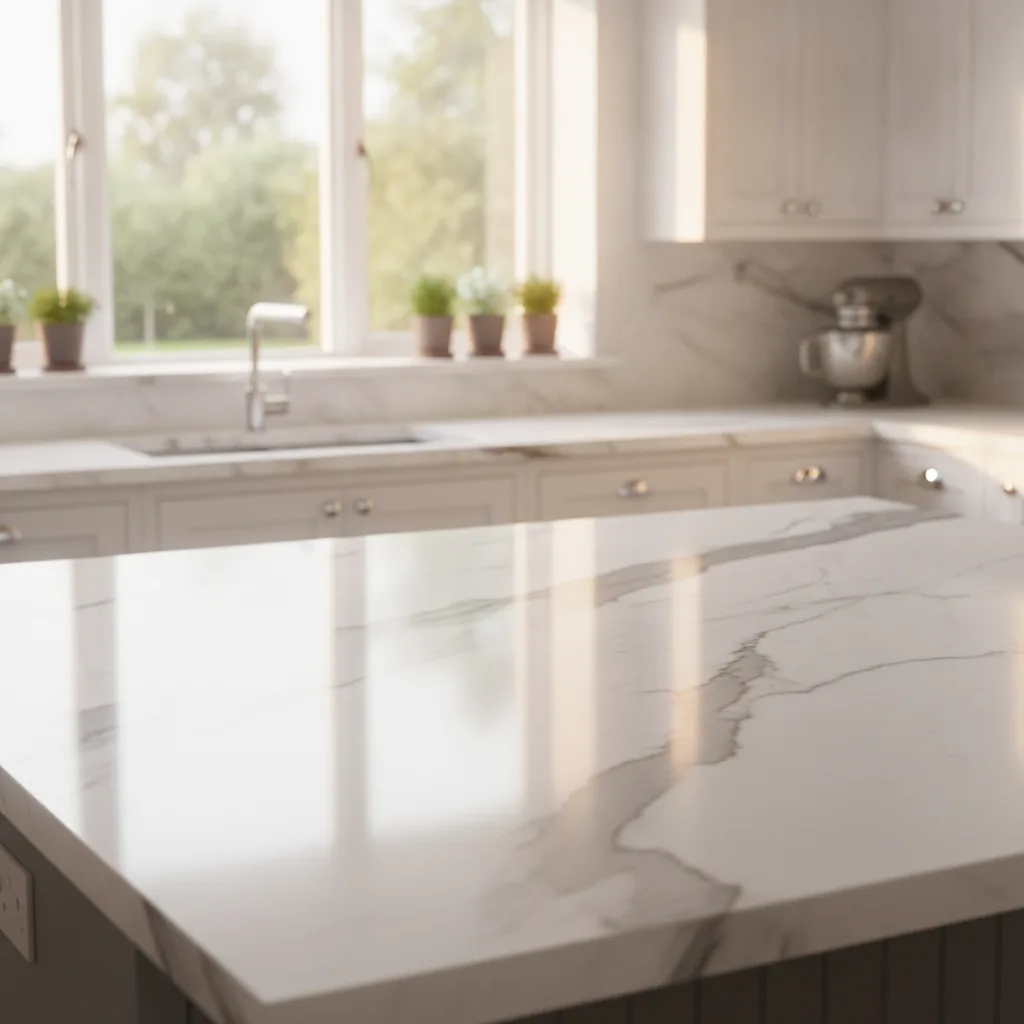
Professional marble countertop installation takes 10 to 20 business days from slab selection to finished install, with the physical installation day running 4 to 8 hours on-site. The process moves through seven phases: slab selection, cabinet preparation, laser templating, fabrication (the longest phase at 5 to 10 business days), installation day, sealing, and long-term maintenance setup. Installed cost in 2026 runs $75 to $250 per square foot, with a standard 40 sq ft kitchen landing at $4,000 to $6,000 total. Cabinet readiness is the single biggest factor controlling your timeline. Cabinets not fully installed and level before templating add one to three weeks to the overall project.
Professional marble countertop installation follows a clear, predictable sequence — and understanding each phase before you book a consultation is how homeowners avoid the surprises that delay projects and inflate costs. The full process, from choosing your slab to walking away with sealed, finished stone countertops, takes 10 to 20 business days with an in-house fabricator. The physical installation day is 4 to 8 hours. What drives every timeline and cost variable is preparation: cabinet readiness, sink availability, and material selection made before templating begins. This guide walks through all seven phases so you know exactly what happens, what you need to do, and when to act.

The marble countertop installation process starts at the slab yard or showroom, not at your house. This is where you choose the specific slab — not just a color sample — and confirm square footage, edge profiles, and sink cutout details that drive every downstream decision. Veining patterns in natural stone vary slab to slab, so seeing the actual piece you'll install is essential for material selection. Visual appeal and design elements that look identical in a catalog photograph can look completely different in your kitchen's actual lighting.
Marble variety determines your cost range before a single measurement is taken. As of 2026, Carrara marble runs $75 to $120 per square foot installed and is the most accessible option for kitchen countertops. Calacatta Gold sits at $150 to $250 per square foot installed. A typical 40 sq ft kitchen project lands at $4,000 to $6,000 total. Bathroom vanity tops average $1,125 to $2,250 for a standard 15 sq ft surface. Knowing these numbers upfront protects your budget from scope creep during the planning phase.
At Fox Granite, we bring samples to your home during a free in-home consultation so you can evaluate material against your actual cabinets, floors, and kitchen style before visiting the showroom. That step saves most homeowners two or three back-and-forth trips. Edge profiles — eased, beveled, bullnose, half-bullnose, ogee — get confirmed here too, since complex profiles add a few days to fabrication. The right material choice, made with expert guidance at this stage, is the foundation the rest of the installation process rests on.
Free (brought to your home by Fox Granite)
Lets you match stone countertops to your actual lighting, cabinetry, and floor color before committing to a slab
If you're replacing existing countertops with marble and the old surface is laminate or tile, confirm with your fabricator whether the substrate beneath is thick enough to support 20 to 25 pounds per square foot. Cabinets that handled laminate may need reinforcement before marble slabs can be set.
Cabinet readiness is the single biggest factor that determines whether your project finishes on time or runs three weeks late. The number-one cause of project delays in marble countertop installation is cabinets not being fully installed and level before the template appointment. That one issue alone can add one to three weeks to your overall timeline — fabricators cannot hold your slab or your production slot while you wait on a cabinet crew.
Marble weighs 20 to 25 pounds per square foot. A standard 40 sq ft kitchen countertop carries 800 to 1,000 pounds of stone once installed. Your cabinets must be level within 1/8 inch over a 10-foot span and fastened securely to wall studs. Uneven cabinetry creates stress points in the slab that cause cracks over time. No amount of color-matched epoxy repairs that kind of structural failure after the fact. Ensure every cabinet run is set and anchored before you call to schedule templating.
Remove everything from the existing countertops before your template day. Clear the path from your entry door to the kitchen — the installation team needs to carry heavy marble slabs through without obstacles. If your old countertops are still in place, confirm with your fabricator who handles removal. At Fox Granite, removal of old countertops is part of the project scope, so homeowners aren't coordinating a separate crew or dealing with disposal on their own.
Scheduling the template appointment before cabinet installation is complete is the most expensive timeline mistake homeowners make. Confirm every cabinet run is set, level, and anchored to the wall before you book templating — not after.
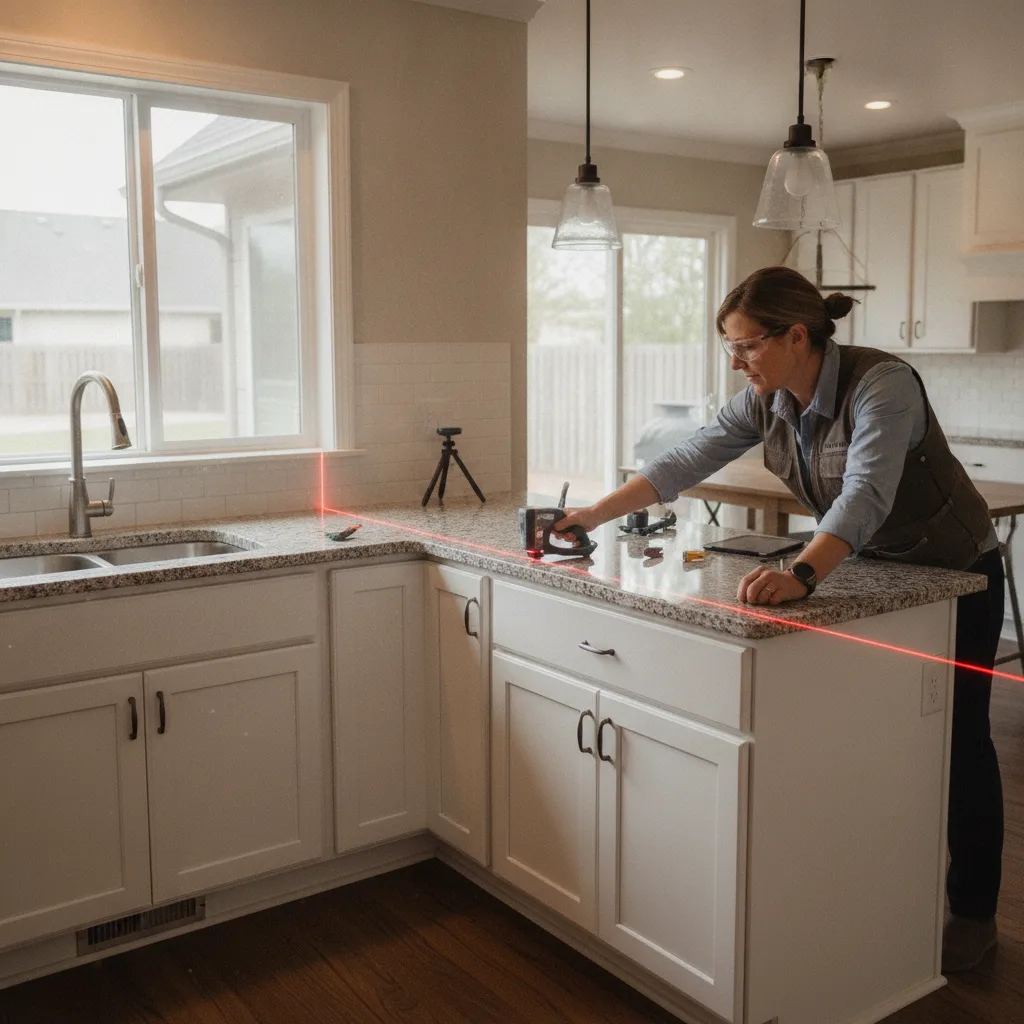
Laser templating is the industry standard for marble countertop installation because it eliminates human measurement errors and accounts for wall irregularities, appliance openings, and sink placement in one pass. The on-site templating appointment takes 30 to 60 minutes — the shortest phase in the entire process, but the most consequential for fit accuracy. Errors caught here cost nothing to fix. Errors discovered on installation day cost time, money, and sometimes a slab.
During templating, the technician captures precise measurements of every run of cabinetry, marks exact sink cutout placement for your undermount sink, and records out-of-square wall conditions. Those wall irregularities are common in Central Texas homes, particularly in kitchens with older construction. Catching them at the template stage means the fabrication team compensates during cutting rather than discovering the problem when new countertops are already in the house.
Once the digital template is captured, it transfers directly to the fabrication shop's stone-cutting software. That data-to-CNC handoff is what makes in-house fabrication faster and more accurate than outsourced shops, where handoffs introduce opportunities for accidental damage and communication errors. At Fox Granite, we use laser digital templating and process the data in-house, which keeps your project moving without unnecessary back-and-forth.
Included in fabrication cost
Captures precise measurements of wall irregularities, appliance openings, and sink placement to eliminate fit errors at installation
Have your sink on-site the day of templating if possible. The technician needs to confirm exact sink dimensions for the cutout. Ordering or swapping your sink after templating requires re-fabrication and adds time and cost to the project.
Fabrication is the longest single phase of the marble countertop installation process, taking 5 to 10 business days with most fabricators. CNC shops using digital templating can compress that to 3 to 7 days. This is when your specific slab gets cut to template dimensions, edge profiles are shaped and polished, and sink cutouts are finished to fit your exact sink. You won't be on-site for this phase, but what happens in the shop directly influences durability and the quality of your finished installation.
Marble sits between 3 and 5 on the Mohs hardness scale — softer than granite and quartz — which means careful handling and specialized tools during cutting are non-negotiable. A diamond-blade wet saw is required for all cuts. Dry cutting generates heat that can crack marble along its natural veining. In-house fabrication gives your team direct control over this process. Outsourced fabrication adds handoffs where accidental damage and communication errors are more likely to enter the picture.
The edge profile you confirmed at Step 1 gets executed during fabrication. A simple eased or beveled edge adds no significant time. An ogee or stacked profile on a thick slab can add one to two days because of additional polishing passes. If you chose bookmatched veining across two slab pieces as a design element, the fabrication team aligns those cuts during this phase. That level of precision takes time — and rushing it risks the natural stone's visual continuity across the seam.
If your slab was sourced internationally or is a rare variety on back-order, the full project timeline can stretch beyond 4 calendar weeks. Standard domestic Carrara marble available in a local yard moves faster. Ask your fabricator where the slab ships from before you set a target installation date.
The physical installation day for marble countertops takes 4 to 8 hours on-site, depending on kitchen size, number of pieces, and whether old countertops need removal first. Installation begins with the crew removing and disposing of existing countertops if that's part of the scope, followed by a final level check on the cabinetry before any new stone touches the surface. Appliances should already be pulled back from the work area before the team arrives.
The installation team performs a dry fit first — every piece of marble is placed without adhesive to confirm fit, alignment, and seam placement. Seam placement away from the sink area is critical because water seeping under a poorly placed seam weakens structural integrity over time. Installers use shims to address any alignment issues found during the dry fit. Once confirmed, they apply adhesive and set the slabs permanently, checking level throughout the process to ensure the surface is true.
Seams between marble slabs are bonded with color-matched epoxy, then polished flush so the transition is as tight as possible. After the slabs are secured, the installation team mounts the undermount sink, reconnects plumbing connections, and applies silicone caulk where the counter meets the backsplash and around the sink perimeter as finishing touches. A final inspection checks level, seam quality, edge finish condition, and secure placement before the crew signs off and leaves the space.
Clear all appliances away from counter edges, ensure the installation team has a parking spot within reasonable distance for heavy material transport, and keep kids and pets out of the kitchen for the full day. The crew will need access to a water source for wet-cutting adjustments if any field cuts are required.
Marble countertops must be sealed during installation and left untouched for 24 to 48 hours before the surface is used. Marble is a porous natural stone that absorbs liquids, oils, and acidic substances without a protective sealer in place. The first 24 to 48 hours after sealing are when the product cures and bonds to the stone's surface. Using the countertop before cure is complete means the sealer won't protect as designed — and the stone is fully exposed to stains and etching during that window.
The professional sealing done on installation day is the first layer of protection, but it's not permanent. Plan to reseal your marble countertops every 6 to 12 months depending on how heavily the kitchen is used. Annual sealing maintenance runs $50 to $150 per year in materials if you do it yourself. Skipping this step is the third most common marble countertop installation mistake, and it causes the most visible long-term damage through staining and surface etching. Many homeowners skip the first annual reseal because the countertop looks fine — that's precisely when the sealer has worn thin enough to let liquids in.
The water bead test is a simple way to check if resealing is needed: pour a tablespoon of water on the surface and wait 10 minutes. If the stone darkens and absorbs the water, reseal immediately. If the water beads and sits on top, the current sealer is still doing its job. Run this test every six months as part of your regular maintenance routine to protect your investment and ensure long-term durability.
$25–$60 per bottle (covers 100–200 sq ft)
Penetrates the porous marble surface to create a barrier against liquids, oils, and acidic spills without altering the polished appearance
Do not use acidic cleaners — including vinegar, lemon juice-based products, or standard bathroom tile sprays — on marble countertops. Marble etches (loses its polish in dull spots) on contact with acids even through a sealer. Use pH-neutral stone cleaners only.
Marble countertops with proper care can last 50 years or more, but in high-traffic kitchens they require more active maintenance than granite or quartz. The habits you build in the first 30 days after installation — spill cleanup speed, cleaner choice, trivet use near cooktops — determine whether your marble stays polished or starts showing wear within a year. Installation complexity ends on day one. Maintenance is what makes that lasting investment pay off over decades.
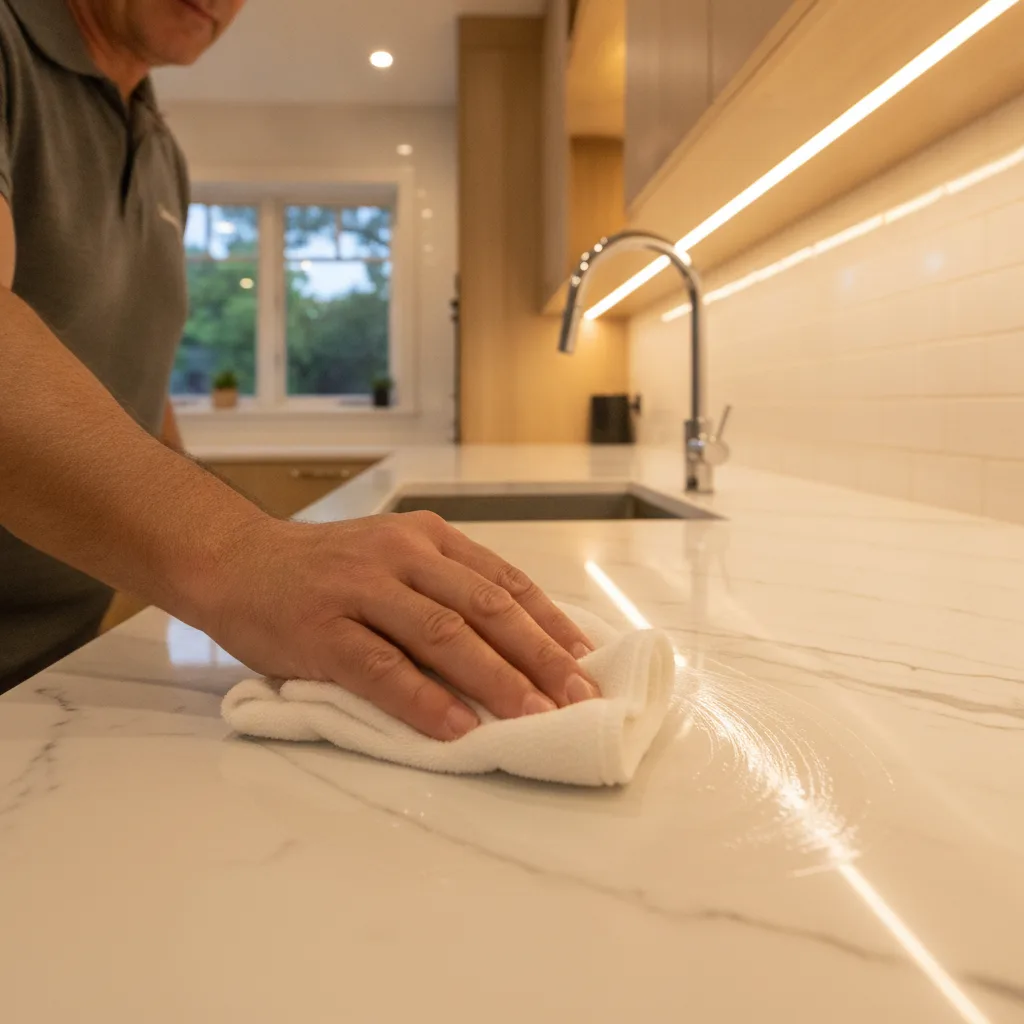
Clean up spills immediately, especially red wine, citrus juice, tomato sauce, and coffee. Use pH-neutral stone cleaner for daily cleaning with a soft cloth or microfiber pad. Use trivets under hot pans near the cooktop — marble is generally heat-resistant, but direct contact with a hot cast iron skillet can cause thermal shock along natural veining. Cutting boards are non-negotiable: marble scratches more easily than granite or quartz, and surface scratches dull the polished finish quickly. These habits protect the stone's beauty and longevity year after year.
Compared to granite and quartz, marble asks more of the homeowner in daily maintenance. It also offers something the others can't match: natural veining patterns and timeless appeal that create a classic beauty in a kitchen that engineered stone cannot replicate. If your cooking habits include regular acidic prep work or heavy daily use, talk honestly with your fabricator about whether granite countertops or quartzite might be a better fit for your space. We'd rather you love your countertops for 20 years than regret a marble decision in 12 months.
Every 6 to 12 months: run the water bead test, reseal if needed ($50 to $150 in materials), inspect caulk lines at the backsplash and sink perimeter for gaps, and check for chips along the edge profile. Small chips caught early can often be repaired without replacing the slab.
The most expensive marble countertop installation mistake isn't picking the wrong stone — it's calling for a template appointment before the cabinetry is fully installed and level. Fabricators can't hold your slab or your production slot while you wait on a cabinet crew. If the template has to be rescheduled, you lose your place in the fabrication queue and your total project timeline stretches by one to three weeks. Get cabinets completely done, level-checked within 1/8 inch over 10 feet, and anchored to the wall before you book the template appointment. Everything downstream — fabrication, installation day, sealing — runs on schedule the moment that first step is right.
Marble countertop installation isn't complicated when you know what's coming at each phase. The full process — from choosing your slab to walking away with sealed, finished stone countertops — takes 10 to 20 business days with an in-house fabricator. The installation day itself is 4 to 8 hours. What makes or breaks the project is preparation: cabinets ready, sink on-site for templating, and a fabricator who handles measurement, cutting, and installation without handing your project off to subcontractors. For marble countertop installation in Austin, San Antonio, New Braunfels, and across the Central Texas corridor, Fox Granite has completed over 10,000 projects with in-house fabrication, precision laser templating, and no-surprise pricing. Contact us today to schedule your free in-home consultation — we'll bring samples to you.
Ready to get started? Contact Fox Granite today.


BY APPOINTMENT ONLY
1379 Wald Road
New Braunfels, TX 78132
Austin, San Antonio, Cedar Park, Kyle, New Braunfels, Del Valle, Elgin, Lago Vista, Shady Hollow, Onion Creek, Buda, San Marcos, Lockhart, Temple, Wimberley, Dripping Springs, Bee Cave, Lakeway, Leander, Anderson Mill, Jollyville, Spicewood Springs, Round Rock, Georgetown, Pflugerville, Manor, Taylor, Manchaca, Mountain City, Hutto, West Lake Hills, Bastrop, Liberty Hill, Driftwood, Sun City, Steiner Ranch.