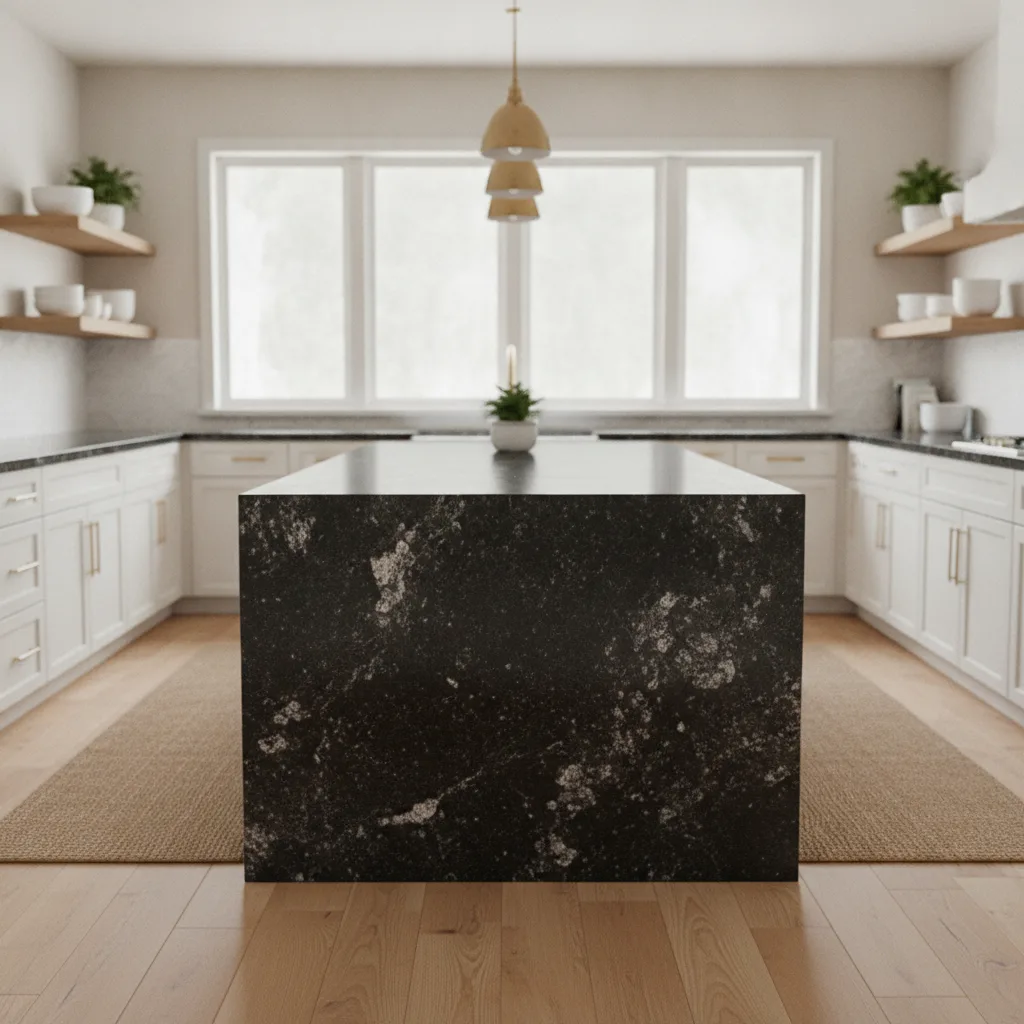
Leathered granite countertops are a textured, matte finish applied to granite slabs using diamond-tipped brushes during fabrication. As of 2026, they are the most popular emerging countertop finish in Texas kitchens. Installed cost runs $60–$120 per square foot all-in — about $10–$25 more per square foot than a polished version of the same slab, adding roughly $500–$1,000 to a standard kitchen project. The finish hides fingerprints and water marks better than polished granite, suits busy kitchens and heavy use, and pairs best with darker stones like Black Pearl, Steel Grey, and Absolute Black. The one non-negotiable: leathered granite must be chosen before fabrication. You cannot convert a polished slab to leathered after installation.
Leathered granite countertops are the most-asked-about finish in Central Texas kitchens right now — and for good reason. As of 2026, design publications have named leathered granite the number-one emerging countertop finish trend, with polished and shiny surfaces losing ground to tactile, textured options across Austin, San Antonio, and New Braunfels alike. But trend momentum alone is not a reason to commit $3,500 to $8,000 to a new granite countertop. This guide gives you the real picture: what the leathered finish actually is, how it's made, exactly what it costs compared to polished granite, which stones look best with it, and the three honest reasons it might not be the right choice for your specific kitchen. Read this before you walk into a showroom or talk to a fabricator.
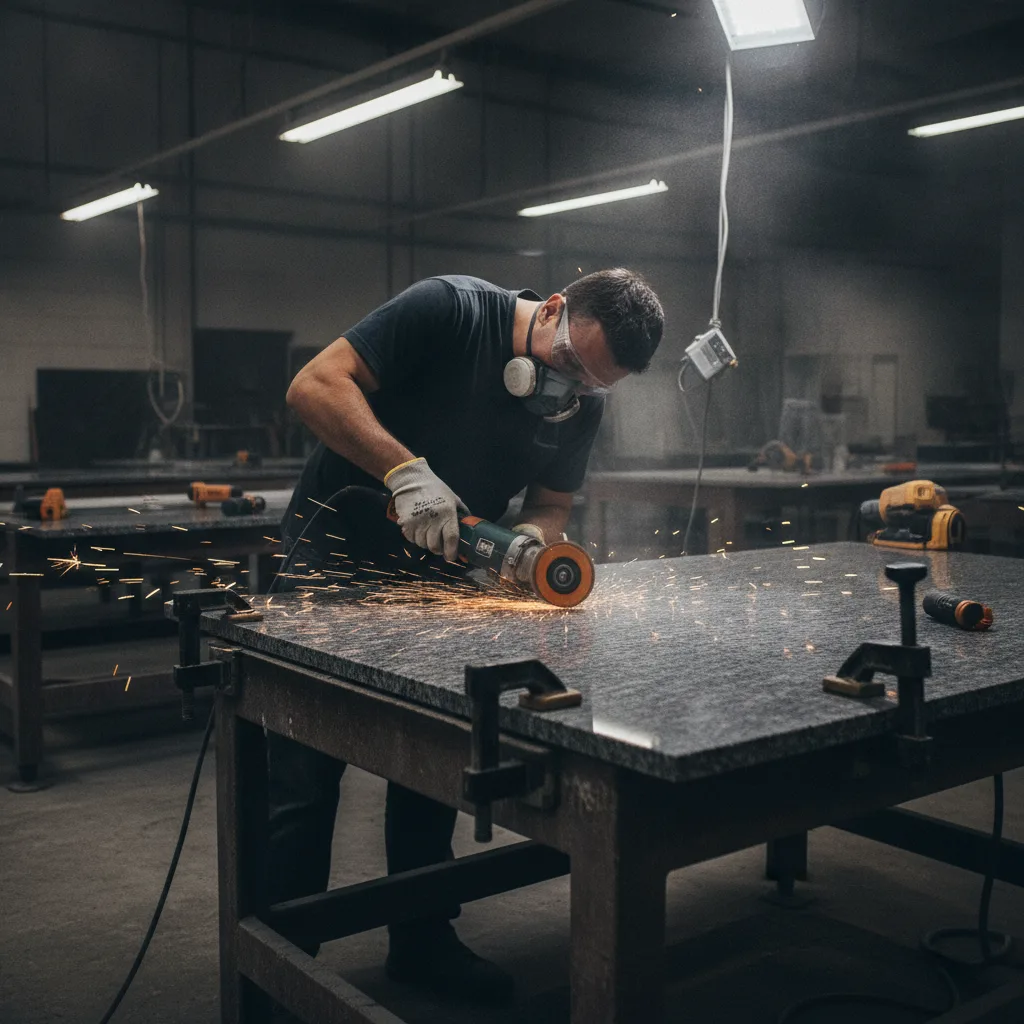
Leathered granite is a textured, matte finish applied to granite slabs during fabrication — it is not a separate material, just a different surface treatment on the same stone. The leathered finish sits in a practical middle ground between polished granite and honed granite. Unlike polished granite, which delivers a mirror-bright reflective surface, leathered granite offers a low-sheen matte finish with a subtle texture you can feel under your hand. Unlike honed granite, which is flat and matte, leathered granite brings out more depth and dimension in the stone's natural color. The texture catches light differently at different angles, making the mineral flecks in the granite slab pop in a way a flat honed surface simply cannot replicate — it reveals the stone's natural beauty rather than flattening it.
The result is a granite countertop that hides fingerprints and water marks far better than a polished surface, photographs beautifully in listing photos, and reads as warm and natural rather than cold or formal in a kitchen setting. Homeowners who absolutely love natural stone but find that a mirror-bright polished surface shows every smudge within minutes of cleaning often find leathered granite is exactly what they were looking for. It's a popular material choice precisely because it performs well in real life rather than just in a showroom.
One thing worth understanding before you go further: leathered granite is a finish choice, not a stone category. Granite leathered at the shop is the same granite as the polished version — same quarry, same slab, same durability. The distinction is entirely in the surface treatment. That means the unique texture you're considering comes entirely from how the fabricator processes the stone, not from any premium sourcing of the material itself.
Leathered is a finish, not a stone variety. Any granite slab can technically be leathered, but darker stones like Black Pearl, Steel Grey, and Absolute Black show the texture and depth most dramatically. Lighter stones develop a subtler, less dramatic effect — which may or may not suit your design direction.
Making leathered granite starts with a honed slab — one that has already been ground flat and smooth but not yet polished to a shine. Fabricators then run diamond-tipped abrasive brushes (also called antiquing brushes or leather brushes) across the surface at high speed. These diamond-tipped brush heads abrade the softer mineral crystals in the granite while leaving the harder crystals — primarily quartz and feldspar — intact. The result is a textured surface with subtle peaks and valleys: recessed dips where softer minerals were worn away and slightly raised ridges of harder minerals left standing. That unique texture is what gives leathered granite its distinctive look and feel.
The leathering process does not close the stone's pores as completely as polishing does. Polishing creates a dense, compressed surface layer that makes the granite less porous and easier to wipe clean. A leathered granite surface stays slightly more open, which is why it requires a second sealer coat during fabrication and more frequent resealing over its lifetime. This is not a defect — it is a trade-off to understand and plan for before you choose.
The entire finishing process happens at the fabrication shop, not on-site after installation. That matters because the finish cannot be retrofitted once your countertop is in your kitchen. If you want leathered granite, you choose that finish during the slab selection and fabrication phase — before templating, before cutting, before installation. There is no going back once the slab is polished and set.
Fabricator-supplied — not a homeowner purchase
The specific commercial tooling that creates the leathered texture by abrading softer minerals while leaving harder crystals like quartz and feldspar raised — unavailable outside professional fabrication shops
Because making leathered granite requires commercial fabrication equipment, there is no DIY version of this process. Your job as the homeowner is to choose the finish before the fabricator starts cutting — not to apply it yourself.
Leathered granite works best in kitchens and bathrooms with good natural light and a design direction that leans warm, organic, or modern-rustic. The matte finish absorbs rather than reflects light, which reads beautifully in bright, open kitchens but can make a small or dark room feel even smaller and heavier. This is the number-one reason to pass on leathered granite: if your kitchen has limited windows and low ambient light, a polished or honed surface will serve you better. Unlike polished granite's shiny reflective surface, leathered granite offers no bounce-back light to open up a space.
For busy kitchens with kids, heavy use, and real cooking happening daily, leathered granite is a genuinely practical choice. It hides fingerprints and water marks better than a polished surface, and the textured surface masks minor scratches that would show on a mirror-finish slab. Granite sits at 6–7 on the Mohs hardness scale regardless of finish — the leathering process doesn't change the stone's durability. You still get a scratch-resistant, heat-resistant countertop you can use a cutting board on without worry. It's a durable, low-maintenance surface that can stand up to decades of real kitchen use without looking worse for it.
Leathered granite also works well beyond the kitchen. Bathroom vanities, fireplace surrounds, outdoor countertops, bar tops, and accent walls all benefit from the textured finish. On waterfall edges — where the countertop continues vertically down the side of a kitchen island — leathered texture creates a striking focal point that a flat polished surface cannot match. For outdoor installations in Central Texas, leathered granite holds its color in the sun, hides dust with ease, and resists the heat that would make a shiny polished surface feel even hotter to the touch. Leathered granite works in a wider range of applications than most homeowners initially realize.
If your kitchen or bathroom is under 150 square feet or has fewer than two natural light sources, lean toward polished granite. The non-reflective matte surface of leathered granite absorbs light and can make tight spaces feel compressed rather than open.
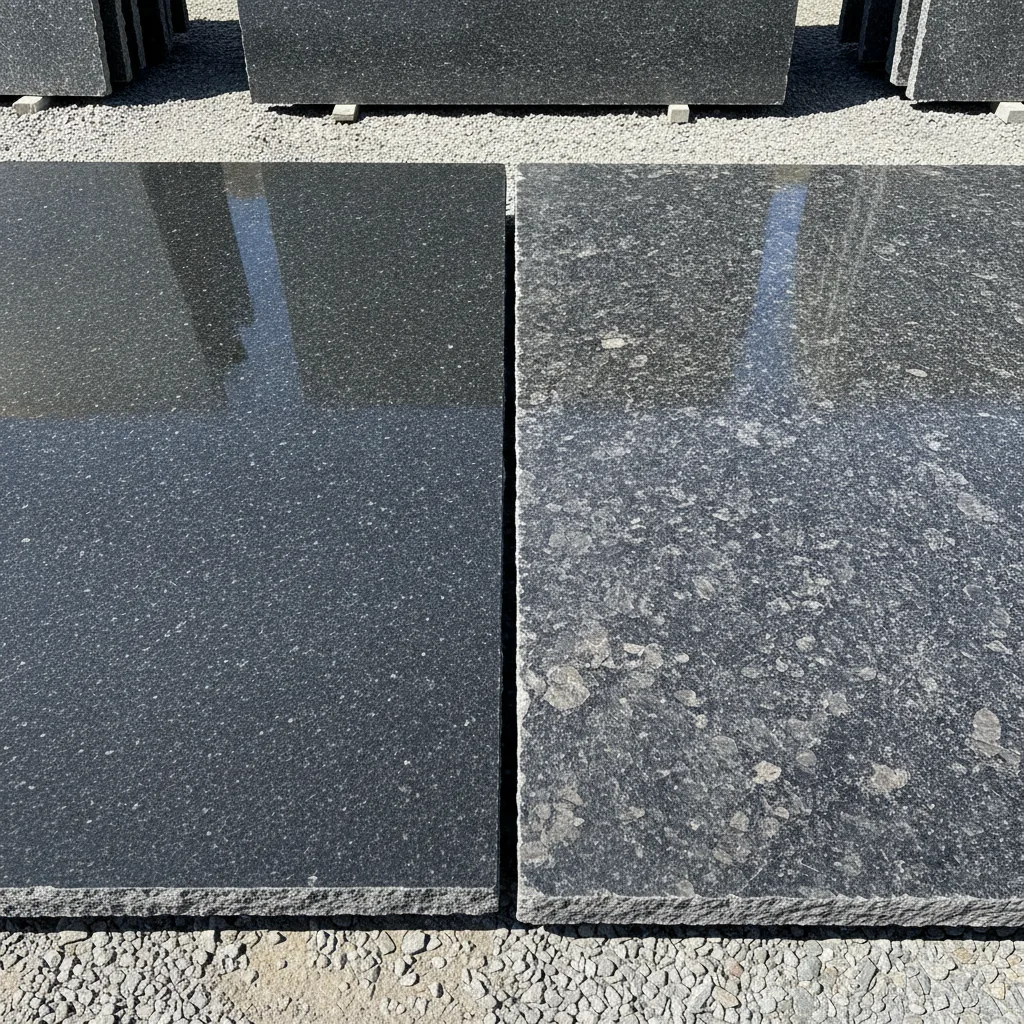
Darker granites are the best candidates for the leathered finish. Black leathered granite — especially leathered Black Pearl granite and Absolute Black — shows the most dramatic effect because the brushing process reveals subtle metallic mineral flecks that a polished version of the same slab cannot replicate. Steel Grey is another strong performer: the leathered texture adds warmth and depth to what might otherwise read as a cold, industrial stone. As of 2026, the most popular leathered granite slab choices in Central Texas are Black Pearl, Steel Grey, Absolute Black, Titanium, Fantasy Brown, and Silver Pearl. Black Pearl granite in particular is the top-selling leathered granite in Texas fabrication shops right now. Leathered black granite of any variety remains the dominant category in countertop specification requests.
Lighter granites — whites, creams, and pale beiges — can be leathered, but the effect is subtler and the trade-offs feel more pronounced. The texture on lighter stones can trap fine powders like flour and spices more visibly against a light background, and the sealing demands are identical regardless of color. If you love a light-colored granite and want to pair it with white cabinets, a polished finish may serve you better day-to-day. The stone's natural beauty tends to show best in leathered finishes when there's enough mineral contrast in the slab for the textured surface to enhance.
Feel the actual leathered slab in person before you commit — this is the single most consistent piece of advice from experienced fabricators, and it's correct. Texture depth varies significantly by stone variety. Some granites develop deep, pronounced ridges under the diamond-tipped brush; others stay relatively smooth. Leathered Black Pearl granite feels noticeably different from leathered soapstone (which some fabricators offer as a companion product) and from leathered Steel Grey. Photographs cannot capture the tactile difference. This is not a decision you should make from a screen.
Ask your fabricator to show you leathered samples side by side with polished and honed versions of the same stone. The visual and tactile contrast between the three granite finishes in person is more instructive than any amount of online research.
Leathered granite countertops installed in Central Texas run $60–$120 per square foot all-in for standard slabs, with exotic or rare stones reaching $150 per square foot. That's $10–$25 more per square foot than a polished version of the same slab. For a standard kitchen countertop layout, the leathered finish premium typically adds $500–$1,000 to the total project cost. The extra cost comes from specialized diamond brushes, additional fabrication time, and a second sealer coat applied during finishing — not from the stone material being more expensive. A honed granite finish runs about $10–$20 more per square foot than polished for comparison, making leathered slightly more expensive than honed because the diamond-tipped brush process is more labor-intensive than simply stopping the polish before the final buffing stage.
The finish does not change what you pay for edge profiles, undermount sink cutouts, or templating — those costs are the same regardless of finish choice. A waterfall island edge, for example, is priced identically whether you choose a polished or leathered surface. What changes is purely the per-square-foot fabrication cost of the leathered texture itself.
The $500–$1,000 kitchen premium is a small fraction of an overall installed granite project. On a $3,500 project, that premium is about 14% of the total. On a $6,000 project with a higher-grade granite slab, it's under 10%. Factor it into your budget early so it doesn't feel like a surprise line item when you review the final quote. All-in pricing from Fox Granite includes fabrication, templating, edge profiling, and professional installation with no surprise add-ons after the fact.
The leathered finish premium is a fixed fabrication cost — it does not scale dramatically with slab price. Get the leathered finish cost confirmed in writing on your quote before fabrication begins so there are no ambiguities on the final invoice.
Leathered granite is stain-resistant and low maintenance, but it is not maintenance-free. Because the leathering process leaves the stone's pores slightly more open than polishing, leathered granite requires sealing once or twice a year indoors to stay protected. For outdoor countertops and fireplace surrounds in the Texas climate, seal twice a year — spring and fall — using an exterior-grade penetrating sealer. Fluoropolymer or silane-siloxane formulas hold up best in heat and UV exposure; standard indoor sealers break down faster outdoors under Central Texas sun.
Daily cleaning is simple: wipe with a damp cloth and a pH-neutral stone cleaner. Avoid acidic cleaners, bleach, and anything abrasive. The one cleaning difference from polished granite: a flat cloth doesn't always reach the recessed valleys of the leathered texture. Use a soft-bristled brush to work sealer into those dips during annual sealing, and to dislodge fine dry powders like flour or spice dust that can settle into the texture between wipes. Wet spills on a leathered surface wipe up as easily as on any polished countertop; dry fine-particle spills need the extra attention.
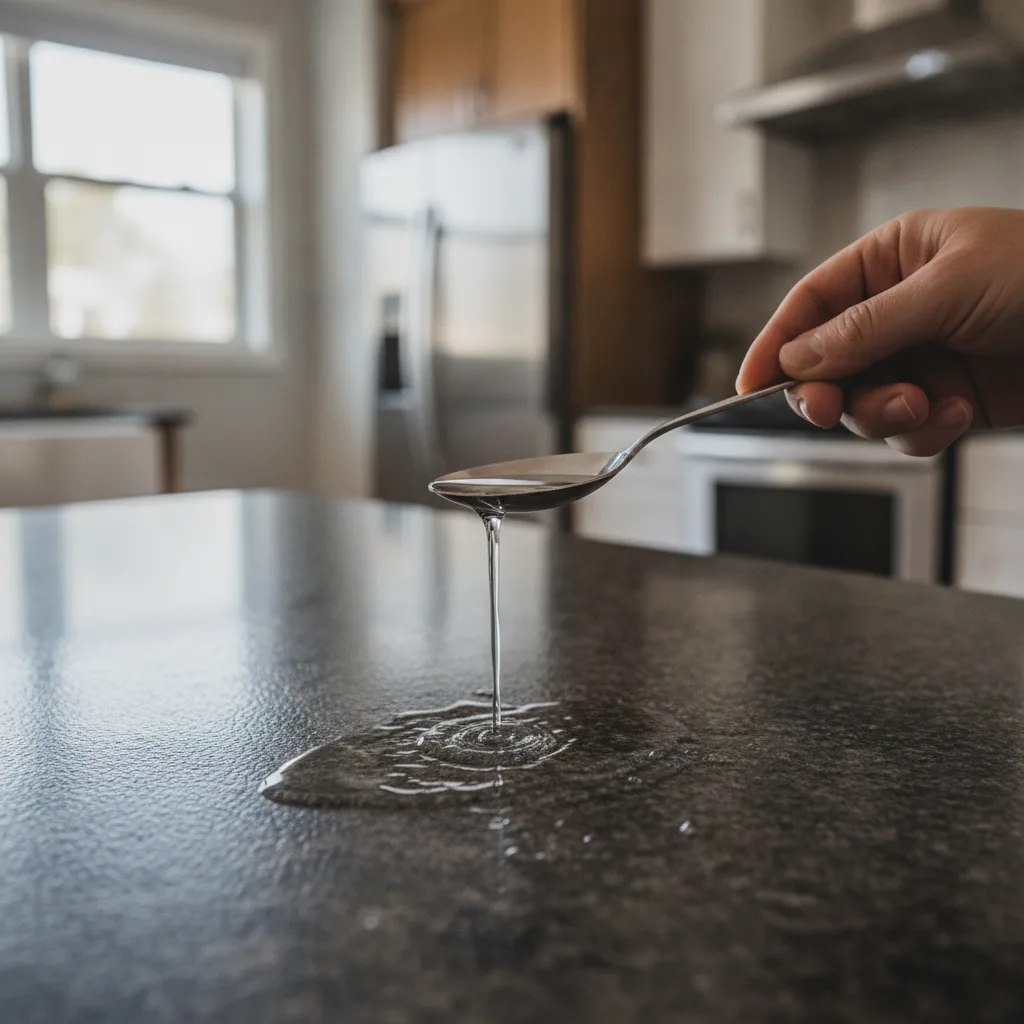
Your countertop arrives sealed from the fabrication shop — that first coat is standard practice. After that, a simple water-bead test tells you when it's time to reseal: pour a tablespoon of water on the surface and wait five minutes. If the water soaks in rather than beading up, reseal. A quality penetrating sealer applied by hand and wiped off after the dwell time takes about 30 minutes per kitchen and protects the stone for the next six to twelve months. That's the full scope of maintenance — not a significant burden for a gorgeous, durable natural stone surface.
$8–$15 per bottle
Safe for daily cleaning on leathered granite without breaking down the sealer or etching the stone's natural minerals — the only type of cleaner you should use on any natural stone surface
$20–$40 per bottle
Fills the stone's open pores to create a stain-resistant barrier; penetrating formulas don't alter the matte finish or add unwanted sheen to the leathered surface
$35–$60 per bottle
Required for outdoor leathered granite countertops and fireplace surrounds in Central Texas; handles UV exposure and temperature swings that standard indoor sealers cannot withstand
$5–$12
Works sealer and cleaner into the recessed valleys of the leathered texture that a flat cloth can't reach; also useful for brushing out dry spills like flour or spice powder
Pour one tablespoon of water on the leathered granite surface and wait five minutes. Water beading means you're protected. Water soaking in means it's time to reseal. Test once a year, and reseal the moment you fail the test — don't wait for stains to appear first.
The leathered finish is chosen at fabrication — not after. Once your slab is cut, edged, and installed as a polished countertop, there is no converting it to leathered in place. The diamond-tipped brush process happens at the shop, on the full slab, before your template is even cut. If you're seriously considering leathered granite, make that call before your fabricator starts cutting. And before you make that call, go feel an actual leathered slab in person. Photos will not show you what your hand will know in about five seconds.
When you land on leathered granite for your kitchen or bathroom, you get a surface that is genuinely low maintenance, stain-resistant, durable enough for decades of heavy use, and warm in a way that polished stone simply isn't. The finish brings out the natural beauty in darker granites better than any other treatment on the market right now. For leathered granite countertops in Austin, San Antonio, New Braunfels, and across Central Texas, Fox Granite fabricates in-house, offers free in-home consultations with samples, and stocks leathered granite slabs you can see and touch in our New Braunfels showroom before you commit to anything. Call (512) 653-5541 or stop by to schedule your free consultation and get your free estimate today.
Ready to get started? Contact Fox Granite today.


BY APPOINTMENT ONLY
1379 Wald Road
New Braunfels, TX 78132
Austin, San Antonio, Cedar Park, Kyle, New Braunfels, Del Valle, Elgin, Lago Vista, Shady Hollow, Onion Creek, Buda, San Marcos, Lockhart, Temple, Wimberley, Dripping Springs, Bee Cave, Lakeway, Leander, Anderson Mill, Jollyville, Spicewood Springs, Round Rock, Georgetown, Pflugerville, Manor, Taylor, Manchaca, Mountain City, Hutto, West Lake Hills, Bastrop, Liberty Hill, Driftwood, Sun City, Steiner Ranch.