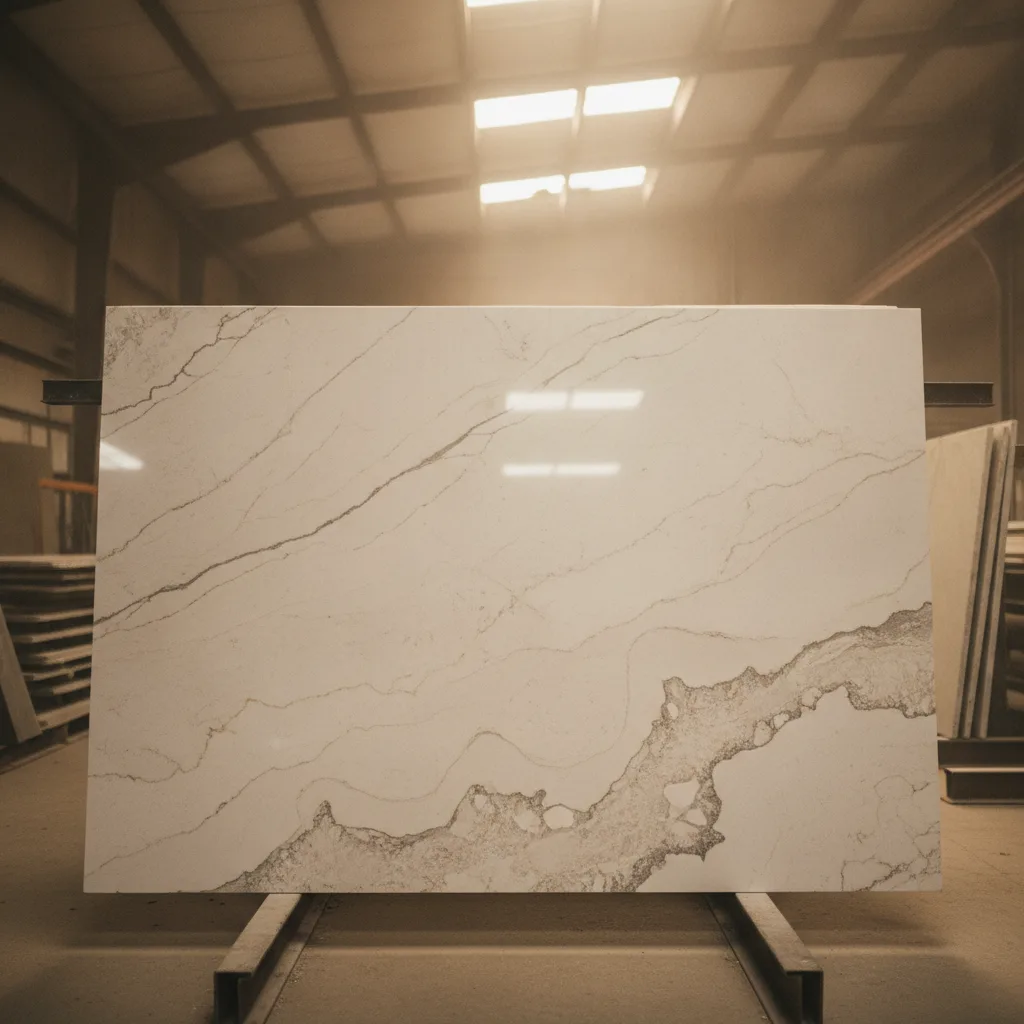
Yes, quartzite countertops are one of the most defensible eco-friendly choices available in 2026. Natural Stone Institute EPD data puts quartzite's global warming potential at 46.8 kg CO2e per square meter — 54% lower than engineered quartz at 102.6 kg CO2e/m² and 84% lower than large-format ceramic or porcelain tile. Quartzite requires no synthetic resins, no petroleum-based binders, and no added pigments during manufacturing. It lasts 50 to 100 years — two to four times longer than engineered quartz — meaning fewer replacements, less raw material demand, and less landfill waste over a home's lifetime. Its one real weak spot is transportation distance: most slabs ship from Brazil. Ask your fabricator where the slab was quarried and whether shorter shipping distances are available. Those two questions separate a genuinely sustainable purchase from one that just looks green on a product page.
Quartzite countertops are eco friendly — and the data to back that up is independently verified, not marketing copy. The Natural Stone Institute's ISO Type III Environmental Product Declaration puts quartzite's global warming potential at 46.8 kg CO2e per square meter, compared to 102.6 kg CO2e for engineered quartz countertops. That's a 54% reduction in embodied carbon in favor of natural stone, covered cradle to grave: quarrying, fabrication, installation, maintenance, and disposal. For Central Texas homeowners researching countertops for a kitchen or bathroom remodel, this guide breaks down exactly where quartzite earns those credentials, where it falls short, and three concrete questions to ask any fabricator before you commit to a slab.
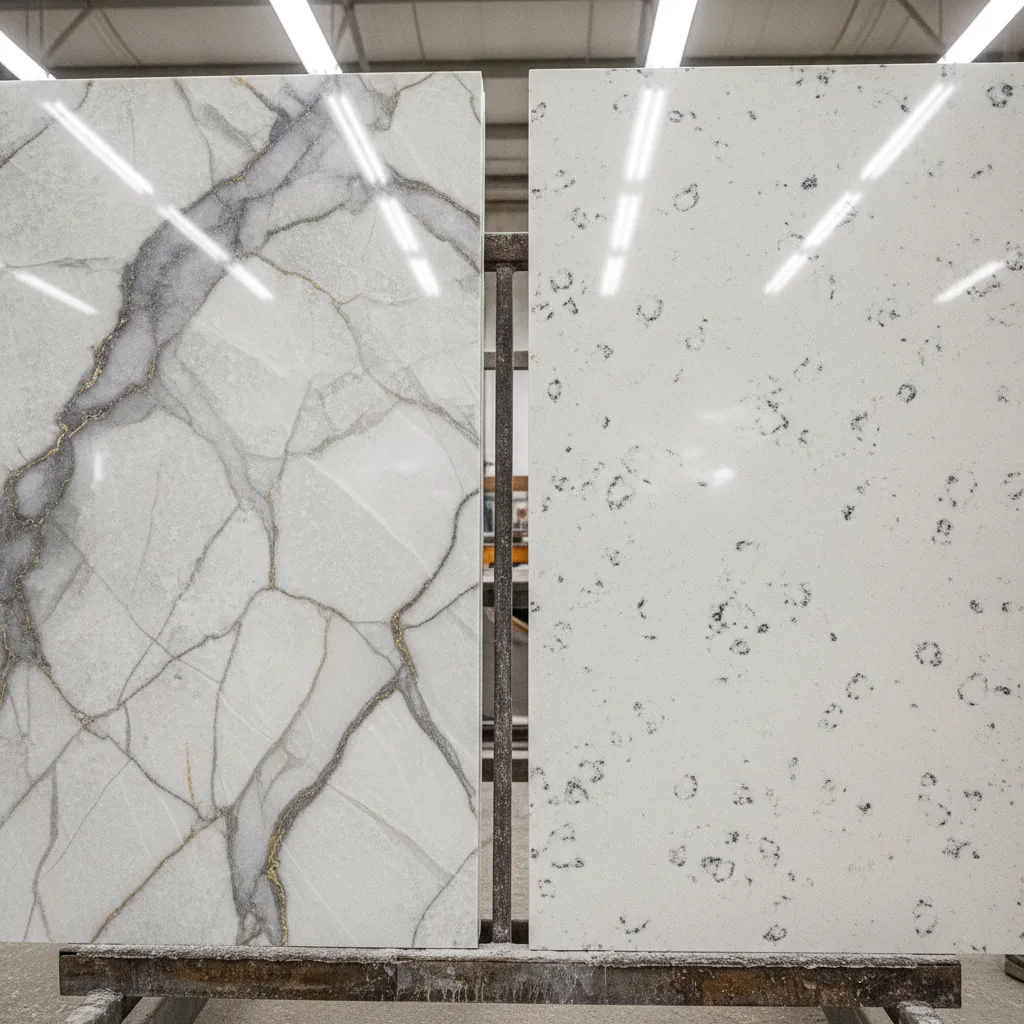
Eco friendly countertops are evaluated across four separate stages: raw material extraction, the manufacturing process, lifespan and maintenance, and end-of-life recyclability. A material that scores well in one stage can fail badly in another — which is why single-claim marketing ('it's natural, so it's green') almost never tells the full story. Not every product labeled eco friendly has independent certification to back it up.
The most credible tool for comparing countertop sustainability is an Environmental Product Declaration, or EPD. Think of it as a nutrition label for building materials. The Natural Stone Institute has published ISO Type III EPDs for natural stone countertops — including quartzite — that are third-party verified and cover cradle-to-grave environmental impact: quarrying, fabrication, installation, maintenance, and disposal. Engineered quartz and most manufactured materials do not have equivalent independently audited documentation at the same verification level, which gives natural stone a meaningful transparency advantage for eco conscious buyers.
For homeowners who care about sustainability but also want beautiful, durable kitchen countertops, quartzite sits near the top of the list. It isn't a perfect material — no countertop is — but the data backs up its eco credentials in ways that reclaimed wood, recycled glass, and composite surfaces often can't match at the same durability level. The rest of this guide breaks down exactly where quartzite wins, where it doesn't, and what to do about the gaps.
Asking your supplier for an EPD or ANSI/NSC 373 documentation is the fastest way to separate verified sustainability claims from marketing language. If they can't produce either, that tells you something about their supply chain transparency.
Quartzite requires no synthetic materials, no resins, and no added pigments to become a countertop slab. It forms when sandstone is subjected to intense heat and pressure deep in the earth over millions of years — a natural mineral process that produces a dense, hard surface. Once quarried, it is sliced and polished. That is the entire manufacturing process. No chemical formulation. No factory mixing. Minimal processing compared to any manufactured alternative.
Engineered quartz countertops are a different story. They are composed of 90 to 95 percent ground quartz bound together with 5 to 10 percent petroleum-based resins and pigments. That resin component is fossil-fuel derived, energy intensive to produce, and the source of volatile organic compounds (VOCs) that can off-gas into your home after installation — a concern for indoor air quality that quartzite simply doesn't share. Quartzite is non-toxic, contains no synthetic binders, and produces no VOC emissions once installed. For homeowners who prioritize a healthier indoor environment and low emissions, quartzite is the straightforward choice.
The embodied carbon numbers confirm the gap. According to EPD data published by the Natural Stone Institute, natural stone countertops carry a global warming potential of 46.8 kg CO2e per square meter. Engineered quartz comes in at 102.6 kg CO2e per square meter — more than double. That's the 54% embodied carbon reduction for natural stone. On a 40-square-foot kitchen, that difference adds up to roughly 230 kg CO2e less embodied carbon — the equivalent of driving a gas car about 600 miles. How much energy goes into manufacturing countertops matters, and on that measure, quartzite wins decisively.
Free
Provides ISO Type III verified environmental impact data for quartzite and other natural stone countertops — the gold standard for comparing embodied carbon between countertop materials with independently audited numbers.
Free
Search by product to verify low-emission and indoor air quality certifications. Useful for comparing engineered quartz brands that claim GREENGUARD certification against quartzite's baseline zero-VOC profile. GREENGUARD certification is meaningful for manufactured products, but quartzite doesn't need it — it has no synthetic off-gassing to certify against.
Quartzite countertops last 50 to 100 years with proper care. Engineered quartz countertops typically last 25 to 30 years. That single difference — a lifespan two to four times longer — may be the most underrated sustainability argument for quartzite countertops. Every replacement cycle means new raw materials, new energy, new transportation, and new landfill waste. Fewer replacements across a home's lifetime directly cuts total environmental impact, even before you factor in the embodied carbon difference at the manufacturing stage.
Quartzite's durability isn't just a spec-sheet figure. It is scratch resistant enough to handle everyday wear from knives and cookware, and heat resistant enough to withstand high temperatures from pots and pans without the surface damage that degrades engineered quartz over time. The stone resists scratches and stains with proper sealing, and its strength comes from the same metamorphic pressure that formed it — not from synthetic binders that degrade. Minimal maintenance is required: seal every one to two years with a penetrating stone sealer, and clean daily with mild soap and warm water. Avoid harsh chemicals that can break down the sealer.
At end-of-life, quartzite is fully recyclable and can be repurposed for garden pavers, outdoor countertops, retaining walls, or other landscape materials — giving the stone a second life without new raw materials. Engineered quartz countertops, by contrast, are assumed in most life cycle assessment models to go to a landfill or be incinerated — an energy-intensive process with no material recovery value. That recyclability gap between natural stone and manufactured surfaces is a significant long-term sustainability advantage for quartzite, and one that rarely appears on a product page.
Sealing quartzite every one to two years protects its naturally porous surface and is the single most important step for maximizing longevity. Use a penetrating stone sealer rated specifically for quartzite — avoid multi-surface sealers that may contain harsh chemicals incompatible with natural stone.
Quartzite's one honest environmental weakness is transportation distance. Most quartzite slabs sold in the US market are quarried in Brazil and South America, meaning the stone travels thousands of miles by ship and truck before it reaches a Texas fabrication shop. That shipping distance is a meaningful contributor to the slab's total carbon footprint. It is also the part of quartzite's environmental impact most easily reduced with one direct question to your fabricator.
Ask where the specific slab was quarried and whether they stock options with shorter shipping distances. Some suppliers carry quartzite from domestic or North American sources, which cuts transportation-related emissions significantly. Granite, by comparison, is often sourced from closer regions — domestic quarries in the Southeast US or closer South American ports — so a Texas homeowner choosing between similar slabs might find that a local granite option carries a lower transportation footprint than an equivalent quartzite. Choosing a regionally stocked slab over one that's traveled from a distant port is a concrete, actionable way to shrink your countertop's carbon footprint without changing your material preference.
Quarrying itself also carries environmental responsibility. Land disturbance, water use, and energy consumption at the extraction stage are real factors. The ANSI/NSC 373 Sustainable Production of Natural Dimension Stone standard certifies quarries that follow responsible practices — including land reclamation and reduced energy consumption during extraction. Ask your supplier whether their quartzite source holds this certification or can provide EPD documentation covering the quarrying stage. A fabricator who can answer that question confidently is one who takes supply chain transparency seriously. NSF certification is a separate standard worth noting for food-contact surfaces; ask your fabricator whether their specific stone products carry NSF or equivalent testing documentation.
Before committing to a slab, ask: 'Where was this quartzite quarried, and does your supplier hold ANSI/NSC 373 certification or a current EPD?' A fabricator who can show documentation is one who has vetted their supply chain. One who can't is worth pressing further before you sign.
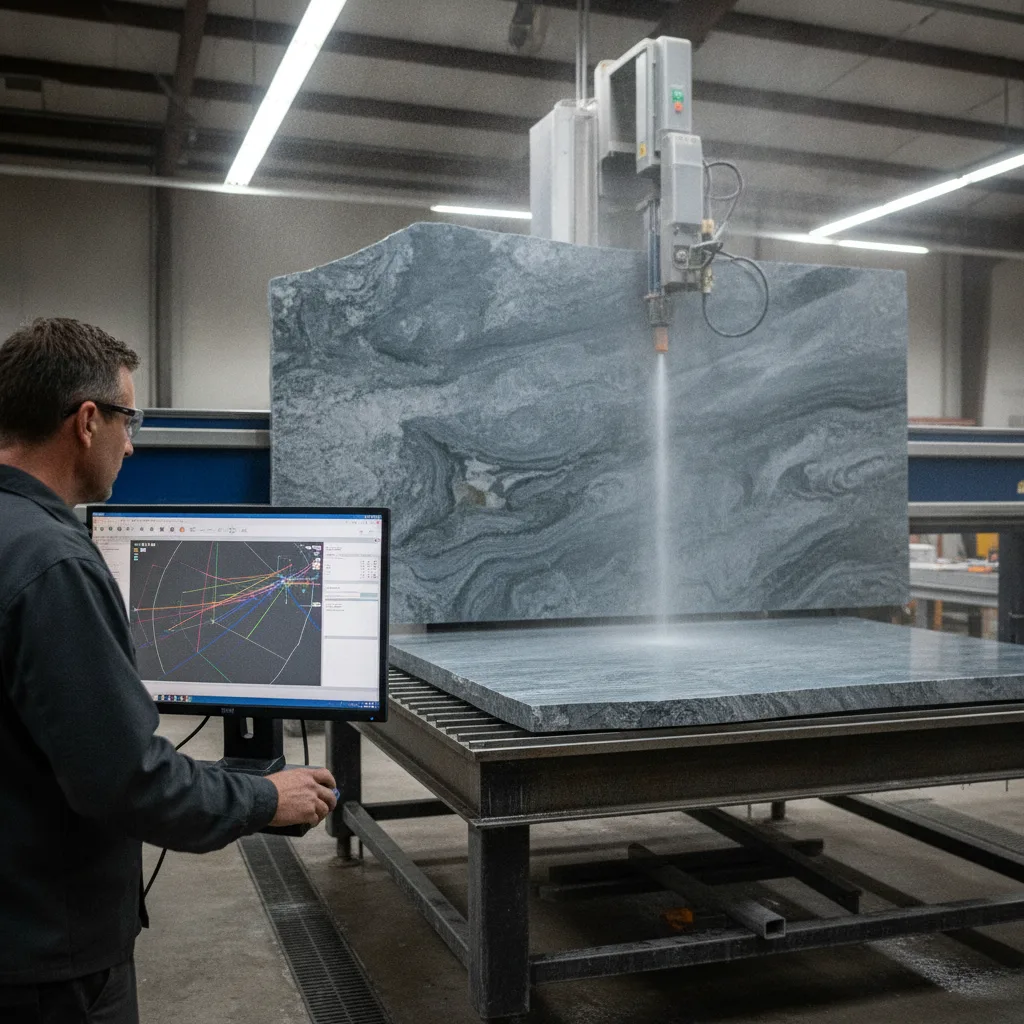
The fabrication stage is where quartzite's environmental impact can be meaningfully reduced or made significantly worse, depending on how the shop operates. Fabricators who optimize cutting patterns to minimize offcuts, handle stone remnants responsibly, and reuse water from the wet-cutting process shrink the job's total waste footprint. Those who don't can negate a meaningful portion of the stone's natural sustainability advantage. Reducing waste at the fabrication stage is as important as the material choice itself.
Fox Granite fabricates all countertops in-house using precision stone-cutting software that optimizes slab layout before a single cut is made. That process reduces material waste at the fabrication stage — a direct environmental benefit that a shop outsourcing its cutting work can't guarantee. Water used in the cutting process is managed on-site, and stone offcuts from your project don't simply go to a dumpster. Remnants from quartzite slabs can become bathroom vanity tops, bar tops, or outdoor countertops for other homeowners — keeping usable stone out of landfills and reducing demand for new raw materials.
For eco conscious buyers in Austin, San Antonio, New Braunfels, Georgetown, Round Rock, and across Central Texas, working with a fabricator who controls the full process in-house — rather than outsourcing cutting and finishing — gives you the most visibility into how your slab is handled from delivery to installation. That transparency is part of what makes a countertop choice genuinely sustainable, not just on paper. Ask for a walkthrough of the shop's process before you commit. A fabricator with nothing to hide will walk you through it.
Quartzite is one of the most defensible eco friendly choices available for kitchen countertops and bathroom vanity tops as of 2026. Its manufacturing process uses no synthetic materials, no petroleum-based resins, and no added pigments. Its embodied carbon is 54% lower than engineered quartz and 84% lower than large-format ceramic or porcelain tile, per NSI EPD and Life Cycle Assessment data. It lasts 50 to 100 years — far beyond engineered alternatives — and it is recyclable and repurposable at end-of-life. Crystalline silica, which is present in quartzite's natural mineral composition, is a recognized occupational health concern during dry cutting and grinding at the fabrication stage; responsible fabricators use wet-cutting methods and proper ventilation to manage that risk, which is another reason to ask how your fabricator runs their shop. Those numbers and that context are hard to argue with.
The material isn't perfect. Transportation from Brazil adds carbon miles that granite sourced from closer regions may not accumulate at the same rate. Quartzite requires periodic sealing — every one to two years — to protect its surface and preserve its longevity. And its beauty and natural variation mean two slabs are never identical, which can be a supply challenge for large modern kitchen designs requiring consistent coloring. But 'not perfect' is a much lower bar than 'not green.' Compared to recycled glass countertops with energy-intensive manufacturing, reclaimed wood with moisture and durability concerns in a kitchen, or engineered quartz with fossil-fuel resins and a landfill end-of-life, quartzite holds up as the sustainable choice that also performs like one. Post-consumer recycled content options like recycled glass carry legitimate eco credentials but can't match quartzite's durability or lifespan.
The key benefits of quartzite — zero VOCs, minimal processing, 50-to-100-year durability, and full recyclability — make it an ideal choice for environmentally conscious homeowners who want a surface that looks stunning and supports responsible kitchen design. If you're planning a remodel in Austin, San Antonio, Georgetown, Round Rock, Dripping Springs, or anywhere in Central Texas, quartzite countertops are worth a serious look. Visit the Fox Granite showroom in New Braunfels to see slabs in person, ask about slab origins, and talk with our team about how in-house fabrication keeps your project's waste footprint low. We'll give you straight answers — no pressure, no spin.
Free
Verify whether your quartzite supplier's source quarry holds the Sustainable Production of Natural Dimension Stone certification — the most widely recognized responsible quarrying standard in the US market.
Free
Download the Natural Stone Institute's ISO Type III EPD to compare quartzite's cradle-to-grave environmental impact against engineered quartz, ceramic tile, and other countertop materials using independently audited, third-party verified numbers.
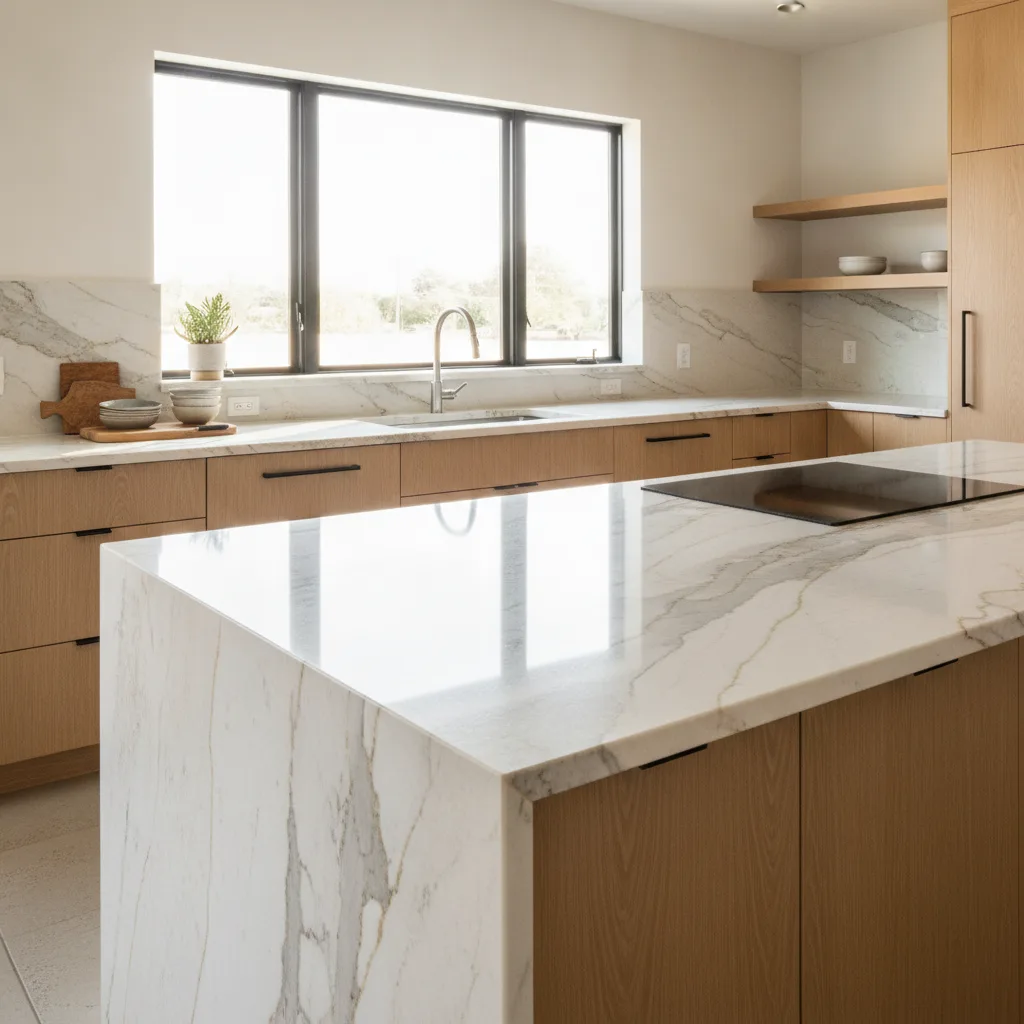
Quartzite earns its eco-friendly reputation, but only when the full picture is considered: where the slab was quarried, how far it traveled, how the fabricator handled cutting waste, and whether it was properly sealed to maximize its lifespan. A beautiful quartzite slab that gets replaced in 15 years because it wasn't sealed is less sustainable than an average slab that lasts 80. Ask your fabricator for slab origin documentation and ask how offcuts from your job are handled. Those two questions separate a genuinely sustainable countertop purchase from one that just looks good on a product page.
For quartzite countertops in Austin, San Antonio, New Braunfels, and across Central Texas, Fox Granite fabricates every countertop in-house, uses precision cutting software to reduce material waste, and gives you straight answers about slab sourcing — because a countertop purchase this size deserves full transparency. Contact us today to schedule your free in-home consultation, or visit our New Braunfels showroom to see our quartzite slab selection and talk with our team about what makes a countertop a truly smart investment for your home and the planet.
Ready to get started? Contact Fox Granite today.


BY APPOINTMENT ONLY
1379 Wald Road
New Braunfels, TX 78132
Austin, San Antonio, Cedar Park, Kyle, New Braunfels, Del Valle, Elgin, Lago Vista, Shady Hollow, Onion Creek, Buda, San Marcos, Lockhart, Temple, Wimberley, Dripping Springs, Bee Cave, Lakeway, Leander, Anderson Mill, Jollyville, Spicewood Springs, Round Rock, Georgetown, Pflugerville, Manor, Taylor, Manchaca, Mountain City, Hutto, West Lake Hills, Bastrop, Liberty Hill, Driftwood, Sun City, Steiner Ranch.