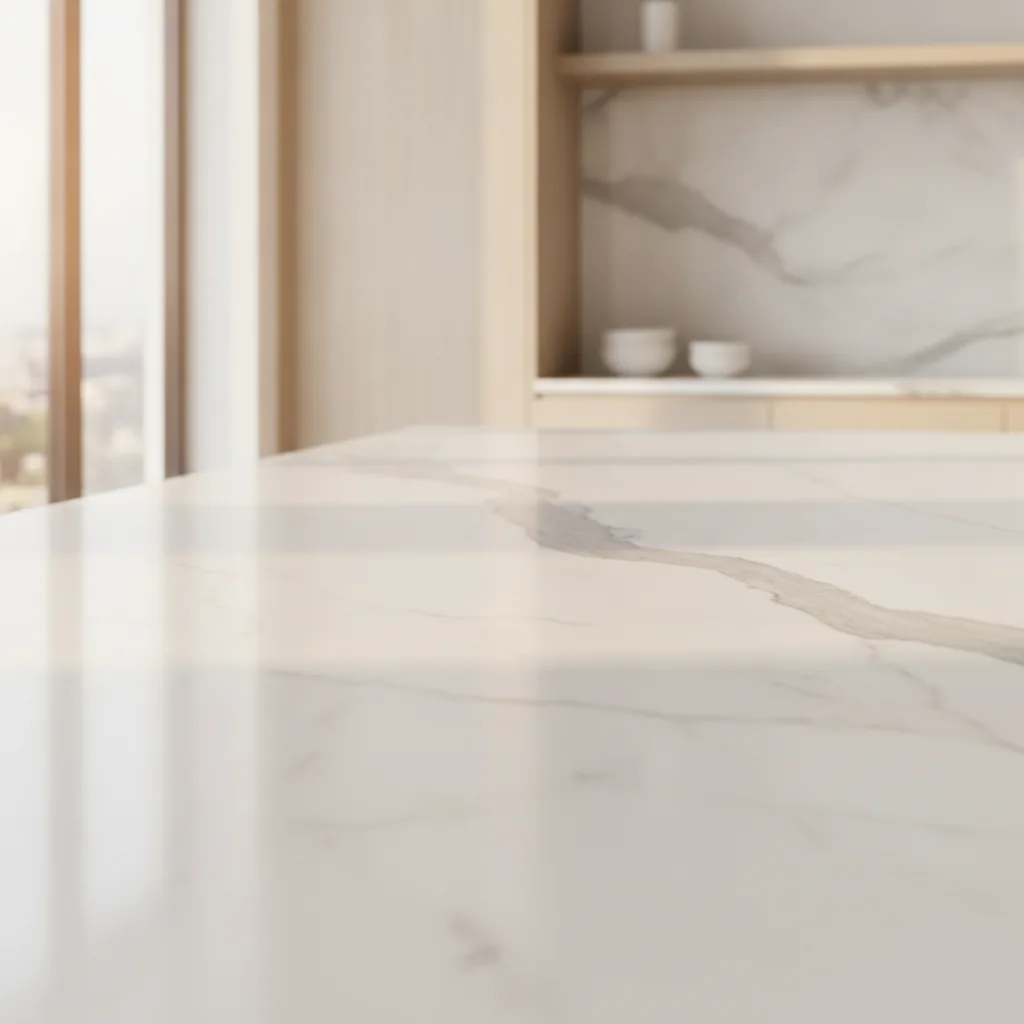
Marble is not a zero-impact material, but it compares favorably to engineered stone alternatives when measured across its full lifecycle. It requires no petroleum-based resins, no factory synthesis, and no synthetic binders to create. A 2026 peer-reviewed LCA published in Sustainability (MDPI) puts marble's production-stage climate impact at 43.97 kg CO2-eq per cubic meter. That number rises with long shipping distances — transportation alone accounts for roughly 47% of that total. The stronger sustainability argument is longevity: a properly maintained marble countertop can last 100 or more years, while engineered stone typically needs replacement every 25 to 30 years. At end of life, marble is 100% recyclable and inert; engineered stone composite often ends up in a landfill.
Marble sustainability is not a simple yes or no question — but it has a defensible answer. Natural marble requires no petroleum-based resins, no synthetic binders, and no factory synthesis to exist: it comes out of the ground, gets cut, and gets polished. That minimal processing is a genuine environmental asset. The quarrying phase carries real costs, particularly in energy consumption and waste generation, and this article explores both sides honestly. The core argument, supported by lifecycle assessments as of 2026, is that marble compares favorably to engineered stone alternatives when measured across decades of useful life rather than just at the extraction stage. For Central Texas homeowners making a high-ticket material decision, understanding that full lifecycle picture is what separates a well-informed choice from one based on marketing claims.
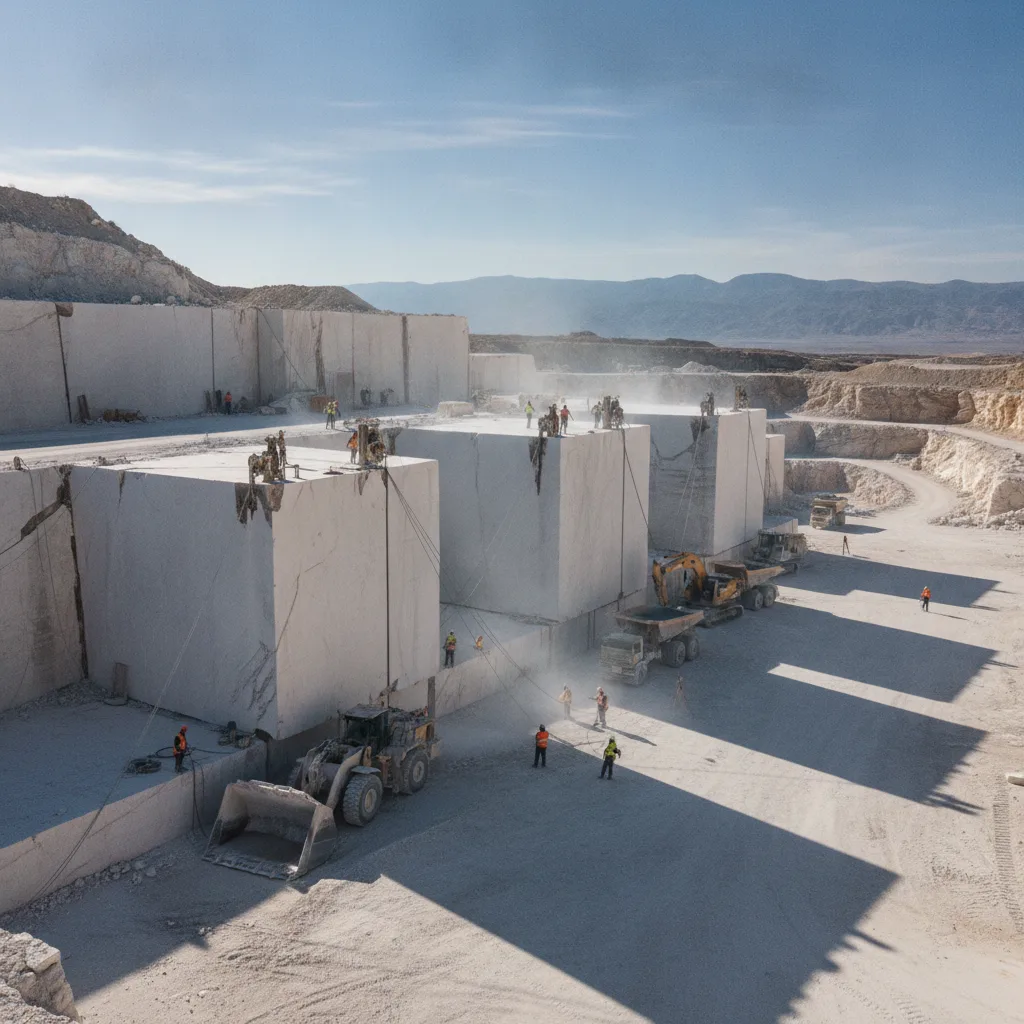
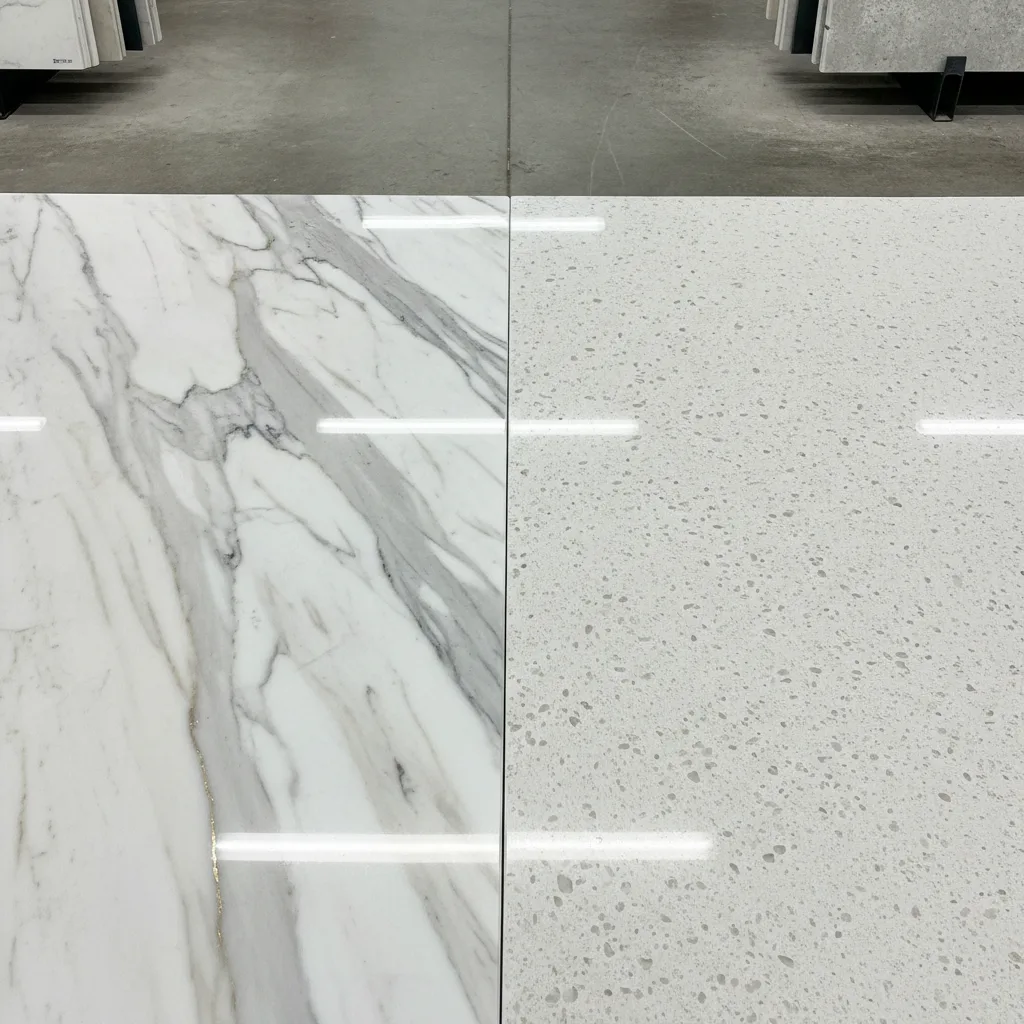
Marble's environmental argument is that it carries lower impact than most manufactured alternatives when you assess it across its full lifecycle and longevity, not just at the quarry gate. That framing matters because nearly every competing material looks better if you stop the clock at day one and ignore what happens over the next 100 years. Natural marble requires no petroleum-based resins, no synthetic binders, and no factory synthesis to create — it exists in natural form, gets extracted, and undergoes minimal processing before installation. Engineered stone, by contrast, requires vibro-compression under vacuum, resin curing, and energy-intensive polishing at every stage of manufacturing.
Lifecycle assessments consistently show that natural stone carries a lower embodied carbon footprint than engineered quartz, terrazzo, or composite materials when longevity is factored in. A marble countertop maintained properly can last 100 or more years. Engineered stone has a typical design life of 25 to 30 years before degradation becomes apparent, meaning it will likely require replacement two or three times over the same span a single marble slab serves. That replacement cycle multiplies every upstream environmental cost of manufactured materials — including the resin extraction, manufacturing energy, and eventual landfill disposal.
The marble industry still has real environmental costs at the extraction stage, and the steps below cover those honestly. But the starting question for environmentally conscious clients should always be: compared to what material, and over what timeframe? Sustainable design principles require measuring the full lifecycle, not just the moment of origin. This article explores that complete picture so you can calculate environmental impact with the same rigor that peer-reviewed lifecycle assessments do.
Sustainability comparisons that only count extraction-stage impact are like judging a car's fuel economy by how much energy the factory used to build it. The full lifecycle — including useful life and end-of-life recyclability — changes the picture significantly for natural stone. Designers and architects who work in sustainable design know this; most consumer-facing content does not.
Quarrying is where marble's environmental impact is most concentrated, and there's no honest way to minimize it. Between 30% and 70% of raw marble extracted from a quarry becomes waste during extraction and processing — the range depends heavily on quarry type and processing methods used. That waste challenge is marble's most significant sustainability liability at the production stage. A 2026 peer-reviewed life cycle assessment published in Sustainability (MDPI) quantified the climate change impact of producing one cubic meter of marble block at 43.97 kg CO2-eq, using a cradle-to-gate methodology at a Turkish quarry and cutting plant.
Diesel use during transportation from quarry to processing plant accounts for approximately 47% of that total — meaning transportation emissions are not a footnote, they're nearly half the problem even before the slab leaves the region. The same study found that switching to solar energy and biodiesel at the quarry level reduced climate impact by roughly 25.6%, bringing it to 32.72 kg CO2-eq per cubic meter. That improvement is real and measurable, though it depends on quarry operators actually adopting renewable energy sources — something buyers can verify by asking about quarry certifications. Reducing energy consumption at the quarry level through renewable energy is the single biggest lever for improving marble's production-stage sustainability profile.
Water consumption during marble processing is also substantial: studies cite 17 to 61 cubic meters per ton during cutting and polishing. Marble dust and sludge — particularly in Italy's Carrara marble district — create aquatic pollution risks if not managed carefully. These are real environmental costs, and buyers who want to source responsibly need to understand them. The good news is that modern facilities are implementing closed-loop water recycling systems that recover and reuse process water, reducing net water consumption significantly. Progress is uneven across the marble industry, which is why certifications matter.
Marble waste — dust, sludge, offcuts — can be repurposed as cement replacement, aggregate in concrete, eco-friendly bricks, and industrial fillers, supporting a circular economy approach. Peer-reviewed research published in 2024 confirms multiple second-life applications for quarry waste. That doesn't erase the waste generation problem, but it does change whether that waste ends up in a landfill or a productive second-life application.
Comparing marble to engineered stone is where eco-conscious buyers need the most clarity, and where most online content gets the comparison wrong. Engineered quartz countertops contain 7 to 10% petroleum-based polyester or epoxy resin binders by composition. Manufacturing those slabs is energy-intensive by design: vibro-compression under vacuum, resin curing, and polishing all require significant heat and electricity. Those are environmental costs marble quarrying simply does not carry. Marble doesn't require a factory, synthetic materials, or chemical binders — that gap in energy consumption is a genuine and measurable difference.
End-of-life recyclability is where the gap between natural marble and composite materials widens considerably. Natural marble is 100% recyclable and inert. It contains no polyester or epoxy resins, so demolished marble can be crushed and reused as aggregate, decorative chips, or landscape material indefinitely without material degradation. Engineered stone often ends up as landfill because the resin-composite matrix is difficult to separate and recycle — it's a manufactured material that resists circular economy approaches in a way that natural stone does not. Reclaimed marble takes recyclability even further: salvaged from demolished buildings or renovation projects, it contributes zero new extraction impact while delivering a durable surface with timeless beauty.
Natural marble is also free of volatile organic compounds (VOCs). Some adhesives and engineered surfaces off-gas VOCs into indoor environments, with implications for indoor air quality and occupant well-being. Natural stone does not. For homeowners aligning material choices with sustainability goals around healthy indoor environments, that's a meaningful difference. Reclaimed materials in general represent the highest-sustainability option in almost any material category — and reclaimed marble specifically is one of the more available reclaimed materials in the residential market.
Granite and quartzite share most of marble's sustainability profile: natural formation, no synthetic resins, 100% recyclable, and long useful life. If marble's maintenance requirements — periodic sealing, sensitivity to acids — don't fit your kitchen habits, quartzite or granite can deliver a similar lifecycle sustainability advantage with more scratch-resistant surfaces. The sustainable alternative is whichever stone you'll actually keep for decades.
Transportation emissions are marble's second-biggest sustainability variable after quarrying energy, and most buyers never ask about it. Shipping Carrara marble from Italy to Central Texas adds meaningful carbon cost to the slab before it ever reaches a kitchen. Given that diesel transport within the quarry-to-processing leg alone accounts for roughly 47% of marble's total production-stage climate impact, adding ocean freight and long-haul trucking significantly amplifies that figure. The environmental damage from long shipping distances is invisible on the invoice but entirely visible in a full lifecycle assessment.
The practical fix is straightforward: ask where the slab was quarried and request supplier documentation on shipping origin. Marble quarried in North America — including from domestic sources closer to Texas — has a meaningfully smaller carbon footprint than European or distant Asian imports, even when the slab aesthetics look similar. For buyers pursuing LEED credits under Leadership in Energy and Environmental Design, locally sourced marble can contribute directly to those certification points. Regional sourcing isn't just an environmental preference — it's a verifiable, documented sustainability advantage with real market value for projects seeking green building designations.
Some marble suppliers also distinguish between quarrying country and processing country, since blocks are sometimes quarried in one region and processed in another before shipping. A slab might be extracted in Greece or Turkey and processed in Italy, or quarried in Brazil and finished in the United States. Asking both questions — where was it extracted, and where was it cut and polished at the processing plant — gives you a more complete picture of your slab's actual carbon footprint from transportation alone.
Ask: 'Where was this slab quarried, and where was it processed?' If your supplier can't answer both questions, that's a signal about their sourcing transparency. Responsible sourcing starts with knowing the origin of your raw material — and those two questions are free to ask.
Modern responsible quarrying practices include diamond wire cutting to reduce marble waste, closed-loop water recycling systems, ISO 14001 environmental management certification, site rehabilitation programs, and renewable energy adoption at processing plants. These improvements don't erase quarrying's environmental cost, but they represent measurable progress in the marble industry's sustainability profile — and they give buyers a concrete checklist for evaluating marble suppliers. The difference between a quarry with documented environmental standards and one without them is the difference between responsible sourcing and accepting an unknown environmental liability.
Three certifications are worth asking about by name. ISO 14001 is an international environmental management standard requiring quarries and processors to document, monitor, and reduce their environmental impact — it's third-party verified, not self-declared. ANSI/NSI 373 is a North American standard covering responsible quarrying and environmental standards specifically for natural stone. Both provide documented, audited evidence of responsible practices and ethical practices, not just marketing language. LEED certification applies to the building project itself, but using locally sourced marble or recycled marble can contribute credits toward that green building designation if environmental design goals include formal certification.
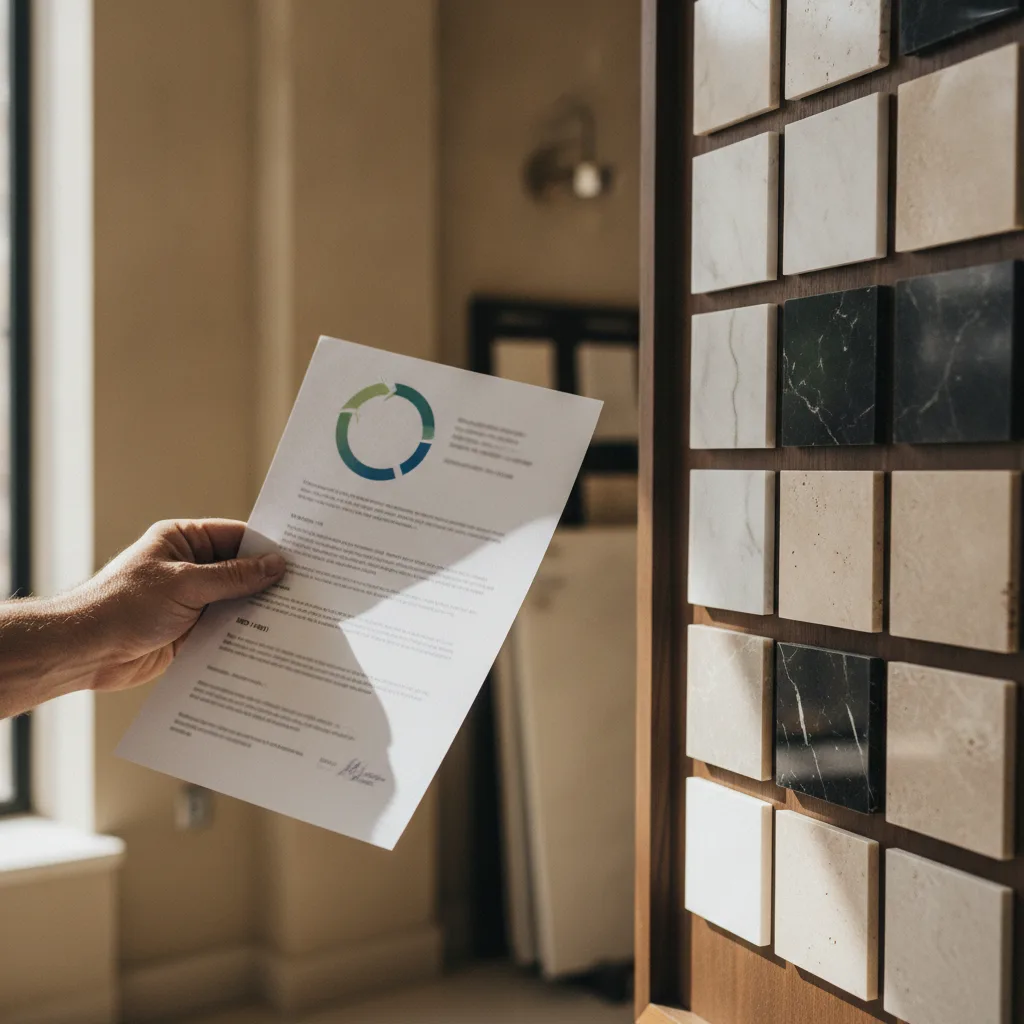
Environmental Product Declarations (EPDs) are another verification tool that more environmentally conscious clients are requesting in both residential and commercial projects. An EPD is a standardized, third-party-verified document that quantifies a material's environmental impact across its lifecycle — similar to the LCA data cited in this post, but product-specific and directly comparable across marble products and other materials. If a marble supplier can provide an EPD for a specific slab or product line, that's a sign of genuine commitment to environmental responsibility and transparency, not just sustainability positioning. Ask your fabricator whether their suppliers offer EPDs, and check whether the quarry has pursued renewable energy for cutting and processing operations.
ISO 14001 (environmental management, quarry-level), ANSI/NSI 373 (responsible natural stone sourcing), and Environmental Product Declarations (EPDs) are the three most meaningful third-party verifications for marble sustainability. LEED credits are project-level and apply to energy and environmental design goals for the building, but locally sourced and recycled marble contribute directly toward those credits.
Marble makes the strongest environmental case in situations where longevity is the goal. A kitchen marble countertop that you maintain and keep for decades amortizes its quarrying carbon cost across a useful life that manufactured materials simply can't match. Its timeless appeal and timeless beauty are themselves sustainability assets — marble doesn't go out of style and get removed due to trend fatigue the way materials with shorter aesthetic shelf lives do. That reduces premature replacement, which is one of the biggest drivers of unnecessary environmental impact in residential spaces. Lower maintenance costs over that lifespan also compound the lifecycle advantage.
If your household habits make marble a poor durability fit — heavy acid use, kids who treat counters like cutting boards — that's worth weighing honestly. A marble countertop that gets replaced in 15 years because of damage loses much of its lifecycle advantage. In that case, quartzite or granite deliver similar sustainability profiles with more forgiving surfaces. The sustainable choice is the one that actually stays in your kitchen for generations, not the one that scores best on a material spec sheet and then gets ripped out. The right material supports both your sustainability goals and your actual daily use patterns.
For Central Texas homeowners working through this decision, the conversation doesn't need to be complicated. At Fox Granite, we help you match material to your actual habits and sustainability goals — whether that's marble, quartzite, or granite — and we source slabs with an eye toward responsible suppliers. We've completed over 10,000 projects since 2010 across Austin, San Antonio, New Braunfels, and the surrounding area, and we're glad to walk through origin, certifications, and lifecycle differences during a free in-home consultation. The right material for your kitchen is the one you'll keep and love for decades, and that's always the most sustainable outcome.
Transportation emissions account for nearly half of marble's total production-stage climate impact even before the slab leaves the quarry region — and that figure only grows with ocean freight and long-haul trucking. If your marble supplier can't tell you where the slab was quarried and where it was processed, you're missing the most actionable sustainability variable in your material choice. Ask both questions before you commit to a slab. Responsibly sourced, regionally quarried marble with documented certifications is a genuinely different product from a beautiful-looking slab with an unknown or high-emission supply chain.
For marble countertop fabrication and installation in Austin, San Antonio, New Braunfels, and the surrounding Central Texas areas, trust Fox Granite. We've completed over 10,000 projects since 2010 and we're glad to help you think through material choices — including the sustainability questions most fabricators won't bring up. Contact us today to schedule your free in-home consultation, and let's find the right stone for your kitchen, your habits, and your sustainability goals.
Ready to get started? Contact Fox Granite today.


BY APPOINTMENT ONLY
1379 Wald Road
New Braunfels, TX 78132
Austin, San Antonio, Cedar Park, Kyle, New Braunfels, Del Valle, Elgin, Lago Vista, Shady Hollow, Onion Creek, Buda, San Marcos, Lockhart, Temple, Wimberley, Dripping Springs, Bee Cave, Lakeway, Leander, Anderson Mill, Jollyville, Spicewood Springs, Round Rock, Georgetown, Pflugerville, Manor, Taylor, Manchaca, Mountain City, Hutto, West Lake Hills, Bastrop, Liberty Hill, Driftwood, Sun City, Steiner Ranch.