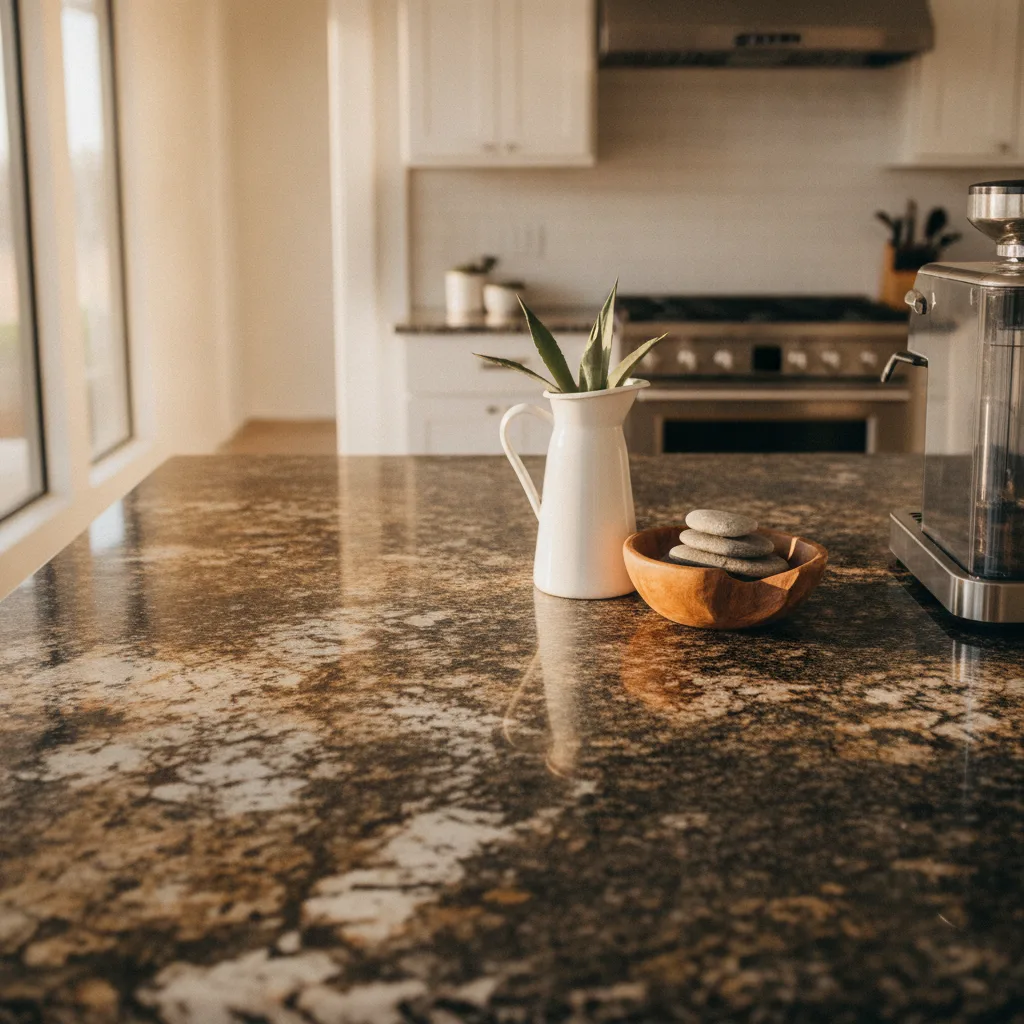
Yes, granite is a porous natural stone — but its porosity ratio ranges from just 0.2% to 1.5%, making it one of the least porous natural stone countertop options available. In its natural state, granite can slowly absorb liquids through microscopic pores along mineral grain boundaries. A properly applied penetrating sealer closes those pores at the surface level, making granite behave like a non-porous countertop material for everyday kitchen use. Most granite countertops in a high-use kitchen need to be resealed every 12 to 18 months. The short answer: granite is porous, yes — but properly sealed, it's a practical, durable surface that handles real-world spills, heat, and daily use without drama.
Granite is porous. That's the honest answer — and it's also the beginning and end of most homeowners' concern about it. At a porosity ratio of 0.2% to 1.5%, granite is one of the least porous natural stone countertop options on the market, far below marble and vastly below limestone. Its porous nature is real, manageable, and handled by a simple sealing schedule that takes less than 30 minutes once a year. This guide walks Central Texas homeowners through exactly what granite's porosity means in a real kitchen, how it compares to other countertop materials, and the straightforward maintenance steps that keep it performing well for years to come.
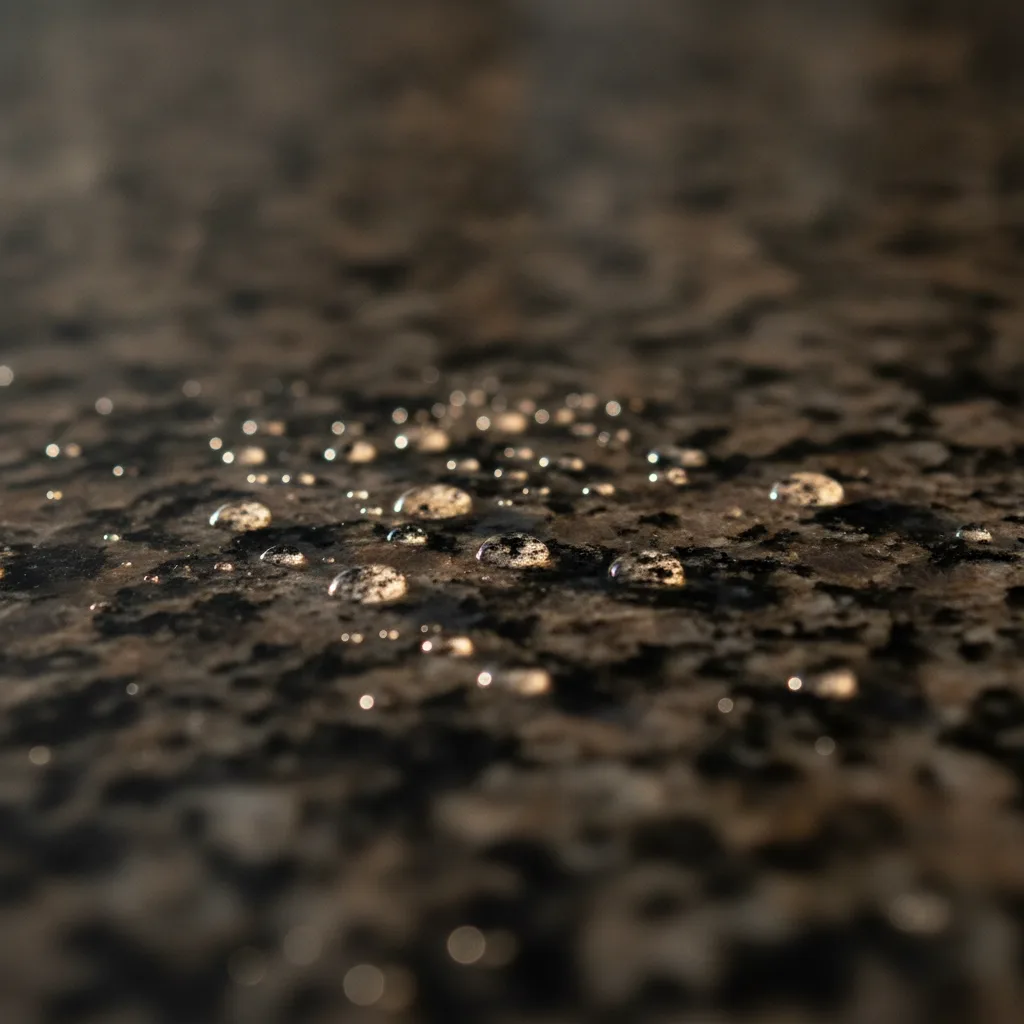
Yes, granite is a porous material — but its porosity ratio ranges from just 0.2% to 1.5%, making it one of the least porous natural stone options available for countertops. Those microscopic pores exist along the boundaries between mineral grains, and in its natural state, granite can slowly absorb liquids. The short answer: porous, yes — a problem, not if you seal it properly.
Here's why that number matters. Marble sits at 0.5%–2.0% porosity and etches from acidic substances like lemon juice and wine on top of staining. Limestone runs 2%–20% or higher. Quartzite is denser than granite at 0.1%–0.5%. Engineered quartz, made with resin binders that fill every void, is near zero and completely non-porous. Granite falls in a very manageable middle ground — porous enough to need sealing, dense enough that a quality sealer handles it with ease. Among porous stones, granite's stain resistance is strong.
Hardness and porosity are two separate things, and confusing them leads to bad countertop decisions. Granite scores 6 to 7 on the Mohs hardness scale — harder than marble (3–5) and comparable to quartzite (7). That hardness measures resistance to scratching, not the presence of pores. A stone can be extremely hard and still have microscopic pores between its minerals. Granite is both hard and practical when sealed properly.
Granite's porous nature is not the same as being fragile or high-maintenance. At 0.2%–1.5%, the porosity is so low that a quality penetrating sealer closes it off at the surface level — which is the only level that matters in a kitchen.
Granite compared to marble is not a close race in the kitchen. Marble's porosity (0.5%–2%) overlaps with granite at the low end, but marble countertops carry an additional vulnerability: etching. Acidic substances — wine, vinegar, citrus juices — don't just stain marble, they chemically react with the calcite in the stone and dull the polished surface permanently. Granite does not etch. That single difference makes granite marble's clear superior for any working kitchen, and it's the reason most fabricators steer high-use households away from marble countertops toward granite or quartzite.
Granite compared to limestone is even more decisive. Limestone can hit 20% or higher porosity, which means spills don't need time to cause damage — they soak in fast. Granite's interlocking crystal structure creates far fewer connected pore pathways, so even unsealed granite absorbs liquids more slowly than most porous stones. Sandstone is in the same category: beautiful in low-traffic applications, but not the right countertop material for a busy household kitchen.
Engineered quartz is the only common countertop material that is genuinely non-porous. Because resins fill all voids during manufacturing, spills cannot penetrate regardless of how long they sit — that's quartz's single biggest practical advantage over any natural stone, including granite. If you have young kids, cook with oil and wine regularly, or simply don't want to think about sealing, quartz is a solid surface worth considering. But if you want natural stone's unique veining, depth, and heat resistance — the timeless appeal and luxury aesthetic that no engineered product fully replicates — granite is the right choice, with sealing as the straightforward tradeoff.
$10–$14 (spray bottle)
pH-neutral formula safe for daily use on granite counters — won't strip the sealer over time the way dish soap residue or vinegar can.
$12–$18
Widely available penetrating sealer rated for granite countertops; applies in under 20 minutes and requires no professional tools.
The water bead test is the most reliable way to know if your granite countertops need resealing — no guesswork, no schedule to memorize. Pour a few tablespoons of water onto a dry section of the countertop surface and wait 10–15 minutes. If water beads up and stays on the surface, the sealer is intact. If it soaks in and darkens the stone, it's time to reseal.
A faster failure signal: if the stone darkens in 4–5 minutes rather than 10–15, the sealer has degraded significantly and you should reseal as soon as possible. Run this test every six months in a busy household kitchen. Test near the sink and near the stove — those stone surfaces take the most wear and will show sealer failure first.
One variable that affects how often granite needs resealing is color. Lighter-colored granite — whites, creams, and light grays — tends to be more porous than others and may need resealing closer to every 12 months. Dense dark granites like Absolute Black can go three years or more. A polished surface finish also reduces porosity compared to honed or leathered finishes, so a polished slab needs sealing less often than the same stone with a matte texture.
Test multiple spots, not just the center of the slab. Areas near the sink, cooktop, and seams see more daily exposure and may lose their sealer faster than the rest of the countertop surface.
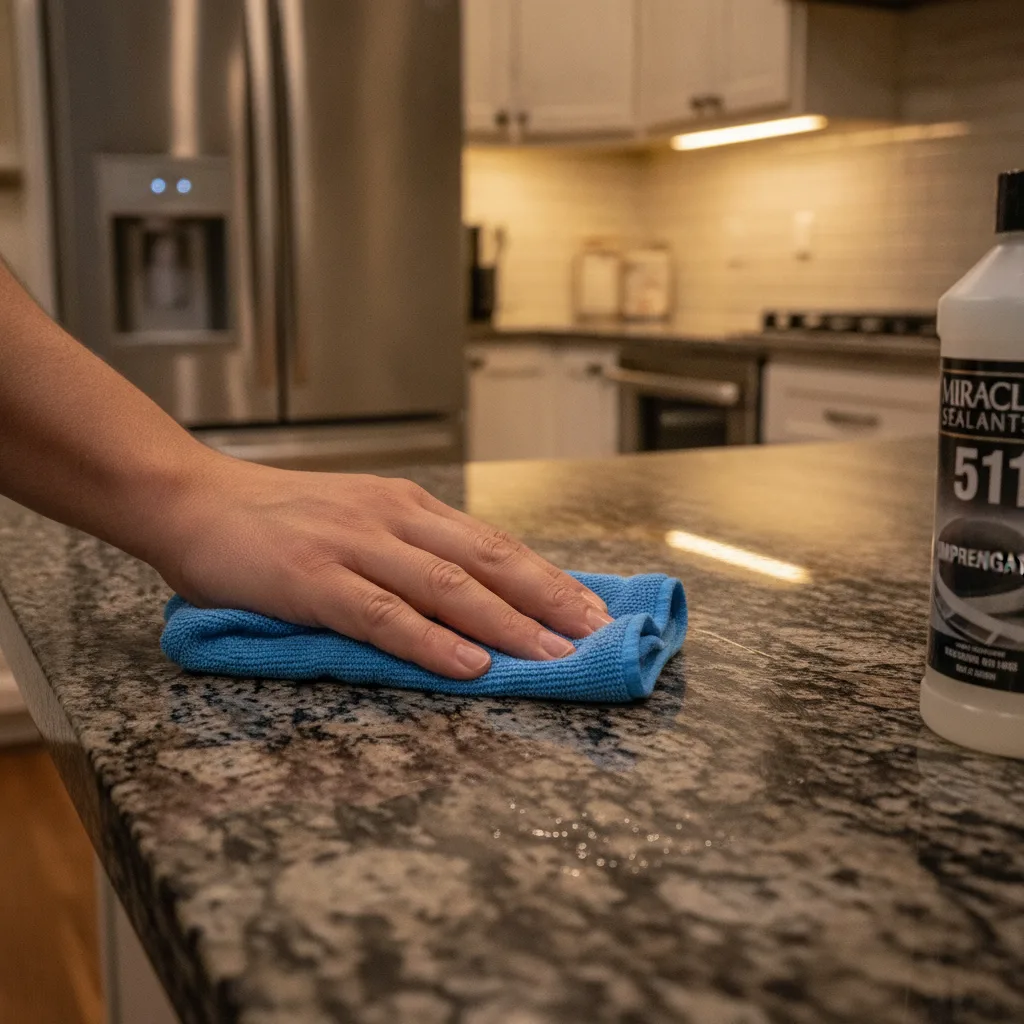
Most granite countertops in a high-use kitchen need to be resealed every 12 to 18 months. Bathroom vanity tops in low-traffic use can go two to three years between sealings. The water bead test is the real trigger — use the schedule as a reminder to run the test, not as a hard deadline. Most granite countertops will communicate clearly when they need attention.
Applying a penetrating sealer is straightforward. Clean the countertop surface thoroughly with a pH-neutral cleaner and let it dry completely — at least an hour, longer if the kitchen is humid. Apply the sealer per the manufacturer's instructions, let it penetrate for the recommended dwell time (usually 15–20 minutes), then wipe away any excess with a clean microfiber cloth. Don't let the sealer pool or dry on the surface — a hazy residue is the result. Most homeowners finish the job in under 30 minutes.
A properly applied penetrating sealer fills granite's microscopic pores at the surface level, creating a barrier that water, oil, and other liquids can't get through without sitting for an extended time. It doesn't make the stone completely impervious — nothing does — but it makes granite behave like a non-porous countertop material for everyday kitchen use. At Fox Granite, every slab leaves our shop already sealed, so your countertops are protected from day one and you won't need to reseal immediately after installation.
The best cleaner for granite countertops is a pH-neutral formula, ideally between pH 7 and pH 9. Products like Granite Gold, Black Diamond Stone Cleaner, Weiman, and Method Stone all fall in that safe range. Dish soap diluted in warm water is also safe for regular cleaning — just don't let soapy water pool near the sink. Wipe and dry the surface after washing to protect the sealer and keep stone surfaces looking polished.
Vinegar, lemon juice, bleach, ammonia, and most glass cleaners fall well outside that safe pH range and strip the sealer over time. Vinegar sits at pH 2.4–3.4 — it's one of the most corrosive common household liquids for granite countertops. Once vinegar or another acidic cleaner strips the sealer, the porous stone underneath is exposed to staining and etching. Regular cleaning with the wrong product will undo a fresh seal in a matter of weeks, which means homeowners using vinegar to 'naturally clean' their granite are actively creating the damage they're trying to avoid.
Properly sealed granite countertops do not harbor bacteria in normal kitchen use. Because sealing closes off the surface pores, bacteria can't get into the stone. Standard cleaning with a pH-neutral cleaner and a microfiber cloth removes surface bacteria effectively — you don't need harsh antibacterial products, and using them risks sealer damage that creates the very vulnerability you're trying to prevent. Sealed granite is a hygienic, food-safe counter surface for any kitchen.
$10–$15
pH-balanced spray cleaner that's safe for sealed granite counters and widely available at major retailers.
$5–$8
Plant-based, pH-neutral formula that handles regular cleaning without degrading the sealer.
Never use vinegar, lemon juice, bleach, ammonia, or abrasive scrubbing pads on granite. All of them damage the sealer — some within a single cleaning session. If your countertop already looks dull or water absorbs in under 5 minutes, the sealer is likely compromised. Run the water bead test and reseal before switching to a safe cleaner.
Granite is heat resistant up to approximately 1,200°F–1,650°F — far above the 300°F–500°F range of a typical stovetop or oven pan. The stone itself won't crack, scorch, or discolor from a hot pan placed directly on the surface. That heat resistance is one of the genuine practical advantages granite has over engineered quartz, laminate, and most other countertop material options — and it's one reason granite remains a worthwhile investment for households that cook daily.
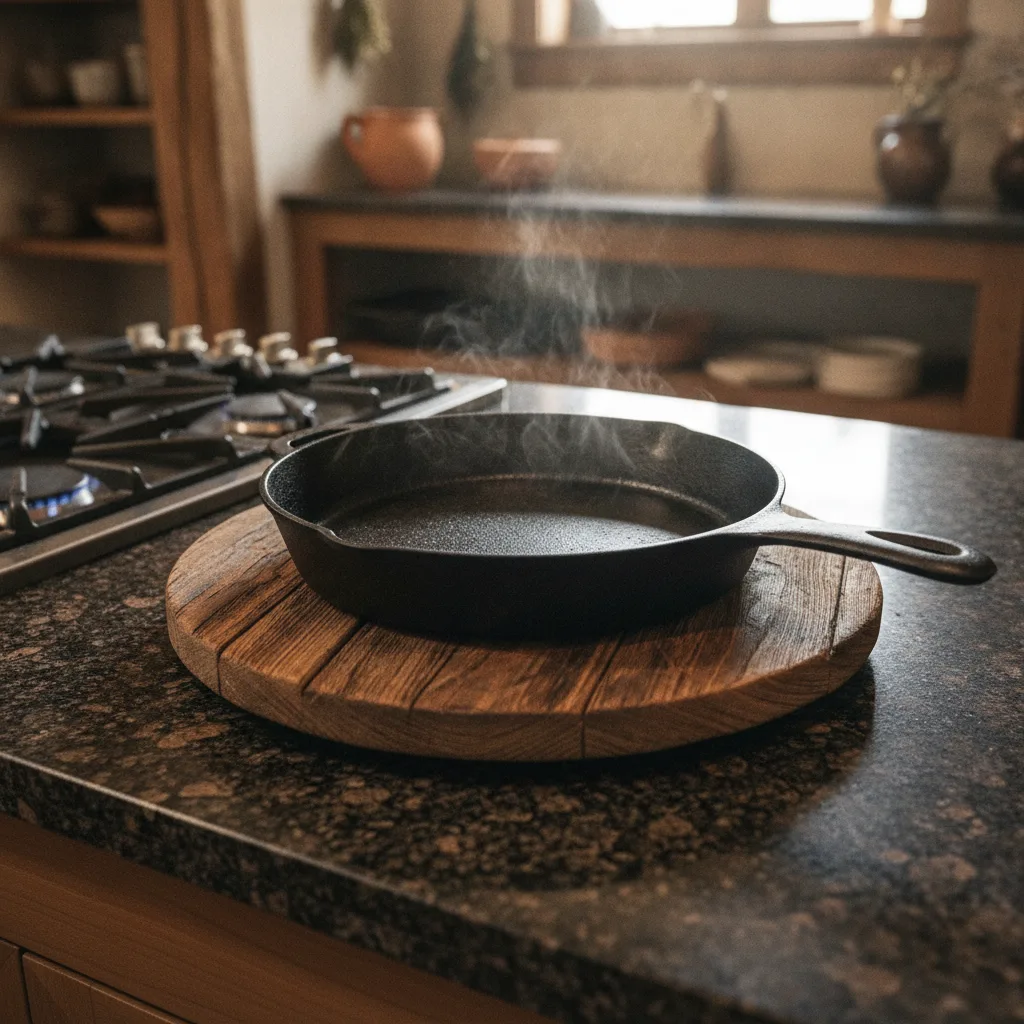
The real risk from hot pans isn't to the stone — it's to the sealant. Repeated direct heat exposure degrades the sealer over time, which opens the porous stone underneath to liquids and stains. Use a trivet or heat pad as a habit, not because granite can't handle the heat, but because protecting the sealer means protecting your countertops long-term. That 10-second step can extend months between resealing cycles and protect the natural beauty and durability of the slab for years to come.
Hot pans are also a minor risk near seams, where two slabs meet and the adhesive can be sensitive to sudden temperature changes. Keep trivets near the cooktop and oven, and you won't think about this again. Granite's durability and timeless appeal shine in busy households precisely because this is the full extent of the required care: no special coatings, no annual refinishing, no solid surface repairs — just a simple sealing schedule, the right cleaning products, and a trivet near the stove.
The single most common mistake granite owners make is resealing on a fixed calendar schedule instead of checking whether the sealer actually needs it. Always run the water bead test before applying a new coat. Sealing over an intact sealer wastes product and can leave a hazy residue on the countertop surface. If water beads up cleanly after 10–15 minutes, your granite is protected. If it darkens — especially within 4–5 minutes — reseal immediately. Let the stone tell you what it needs.
Granite's porosity is a fact, not a flaw. At 0.2%–1.5%, it's low enough that a properly applied sealer makes it a practical, durable countertop material for real Central Texas kitchens — busy households, high heat, daily spills, and all. The maintenance routine is simple: run the water bead test every six months, reseal every 12–18 months in a high-use kitchen, clean with a pH-neutral product, and use a trivet near the stove. That's it. For granite countertops in Austin, San Antonio, New Braunfels, and the surrounding Central Texas area, Fox Granite handles in-house fabrication so quality is never handed off to a subcontractor — and every slab leaves our shop already sealed. Contact us today to schedule your free consultation, or call (512) 653-5541 to get your free estimate.
Ready to get started? Contact Fox Granite today.


BY APPOINTMENT ONLY
1379 Wald Road
New Braunfels, TX 78132
Austin, San Antonio, Cedar Park, Kyle, New Braunfels, Del Valle, Elgin, Lago Vista, Shady Hollow, Onion Creek, Buda, San Marcos, Lockhart, Temple, Wimberley, Dripping Springs, Bee Cave, Lakeway, Leander, Anderson Mill, Jollyville, Spicewood Springs, Round Rock, Georgetown, Pflugerville, Manor, Taylor, Manchaca, Mountain City, Hutto, West Lake Hills, Bastrop, Liberty Hill, Driftwood, Sun City, Steiner Ranch.