
Before hiring a quartz countertop fabricator, ask for a fully itemized quote (not just a per-square-foot number), confirm whether fabrication and installation are done in-house, verify the templating method, and get the exact slab brand and lot number in writing. Also request a certificate of insurance with at least $1 million general liability, written warranty terms for both material and labor, and a signed contract before any work starts. In Central Texas, installed quartz runs $55–$120 per square foot in 2026, and quotes for identical scopes commonly differ by 20–30%. Asking these questions before signing is the only reliable way to know whether that difference reflects material quality or missing line items.
A typical Central Texas kitchen quartz countertop project runs $2,800–$6,000 all-in as of 2026 — but that number only holds if your quote actually includes everything. Price differences of 20–30% between quartz countertop fabricators quoting the same scope are common, and the gap almost never reflects a shop passing savings along to you. It reflects missing line items, B-grade quartz material, subcontracted installation, or warranty terms that exist in name only. This guide gives you eight concrete questions to ask before you sign anything, along with what a straight answer sounds like versus a red flag. Whether you are choosing countertops for a kitchen remodel, bathroom vanities, bar tops, or fireplace surrounds, these steps apply. Budget 30–45 minutes to read through and write your questions down before your first appointment.

A low per-square-foot price on a quartz countertop quote often hides costs that will hit you at the end of the project. In 2026, a complete kitchen countertop project for a 45-square-foot space typically runs $2,800–$6,000 all-in — but that total only holds if the estimate includes fabrication, installation, templating, edge profile, sink cutout, and old countertop removal. Ask the fabricator to break each of those out as a line item so you understand exactly what you will pay and why.
Here is what shops commonly charge separately: the template visit ($50–$150 at some shops), edge profile upgrades like ogee or waterfall ($15–$30 per linear foot above the basic eased edge), sink and cooktop cutouts ($50–$150 each), and old countertop removal and disposal ($100–$300). A quote that skips these line items is not cheaper — it is incomplete. This applies whether you are doing a kitchen remodel, bathroom vanities, bar tops, or fireplace surrounds. Interior spaces of every type deserve a complete written estimate before work starts.
A good answer sounds like this: 'Here is everything included, and here is what costs extra if you choose it.' A red-flag answer is a single number with no detail, or a salesperson who says 'we will figure out the rest at templating.' That phrase is how budgets grow 20–30% after you have already committed. Getting all details in writing from the start is the only way to avoid that outcome.
Ask specifically whether the template visit is included in the quote or billed separately. At shops that charge for it, you will see $50–$150 added after the fact if you do not confirm upfront.
In-house fabrication and installation is one of the most important things to confirm before signing with any quartz countertop fabricator. When a shop subcontracts cutting to one company and installation to another, no single party owns the full project. If something goes wrong — a seam placed in the wrong spot, a cabinet damaged during install, a slab that does not fit — you are left making calls between a salesperson, a fabricator, and a third-party installer who all point at each other. Understanding this distinction helps you avoid a situation that is difficult to resolve after the work is completed.
Ask directly: 'Do your own employees cut and install the stone, or do you subcontract either step?' A reputable shop answers clearly. Subcontracting is not automatically disqualifying, but it raises accountability questions you will want answered in writing before work starts. Who is responsible if the slab is cut wrong? Who fixes cabinet damage? Who is on-site during install? These are the types of questions that countertop fabricators with strong track records answer without hesitation.
At Fox Granite, our team handles quartz countertop fabrication and installation in-house from start to finish — the same people who fabricate your stone show up at your home to set it. That single chain of ownership is what makes it straightforward to stand behind the work, whether the project is kitchen countertops, bathroom vanities, or custom countertops for a bar or outdoor space. We are proud of the craftsmanship our staff delivers on every job.
Digital laser templating produces more accurate measurements than physical luan board templates, especially in kitchens with irregular shapes, curved walls, or corner angles that are not exactly 90 degrees. Systems like Prodim or Laser Products Industries capture precise dimensions digitally, and the best shops pipe that data directly into their CNC saw — cutting out the manual transfer errors that cause fitment problems and callbacks. Ask for a quick explanation of their template process before your appointment so you know what to expect on the day they visit your home.
Ask: 'Do you use digital laser templating, and does that data drive your CNC cut file directly?' A shop running a tight digital workflow from dimensions to fabrication will have fewer fitment issues than one still pulling physical boards. If the answer is vague or the fabricator does not know which system they use, that is worth noting in your comparison. Knowledgeable staff at reputable shops can answer this question in under a minute.
Precision templating matters for quartz surfaces more than it might for some natural stone. Quartz slabs are engineered with resin, pigments, and dyes for consistency — characteristics that make quartz an extremely strong and durable material. But that same rigidity means a bad measurement does not self-correct at install; it shows up as a gap or an unlevel counter. Getting the template right is the foundation of a perfect job.
Used by professional fabrication shops — not a homeowner purchase
Captures kitchen and bathroom dimensions digitally and feeds measurements directly to CNC saws, reducing fitment errors compared to physical board templates
A written contract must specify the exact quartz slab you are buying — not 'white quartz' but something like 'Calacatta Gold Quartz, 3 cm, polished finish, Lot #XXXXX, Cambria.' Quartz manufacturers including Cambria, Silestone, and Caesarstone produce slabs in standard sizes (typically 55 by 120 inches or 63 by 126 inches), and the lot or bundle number matters because colors, veining patterns, and textures can vary between production runs. Cambria in particular offers one of the widest selections of patterns manufactured domestically in the country, making lot documentation easy to request.
Ask: 'Can you give me the brand, color name, lot number, thickness, and finish in writing before I sign?' Fabricators who sell non-branded or house-brand quartz material at attractive prices may be moving B-grade slabs purchased at a discount. A reputable shop can name the source and provide documentation without pressure. If the answer is evasion — 'it is comparable to Cambria' or 'we have our own line' — ask to see the spec sheet before you go further. Slabs that cannot be matched to a named manufacturer are worth scrutinizing.
This detail also matters for warranty purposes. The material warranty on quartz (covering manufacturing defects) comes from the quartz manufacturer, not the fabricator. Cambria, for example, offers a limited lifetime warranty — but only for named, documented products. If you cannot confirm which brand you purchased, you cannot file a manufacturer warranty claim later. That warranty is one of the long-term benefits of choosing a named quartz brand over a house-brand alternative.
If a quote is significantly below the going rate and the shop is vague about the slab source, that gap often traces back to B-grade quartz material. The stone may look fine initially but can show inconsistencies in color, finish, or structural integrity over time.

Seam placement is one of the most common sources of homeowner complaints after quartz countertop installation — and one of the easiest to avoid if you ask the right questions upfront. Professional countertop fabricators target seam widths of 1/16 inch or less; high-end CNC work reaches 1/32 inch. Anything wider than 1/16 inch is visible, will collect debris, and detracts from the beauty and elegance of the finished surface. Ask to see a slab layout drawing showing where seams will fall before any cuts are made.
A shop that will not show you a layout drawing, refuses a dry-fit inspection before bonding, or cannot explain how they matched adhesive color to your specific quartz surface is skipping quality-control steps that exist to prevent callbacks. These are not extras — they are basic professional practice. Ask to look at a gallery of completed projects with visible seams so you can view their craftsmanship before you commit. Strong countertop fabricators who do good work are happy to provide photos and references.
Seam placement also affects the appearance and beauty of quartz countertops in ways that matter to the finished kitchen or bathroom. Seams placed in a high-visibility spot — directly in the center of an island, for example — will always draw the eye. A good fabricator places seams at natural break points and matches veining patterns across the joint for a result that reads as close to seamless as the quartz surface allows. Experts who understand both the technical and design side of the work will discuss seam strategy with you before fabrication starts.
Ask every quartz countertop fabricator for a certificate of insurance (COI) before work begins. You are looking for general liability coverage of at least $1 million per occurrence and active workers' compensation coverage. A verbal 'yes, we are insured' is not enough — a COI takes 60 seconds to email, and any legitimate business can produce one on request. Do not let a strong rating on Google or Yelp substitute for a document. Reviews reflect customer experience; a COI protects you from financial exposure.
If an uninsured worker is injured at your home during installation, your homeowner's insurance policy may or may not cover that liability depending on your specific coverage. Do not find out the hard way. Confirm that any subcontractors the shop uses carry their own COI as well, not just the parent company's policy. This is a simple step that takes almost no time and can save you significant trouble down the road.
Checking a fabricator's reputation goes beyond insurance. Look at Google reviews specifically for mentions of post-installation follow-through — did the company respond when something needed repair? Strong reviews on that specific dimension are a better indicator of quality than a polished showroom. Customers who recommend a shop for how it handled a problem after the job was completed give you the most useful signal. A shop with documented responsiveness shows you how they handle issues, not just how they make the sale.
Quartz countertops come with two separate warranties, and most homeowners do not realize it until something goes wrong. The material warranty covers manufacturing defects and comes from the quartz manufacturer — Cambria's limited lifetime warranty is one of the strongest in the industry, and it is a core reason Cambria is an excellent choice for kitchen and bathroom surfaces. The labor warranty covers the fabrication and installation work itself and is the fabricator's own commitment. Get both in writing before signing, and understand what each one does and does not cover.
Ask: 'What does your workmanship warranty cover, and for how long?' A clear answer might be: 'We warrant our fabrication and installation against defects for one year — if a seam opens or a counter is not level, we come back and fix it.' A vague answer — 'we stand behind our work' — is not a warranty. A handshake is not either. The warranty details should be part of the contract so there is no ambiguity about the repair process if something goes wrong after the job is completed.
Also ask what happens if something chips or cracks after installation. Quartz is an extremely strong countertop material with superior strength compared to marble or quartzite, and it is a nonporous surface that does not require sealing — but edges near sinks can chip under heavy impact. A fabricator who handles repair in-house rather than referring you to a third party shows confidence in their own work and keeps the accountability chain short. Quartz's non porous characteristics also make it easy to clean: a quick wipe with a damp cloth handles most spills, though you should avoid harsh cleaners like bleach on polished surfaces to maintain the finish long-term.
Legitimate quartz countertop fabricators take 50% at signing and 50% at installation or completion. Any shop asking for 100% payment upfront before work begins is a red flag — that payment structure removes your only leverage if the project runs late, the slab is wrong, or the installation damages your cabinets. This standard applies whether the countertop project is a small bathroom vanity or a full kitchen and bar top remodel. Understanding standard payment terms before you select a fabricator helps you spot pressure tactics early.
The signed contract should include: the exact slab brand, color, lot number, thickness, and finish; a complete itemized scope of work; installation date and lead time; payment schedule; cancellation policy; and both the material and labor warranty terms. If any of those details are missing, ask for them before you sign. A fabricator who pushes back on contract specifics is showing you how they will handle disputes later. The time to understand the terms is before work starts, not after something goes wrong.
Confirm the installation date in writing, not just as a verbal estimate. Scheduling delays are one of the five most common homeowner complaints about countertop installation — and a written date gives you something concrete to reference if the project slips. Ask what the shop's policy is if they miss the scheduled day, and get that in writing too. Good fabricators who value their customers' time will provide clear scheduling commitments and a fast response if the timeline needs to change.
If a fabricator asks for full payment before templating or fabrication begins, walk away. The standard across reputable shops is 50% at contract signing and the remaining 50% at installation. Paying in full before work starts gives you no recourse if something goes wrong.
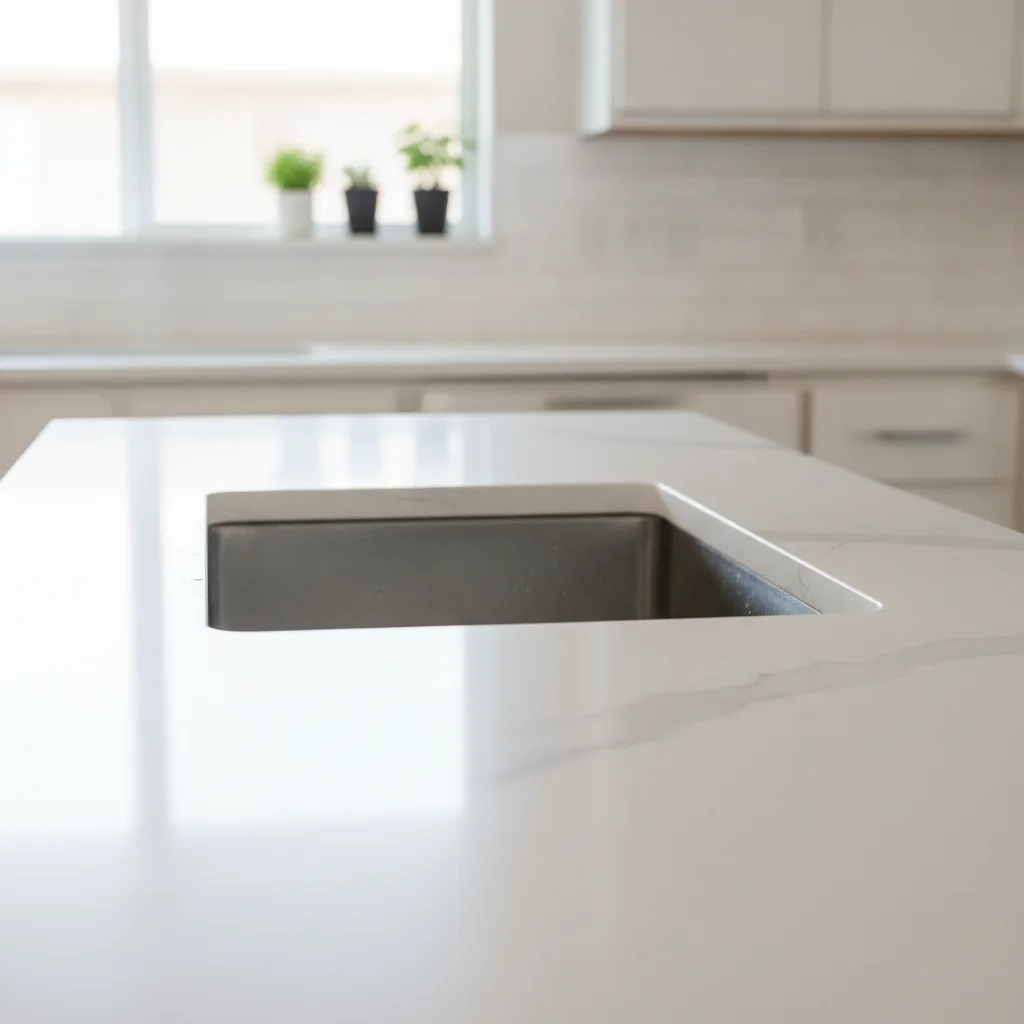
Price differences of 20–30% between shops for the same quartz material and scope are common in 2026. Getting three estimates is not about finding the cheapest option — it is about understanding why the numbers differ. A shop quoting $3,200 all-in and a shop quoting $4,500 all-in for the same kitchen are not necessarily offering the same thing. One may be using a house-brand slab, subcontracting installation, or leaving line items off the quote that will appear later. Ask each shop the questions in this guide and the quotes will start to tell their own story. When you bring this level of preparation to each conversation, you give yourself the resources needed to make a confident, well-informed decision.
When you have worked through these eight steps with every fabricator on your list, you will have a clear picture of who owns the full process, what the quote actually includes, and which shop's warranty is worth the paper it is on. Fox Granite serves customers across Austin, San Antonio, and the surrounding Central Texas areas — and we handle everything in-house: templating, countertop fabrication, and installation, with transparent all-in pricing and no surprise charges. We offer a free in-home consultation where we bring samples directly to you, so you can see colors, patterns, edge profiles, and textures in your actual space before making a decision. Interior design is personal, and we want your vision for the space to guide the process from start to finish. Our knowledgeable team is ready to help you find the right quartz for your home and your life — whether you are transforming a kitchen that has needed an update for years or adding a beautiful new vanity surface to a bathroom. Contact us today to schedule your free estimate or visit our showroom in New Braunfels to view our full quartz slab selection. Connect with our team by calling (512) 653-5541 or get your free estimate online — next steps take about five minutes.
Ready to get started? Contact Fox Granite today.


BY APPOINTMENT ONLY
1379 Wald Road
New Braunfels, TX 78132
Austin, San Antonio, Cedar Park, Kyle, New Braunfels, Del Valle, Elgin, Lago Vista, Shady Hollow, Onion Creek, Buda, San Marcos, Lockhart, Temple, Wimberley, Dripping Springs, Bee Cave, Lakeway, Leander, Anderson Mill, Jollyville, Spicewood Springs, Round Rock, Georgetown, Pflugerville, Manor, Taylor, Manchaca, Mountain City, Hutto, West Lake Hills, Bastrop, Liberty Hill, Driftwood, Sun City, Steiner Ranch.