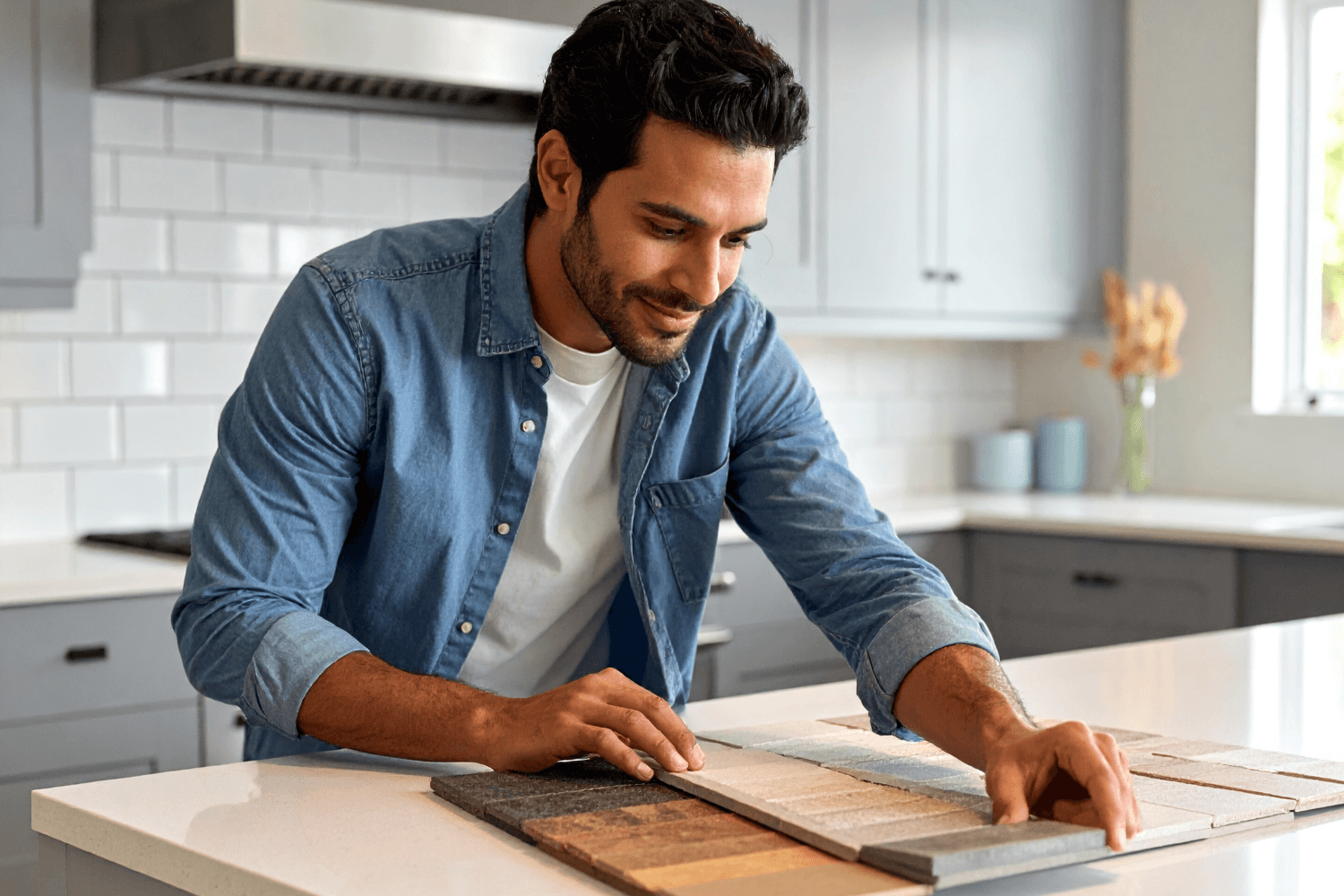
Black quartz countertops cost $55 to $130 per square foot installed in 2026, putting a typical 40-square-foot kitchen project between $2,200 and $5,200 all-in. They're non-porous, never need sealing, and hold up well against stains — but they show fingerprints aggressively on polished finishes and can crack from direct pan contact above 300 degrees Fahrenheit. A honed or leathered finish solves the fingerprint problem. Seam placement is the most overlooked risk: on a solid jet-black slab, a seam between production lots shows as a hard color break. Get layout drawings and lot confirmation from your fabricator before you sign anything. Template to install runs 5 to 14 business days for most Central Texas fabricators.
Black quartz countertops are bold, beautiful, and — if you get the finish and slab wrong — a daily source of regret. The good news: every mistake that makes homeowners miserable with black quartz is avoidable with thirty minutes of planning before you visit a showroom. This guide covers the six decisions that separate the kitchens people love from the ones they quietly wish they'd done differently. Budget 30 to 45 minutes to read and plan; from template appointment to installation day, expect 5 to 14 business days with most Central Texas fabricators.
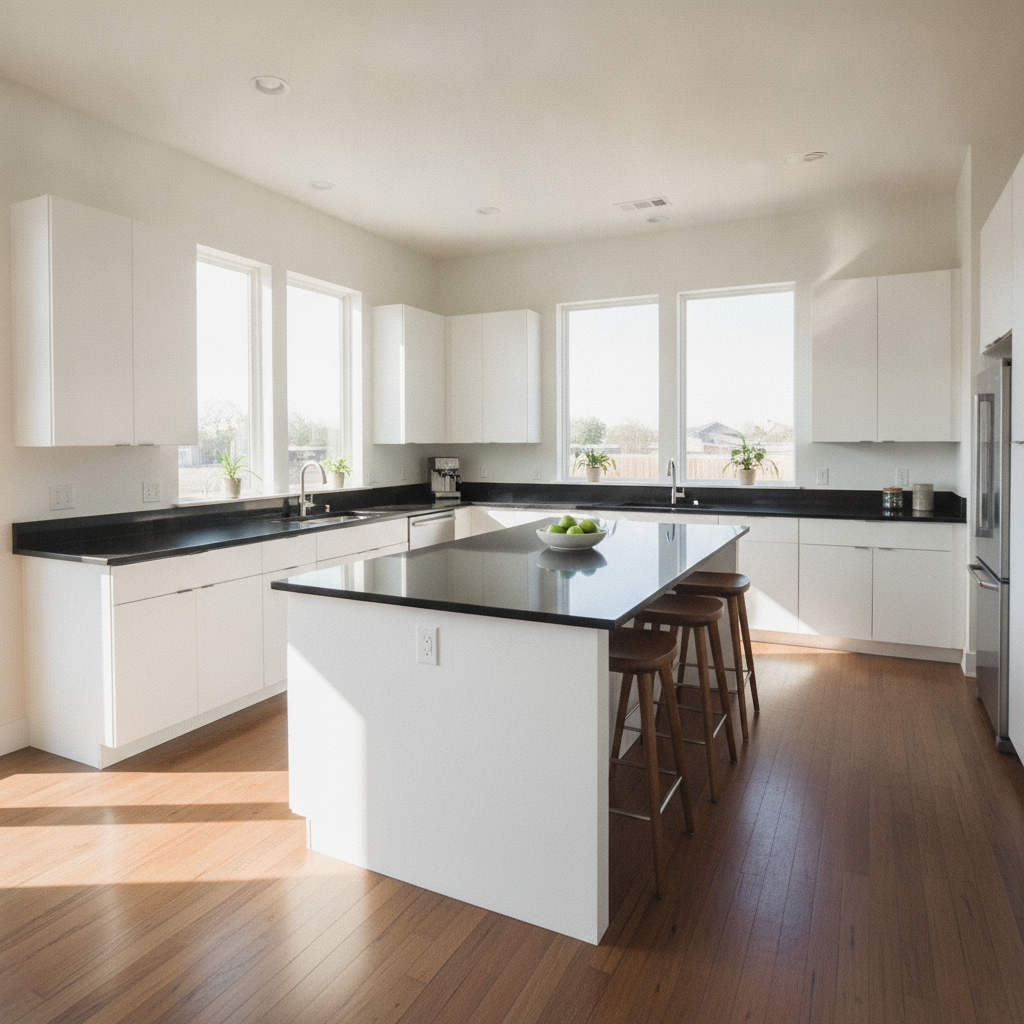
Black quartz countertops read best in modern and contemporary kitchens with flat-panel cabinetry — especially when paired with white or light-wood cabinets where contrast is high. As of 2026, darker countertop colors are resurging after years of white and light gray dominance, and black quartz is showing up in design-forward projects alongside deep green and navy surfaces. That trend is real, but it does not mean black quartz is a universal fit for every kitchen design.
The kitchen style where black quartz struggles most is traditional or farmhouse. Next to warm cream cabinetry, raised-panel doors, and butcher-block accents, a solid jet-black surface can read cold instead of sophisticated. If your kitchen leans that direction, a veined black-and-white slab — options like Caesarstone Jet Black 3100 or Cambria Cleft Black have enough movement to soften the contrast. A honed or leathered finish also reduces the stark, glossy read that makes some traditional kitchens feel off.
Before you fall in love with a slab at the showroom, pull out your phone and look at photos of your kitchen in full daylight. Texas kitchens with south- or west-facing windows get intense afternoon light, and a high-gloss polished finish on black quartz will show every water spot, fingerprint, and crumb the moment the sun hits it. That is not a dealbreaker — it is information that shapes your finish decision in the next step.
Black quartz works beautifully with white shaker cabinets, flat-panel modern boxes, and light Scandinavian wood tones. It is harder to place with honey oak, distressed wood, or warm cream paint. If your cabinets fall in the warm-wood camp, a veined slab with white veins will bridge the gap better than a solid jet-black surface — and give the room more visual depth.
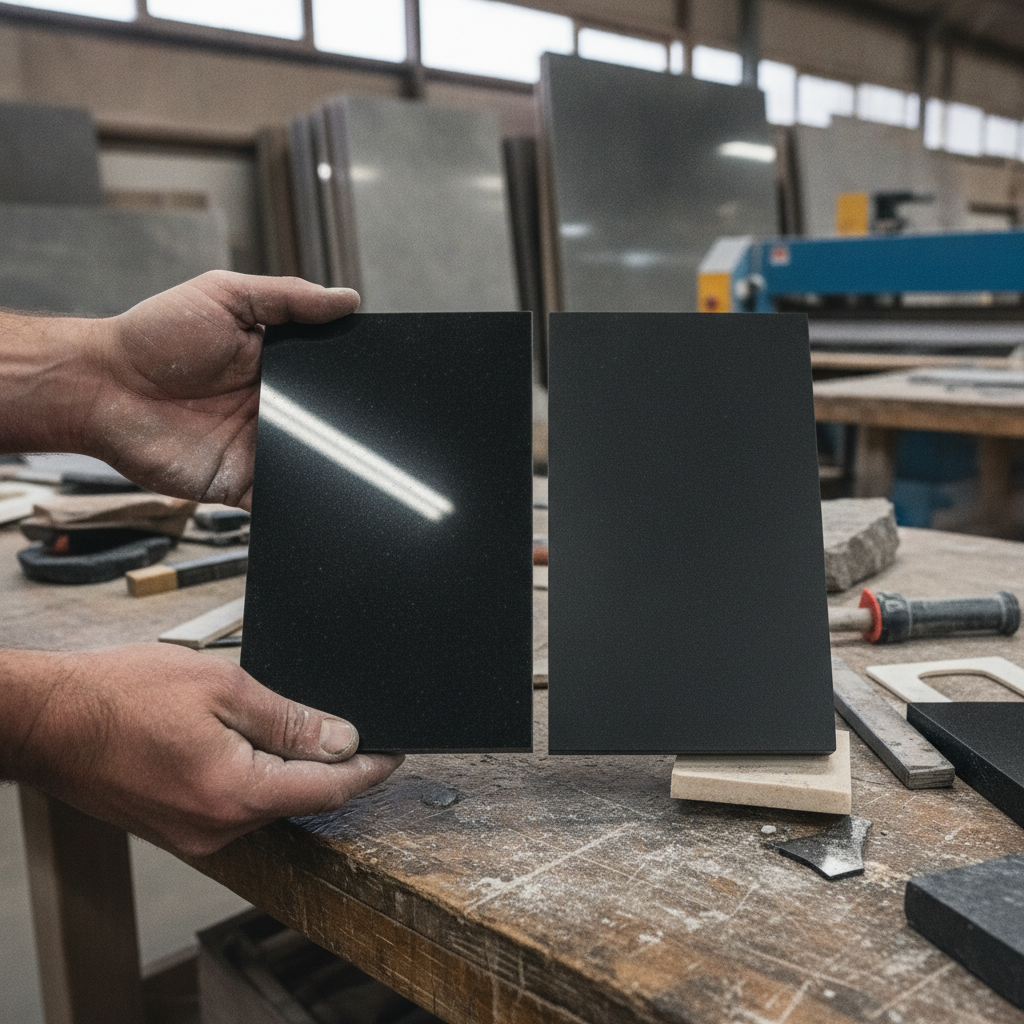
The finish you pick — polished, honed, or leathered — changes how your black quartz countertop looks and how much daily upkeep it actually takes. A polished finish is high-gloss and reflects light dramatically, which creates real visual impact but also catches every fingerprint, water spot, and grease smudge. On a black surface, smudges are visible almost immediately after you touch it — that is physics, not a material defect.
A honed finish is matte and flat. It shows far fewer fingerprints and grease marks because it does not reflect light the same way. The trade-off is that the deep, mirror-like color saturation of a polished slab is gone — honed black quartz reads more charcoal than jet black. That is a legitimate design choice, especially in kitchens with a lot of texture and natural materials where a matte surface adds sophistication rather than taking it away. A leathered finish sits between the two: slight sheen, subtle tactile texture, and a surface that breaks up the reflective plane without going fully matte.
The fastest route to smudge frustration is choosing a solid jet-black polished finish without seeing it in your actual kitchen lighting first. The smarter approach: ask your fabricator for a polished sample and a honed sample of the same color, bring both home, and set them on your existing counter top for a weekend. See which one bothers you more after cooking a real meal. Our team at Fox Granite can bring samples directly to your kitchen during a free in-home consultation — that is exactly the kind of side-by-side comparison that saves you from a finish you will regret.
Free (ask your fabricator)
Seeing polished vs. honed vs. leathered black quartz in your actual kitchen light — not a showroom — is the single best way to avoid finish regret before fabrication starts.
If you love the polished look but dread smudges, choose a slab with bold white veining rather than solid jet black. The veined pattern breaks up the reflective plane visually, so fingerprints and water spots are much less obvious in daily use. Veined black quartz slabs like Cambria Blackpool are popular in contemporary kitchens right now and land at the mid-to-upper end of the price range.
Black quartz countertops cost $55 to $130 per square foot installed in 2026, with material, fabrication, and installation labor included in that range. For a typical 40-square-foot kitchen, that works out to $2,200 to $5,200 all-in. White quartz runs a touch cheaper at $50–$120 per square foot installed, but the gap between white and black is rarely more than $5–$10 per square foot — not enough to drive the color decision.
That installed price does not include tear-out of your old countertops, plumbing reconnection, or backsplash work. Sink cutouts, cooktop cutouts, and upgraded edge profiles can add $300–$800 to a project that looked cheaper in a first-line quote. A waterfall edge — where the quartz extends down the sides of the island — is one of the most popular design trends in 2026, but waterfall, ogee, and mitered profiles add $10–$30 per linear foot over a standard eased edge. Know that before you fall in love with the look at the showroom.
Slab thickness matters for both budget and durability. The residential standard is 3 cm (about 1.25 inches). A 2 cm slab saves $5–$15 per square foot on material but requires a plywood substrate, and more critically for black quartz, increases the risk of visible edge chips where the white or gray resin core contrasts sharply against the black face. Spend the extra on 3 cm and a beveled or eased edge profile — both reduce chip risk meaningfully over the life of the stone surface.
Get an all-in quote that explicitly lists edge profiles, sink cutouts, cooktop cutouts, and old-surface removal as separate line items. Fabricators who give a per-square-foot price without those details often look cheapest on paper and most expensive at final invoice. At Fox Granite, our pricing is transparent from the start — no surprise fees at installation day.
Not all black quartz countertop slabs are the same, and the difference between a stunning result and a disappointing one often comes down to the slab selection conversation you have before signing anything. The most commonly specified options in 2026 are Caesarstone Jet Black (3100), Cambria Blackpool and Cleft Black, Silestone Eternal Charcoal Soapstone and Negro Tezate, and MSI Q Jet Black. Caesarstone's material is 93% quartz mineral with a lifetime limited warranty for the original purchaser; Silestone backs its product with a 25-year transferable warranty. Both exclude heat damage and outdoor use.
If your project requires two or more slabs — an island plus a perimeter run, for example — ask your fabricator to pull from the same production lot. Black quartz from different production batches of the same product line can vary slightly in hue, and on a darker surface that variation is much more visible than it would be on a light gray or white slab. This is not a hypothetical risk; it is one of the most common complaints on projects where slabs were sourced from different shipments. A verified same-lot match is worth confirming in writing.
Ask your fabricator four specific questions before you sign off: (1) Where will the seams fall, and can you see a dry-fit layout before installation day? (2) Are these slabs from the same production lot? (3) What edge profile do you recommend for this slab thickness, and why? (4) What is included in the installed price — and what is not? A fabricator with real experience templating black quartz kitchens will answer all four without hesitation. If the answers are vague, keep shopping — the process of reviewing these details reveals exactly how much precision and care a fabricator actually brings to your project.
Free
Seeing the full slab in person — not a 4-inch sample chip — is the only reliable way to evaluate veining, color consistency, and how the finish reads at scale before fabrication begins.
Free
Fox Granite brings samples to your kitchen so you can evaluate color and finish under your actual lighting conditions before committing to a slab and a finish.
Quartz is engineered from 90 to 93% ground quartz crystals mixed with polymer resins and pigments. That resin matrix makes the surface non-porous — it does not absorb wine, oil, or bacteria the way granite or marble can, and it never needs sealing. If a contractor recommends an annual sealing service for your quartz countertop, the recommendation is wrong. Every major quartz manufacturer states that sealing is neither required nor recommended. That is a genuine maintenance advantage over black granite, which needs periodic resealing every one to three years to maintain stain resistance.
The resin binders have one real vulnerability: heat. Quartz can crack, scorch, or discolor from direct contact with pans above roughly 300 degrees Fahrenheit. Thermal shock from a high-temperature pan moved directly from the oven to the counter is the most common cause of damage — even if the average surface temperature stays below the threshold, a sudden spike can damage the resin. Trivets are not optional with quartz. This is especially important to understand before installation because no warranty — including Caesarstone's lifetime limited warranty and Silestone's 25-year warranty — covers heat damage.
UV exposure is the other limitation most homeowners discover after installation. Sunlight breaks down the polymer resin in quartz over time, causing discoloration and delamination. Every major quartz manufacturer excludes outdoor applications from the warranty. If you are planning an outdoor kitchen in your Austin or San Antonio backyard, black quartz is not the right material for that space — granite or quartzite hold up to sun exposure far better, and both are excellent outdoor countertop materials we can fabricate and install. For bathroom vanity applications, quartz is a strong choice since UV exposure is minimal and the non-porous surface resists the daily moisture that damages stone in bath spaces.
Quartz is genuinely maintenance-free in the sealing department — a real advantage over black granite or black marble, both of which need sealing every one to three years. The trade-off is heat sensitivity. Black granite handles a hot pan better; black quartz handles a spilled glass of red wine better. Know which scenario happens more often in your kitchen before you decide.
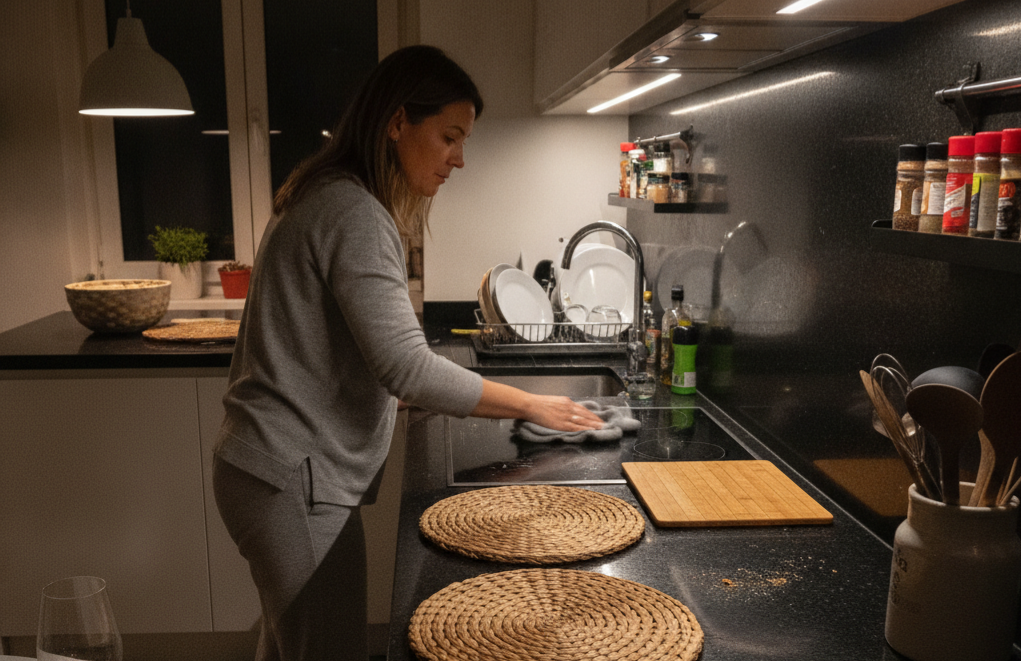
Daily cleaning for black quartz requires warm water, a microfiber cloth, and mild dish soap. That is it. The non-porous surface does not trap bacteria or absorb stains, so there is no special product lineup to maintain. What to avoid: abrasive pads, bleach-heavy cleaners, and anything high-pH or high-acid (below pH 4). Those products dull the resin finish over time, and on a black surface, a dull or etched patch is very visible against the surrounding polished or honed area.
Dust and crumbs show on black quartz more than on lighter surfaces — that is physics, not a material flaw. A quick wipe-down after cooking keeps the surface looking sharp. The homeowners who struggle most with black quartz are the ones who chose a high-gloss polished finish in a kitchen with heavy daily cooking traffic and then skip daily wiping. The ones who are happiest either chose honed or leathered finishes, picked a veined slab that hides smudges in the pattern, or simply built a thirty-second wipe into their end-of-cooking routine. Daily care is the single biggest factor in how these surfaces age.
Edge chipping is the most common warranty-adjacent issue with black quartz. The resin core is often white or gray, so a chip on a dark slab is very visible. A 3 cm slab thickness and a beveled or eased edge profile both reduce chip risk compared to a sharp 90-degree edge. If a chip does occur, a professional stone repair can color-match and fill it. Call your fabricator rather than attempting a DIY fix — color-matching black quartz filler without experience and the right stock of pigmented compounds usually makes the chip more visible, not less. The appearance of the repair matters as much as the structural fix.
$5–$15 for a pack
Soft enough to clean the resin surface without micro-scratching the finish; more effective at lifting grease smudges than paper towels on a polished black surface.
$3–$6
The only cleaner you need for daily quartz maintenance. High-acid or high-alkaline cleaners dull the resin finish over time and are the most common source of surface damage that voids warranties.
$10–$30
Required, not optional. Quartz resin can crack or discolor from direct pan contact above 300 degrees Fahrenheit. Buy them before installation day and place them next to the cooktop and oven landing zone.
On white or light gray quartz, a seam is barely visible. On solid jet-black quartz, a seam is a hard line across your counter — especially if the two slab sections come from different production lots with even a slight color variation. Before your fabrication sign-off, ask your fabricator to show you exactly where seams will fall on a layout drawing, and confirm that all slabs are from the same production lot. A good fabricator does this automatically. If yours does not bring it up, you should. This one conversation is the highest-value thing you can do to protect the beauty and market appeal of your finished kitchen.
Ready to get started? Contact Fox Granite today.


BY APPOINTMENT ONLY
1379 Wald Road
New Braunfels, TX 78132
Austin, San Antonio, Cedar Park, Kyle, New Braunfels, Del Valle, Elgin, Lago Vista, Shady Hollow, Onion Creek, Buda, San Marcos, Lockhart, Temple, Wimberley, Dripping Springs, Bee Cave, Lakeway, Leander, Anderson Mill, Jollyville, Spicewood Springs, Round Rock, Georgetown, Pflugerville, Manor, Taylor, Manchaca, Mountain City, Hutto, West Lake Hills, Bastrop, Liberty Hill, Driftwood, Sun City, Steiner Ranch.