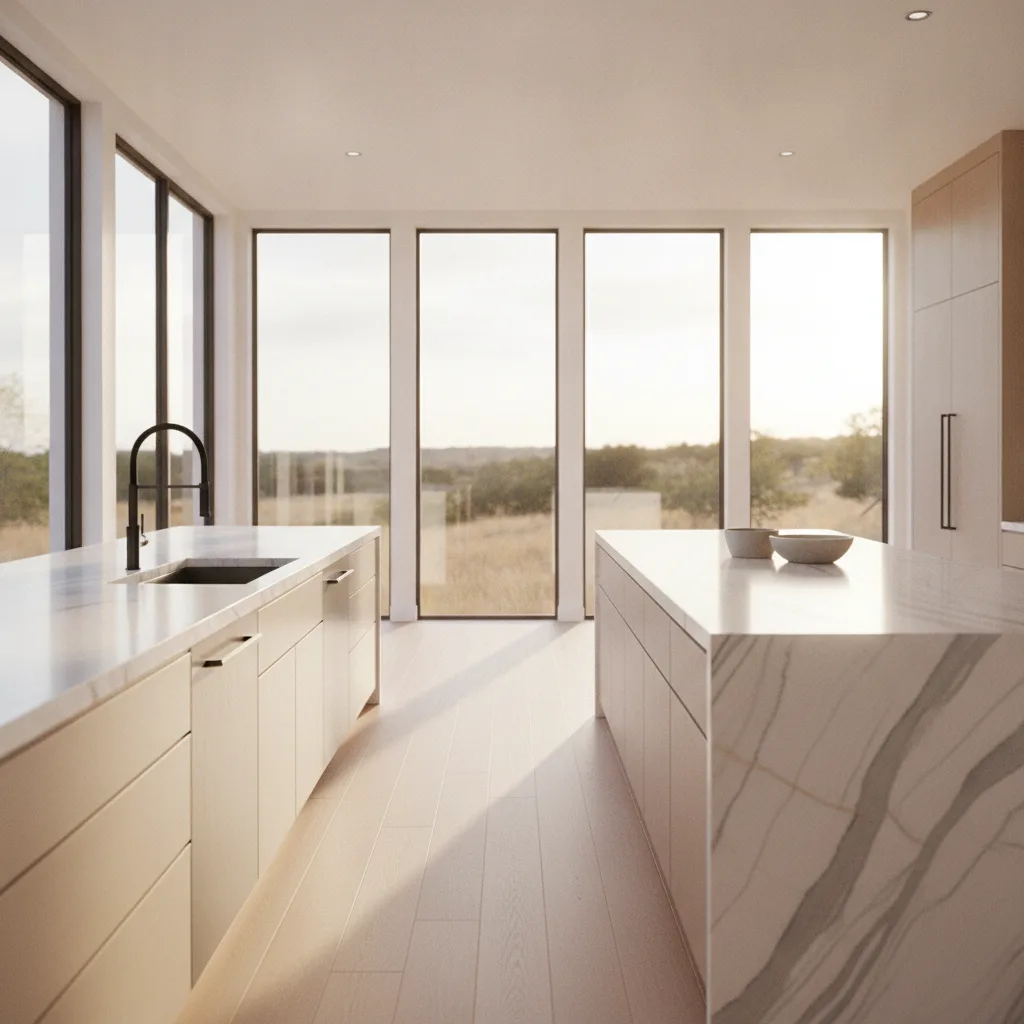
The fastest way to plan a cohesive kitchen look is to choose your countertop material first, then use the 60-30-10 color rule to lock in proportions across cabinets, countertops, and flooring. Match undertones — warm or cool — across every surface before committing to any slab. Then select a finish (honed, leathered, or polished) that fits both your style and your cleaning habits. For Central Texas kitchens in 2026, quartz countertops lead for low-maintenance households, quartzite for homeowners who want the marble look with real durability, and granite for heat-heavy cooks who want a 50-year surface. The full process takes 2–3 hours of planning plus one slab yard visit.
Most countertop design mistakes aren't about choosing the wrong material. They happen because homeowners choose in the wrong order — cabinets first, flooring second, a backsplash tile they loved third, and then a countertop they squeezed in last. The result is four surfaces picked on four different days under four different lights that don't read as one kitchen. This guide fixes that problem with a concrete six-step sequence: choose your material first, lock in proportions with the 60-30-10 color rule, match undertones across every surface, then pick a finish that fits your life. Central Texas homeowners can complete the planning portion in 2–3 hours, plus one slab yard visit — and walk out with a plan instead of a mood board full of competing inspiration.
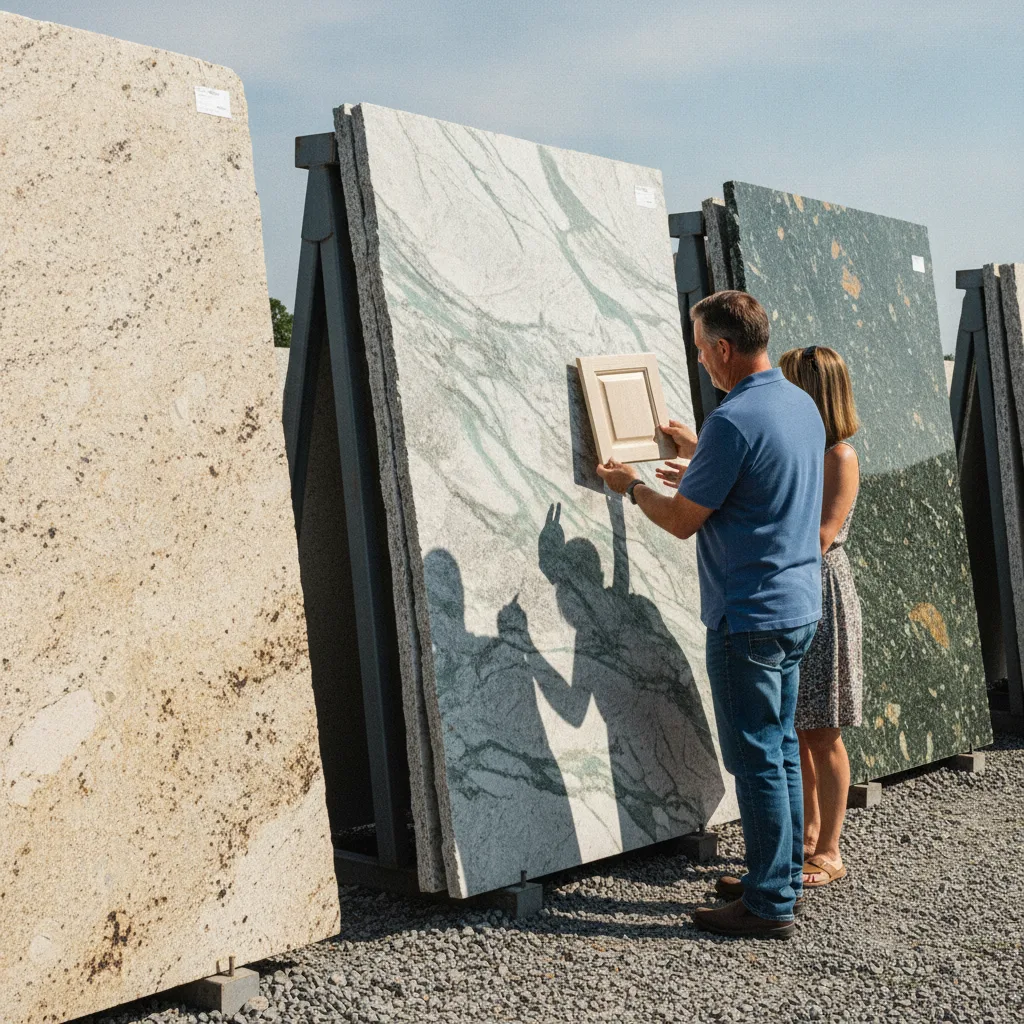
Kitchens that feel disjointed almost always share the same root cause: the countertop was chosen last. The homeowner picked cabinets first, flooring second, a backsplash tile they loved third, and then tried to find a stone countertop that matched all three. That sequence almost never works. The countertop is the largest horizontal surface in the kitchen — it anchors the entire interior design — so it should be the first decision, not the last rescue.
As of 2026, the top principle among design professionals surveyed by the National Kitchen and Bath Association isn't about any single material. It's cohesion: selecting countertop materials in concert with the rest of the kitchen rather than for performance or beauty alone. Four surfaces picked on four different days under four different lights will rarely look like one intentional space. A clear countertop design sequence solves that problem before it starts, and it's the expertise that separates a kitchen that looks designed from one that just looks expensive.
The steps in this guide follow that sequence exactly. You'll lock in your material first, use the 60-30-10 rule to set proportions, match undertones across cabinets and flooring, then choose a finish that works as hard as your kitchen does. By the end, you'll have a complete plan — not a pile of conflicting decor inspiration.
Already ordered cabinets or installed flooring? Start at Step 4 (undertone matching) and work backward. The sequence is most powerful from scratch, but the undertone rule alone saves kitchens at any stage of the remodel.
Countertop materials aren't interchangeable, and durability numbers define which surface actually survives your kitchen. Granite rates 6–7 on the Mohs hardness scale, quartz countertops rate 7, quartzite rates 7–8, and marble rates only 3–5. That gap is practical: marble scratches from a ceramic mug dragged across it; quartzite shrugs it off. Pick the wrong material for your cooking habits and no amount of good countertop design recovers the investment.
Here's how the four materials stack up for Central Texas kitchens in 2026. Quartz countertops are non-porous, never require sealing, and offer the most versatile look in the market — 78% of design professionals surveyed by the NKBA say quartz will be the preferred surface for the next three years, making it the most specifier-recommended stone countertop option available. Granite is scratch-resistant, heat-resistant, and lasts 50+ years with resealing every 1–3 years ($10–$30 DIY or $50–$150 professional). Quartzite offers the sweeping veining and natural stone beauty of marble with a Mohs 7–8 hardness that marble cannot match — over 60% of design professionals expect quartzite's popularity to increase significantly this year. Marble (Mohs 3–5) etches and scratches in a working kitchen; reserve it for low-traffic bathrooms or bakers who accept the patina as part of the look.
Laminate countertops ($15–$40/sq ft installed) are a legitimate budget pick for rental properties or short-term spaces, but laminate doesn't pair the same way with natural stone backsplashes or hardwood flooring and limits your design range significantly. If you're choosing natural stone countertops or quartz for a long-term kitchen upgrade, you're in the right price range to make cohesion worth the full effort.
Free to visit
See full slabs of granite, quartz, quartzite, and marble side by side — you cannot evaluate stone countertops from a 4-inch sample alone
Free
A Fox team member brings samples directly to your kitchen so you can evaluate countertop colors and natural stone under your actual lighting conditions
Quartzite's jump from niche to mainstream is real — but its installed cost of $80–$200+/sq ft reflects that popularity surge. Confirm your budget before falling for a slab at the yard.
The 60-30-10 color rule is the most reliable framework for planning a cohesive kitchen: 60% goes to the dominant element (typically cabinets or walls), 30% to countertops or flooring, and 10% to accent details like hardware or backsplash tile. This proportion split is why some kitchens feel calm and intentional — the eye knows where to land. Break it and the space feels busy or flat, even with expensive stone countertops and good decor choices.
In practice: if your cabinets are a warm white (your 60%), your countertop is your 30% — this is where you add depth, color, or pattern. A quartz countertop in a soft gray-white or a granite in a warm cream picks up the cabinet tone without competing with it. Your backsplash tile or hardware is the 10% where you can go bolder. Popular 2026 material pairings that follow this logic: quartz countertops with painted white cabinets, granite with dark charcoal or black cabinetry, quartzite with white oak cabinetry, and marble with warm wood tones. Each pairing works because the proportions define where the eye rests — not because the materials are expensive.
A huge range of countertop colors exists for every material, which is exactly why the 60-30-10 rule matters. Without it, homeowners tend to pick the slab they love most in isolation — and it clashes with everything already in the space. Let the proportions guide you to a short list of candidates, then choose the one you love from that list. That's the sequence that produces a kitchen that reads as one cohesive design decision rather than four separate ones.
If your cabinets are already a statement color — deep navy, forest green, charcoal — treat them as your 60% and go quieter on the countertop. A calm quartz or a honed granite in a neutral countertop color keeps the cabinets as the focal point rather than creating a visual fight between your two biggest surfaces.
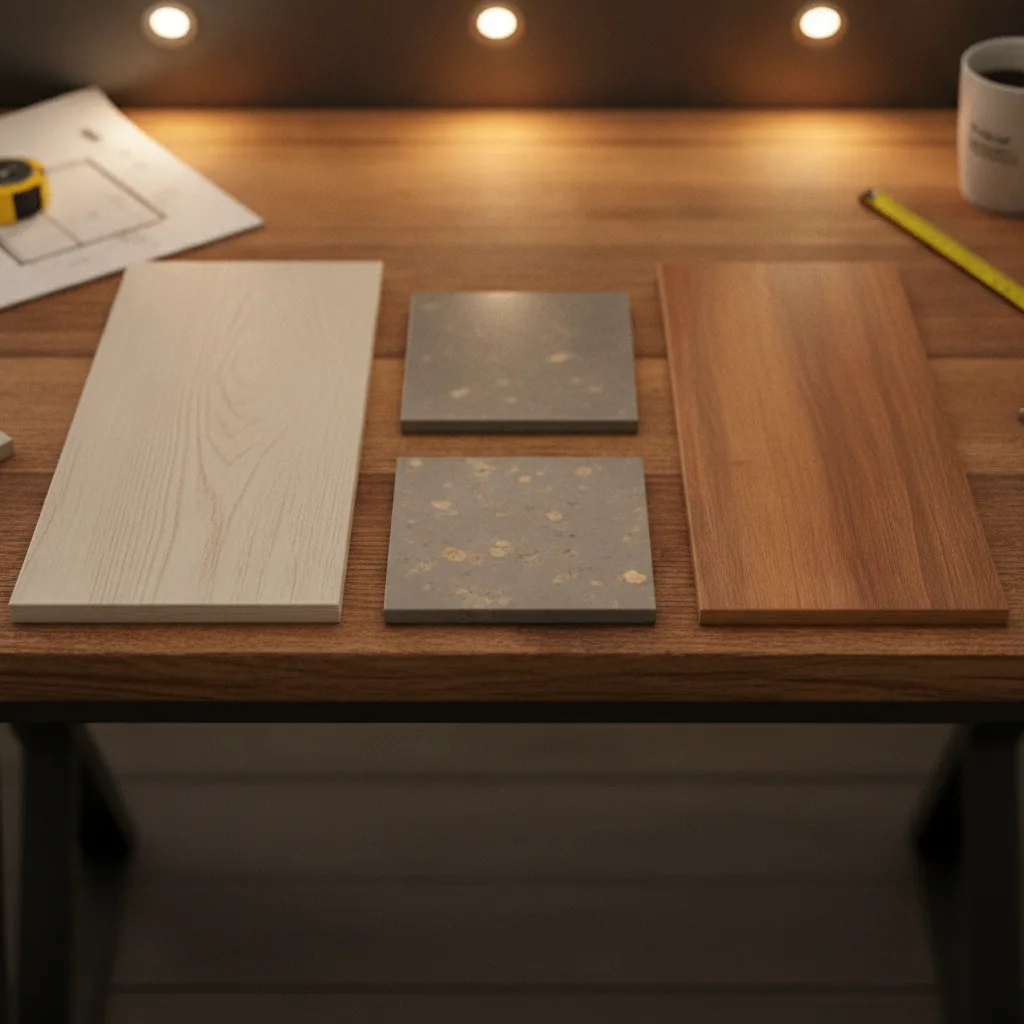
Matching undertones across cabinets, flooring, and countertops is the single most reliable method for creating a unified kitchen aesthetic. Undertones are either warm (yellow, orange, red) or cool (blue, gray, green). A warm beige granite next to cool gray cabinets creates an undertone mismatch that makes even a $15,000 kitchen look off — even if both individual colors are technically neutral. This is the reason people say a kitchen doesn't feel right after spending real money on it, and it's the difference a five-minute sample comparison at the slab yard would have caught.
The practical way to check this: bring your physical cabinet door sample and flooring chip to the slab yard and evaluate them together under both natural light and artificial light. A warm beige slab in the showroom may read distinctly orange under the recessed LED lights in your kitchen. Don't rely on photos. Don't rely on memory. Bring the actual samples and hold them next to the full slab. This single step prevents the most common countertop design mistake we continue to see in Central Texas kitchens, year after year.
For kitchens with cool-toned white oak cabinetry — one of 2026's most popular pairings — find quartzite or quartz countertops with gray, blue, or white undertones, not yellow or gold. For dark charcoal cabinets, granite with silver or white veining keeps the look sleek. For warm wood tones, choose marble or granite with cream, gold, or brown movement that carries warmth through the space without overwhelming the flooring and cabinetry already anchoring the room.
Free from your cabinet supplier
The only accurate way to check undertone compatibility at the slab yard — your phone camera will misread warm and cool tones under showroom lighting
Free from your flooring supplier
Flooring covers more square footage than countertops in most kitchens; an undertone clash there reads louder than anywhere else in the space
Ultra-glossy countertop finishes are shifting out of style in 2026. Designers are moving toward honed, leathered, and matte finishes that highlight a stone's natural color, hide fingerprints, and create a softer, more organic look. A leathered granite gives you texture and depth without the high-shine reflectivity that shows every smudge in a busy kitchen. Honed quartz countertops offer a sleek matte surface that looks current and pairs well with both warm wood cabinetry and cool painted finishes — a versatile choice that works across a wide range of kitchen styles.
Pattern balance matters as much as finish. Strong countertop patterns — dramatic veining, bold movement, high-contrast color — pair best with simple, calmer backsplashes. Conversely, detailed tile backsplashes call for a quieter countertop surface. Getting this balance wrong is one of the most common kitchen interior design mistakes, and it's easy to avoid: if you want a statement marble-look quartzite slab with sweeping veining, keep the backsplash simple. A stacked stone continuation of the slab, a sleek subway tile, or a clean solid surface all let the stone read clearly without competing patterns pulling the eye in multiple directions.
Layout also shapes the right countertop color and pattern choice. Small kitchens look larger with light countertop colors and subtle patterns that reflect light. Larger kitchens can carry darker shades or bold veining without feeling crowded. If your Austin or San Antonio kitchen runs under 150 square feet, reach for a soft white quartz or a light-veined granite — not an inky black granite that will close the space down visually. Lastly, confirm that your finish pick accounts for maintenance: honed and leathered natural stone countertops are more porous than polished finishes and require slightly more frequent sealing.
Honed and leathered natural stone countertops are more porous than polished finishes. Granite needs resealing every 1–3 years; quartzite needs annual sealing. Factor maintenance practicality into your finish decision — not just the look — so your countertop continues to perform a decade from now.
Once your material, countertop colors, finish, and patterns are locked in, execution begins — and who fabricates and installs your countertops matters as much as what you chose. Precision templating using the overlay method ensures your slab is cut to fit your exact kitchen layout, including sink and cooktop cutouts. Errors at this stage are expensive; there is no patching a mis-cut granite slab. In-house fabrication with state-of-the-art stone-cutting software provides tighter tolerances than subcontracted shops and gives you a single point of accountability from slab yard to installation day.
Before signing with any fabricator, confirm three things: their pricing is all-in with no add-on fees for edge profiles, sink cutouts, or sealing; they do their own installation rather than handing it off to a subcontractor; and they can show you completed projects in materials and finishes similar to what you're choosing. At Fox Granite, we've completed over 10,000 projects across Austin, San Antonio, and the Central Texas corridor since 2010 — and we still do every template, cut, and install ourselves. That experience is what keeps the finished countertop looking as good as the slab you chose at the yard.
Book your free in-home estimate before you finalize your material selection. We bring samples directly to your kitchen, evaluate them under your actual lighting, and walk you through the full process — from slab selection at our New Braunfels showroom through installation day. For countertop design in Austin, San Antonio, Round Rock, New Braunfels, and across Central Texas, Fox Granite is ready to help. Contact us today to schedule your free consultation and get your free estimate.
Ask any fabricator whether they handle templating, cutting, and installation in-house or subcontract any phase. A shop that subcontracts installation loses quality control at the most visible stage of the entire project. Insist on a single team from template to install.
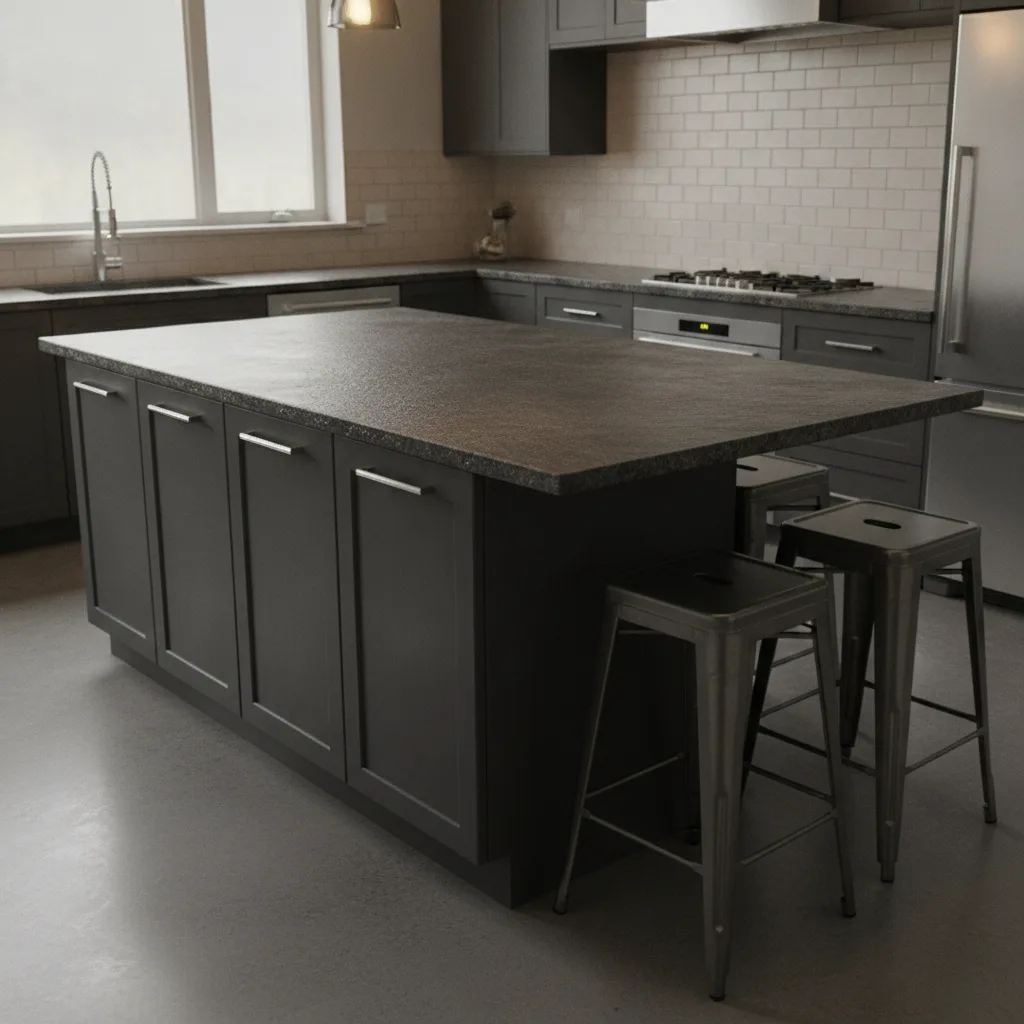
Every cohesive kitchen plan in this guide depends on one step you cannot do online: holding your actual cabinet sample and flooring chip next to a full slab under real light. A warm beige quartz countertop on a website looks completely different from that same slab under your kitchen's recessed lighting. Visit a showroom or schedule a free in-home consultation before you commit to any material, color, or finish. The $0 cost of getting this right upfront beats the very real cost of a countertop you regret three months after install.
Most countertop design mistakes aren't about choosing the wrong material — they're about choosing in the wrong order. Start with the material that fits your life and your budget. Use the 60-30-10 rule to set proportions. Match undertones, not just colors. Then pick a finish that works as hard as your kitchen does. Follow that sequence and your kitchen won't just look good in photos — it'll feel right every single day. For countertop design in Austin, San Antonio, New Braunfels, Round Rock, and across Central Texas, trust Fox Granite. We're family-owned, we fabricate in-house, and we've been doing this since 2010. Contact us today to schedule your free in-home consultation and get your free estimate.
Ready to get started? Contact Fox Granite today.


BY APPOINTMENT ONLY
1379 Wald Road
New Braunfels, TX 78132
Austin, San Antonio, Cedar Park, Kyle, New Braunfels, Del Valle, Elgin, Lago Vista, Shady Hollow, Onion Creek, Buda, San Marcos, Lockhart, Temple, Wimberley, Dripping Springs, Bee Cave, Lakeway, Leander, Anderson Mill, Jollyville, Spicewood Springs, Round Rock, Georgetown, Pflugerville, Manor, Taylor, Manchaca, Mountain City, Hutto, West Lake Hills, Bastrop, Liberty Hill, Driftwood, Sun City, Steiner Ranch.