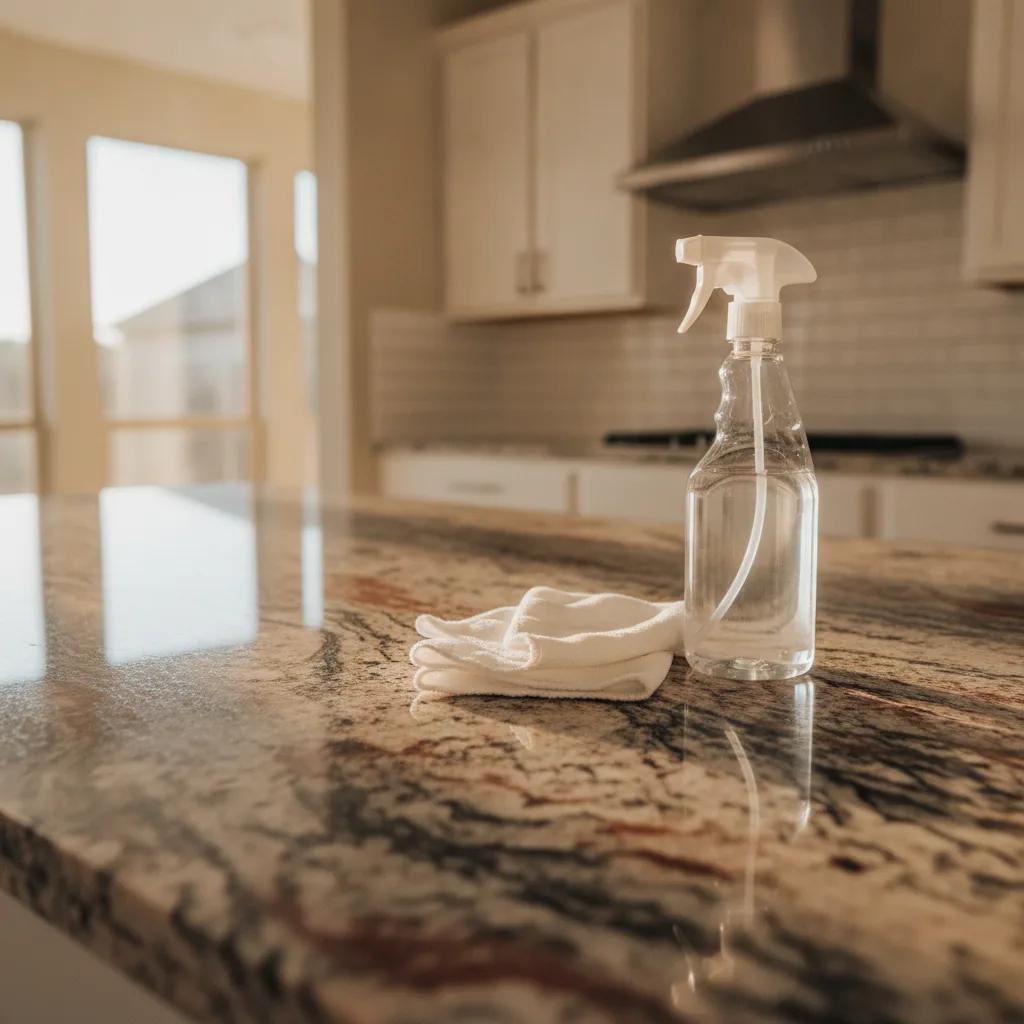
To disinfect granite countertops without damaging the sealant, use a 50/50 mix of 70% isopropyl alcohol and water in a spray bottle. Spray it evenly across the granite surface, let it sit for 3 to 5 minutes so the alcohol can do the killing, then wipe with a damp cloth and dry immediately with a clean microfiber cloth. For daily cleaning, mild dish soap and warm water is all you need. Never use bleach, Clorox wipes, Lysol sprays, vinegar, or ammonia-based cleaners — they all strip the granite sealant over time, leaving the porous stone exposed to bacteria and stains.
The homeowners who damage their granite countertops are almost always trying to keep them clean. They reach for bleach after cutting raw chicken, grab Clorox wipes during flu season, or spray Lysol when someone in the family gets sick — and each time, they're stripping the sealant that actually protects the stone. Disinfecting granite countertops correctly takes the same amount of time and far cheaper products. The difference is knowing which products kill germs without attacking the stone, and understanding why the sealant — not the cleaner — is the real bacteria barrier in your kitchen.
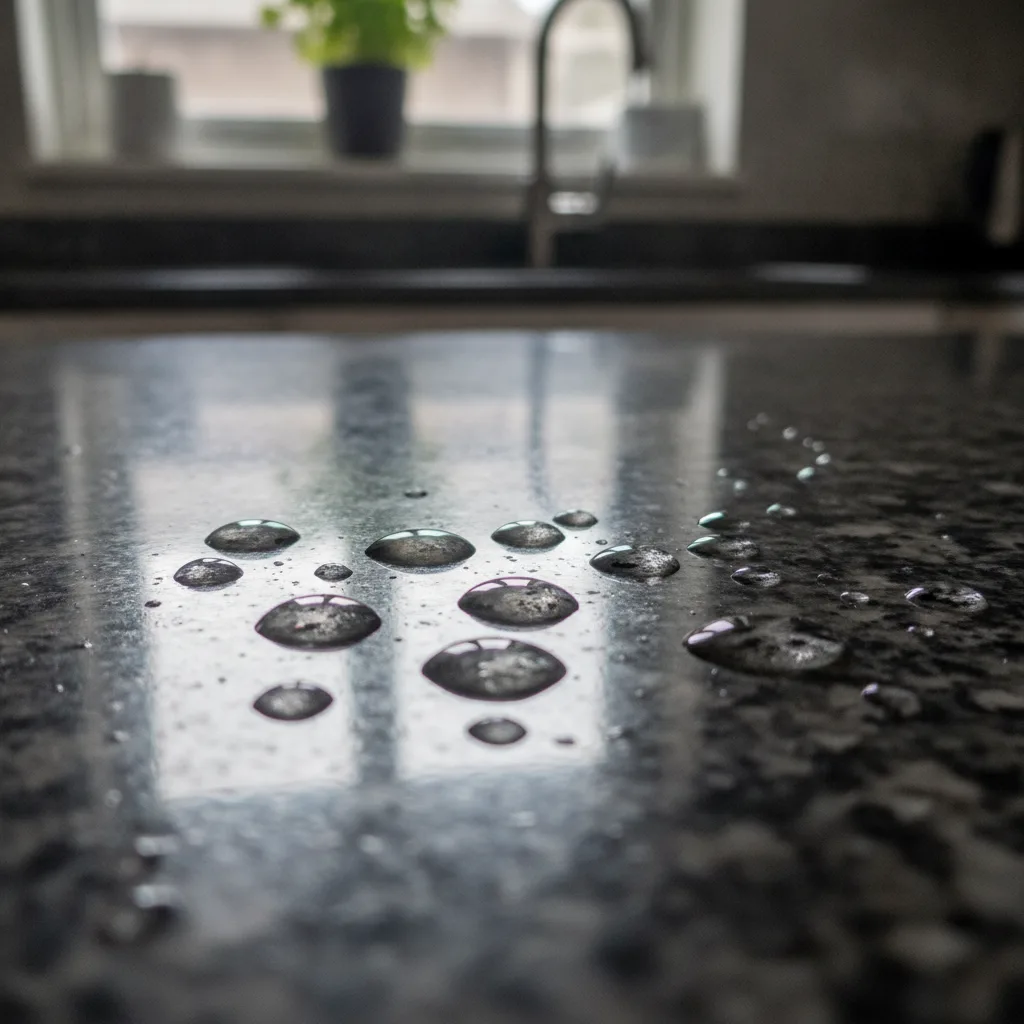
A well-sealed granite countertop is relatively impervious to bacteria — the sealant fills the stone's pores and blocks liquids, germs, and stains from absorbing into the granite itself. Granite is a porous stone, which means an unsealed or under-sealed surface can harbor bacteria in those tiny gaps between the mineral crystals. The sealant is what prevents that. When the sealant is intact, disinfecting granite countertops is straightforward and safe. When it's compromised, no cleaner fully compensates — you're just pushing bacteria around on a vulnerable surface.
This matters because many homeowners reach for heavy-duty disinfectants — bleach, Clorox wipes, Lysol spray — precisely when they're most worried about germs: after a cutting board slipped and raw chicken touched the counter, during cold and flu season, after a stomach bug swept through the family. Those products feel powerful, but on granite they're doing two things at once: killing some germs on top while stripping the sealant underneath. Over time, that tradeoff makes the stone surface less hygienic, not more. The fix starts with knowing your sealant's condition before you clean.
Place a teaspoon of water on your granite counter and let it sit for 10 minutes. If the water beads up, your sealant is in good shape. If the stone darkens or absorbs the water into the surface, it's time to reseal before worrying about disinfecting. Light-colored granite (white, cream, beige) typically needs resealing every 6 to 12 months; dense, dark granite every 2 to 3 years.
Disinfecting works on a clean surface — not on grease, food residue, or crumbs. For everyday cleaning of your granite counter, mix a few drops of mild dish soap (Dawn or any dish soap in the pH 7 to 8.5 range) with warm water, dampen a soft cloth or non-scratch sponge, and wipe down the entire surface. Work from clean areas toward the sink to push grime away from food prep zones. Never use abrasive cleaners, scouring pads, steel wool, or rough scrub sponges — they tear away the sealant and cause scratches and streaks that dull the stone's shine permanently.
Spills deserve immediate attention. Letting liquid sit on granite makes it more likely to soak into the stone, especially if the sealant has any thin spots. Wipe spills quickly with a damp cloth — don't let them soak. Grease and food residue from cooking need a little more soapy water and gentle pressure, but the goal is always the same: clean surface, dry finish, no dirt and grime left behind. Once the surface is visibly clean, you're ready to disinfect.
$3–$6
pH 7–8.5 — safely within the natural stone cleaning range per Natural Stone Institute guidance; won't degrade granite sealant with daily use
$2–$8
Gentle enough to clean without scratching or pulling at the granite's protective sealant
The CDC-backed standard for killing bacteria and viruses on surfaces is an alcohol concentration between 60% and 90% — 70% isopropyl alcohol (rubbing alcohol) is the household benchmark. For disinfecting granite countertops without damaging the sealant, a 50/50 mixture of 70% isopropyl alcohol and water is the most widely recommended method, and it delivers a concentration well above that 60% threshold. Fill a spray bottle with one part rubbing alcohol and one part warm water, shake gently, and label it. That's your go-to disinfecting solution for the kitchen.
If you want a more effective formula — useful after raw meat touched the counter or after illness in the home — combine 2 cups of 100% isopropyl alcohol, 1 cup of warm water, and 1 teaspoon of dish soap in the spray bottle. The alcohol content stays above 60%, and the soap cuts any residual grease while the alcohol handles killing germs. Either mixture keeps the granite surface safe. The key is never diluting below 50% concentration — alcohol's effectiveness against bacteria drops sharply below that threshold, and more water is not better here.
Avoid the temptation to add vinegar, lemon juice, or any acidic ingredient to your spray. Vinegar sits at around pH 2.5 — well below the safe pH 7 to 10 range for polished granite — and repeated use degrades the sealant and can etch calcite-bearing stone over time. The damage is gradual, often invisible for months, and by the time it's noticeable on the stone surface, the protective finish has already been lost.
$3–$7 per 16 oz bottle
CDC-cited optimal concentration range for killing bacteria; safe for granite sealant at proper dilution
$2–$5
Allows even application across the granite surface and controlled contact time — critical for the disinfecting process to work
The 50/50 mix of 70% isopropyl alcohol and water keeps you comfortably above the 50% threshold where alcohol's bacteria-killing power holds. Never substitute hand sanitizer — the gel formula doesn't spread evenly on stone surfaces and leaves a residue that dulls the finish. Four tablespoons of rubbing alcohol per four tablespoons of water is an easy way to measure if you don't have a measuring cup nearby.
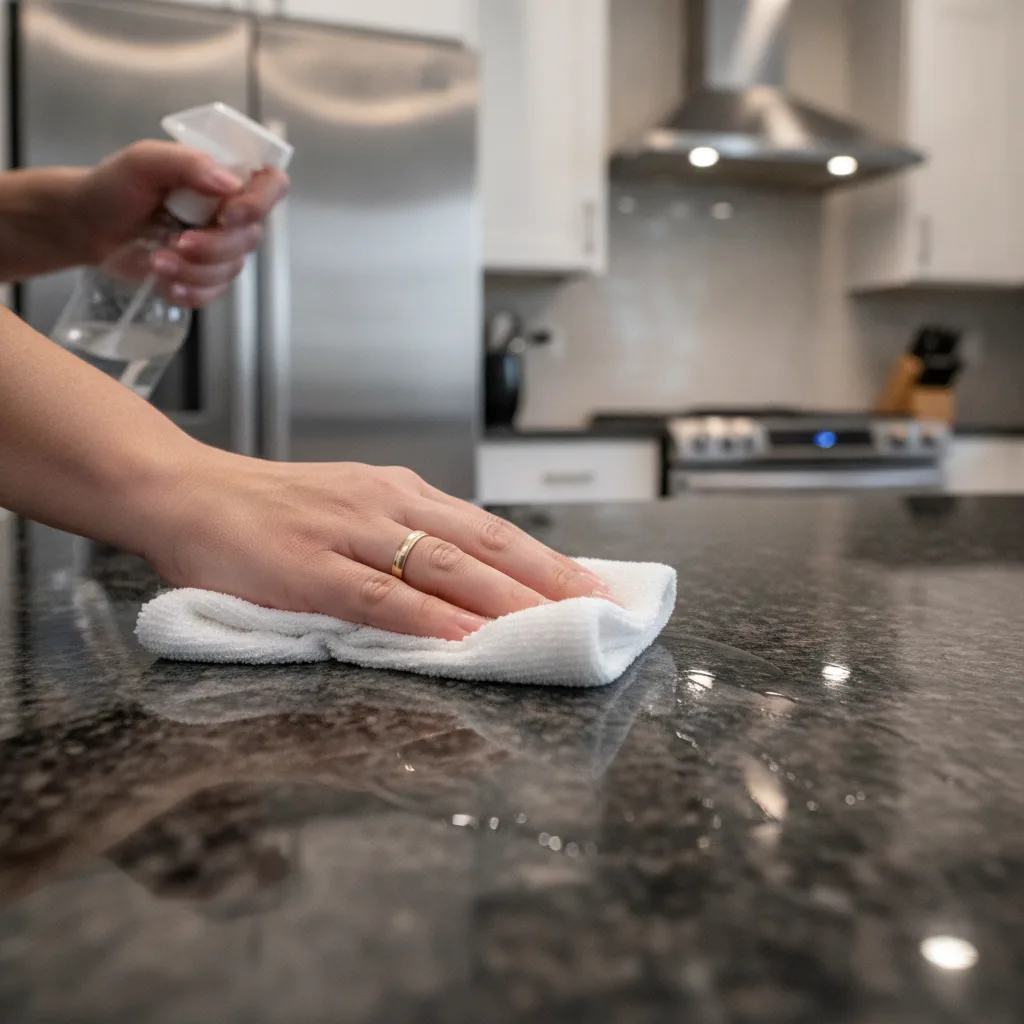
Spray your alcohol solution evenly across the granite surface and let it sit for 3 to 5 minutes. That contact time is what actually does the disinfecting work — spray-and-wipe-immediately is cleaning, not disinfecting. The surface should remain wet for that full window. If you're treating a large granite counter, work in sections so the first area sprayed doesn't dry before you've finished applying to the rest.
After the contact time, wipe the surface with a damp cloth to rinse away any residue, then immediately dry with a clean, dry microfiber cloth. Drying matters. Letting the stone surface air-dry can leave streaks and water spots, especially on polished granite where every smear shows. Use a white or light-colored microfiber cloth to avoid any risk of dye transfer from a colored cloth to the stone. Two wipes — one damp for the rinse pass, one dry for the finish — and your granite counter is both disinfected and streak-free.
For everyday maintenance that doesn't require full disinfection, the soapy water routine from Step 2 is all you need. Reserve the alcohol spray for high-risk situations: raw poultry or meat on the surface, someone in the household is ill, or a spill that may have carried bacteria. Daily disinfecting with alcohol isn't necessary when the sealant is intact — the sealant is already doing most of the protective work and proper cleaning with soap and water keeps the stone in good condition.
Bleach should never be used on granite. It strips the protective sealant, dulls the finish, and in cases of extended contact or high concentration, can alter the stone's color — a problem that's expensive and sometimes impossible to fully reverse. This includes bleach-based sprays like Formula 409 and many bathroom disinfectants. If the shine on your granite countertops has faded after repeated use of bleach, the sealant has likely been compromised and the stone is now porous and vulnerable.
Clorox and Lysol wipes are equally problematic despite their popularity as quick-clean solutions. Clorox wipes carry a pH of around 6.5 and contain citric acid — both strip granite sealant over time. Occasional use is unlikely to cause visible damage, but daily use over months will visibly dull the surface and leave the porous stone exposed to bacteria and stains. Lysol Advanced Deep Clean products have caused similar documented damage on granite counters. The same warning applies to ammonia-based cleaners, including Windex and most glass cleaners — they damage granite's protective seal and dull the stone.
Also avoid cleaners with acidic ingredients of any kind — vinegar, lemon juice, citrus-based sprays. The safe pH range for cleaning polished granite is pH 7 (neutral) to pH 10 (mildly alkaline), per Natural Stone Institute guidance. Most popular household disinfectants land outside that range, which is why the 70% isopropyl alcohol method matters: it kills germs without attacking the sealant. Marble and quartz countertops share many of these same vulnerabilities to acidic and bleach-based granite cleaners, so the same avoid list applies to those stone surfaces.
Run the water-drop test from Step 1. If your granite is absorbing water, the sealant has been stripped and you need to reseal before the stone is reliably protected again. A professional resealing restores the barrier — contact your fabricator or a stone restoration specialist for guidance on the right product and process.
Every cleaning routine for granite countertops depends on the sealant being intact. Reseal on a schedule that matches your granite's color and density: light-colored granite (white, cream, beige) every 6 to 12 months; medium-toned slabs every 1 to 2 years; dark, dense granite every 2 to 3 years. The water-drop test is the most reliable check — place a teaspoon of water on the stone, wait 10 minutes, and watch what happens. Water that beads means you're covered. Water that soaks in means the sealant needs attention now, before your cleaning routine can maintain the stone's shine and protect your family.
When Fox Granite installs your countertops, we apply a professional-grade sealant as part of the installation — it's part of the process, not an add-on. That initial seal sets the foundation for every cleaning routine you'll follow afterward. With proper sealing at installation and a resealing schedule matched to your granite's porosity, disinfecting granite countertops stays simple: dish soap and warm water for daily cleaning, 70% isopropyl alcohol for the moments that call for real disinfection, and a microfiber cloth to finish. No harsh chemicals, no damage to worry about, and your granite keeps its beauty and shine for years.
If you're in Austin, San Antonio, New Braunfels, or anywhere across Central Texas and you're not sure when your countertops were last sealed — or you're considering new granite and want to start with a surface that's properly protected from day one — we're glad to help. A well-fabricated, well-sealed slab is the foundation of easy, safe maintenance. That's something we take seriously at Fox Granite, because how the stone performs in your home matters as much as how it looks on install day.
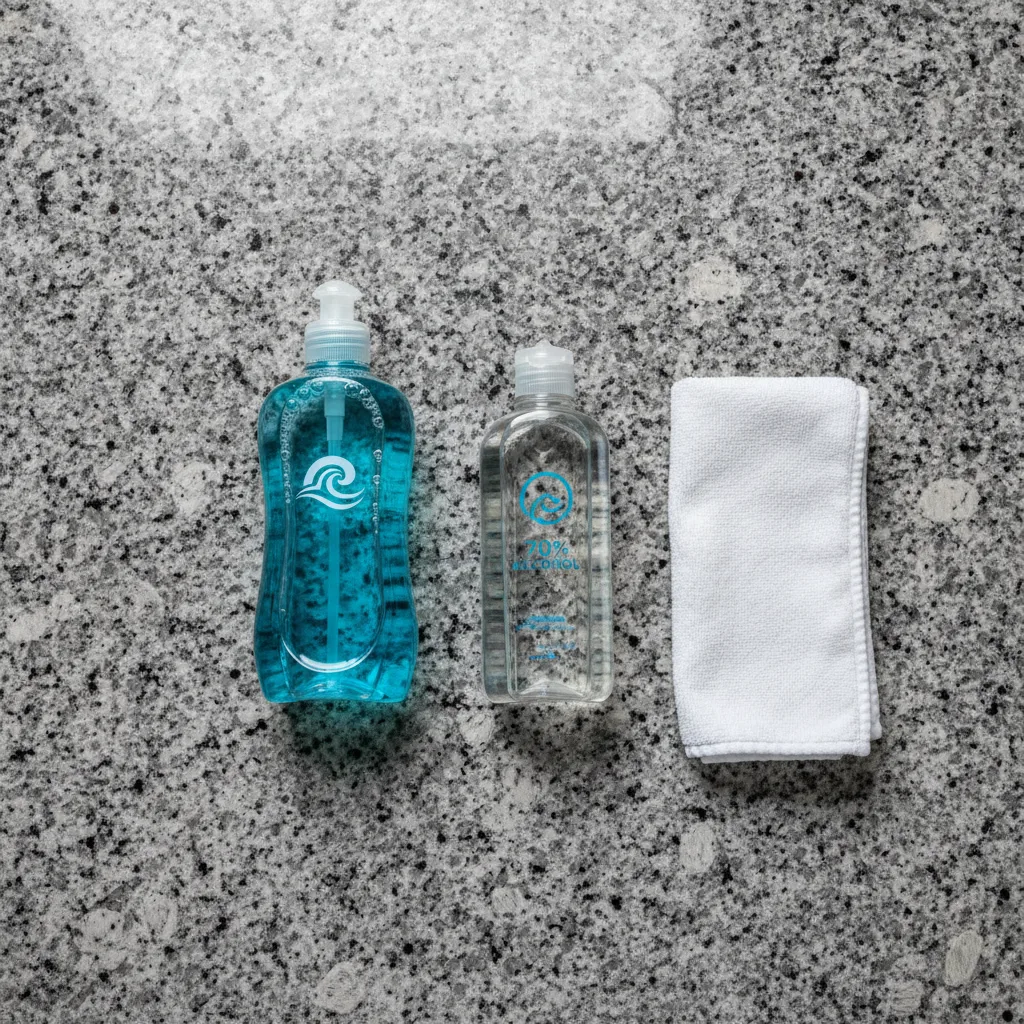
Bleach, Clorox wipes, Lysol sprays, vinegar, and ammonia-based cleaners all damage granite sealant — sometimes visibly within weeks, sometimes gradually over months. By the time you notice the dullness or streaks, the sealant has already been stripped. If you're seeing those signs on your granite counter right now, run the water-drop test, reseal if needed, and switch to 70% isopropyl alcohol and mild dish soap from this point forward. And if you're not sure whether your granite was properly sealed at installation, that's worth finding out sooner rather than later — a compromised sealant is the real bacteria risk, not an undertreated surface.
A clean granite counter after raw meat prep or a flu season in the house is a reasonable goal — and it's entirely achievable without harsh chemicals or expensive specialty granite cleaners. The routine is straightforward: check the sealant with the water-drop test, clean daily with Dawn and warm water, disinfect when it matters with a 70% isopropyl alcohol spray and a 3 to 5 minute sit time, dry thoroughly with a microfiber cloth, and reseal on the schedule your granite's color and porosity requires. Do those things consistently and the stone stays shiny, the sealant stays intact, and you never have to wonder whether your countertops are actually clean. For new granite countertops in Austin, San Antonio, New Braunfels, Round Rock, Georgetown, and across the Central Texas corridor, trust Fox Granite. We handle fabrication, installation, and professional sealing in-house — so your countertops are protected from the first day and easy to maintain for years to come. Contact us today to schedule your free in-home consultation or get your free estimate.
Ready to get started? Contact Fox Granite today.


BY APPOINTMENT ONLY
1379 Wald Road
New Braunfels, TX 78132
Austin, San Antonio, Cedar Park, Kyle, New Braunfels, Del Valle, Elgin, Lago Vista, Shady Hollow, Onion Creek, Buda, San Marcos, Lockhart, Temple, Wimberley, Dripping Springs, Bee Cave, Lakeway, Leander, Anderson Mill, Jollyville, Spicewood Springs, Round Rock, Georgetown, Pflugerville, Manor, Taylor, Manchaca, Mountain City, Hutto, West Lake Hills, Bastrop, Liberty Hill, Driftwood, Sun City, Steiner Ranch.