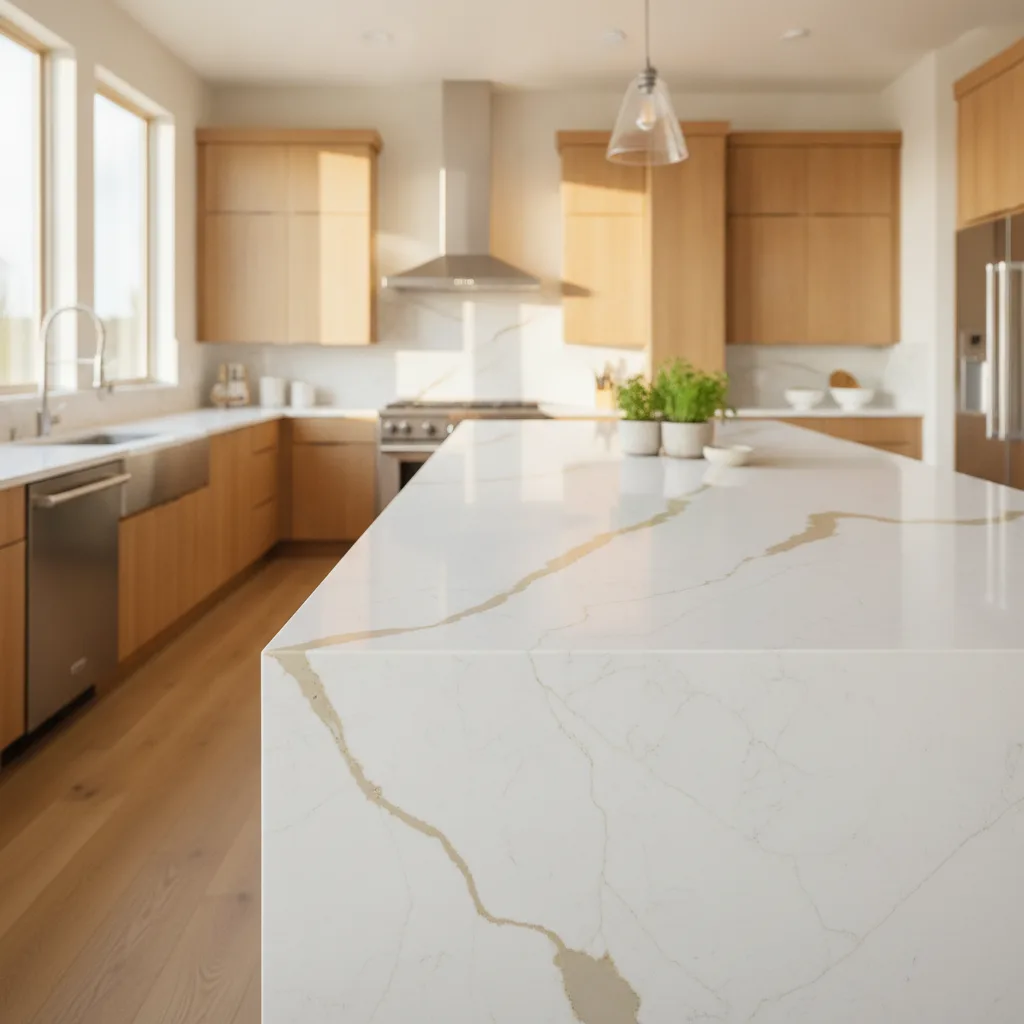
Quartzite stone is a naturally occurring metamorphic rock formed when quartz-rich sandstone is subjected to intense heat and pressure deep in the earth's crust. It ranks 7-8 on the Mohs hardness scale, harder than both granite (6-7) and marble (3-4), and unlike marble it will not etch when exposed to acids like citrus juice or wine. Properly sealed quartzite is stain-resistant and heat-resistant above 1,000 degrees F. Installed cost runs $70-$200 per square foot in 2026 depending on the variety. It requires sealing every 12-24 months for kitchen countertops. It is not the same material as engineered quartz countertops.
Quartzite stone sits in a narrow, genuinely useful space between granite and marble: it delivers marble's flowing veining and natural beauty, it resists acids the way granite does, and it handles heat that would damage engineered materials. The catch is that it costs more than most granite, it requires occasional sealing, and a surprising number of slabs on the market are mislabeled. This guide walks through exactly what quartzite is, how it stacks up against granite and marble on the specs that matter in a real kitchen or bathroom, what maintenance actually looks like, and how to pick a slab with confidence — so you can walk into a stone yard or a fabricator's showroom knowing what questions to ask.
Quartzite stone is a naturally occurring metamorphic rock formed when quartz-rich sandstone is subjected to intense heat and pressure deep within the earth's crust — not to be confused with engineered quartz countertops, which are manufactured from crushed stone and resin binders. The confusion between the two is widespread and it matters: they behave very differently in a kitchen. True natural quartzite contains more than 90% silica (silicon dioxide), with some examples reaching up to 99% pure quartz — among the highest silica concentrations found anywhere in the earth's crust, according to the University of Auckland's geology reference.
During metamorphism, the original quartz crystals in the sandstone recrystallize under extreme pressure and intense heat, fusing into a dense, interlocking mosaic of quartz crystals. That recrystallization process eliminates most of the original pore spaces and creates the stone's exceptional hardness. It also erases the layered look of sandstone and replaces it with the flowing veining that makes quartzite visually striking — a texture that closely resembles marble but comes from a very different durability profile.
The key distinction to hold onto: quartzite is a naturally occurring stone mined from quarries and cut into slabs, the same way granite and marble are. Quartzite deposits form at convergent plate boundaries during mountain-building events, which is why major sources include Brazil, Norway, and parts of Canada. Engineered quartz countertops are a manufactured product. They are not the same material, they don't perform the same way outdoors or under heat, and they have completely different maintenance needs. Any salesperson who uses quartz and quartzite interchangeably is working from a gap in their knowledge.
Some slabs sold as quartzite in stone yards are actually marble or dolomitic marble — mislabeled either by accident or to justify a higher price. The lemon-juice test catches this: drop a small amount of acidic liquid on an inconspicuous spot. True quartzite will not etch. If you see a dull ring form, the slab is marble. Always confirm before you buy.
Quartzite ranks 7-8 on the Mohs hardness scale, putting it harder than granite (6-7) and significantly harder than marble (3-4). That gap between quartzite and marble is not trivial. Marble scratches easily enough that cutting directly on it will mark it over time, while true quartzite resists everyday scratching better than either competing natural stone. For families who cook regularly and want a durable surface that holds up without obsessive care, that hardness advantage is real and consistent.
The bigger practical difference between quartzite and marble is acid resistance. True quartzite will not etch when exposed to citrus juice, wine, or vinegar. Marble will — the acid reacts with the calcium carbonate in the stone, leaving a dull spot that no amount of cleaning removes. If you've ever admired a marble kitchen in a magazine and then heard a fabricator talk a client out of it, etching is usually why. Quartzite gives you the flowing veining and natural beauty of marble without that vulnerability. That's the core of its appeal for kitchen countertops specifically.
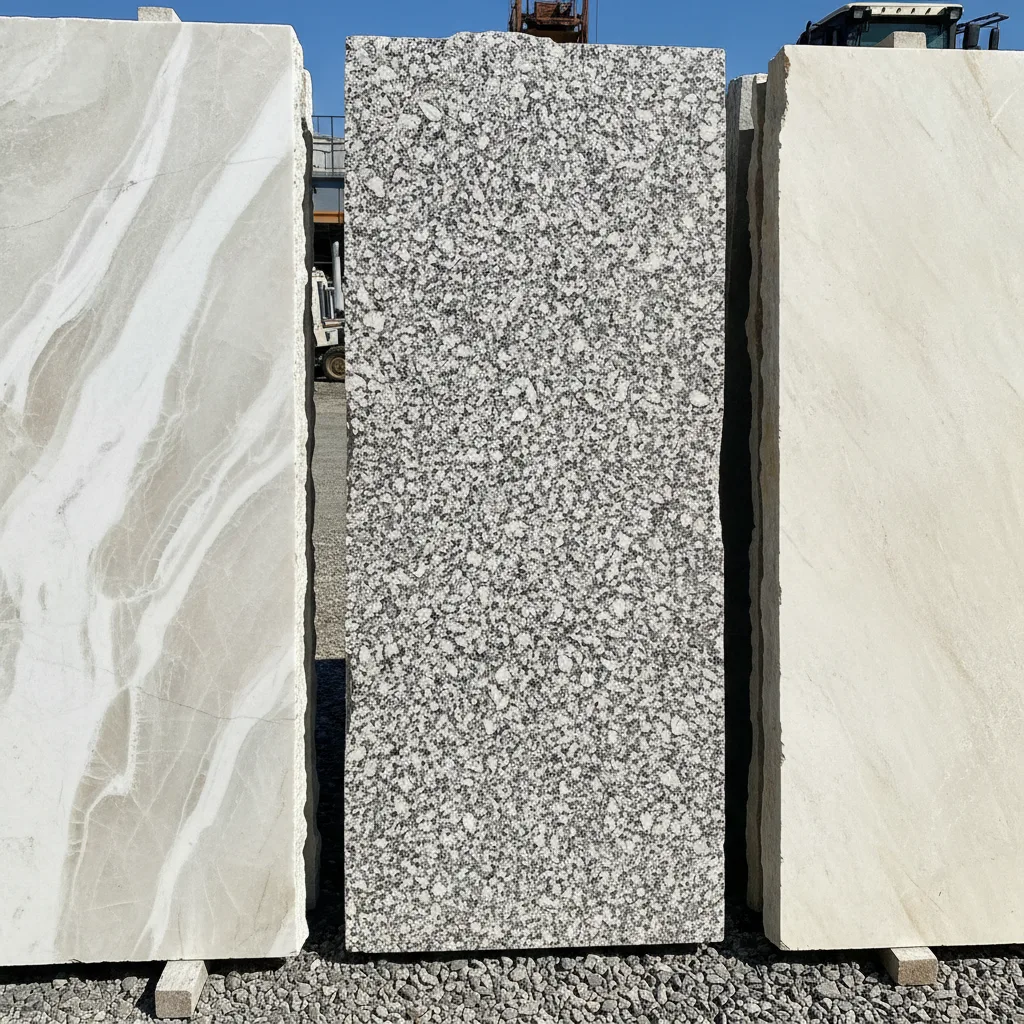
Against granite, the comparison shifts. Granite has a speckled, granular appearance — it's an igneous rock, not a metamorphic rock, and it looks like one. Quartzite delivers the delicate veining patterns that many homeowners associate with marble. Granite also tends to have slightly lower overall porosity than most quartzite, which means it needs sealing a little less often. Heat tolerance favors quartzite: formed under geological heat and high pressure, it withstands temperatures above 1,000 degrees F without damage. The resin binders in engineered quartz countertops can scorch above 300 degrees F, and marble can crack from rapid temperature changes (thermal shock). That said, trivets are still the right call for all stone surfaces — not because the stone can't handle the heat, but because cookware can damage a polished finish over time.
Quartzite is a porous material and does require periodic sealing — this is the single most important maintenance fact to understand before you buy. Properly sealed quartzite is stain-resistant in everyday use; unsealed or under-sealed quartzite will absorb liquids and stain. The sealing schedule depends heavily on which slab you choose and where it's installed.
For kitchen countertops, most quartzite varieties need resealing every 12-18 months. Higher-porosity varieties like Super White and Fantasy Brown may need attention every 6-12 months. Denser varieties like Taj Mahal can go 18-24 months between sealings. Bathroom vanities are easier — lower daily moisture and acid exposure mean you can often push to 24 months. For bathroom space installations and vanity tops, occasional sealing is a minor task. Outdoor kitchens are the most demanding: UV exposure, freeze-thaw cycles, and constant moisture mean resealing every 6-12 months regardless of variety.
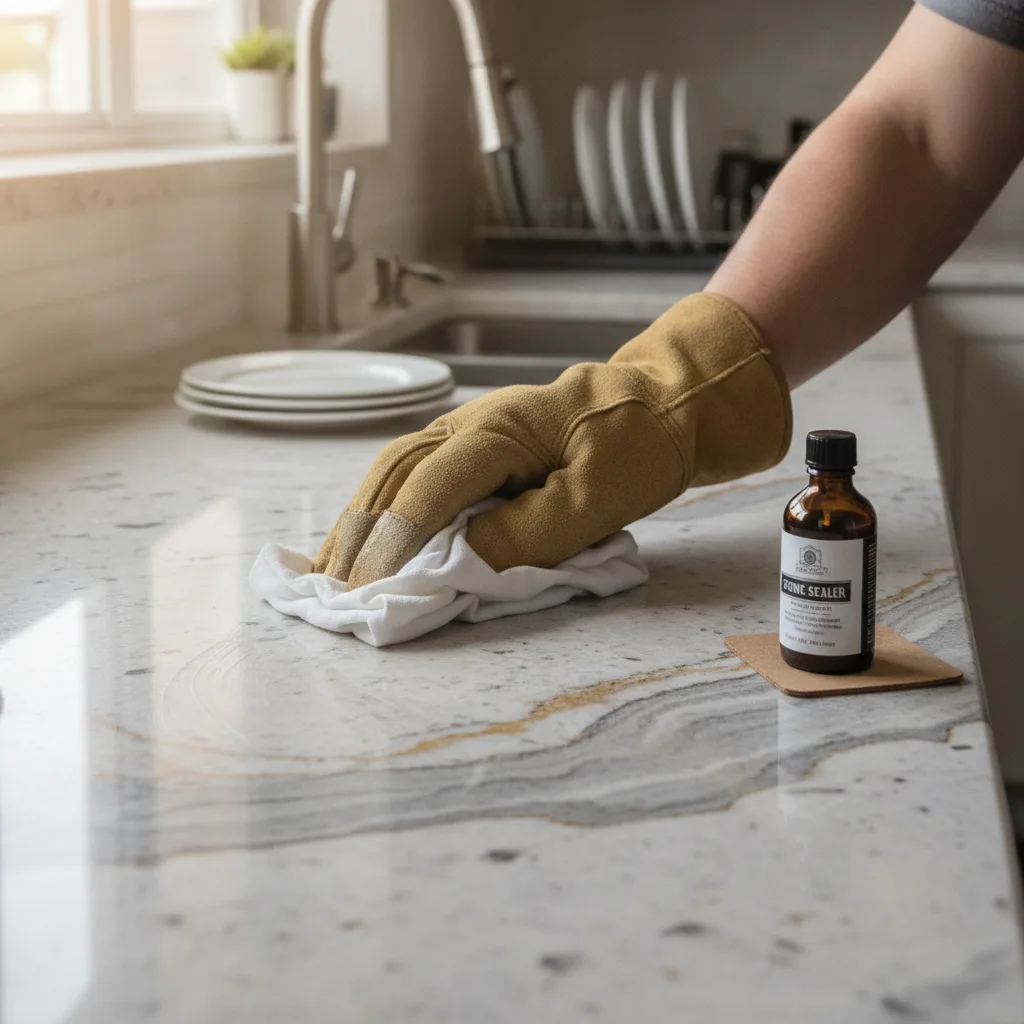
The sealing process itself isn't complicated — a penetrating stone sealer, a clean dry surface, 20-30 minutes of application time, and a 24-48 hour cure window before heavy use. Many homeowners handle it themselves. The key is not skipping the schedule. Occasional sealing is a reasonable trade-off for a surface that's heat-resistant, scratch-resistant, and acid-resistant in ways that marble simply is not. Homeowners who understand that upfront stay far happier with their countertops long-term.
To check whether your quartzite countertops need resealing, pour a small amount of warm water on the surface and wait 10-15 minutes. If the water beads up, the sealer is still working. If it absorbs and darkens the stone, it's time to reseal. This works on any natural stone countertop — granite, marble, or quartzite.
Pure quartzite is white or light gray, but other minerals introduced during metamorphism produce various colors across a wide range. Iron oxide creates pinks and reds. Other minerals produce blues, greens, and gold tones. That color variety is not dyed or manufactured — it's geology creating beauty at a mineral level. The result is that no two quartzite slabs look exactly alike, with colors and patterns unique to each slab. Delicate shades of cream, soft gray, and earthy tones with subtle gold veining produce a timeless, elegant look. Bold varieties in deep blue or bright green are designed to make a statement.
The most popular named varieties as of 2026 include Taj Mahal (warm cream with gold veining, one of the most sought-after slabs on the market, running $80-$200 per sq ft installed), Azul Macaubas (a rare deep blue variety that runs toward the high end of the range), Calacatta Macaubas (white with green and gold veins, a strong marble look-alike with delicate veining detail), and Emerald Green (bold and distinctive, $160-$220 per sq ft). Pink and rose varieties with soft, light coloring run $100-$180 per sq ft. Each variety adds beauty to its setting in a different way — the right choice depends on your kitchen's cabinetry color, lighting, and overall design direction.
The slab median price is $65.94 per sq ft for the raw material (Flume AI, 2026), but installed cost — which includes fabrication, templating, edge profiling, and installation — typically lands between $70 and $200 per sq ft depending on the variety, slab thickness, edge profile chosen, and project complexity. If budget is a constraint, granite delivers comparable durability at that lower price point, and many granite slabs now come in veined patterns that read more like quartzite than the speckled look of older granite. The investment in quartzite is primarily for the aesthetic — the specific natural beauty of flowing veining that granite, in most cases, doesn't replicate.
Quartzite works across more applications than many homeowners realize when they first start researching it. Kitchen countertops and bathroom vanity tops are the obvious starting points, but the stone's durability profile opens up a wider list: shower walls, wall cladding, flooring, fireplace surrounds, bar tops, and outdoor kitchens. The characteristics that make it durable in a kitchen — hardness, heat resistance, acid resistance — translate directly to other surfaces in the home.
Fireplace surrounds are one of the best low-maintenance uses for quartzite. Unlike kitchen countertops that face daily acid and moisture, a fireplace surround sees very little of either. The sealing concern nearly disappears in that application — occasional dusting and a wipe with warm water is typically all it needs. The stone's natural beauty and heat-resistant properties make it a genuinely practical choice there, not just an aesthetic one. Flooring and wall cladding installations add beauty and durability to spaces like mudrooms, foyers, and feature walls, where the stone's texture and veining create visual depth.
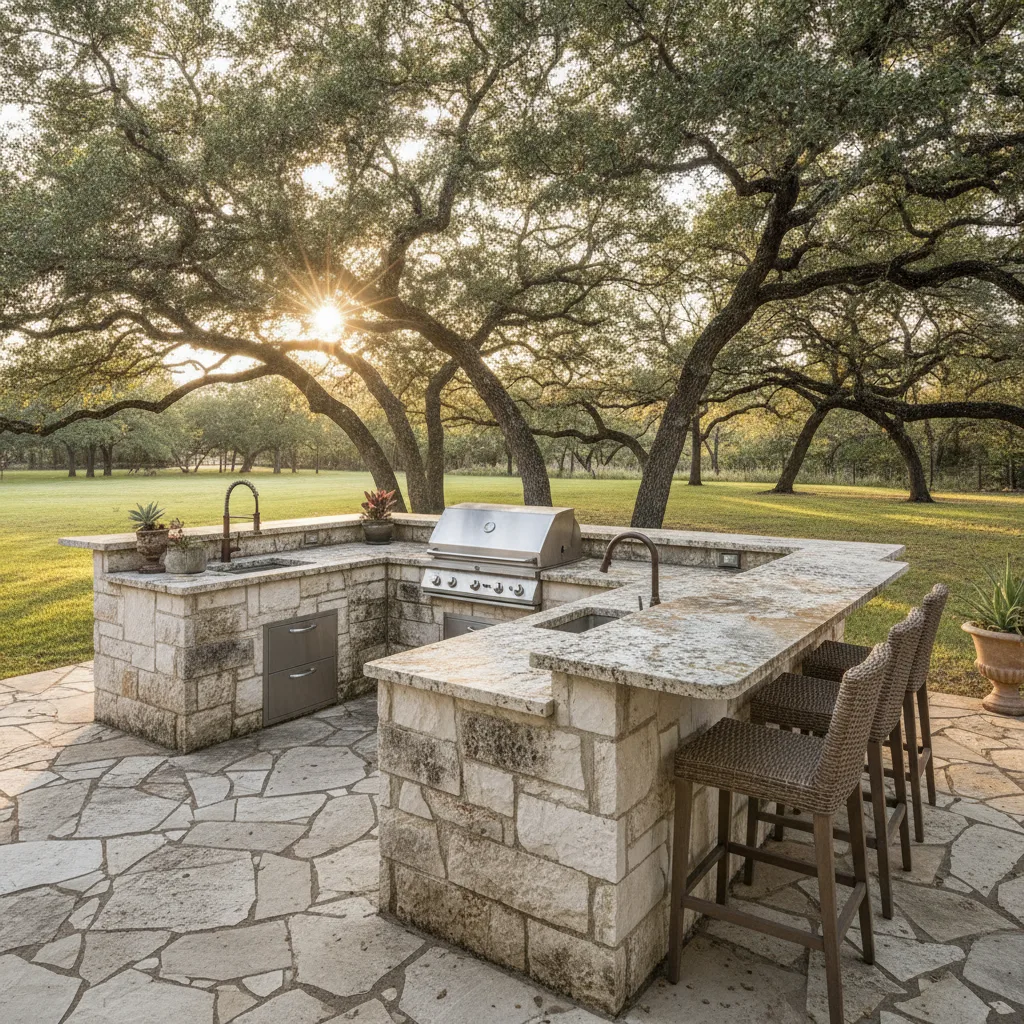
Outdoor kitchens are where quartzite really separates itself from engineered materials. Engineered quartz countertops cannot be installed outdoors at all — UV exposure degrades the polyester resin binders over time, causing discoloration and structural breakdown. Natural quartzite has no resin binders. Its UV resistance means color and polished finish hold up in direct sunlight, and its hardness handles the temperature swings Central Texas outdoor kitchens see year-round. The tradeoff is that outdoor applications need resealing every 6-12 months. Shower walls and wall cladding are also solid applications — quartzite handles moisture well when properly sealed, and the veining that works on a countertop translates beautifully to a full shower surround, creating highly resistant surfaces in a bathroom space that sees daily water exposure.
Picking a quartzite slab in person — not from a photo online — is the step most homeowners underestimate. Quartzite's natural beauty comes from variation in veining, color depth, and movement, and two quartzite slabs from the same variety can look noticeably different. The only way to know what you're actually getting is to see the full slab in person before it's cut. At Fox Granite, we bring samples to your home during a free in-home consultation so you can see how a variety reads in your actual lighting conditions. For final slab selection, visiting a stone yard or our showroom in New Braunfels is the step that prevents regret.
When evaluating slabs, look at the full book-matched pair if your project is large enough to use two. Check the veining direction — most fabricators can orient the slab to run the veining horizontally or vertically depending on your layout. Ask about slab thickness (2 cm vs. 3 cm), which affects both cost and edge profile options. Confirm the edge profile that fits your kitchen: an eased or beveled edge suits modern kitchens; a half-bullnose or ogee adds traditional character to bathroom vanity tops. The texture and finish matter too — polished quartzite shows the veining most vividly, while a honed or leathered finish creates a softer, more matte look and feel with slightly better scratch resistance in high-traffic areas.
Fabrication quality matters as much as slab selection. Quartzite is harder than granite and requires experienced stone-cutting equipment and technique — a shop that primarily cuts softer materials may not have the right diamond blades or the experience to avoid chipping at sink cutouts and edges. At Fox Granite, we fabricate everything in-house using precision stone-cutting software, and we do the installation ourselves with no subcontractors. That in-house process is what gives us tight control over edge profile precision, cutout placement for sinks and fixtures, and final fit. For quartzite countertops in Austin, San Antonio, New Braunfels, and across Central Texas, that control over the full process is the difference between a slab that looks great for years and one that shows fabrication shortcuts within months.
Ask your fabricator to do a water absorption test on the specific slab you're considering before it's cut. Denser quartzite slabs absorb less water and need less frequent sealing. If the fabricator can't or won't tell you the porosity of the slab, that's worth factoring into your confidence in them as a partner for your project.
Two mistakes cost homeowners real money. First: buying quartzite that's actually marble — a slab that etches the first time lemon juice hits it. Second: buying engineered quartz countertops thinking they perform like quartzite outdoors or under heavy heat. True quartzite is a naturally occurring stone with no resin binders, highly resistant surfaces against acids, and heat tolerance that manufactured materials can't match. Before you finalize any slab purchase, ask your fabricator to confirm the material with the lemon-juice test, and ask directly whether the slab is natural quartzite or a quartz-based engineered product. If they can't answer confidently, that's your answer.
When you get this right — the right variety, properly sealed, and cut by an experienced fabricator — quartzite countertops are durable, beautiful surfaces that hold up through years of real cooking and real use without the fragility of marble or the outdoor limitations of engineered quartz. For quartzite countertops in Austin, San Antonio, New Braunfels, and the surrounding Central Texas areas, Fox Granite carries quartzite slabs, fabricates everything in-house, and walks you through the full process from slab selection to installation with transparent pricing. Contact us to schedule your free in-home consultation, or visit our New Braunfels showroom to see quartzite slabs in person.
Ready to get started? Contact Fox Granite today.


BY APPOINTMENT ONLY
1379 Wald Road
New Braunfels, TX 78132
Austin, San Antonio, Cedar Park, Kyle, New Braunfels, Del Valle, Elgin, Lago Vista, Shady Hollow, Onion Creek, Buda, San Marcos, Lockhart, Temple, Wimberley, Dripping Springs, Bee Cave, Lakeway, Leander, Anderson Mill, Jollyville, Spicewood Springs, Round Rock, Georgetown, Pflugerville, Manor, Taylor, Manchaca, Mountain City, Hutto, West Lake Hills, Bastrop, Liberty Hill, Driftwood, Sun City, Steiner Ranch.