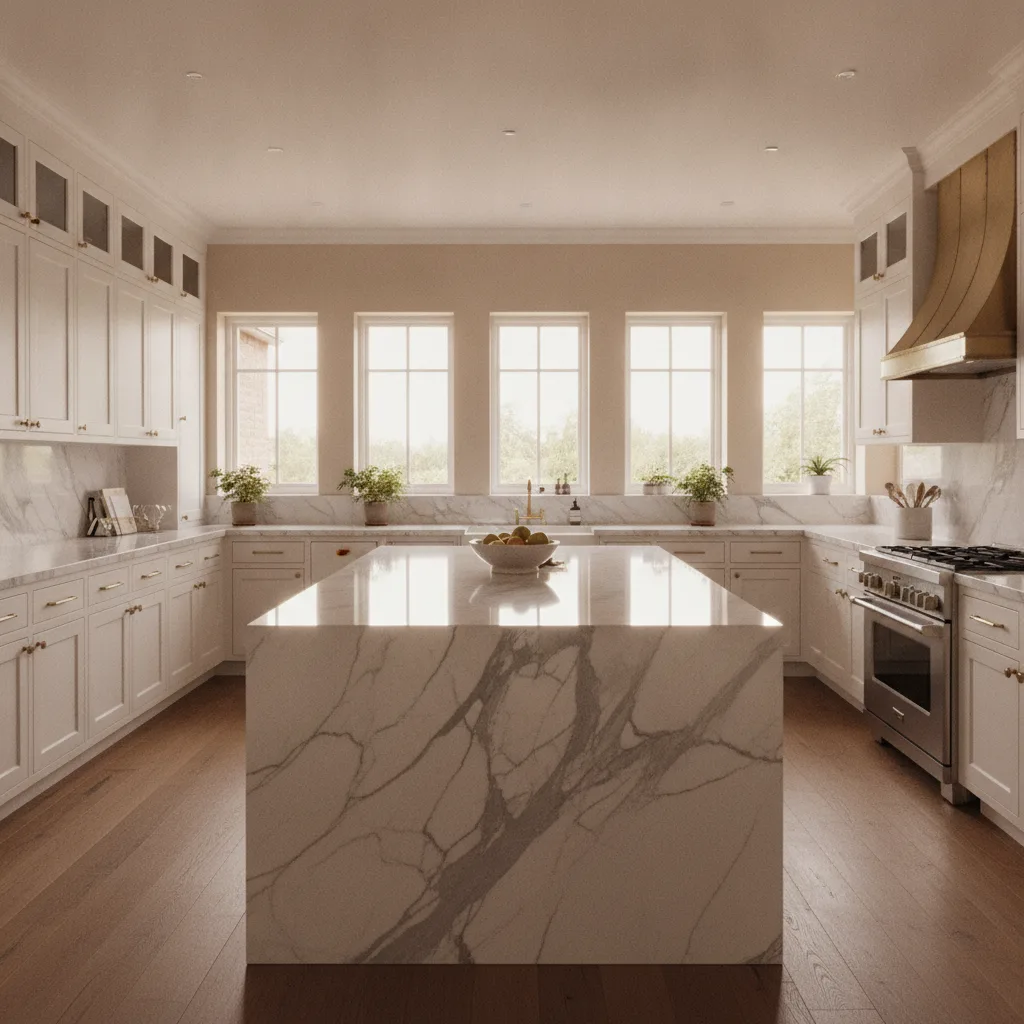
Marble countertops are a natural stone surface made from recrystallized limestone, rated 3–5 on the Mohs hardness scale. As of 2026, installed costs run $65–$250 per sq ft depending on variety: Carrara lands at $65–$120, Calacatta at $130–$250+. The key maintenance facts every buyer must know: sealing every 6–12 months protects against staining, but no sealer stops etching from acids like lemon juice or vinegar. Honed finishes are the right call for most kitchen countertops because etch marks read far less visibly on a matte surface than on polished marble. Homeowners who want the flowing-vein look without the acid-etching risk should compare quartzite slabs side by side before deciding.
Marble countertops cost $65–$250 per sq ft installed in 2026, but the price is only part of what you're committing to. The other part is a natural stone that etches from acids, scratches more readily than granite or quartzite, and rewards attentive owners with a classic elegance that no engineered material quite replicates. This guide covers everything a Central Texas homeowner needs before choosing marble: what the stone actually is, how Carrara compares to Calacatta, why the honed vs. polished decision matters more than most people realize, what proper care looks like in a real kitchen, and when quartzite is honestly the smarter call. Read through all six steps and you'll walk into a Fox Granite consultation with a clear direction — not just a Pinterest board.
Marble is a metamorphic natural stone formed when limestone is subjected to intense heat and pressure, which recrystallizes its calcite and dolomite minerals into the flowing veined patterns that make it one of the most recognized materials in kitchen and bathroom design. That same calcite composition is what gives marble its timeless look — and its vulnerabilities. It rates 3 to 5 on the Mohs hardness scale, compared to granite at 6–7, quartzite at 7–8, and engineered quartz at around 7. Softer stone means more care required, especially in high traffic areas where daily cooking, pots, pans, and cutting boards are in constant contact with the surface.
The biggest misconception homeowners bring to a marble consultation is treating etching and staining as the same problem. They are not. Staining happens when a liquid penetrates the stone's pores and leaves a discolored residue — a sealer slows this process considerably. Etching is a chemical reaction: acids like lemon juice, vinegar, wine, or tomato sauce react with marble's calcite crystals at the surface the moment they make contact, before any liquid has a chance to soak in. No sealer stops an etch from forming. That distinction matters enormously when you're planning a kitchen. Marble's reputation for being high-maintenance comes almost entirely from this one behavior, and understanding it upfront separates happy marble owners from frustrated ones.
Marble also behaves differently from other natural stones when it comes to heat. The marble surface has high thermal mass and stays naturally cool, which is a genuine functional advantage for baking stations and pastry prep areas — not just a nice aesthetic. For homeowners who bake regularly, that cool work surface is one of the strongest practical arguments for marble over other materials. That said, always use trivets or hot pads when placing hot pots directly on the stone; thermal shock from a very hot pan on cold marble can cause cracking over time, even though marble is generally considered heat resistant.
Etching is not a staining problem — it's a chemical reaction with the stone's calcite. A quality penetrating sealer gives you 10–30 minutes to blot a spill before it stains, but it cannot prevent an etch mark from forming the instant an acid touches the surface.
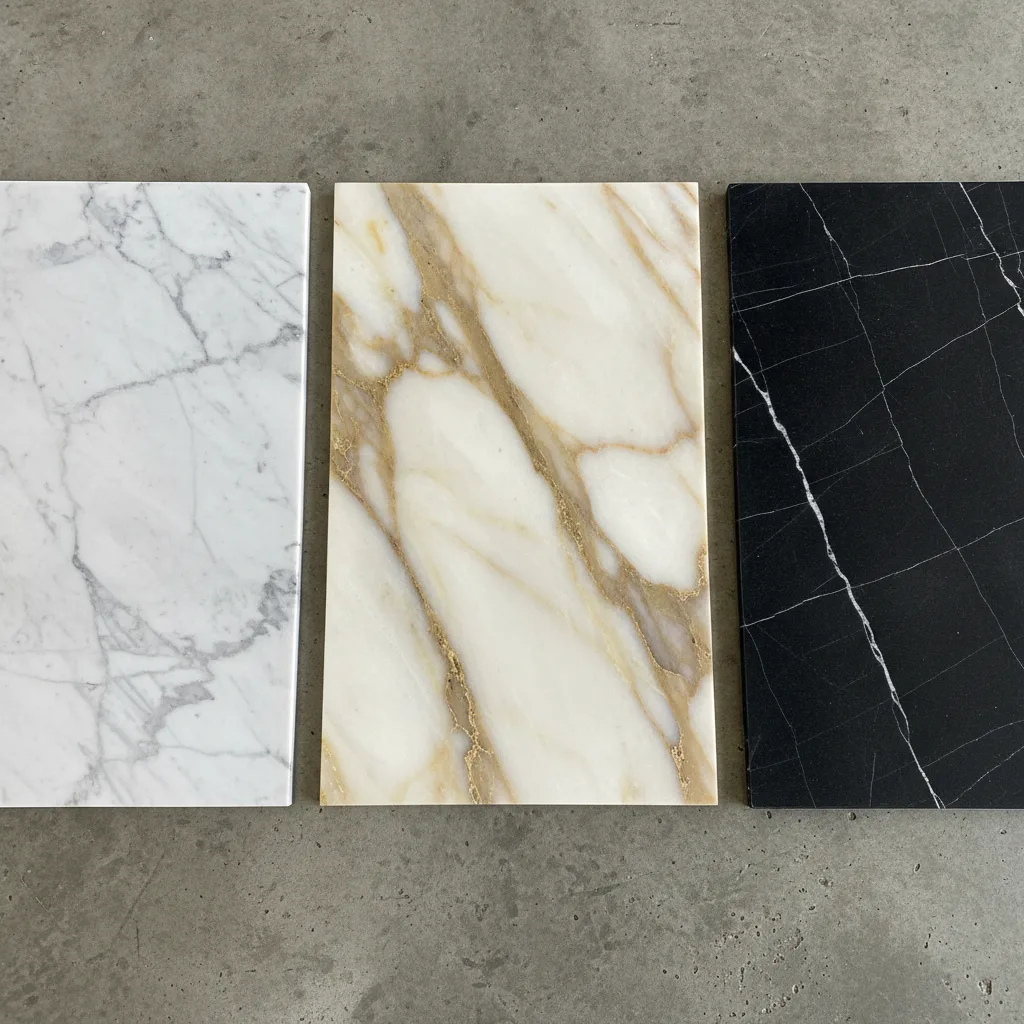
Carrara marble is the starting point for most homeowners. It has a grey-white background with fine, feathery grey veining and accounts for roughly 95% of Italian marble production — that volume is exactly why it is the most accessible and affordable white marble option, running $65–$120 per sq ft installed in 2026. If you've seen marble countertops in a friend's kitchen or a home renovation show, there is a strong chance it was Carrara. The veining is soft and subtle, and it pairs well with both white and warm-toned cabinetry and modern cabinet styles alike. The texture reads as calm and classic rather than bold.
Calacatta comes from the same Apuan Alps region in Italy as Carrara but makes up only about 5% of quarry output. Its background is a brighter, crisper white and its veining is thicker and more dramatic — the contrast creates a stronger design statement that many homeowners find irresistible. That rarity drives the price: Calacatta marble slabs run $130–$250+ per sq ft installed, with rare Calacatta Gold exceeding $300 per sq ft. If your kitchen island is meant to be the focal point of the room, Calacatta delivers that impact. For a full perimeter run, the cost adds up fast. Statuario sits between the two in price — material typically $50–$100 per sq ft, installed $150–$250 per sq ft — with a white base and grey veining that is bolder than Carrara but not as high-contrast as Calacatta. Onyx is another natural stone in this family worth exploring if you want a more translucent, light-diffusing effect, though it is softer and even more porous than standard marble.
Black marble countertops are a separate category worth naming. Nero Marquina is the most recognized variety — deep black with fine white veining — and works especially well against light cabinetry or in a powder room where the contrast is the design point. Black marble slabs are more forgiving of etch visibility on a dark background, but they show water spots and fingerprints more readily on a polished finish. A honed finish reduces both issues on dark stone. Colors across the full marble spectrum also include green (Verde Guatemala), gold-veined cream (Crema Marfil), and warm brown varieties. Soapstone is sometimes grouped with marble in design conversations but is a different material entirely — softer and non-porous with a distinctly different look. The range of true marble is wide enough that 'marble' is really a family of natural stones, not a single look, and no two slabs are identical.
Free to visit
Seeing full marble slabs in person is the only reliable way to judge veining, color tone, and finish — photos don't capture how a slab reads at countertop scale in your light.
Free
Fox Granite brings physical samples to your home so you can hold them against your cabinetry and lighting conditions before committing to a slab selection.
Honed marble is the right finish for most marble kitchen countertops. The surface is already matte, so etch marks from lemon juice, wine, or vinegar read far less visibly against a flat finish than against a reflective one. Fabricators report that roughly 90% of marble kitchen installations use a honed finish for this exact reason. If your household uses citrus, vinegar-based dressings, or wine regularly, choosing honed is not just an aesthetic preference — it is a practical decision that will save you daily frustration. The trade-off is that honed marble is slightly more porous and absorbs spills a bit faster, making prompt blotting with a soft cloth more important.
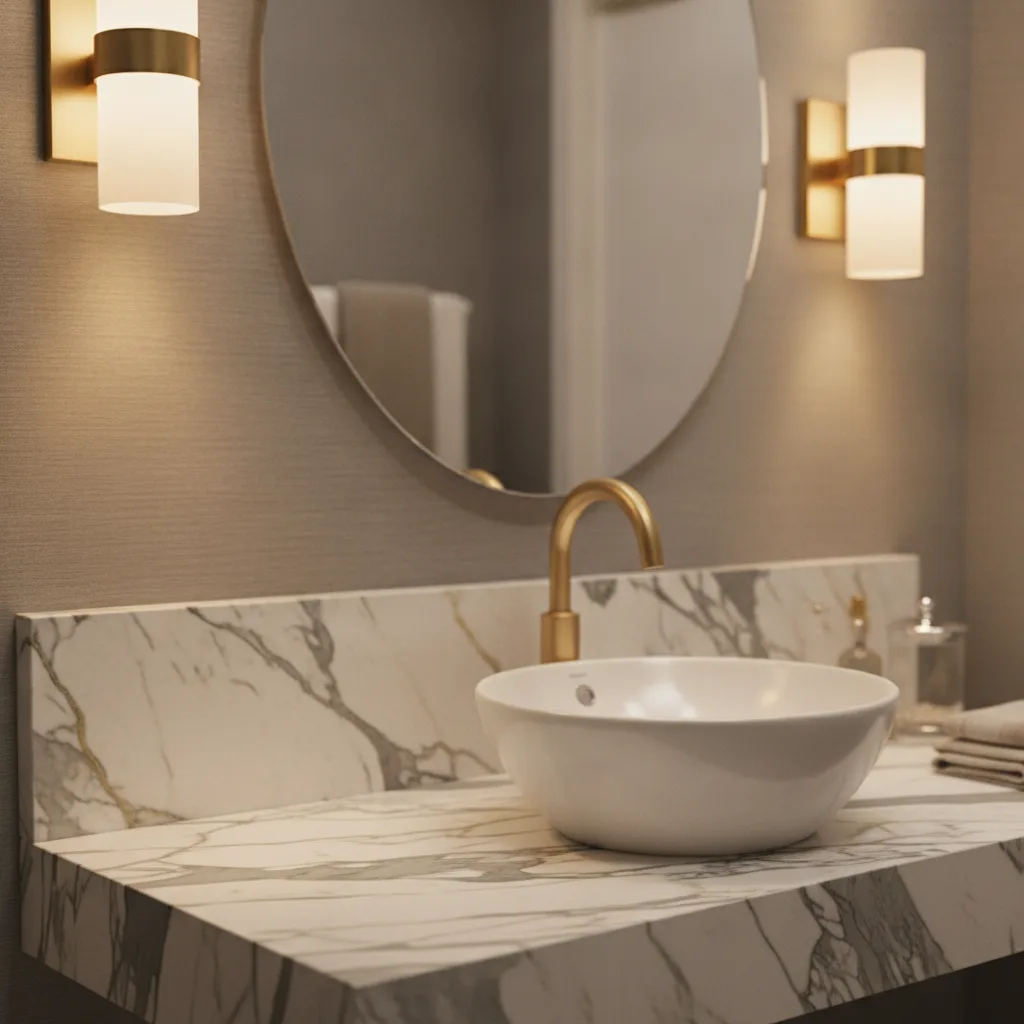
Polished marble is the opposite tradeoff. Its tighter, buffed surface is slightly less porous, so it hides staining marginally better than honed — but it shows etch marks far more dramatically. A dull spot on a high-gloss surface is immediately obvious, especially in direct light. Polished finishes are a strong choice for bathroom vanities and powder rooms, where cooking-acid exposure is near zero and you want the full shine. For a kitchen island used occasionally rather than daily, polished can also work. The key is an honest assessment of how the space gets used, not how you imagine it might.
Daily cleaning for both finishes is straightforward: warm water and a pH-neutral stone cleaner applied with a soft cloth, then dried. Avoid anything acidic or abrasive — most multi-surface sprays contain citric acid and will etch the surface on contact. Do not wipe spills across a honed surface; blot them straight down to avoid spreading the liquid into a larger contact area. The care routine is not complicated, but daily cleaning needs to be consistent to protect the stone and keep the surface fresh.
If you're torn between finishes, ask to see a sample of each with a small etch mark already on it. The visual difference between an etched honed surface and an etched polished surface makes the tradeoff concrete in a way that words can't.
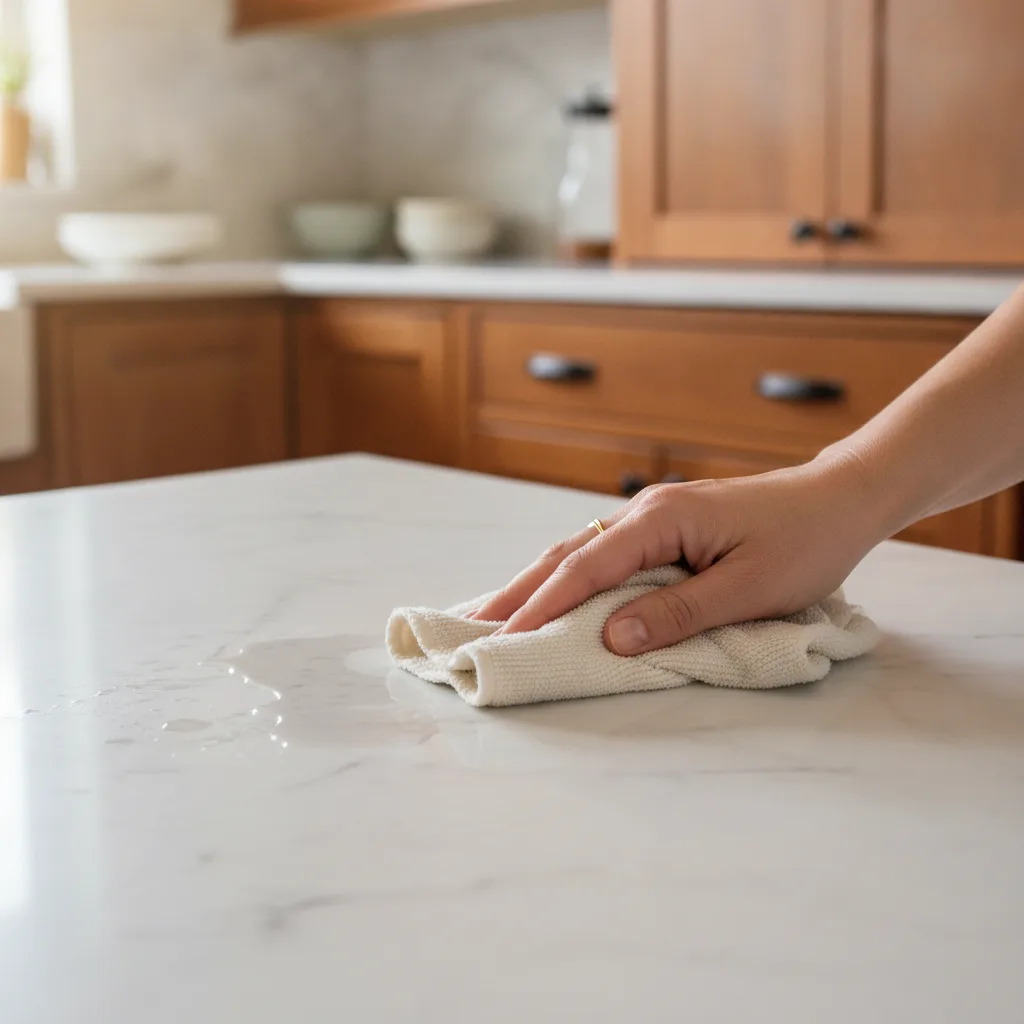
Kitchen marble needs resealing every 6–12 months with daily use; bathroom marble can go 1–2 years between sealings. The test is simple: pour two tablespoons of water on the marble surface and wait five minutes. If the water absorbs and leaves a dark spot, it is time to reseal. A quality penetrating sealer gives you a 10–30 minute window to blot a spill before it penetrates and stains — that is your actual protection margin. Regular sealing keeps that window open. Skipping it closes the window fast and turns a minor spill into a permanent stain. Re-sealing is a legitimate DIY task that takes under an hour and costs $15–$40 for a good penetrating sealer.
Beyond sealing, plan for professional refinishing. Polished marble typically needs it every 2–3 years; honed marble every 3–5 years, according to stone restoration professionals. Refinishing removes the accumulation of light scratches and etch marks and restores the original surface texture. It is not a failure of the material — it is part of owning a natural stone rated 3–5 on the Mohs scale. Budget for it the same way you budget for repainting interior trim or servicing appliances. Professional refinishing for a full kitchen runs $300–$800 depending on size and condition.
For daily use in high traffic areas, the practical rules are consistent: always use cutting boards (marble scratches from knives), always use trivets or hot pads (thermal shock from hot pots placed directly on cold stone can cause cracking over time), and blot spills immediately rather than wiping. Marble rewards attentive owners. Homeowners who treat marble like a low maintenance laminate surface will be disappointed within months. The material demands attention — and gives back natural beauty and a one-of-a-kind character that no engineered countertop can match.
Marble develops a patina over years of use — minor etches and subtle shifts in the marble surface that many owners find more beautiful than the pristine original, similar to the character that develops in fine leather or antique wood. Whether that patina feels like charm or damage is a personal decision worth making before installation, not after.
Marble countertop installed cost in 2026 runs $65–$250 per sq ft depending on variety, with most quality Italian marble projects landing in the $75–$150 per sq ft range. For a typical 30–40 sq ft kitchen, that translates to $1,200–$6,000 total — covering material, fabrication, and installation labor. Installation labor alone runs $10–$20 per sq ft, and a standard kitchen install takes about 10 hours. The slab and fabrication portion ($30–$130+ per sq ft) is where variety choice makes the biggest price difference. Edge profiles, sink cutouts, and backsplashes add cost; confirm those line items before approving a fabrication quote.
Carrara marble is the budget-friendly entry point at $65–$120 per sq ft installed — close to mid-range granite, which runs $60–$100 per sq ft installed. That proximity in price is one reason many homeowners who start shopping granite end up selecting Carrara instead. Calacatta starts where Carrara tops out: $130–$250+ per sq ft installed, with rare varieties exceeding $300. If Calacatta is the look you want but the budget is closer to Carrara pricing, that is a real gap to address at the slab selection stage. Seeing slabs in person at the showroom often clarifies whether a premium Carrara slab with bold veining can deliver a similar visual effect at a lower cost. Many designers and homeowners find it can.
For bathroom vanities and powder rooms, the smaller square footage keeps total costs manageable even with premium marble. A 10–15 sq ft bathroom vanity top in Calacatta might run $1,500–$3,750 installed — a realistic entry point for homeowners who want the high-impact look in a lower-exposure space. That math is worth knowing if the full-kitchen marble budget feels like a stretch. A marble vanity top in a bathroom or powder room gives you the natural beauty and elegance of the stone in a space where the maintenance demands are a fraction of what a kitchen requires.
Marble is a strong fit for bathroom vanities, powder rooms, baking stations, and kitchen islands used for prep and presentation rather than daily heavy cooking. The lower acid exposure in bathrooms removes the etching risk almost entirely, letting the natural beauty of the stone carry the room without constant vigilance. A marble kitchen island paired with quartzite or granite perimeter countertops is a practical hybrid approach that many homeowners across Austin, San Antonio, and the New Braunfels corridor have used well. It limits daily acid and oil exposure to the most durable surfaces while keeping marble's visual impact as the room's focal point.
Quartzite is the honest alternative for homeowners who love the flowing-vein look of marble but want lower maintenance. Quartzite rates 7–8 on the Mohs scale, does not etch from acids, and delivers a similar aesthetic with significantly better scratch and stain resistance compared to marble. It still requires sealing, but it is a fundamentally tougher material for a high-traffic kitchen. Other materials worth considering: engineered quartz is fully non-porous and acid-resistant, making it the top choice for a completely worry-free countertop surface. It does not have the natural variation of marble slabs, but the consistency appeals to many homeowners. If you find yourself writing out a list of rules about what cannot touch your countertop, quartzite or quartz may be the better fit for your household and cooking styles.
The right call depends on how you actually use your kitchen — not how you imagine you might use it. Our team can bring samples of marble slabs, quartzite slabs, and granite to your home so you can compare materials under your actual lighting with your existing cabinetry and walls. There is no pressure to decide on the spot. We have helped homeowners across Central Texas choose confidently between marble, quartzite, granite, and other natural stones for every space — from full kitchen perimeters to single-wall backsplashes and tile accents. The goal is finding the material that fits your real life, not just the prettiest one in the showroom.
Free
Compare marble, quartzite, and granite samples in your actual space before committing — includes templating walkthrough and transparent installed pricing.
The single most common source of disappointment with marble kitchen countertops is etching — and it happens to homeowners who did everything else right. They sealed on schedule, blotted spills promptly, and used cutting boards. But a squeeze of lemon over the sink or a splash of wine during dinner left a dull spot on the marble surface within seconds. That is not a defect and it is not a failure of your sealer. It is how marble behaves with acids at the chemical level. If that is a tradeoff you can accept — or even appreciate as part of the stone's character over time — marble is a beautiful, lasting choice. If it would bother you every time you noticed it, quartzite gives you the same flowing-vein look with none of the etching risk. We will tell you honestly which direction fits your household better.
For marble countertops, quartzite countertops, and granite in Austin, San Antonio, New Braunfels, and across Central Texas, Fox Granite is a family-owned team with over 15 years of in-house fabrication experience. We will help you choose the right material for your real life — not just the sleek, photogenic one in the showroom. Contact us today to schedule your free in-home consultation and see marble slabs, quartzite, and granite samples side by side in your own kitchen.
Ready to get started? Contact Fox Granite today.


BY APPOINTMENT ONLY
1379 Wald Road
New Braunfels, TX 78132
Austin, San Antonio, Cedar Park, Kyle, New Braunfels, Del Valle, Elgin, Lago Vista, Shady Hollow, Onion Creek, Buda, San Marcos, Lockhart, Temple, Wimberley, Dripping Springs, Bee Cave, Lakeway, Leander, Anderson Mill, Jollyville, Spicewood Springs, Round Rock, Georgetown, Pflugerville, Manor, Taylor, Manchaca, Mountain City, Hutto, West Lake Hills, Bastrop, Liberty Hill, Driftwood, Sun City, Steiner Ranch.