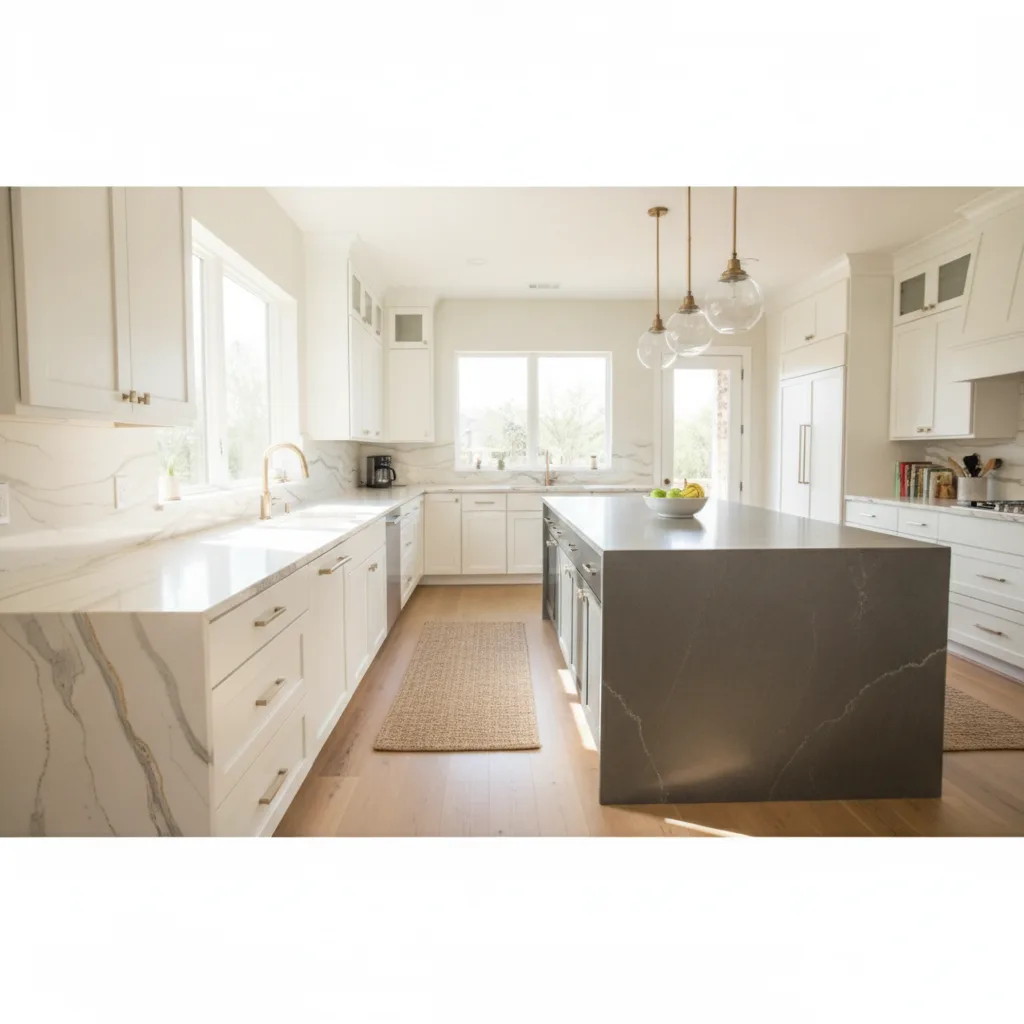
As of 2026, quartz countertops hold 35% of the U.S. market and remain the best all-around choice for busy kitchens: non-porous, stain resistant, and available in the warm neutral tones dominating this year's kitchen style. Quartzite is the fastest-growing natural stone option, up 12% year-over-year, prized for marble-like looks with better durability. Installed costs range from $20 per square foot for laminate to $200-plus for exotic quartzite. For most Central Texas kitchens in the 30-55 square foot range, a completed quartz or granite project lands at $3,500-$6,500 installed. A new countertop averages 60-80% ROI at resale. Pick material first based on daily habits, then choose finish and edge profile to match your kitchen style.
The biggest shift in kitchen countertops in a decade is underway in 2026 — and most Central Texas homeowners are only halfway aware of it. Cool gray engineered surfaces, which dominated kitchens for the better part of the 2010s, are fading fast. Warm, character-driven natural stone and natural-look materials are taking over, driven by what the industry is calling 'quiet luxury': creams, beiges, taupes, dramatic veining, and matte or honed finishes instead of high-gloss polish. The NKBA 2026 Kitchen Design Trends report confirms it: 78% of design professionals expect quartz countertops to remain the preferred surface, but the story is in what's growing alongside it. This guide walks through every tier of countertop materials — from quartzite and marble at the top, through granite and quartz in the middle, to solid surface countertops and laminate countertops at the budget end — with real installed prices, maintenance realities, and the 2026 design directions that make each material look its best.
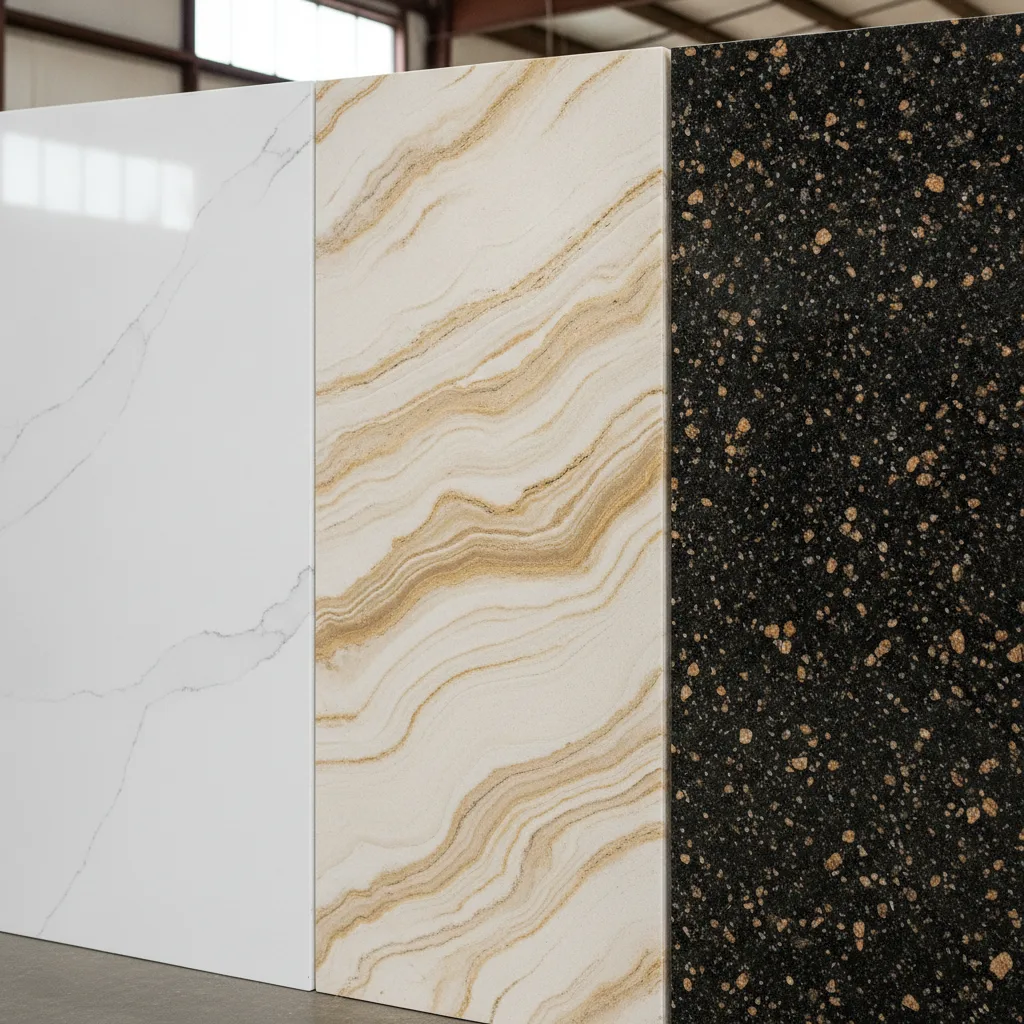
The era of uniform, cool gray engineered surfaces is giving way to warm, expressive natural stone and natural-look materials — and the data backs it up. The NKBA 2026 Kitchen Design Trends report found that 78% of design professionals expect quartz to be the preferred countertop surface, but natural quartzite came in second at 62% predicting strong popularity, up from a much smaller base. Granite, once the automatic default natural stone, is expected to remain popular by only 43% of those same professionals. The countertop market as a whole is valued at $22.1 billion in 2026, growing at 3.8% annually.
The market share numbers tell the same story. Quartz holds 35% of all U.S. countertop installations — the highest of any single material — but its growth has plateaued. Quartzite has grown 12% year-over-year, rising to 10% of the market. Granite has declined from 30% market share in 2020 to 21% as of 2026, with younger homeowners under 40 increasingly choosing quartzite or quartz alternatives. Knowing these shifts matters because the kitchen countertop types that are growing in demand today are also the ones buyers will expect at resale in three to five years.
The aesthetic driving all of this is 'quiet luxury': a decisive move away from stark white minimalism toward warm neutrals — creams, beiges, taupes, soft browns — with dramatic veining and honed or matte finishes over high-gloss polish. The KBDN 2026 survey of 300-plus design professionals found that 48.3% of respondents say their clients are willing to invest more in kitchen countertops now than in previous years, with fewer than 10% saying clients are spending less. Choosing a material and color direction that aligns with 2026 demand protects your investment better than a cool gray slab that peaked five years ago.
If you're choosing countertops partly with resale value in mind, picking a material and finish that aligns with 2026 buyer expectations — warm tones, natural stone character, matte finishes — protects that investment better than trend-chasing in the other direction. The 'quiet luxury' direction is a multi-year move, not a one-season spike.
Natural stone countertops are the top trend story of 2026, and quartzite is leading the charge. Quartzite varieties like Taj Mahal and Perla Venata are the standout requests this year — they offer the marble-like elegance that homeowners love, but with greater durability. Quartzite is scratch-resistant, handles heat well, and comes in the warm cream-to-gold palette that defines 2026 kitchen style. The trade-off: quartzite is porous, so it needs sealing every 6–12 months, and it costs more than granite. Installed prices for quartzite run $70–$150 per square foot, with Taj Mahal quartzite averaging around $130 per sq ft and exotic slabs reaching $200 or more.
Granite is no longer the automatic default, but it remains one of the best combinations of durability and price in natural stone. As of 2026, granite holds 21% of the U.S. market, and it comes in a wide range of colors — including warmer tones now trending, like gold, caramel, and cream veining rather than the speckled blacks and grays of the 2010s. Granite is heat resistant and scratch resistant, and each slab is unique in appearance. Installed granite runs $40–$100 per square foot; a 40 sq ft kitchen lands at $1,600–$4,000 installed. It is porous and benefits from resealing every one to three years, but it's a proven performer in busy kitchens and a strong choice for homeowners who want natural stone at an accessible price point.
Marble is the high-maintenance, high-reward natural stone option. Carrara marble runs $75–$150 per sq ft installed; Calacatta ranges from $180–$250 per sq ft. Marble is porous and prone to etching from acids — citrus, vinegar, and wine will mark it if left unwiped. It scratches more easily than granite or quartzite. The warm veining in Calacatta and Arabescato slabs fits 2026's aesthetic perfectly, making marble a genuinely beautiful choice for kitchens where looks are the priority and the homeowner is ready to maintain it carefully. For high-use, family kitchens, quartzite delivers similar visual impact with meaningfully better durability.
Free to visit
See full-size natural stone slabs in person before committing. Photos rarely capture the veining, color depth, or finish quality of quartzite, granite, or marble accurately.
Free
Bring samples into your own kitchen to compare against your cabinetry, flooring, and lighting before you make a $3,000–$8,000-plus decision.
Quartz countertops remain the best-selling single material in the U.S. as of 2026 — and for practical reasons that haven't changed. Quartz countertops are made from roughly 90–95% ground natural quartz crystals bound with resin, which creates a surface that is non-porous, stain resistant, and requires no sealing. The color palette is shifting in 2026: the gray-and-white dominance of the past decade is giving way to butterscotch, caramel, cream, cognac, and coffee tones. Bielinski Homes identifies the 'Taj Quartz' pattern — soft feathered veining inspired by Taj Mahal quartzite — as the standout 2026 quartz direction. Installed quartz costs $60–$120 per square foot at the mid-tier most homeowners buy; a 55 sq ft kitchen with an island typically runs $3,250–$6,500.
The main trade-off with quartz is heat sensitivity. Quartz countertops are heat resistant to a point, but the resin binders can discolor or crack under direct high heat — always use trivets. They're also scratch resistant but not scratch-proof; knife marks will dull the surface over time. For busy kitchens with kids, heavy cooking, and daily spills, quartz delivers the most consistent performance across price tiers and holds strong resale value. Additionally, the color and thickness consistency across quartz slabs makes it easier to match sections precisely during installation, which matters for long runs and waterfall islands.
Solid surface countertops — Corian-class materials — are seeing a genuine resurgence in 2026. Solid surface countertops are made from acrylic or polyester resin and come in a variety of colors and styles. They can be thermoformed into curved island designs, creating seamless integration that stone cannot match. GREENGUARD sustainability certifications on many solid surface products appeal to eco-conscious buyers, making solid surface a strong eco-friendly option for homeowners who want a matte, soft-touch look at a mid-range budget. Installed solid surface runs $50–$150 per sq ft; a 30–40 sq ft kitchen lands at $1,500–$6,000. They scratch more easily than stone but can be sanded and repaired — a meaningful advantage that most materials cannot offer.
Quartz (engineered, non-porous, no sealing needed, $60–$120 per sq ft) and quartzite (natural stone, porous, requires sealing, $70–$150 per sq ft) sound nearly identical but behave very differently. Quartz is the low-maintenance choice; quartzite is the natural stone choice with marble-like beauty and better durability than marble. Don't let the names trip you up when you're talking to a fabricator about countertop materials.
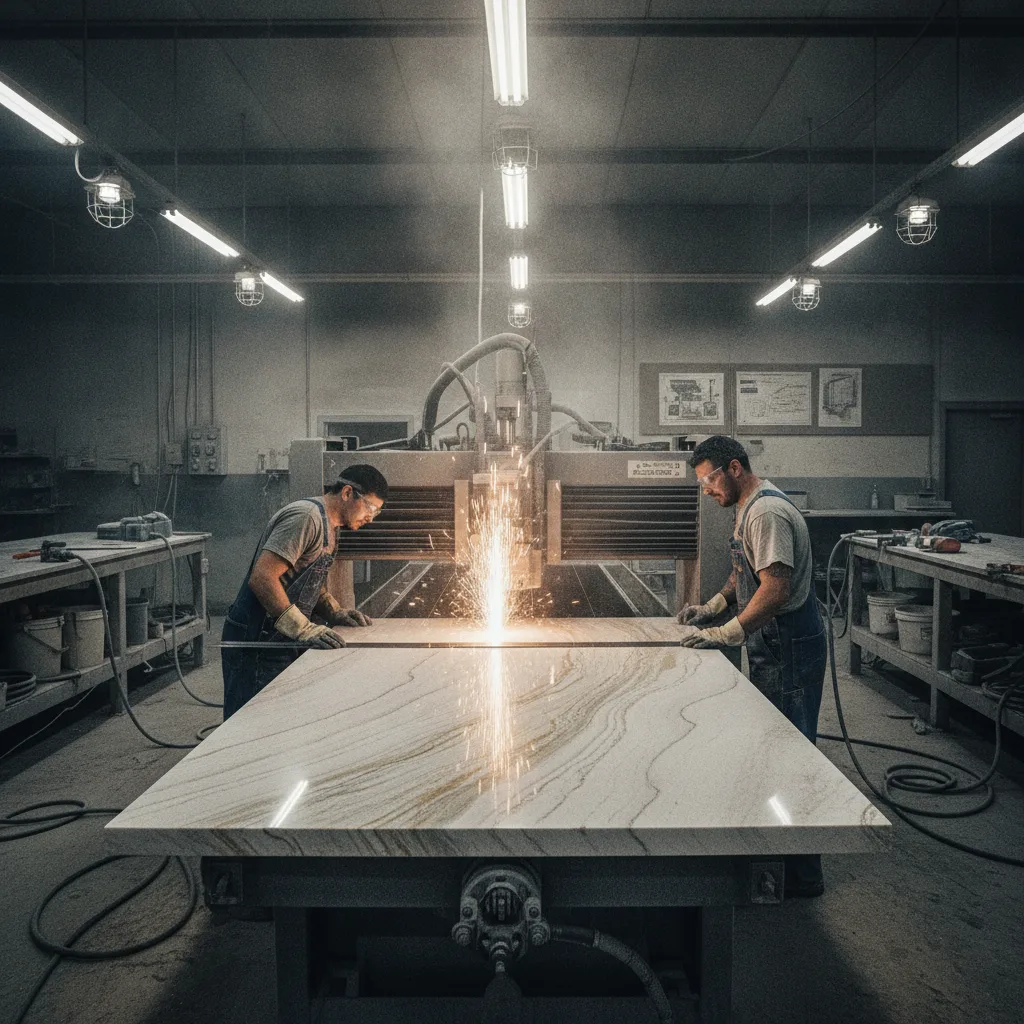
Budget-friendly countertop materials have come a long way by 2026 — the best options no longer look like compromises. Modern laminate countertops use high-definition printing technology to closely replicate stone and wood looks in ways that genuinely close the appearance gap with entry-level quartz. Brands like Formica 180fx and Wilsonart AEON are the leaders in this space. Installed laminate runs $20–$60 per square foot; a 40 sq ft kitchen costs $800–$2,400 installed — far below the $60–$120 per sq ft range of mid-tier quartz. The downsides are real: laminate scratches easily, cannot be repaired once damaged, and blisters under hot pans. For a rental property or a homeowner who plans to sell in two to three years and needs an affordable surface now, laminate is a practical choice. It is not a long-term natural stone substitute.
Ceramic tile countertops are one of the most versatile and budget-friendly options, running $20–$60 per square foot installed. Ceramic tile is heat resistant, stain resistant, and comes in a huge variety of colors and shapes. Ceramic tile countertops are made from fired clay and come in both glazed and unglazed finishes, offering flexibility that most materials cannot match. The grout lines are the weak point: grout is porous and prone to staining, and grout lines make the surface harder to keep clean in busy kitchens. Ceramic tile works better as a backsplash or accent wall application than as a primary kitchen countertop in 2026's design climate, but it remains a viable and affordable choice for homeowners who want a surface that handles heat well on a tight budget.
Concrete countertops offer a custom, organic-industrial look that fits 2026's interest in natural textures — but the price surprises most homeowners. Installed concrete runs $65–$185 per square foot. Concrete is porous, requires careful sealing to resist stains, and can chip at the edges. It's made on-site or precast, and both methods require skilled fabrication. The look is genuinely unique and custom, which is the point for buyers who choose it. Bamboo and butcher block countertops come in at $35–$120 per sq ft installed and add natural warmth to a kitchen. Bamboo is considered a renewable resource, making it one of the stronger eco-friendly options among countertop materials — but wood surfaces require regular oiling and are prone to moisture damage and scratches over time.
The 2026 design shift isn't only about material — the finish and edge profile you choose make as much visual impact as the slab itself. Matte and honed finishes are outpacing high-gloss polished surfaces this year. Honed finishes reduce glare, hide fingerprints and water spots better than polished surfaces, and align with the broader move toward organic textures and warm kitchen styles. The practical catch: honed natural stone — granite, quartzite, marble — is more porous than its polished counterpart and absorbs spills more readily. That means more careful sealing and faster cleanup. For quartz or solid surface, matte finishes carry none of that maintenance penalty since the material itself is non-porous regardless of finish. These are the kinds of trade-offs that should inform your final selection rather than just following what looks best in a showroom photo.
Edge profiles are becoming a genuine design feature in 2026, not a minor detail. Homeowners are requesting ogee, cove bullnose, and Dupont profiles rather than the eased or square-cut edges that dominated the past decade. The ogee edge — an S-curve profile — is the standout direction this year, appearing on Homes and Gardens' official 2026 predictions list. Designer Tom Wicksteed describes it plainly: 'An expressive edge profile turns a worksurface into something tailored and distinctive.' Fox Granite offers eased, beveled, bullnose, half-bullnose, and ogee profiles. The edge profile is one of the few countertop decisions that changes the look significantly while adding little to the overall cost.
Waterfall island edges and full-height stone backsplashes extending the countertop slab vertically along the wall are among the top 2026 design requests. A waterfall edge runs the same slab down the side of the island to the floor, creating an architectural feature from dramatic stone veining. A full-height slab backsplash eliminates grout lines and turns the wall behind the range into a statement piece. Both approaches require additional square footage of material and more precise fabrication — plan for the extra cost and discuss the details with your fabricator during the template appointment. These features drive higher average project values ($5,200–$6,800 for natural stone installs versus $3,500–$4,200 for quartz), but the visual return is proportional.
A honed or matte finish on natural stone looks softer and more organic, but it absorbs spills faster than a polished surface. Seal honed granite, quartzite, or marble every 6–12 months and wipe up oils, wine, and citrus immediately. For quartz or solid surface in a matte finish, this is not a concern — those materials are non-porous in any finish.
New countertops average 60–80% ROI at resale, with quartz and granite delivering the strongest returns in mid-to-high-end homes. A minor kitchen remodel recoups roughly 113% of its cost nationally, and countertops are the single highest-return surface upgrade in that scope. Installed costs vary widely: laminate at $20–$60 per sq ft, entry-level granite at $40–$60 per sq ft, mid-tier quartz at $60–$120 per sq ft, quartzite at $70–$150 per sq ft, and marble ranging from $75–$250 per sq ft depending on the stone. Most Central Texas kitchen countertop projects land at $3,500–$6,500 installed for a 30–50 sq ft kitchen. High cost does not automatically mean best choice — it means a different set of trade-offs, most materials at the upper end requiring more maintenance in exchange for greater natural beauty.
The best choice for most busy kitchens in 2026 is quartz: non-porous, low-maintenance, stain resistant, and available in the warm neutral tones dominating this year's kitchen style. Quartzite is the best choice for homeowners who want natural stone character without marble's etching risk and are willing to seal it regularly. Granite is the best choice for homeowners who want a natural stone look at a more accessible price point and appreciate that each slab is unique in appearance. Laminate is the right call for a short-term fix or a budget kitchen where the ROI on natural stone isn't justified yet. Solid surface makes the most sense for curved or seamless island designs on a mid-range budget.
One 2026-specific factor worth noting: the KBDN survey found that 54.2% of design professionals say it is at least moderately important whether a countertop material is made in America — a new decision factor driven by supply chain and economic concerns. Domestic granite slabs and several quartz lines are available through U.S.-based fabricators. Ask your fabricator about slab origin if that matters to your purchase. For Austin, San Antonio, New Braunfels, Round Rock, Georgetown, and the rest of Central Texas, Fox Granite offers free in-home consultations with physical samples, so you can compare materials in your own kitchen lighting — under real conditions — before committing to any surface.
Free
Get a real, all-in installed price for your specific kitchen square footage — no guessing from per-square-foot ranges online.
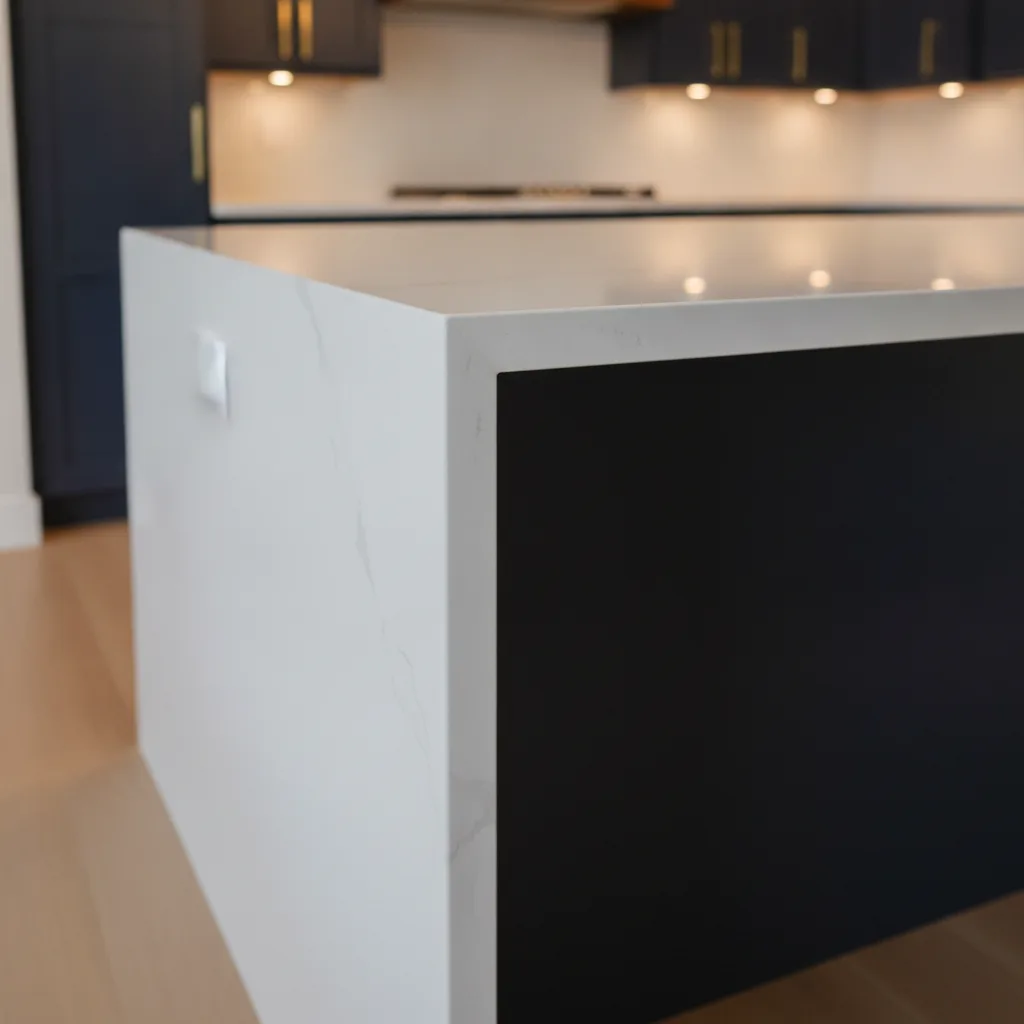
Stone slabs look dramatically different under showroom lighting versus kitchen lighting. A cream quartzite slab can read as white or golden depending on your kitchen's natural light and cabinet color. A polished slab looks nothing like the same stone in a honed finish. Before you commit to any material — quartz, quartzite, granite, or marble — see a physical sample in your own kitchen. Fox Granite brings samples to you as part of our free in-home consultation. Call (512) 653-5541 or schedule online, and we'll bring the countertop to your kitchen before you make the decision.
For new countertop installation in Austin, San Antonio, New Braunfels, Round Rock, Georgetown, and throughout Central Texas, Fox Granite is the fabricator Central Texas homeowners trust. We're a family-owned fabrication and installation team with over 15 years of experience, in-house fabrication, and transparent all-in pricing with no surprise fees after the quote. Contact us today to schedule your free in-home consultation and see how the right material, finish, and edge profile can make your kitchen feel completely new.
Ready to get started? Contact Fox Granite today.


BY APPOINTMENT ONLY
1379 Wald Road
New Braunfels, TX 78132
Austin, San Antonio, Cedar Park, Kyle, New Braunfels, Del Valle, Elgin, Lago Vista, Shady Hollow, Onion Creek, Buda, San Marcos, Lockhart, Temple, Wimberley, Dripping Springs, Bee Cave, Lakeway, Leander, Anderson Mill, Jollyville, Spicewood Springs, Round Rock, Georgetown, Pflugerville, Manor, Taylor, Manchaca, Mountain City, Hutto, West Lake Hills, Bastrop, Liberty Hill, Driftwood, Sun City, Steiner Ranch.