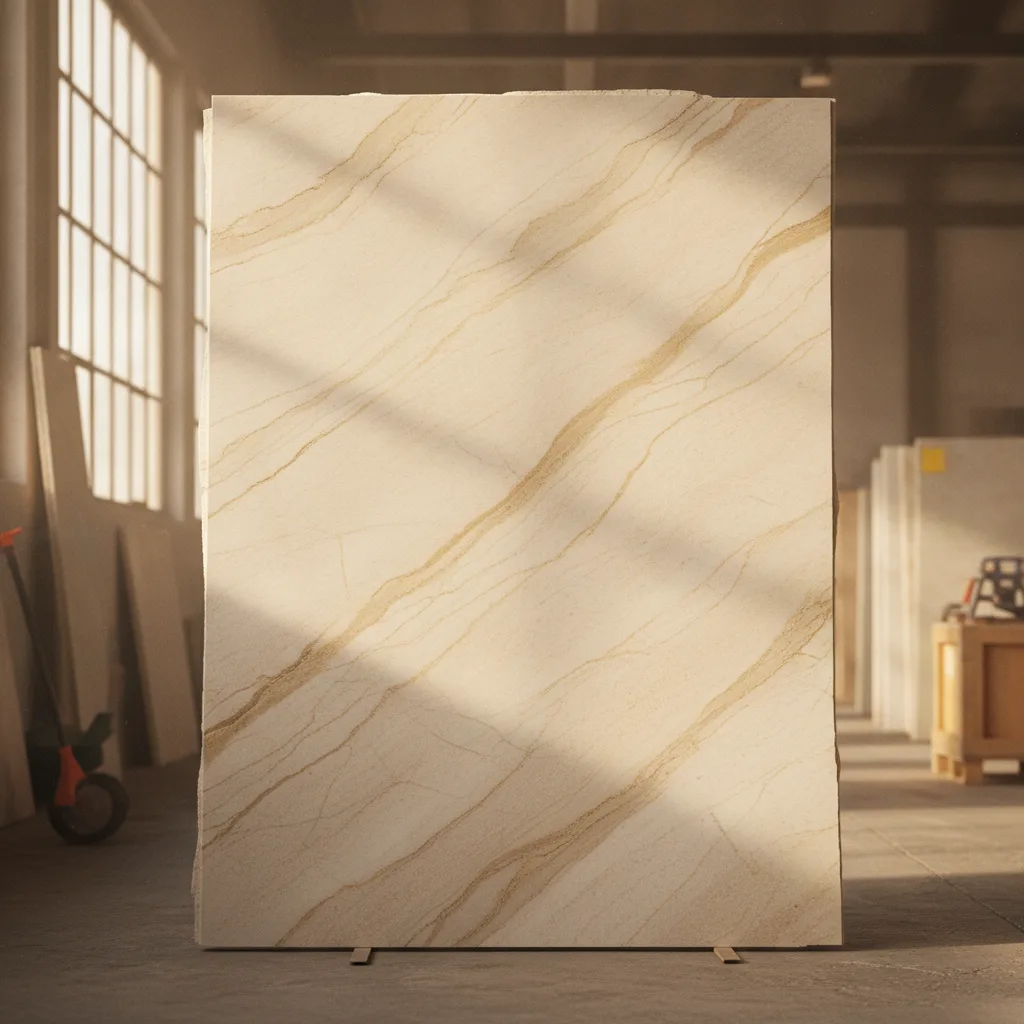
Taj Mahal quartzite is a 100% natural stone quarried in Brazil that rates 7 to 7.5 on the Mohs hardness scale — harder than granite and far harder than marble. Installed in US markets as of 2026, it runs $120–$180 per square foot for standard-grade slabs, putting a typical 40-square-foot kitchen at $4,000–$9,000 all-in. It won't etch from kitchen acids, won't scratch under normal use, and requires sealing every one to two years. The biggest buyer risk is mislabeling: dolomitic marble is regularly sold under the Taj Mahal name. Two field tests — scratching a piece of glass and applying lemon juice — confirm whether the slab is genuine before you commit.
Taj Mahal quartzite countertops are the most-requested natural stone in US kitchens as of 2026 — and also the most mislabeled material at slab yards. The beauty of this stone is real: a warm, creamy ivory base with soft gold and taupe veining that pairs with almost any cabinet color and creates a timeless look without the acid-etch anxiety of marble. But that popularity has made it a target for substitution. Dolomitic marble sold under the Taj Mahal name is a widespread problem, and buyers who skip the verification steps find out the hard way after installation. This guide gives Central Texas homeowners a complete, honest picture of what Taj Mahal quartzite is, what it costs installed, what color it actually is, what its real trade-offs are, and exactly how to confirm the slab you're buying is the genuine article — so you can make a confident decision and love the result for decades.
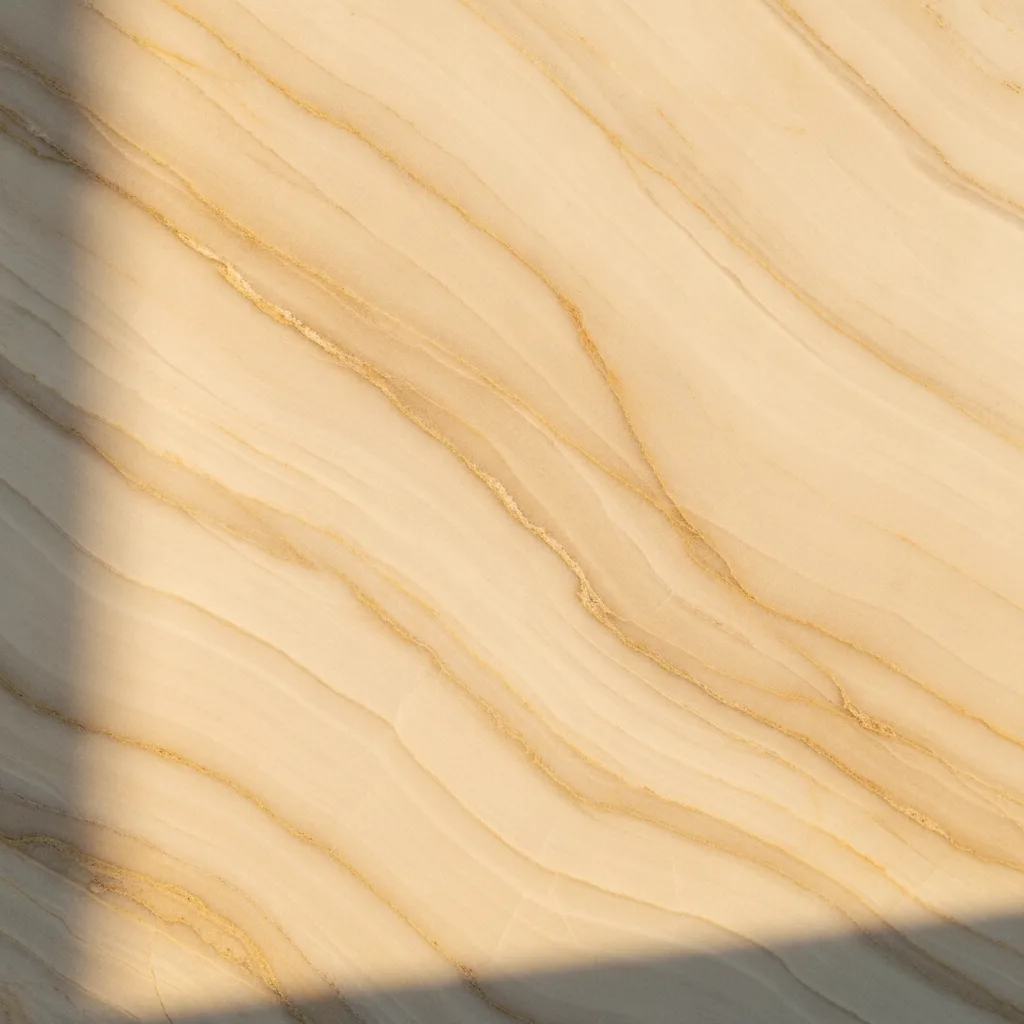
Taj Mahal quartzite is a 100% natural stone quarried from the Ceará and Espirito Santo regions of Brazil — not an engineered product, not a manufactured surface, and not marble. It forms when sandstone undergoes intense heat and pressure over millions of years, fusing quartz grains into an extraordinarily hard natural stone. That geological process gives it properties marble can never match, and it's what separates genuine quartzite from the softer dolomite stones that get sold under the same name.
On the Mohs hardness scale, Taj Mahal quartzite rates 7 to 7.5. Granite sits at 6 to 7. Marble sits at 3 to 5. That difference matters in a working kitchen: a knife blade won't scratch it, a cast-iron pan won't dull the surface, and common kitchen acids like lemon juice, vinegar, or tomato sauce won't etch it. Marble shows a visible etch mark from acid within two minutes. Taj Mahal quartzite won't react at all. Unlike engineered quartz, which contains resins and polymers that can scorch or discolor under high heat, Taj Mahal is a fully natural stone with inherent heat resistance.
As of 2026, Taj Mahal quartzite is the most-requested quartzite variety in US kitchens. The design shift away from cool grays toward warmer, earthier palettes has pushed it to the top of nearly every designer's shortlist. Its warm neutral base pairs with almost any cabinet color and flooring combination — a key reason it's so dominant in Central Texas kitchens where homeowners want a beautiful, timeless look that doesn't chase short-term trends. Every slab is one of a kind due to natural variation in its pattern and movement, which adds character that manufactured surfaces can't replicate.
Quartzite and engineered quartz are completely different materials. Quartzite is a natural stone. Engineered quartz is a manufactured product made from quartz particles, resins, and polymers. The names sound similar, but the performance, care requirements, and pricing differ significantly. If a salesperson uses the terms interchangeably, that's a red flag worth noting before you go further.
Taj Mahal quartzite is neither strictly gray nor strictly beige — it sits in the warm-neutral category. The base is a creamy white or pale ivory, layered with soft veins in gold, taupe, and light brown. Secondary undertones of warm gray and greige appear in many slabs, and some slabs carry faint hints of sand and hazelnut. The exact color varies slab to slab because every piece is a natural stone with its own unique pattern. Two kitchens finished with Taj Mahal quartzite countertops can look quite different depending on which quarry lot each slab came from.
The veining movement ranges from quiet and subtle to long directional flow across the full face of the slab. Some slabs are pale and restrained — almost tone-on-tone. Others show strong earthy warmth with bold champagne or caramel veins. Photographs rarely capture the depth of Taj Mahal's movement accurately. The same slab can look completely different under warm kitchen lighting versus natural daylight, and what appears golden in the morning can read almost white in direct afternoon sun. Always view slabs in person before you select — a 4-inch sample tells you the color direction, not the full story.
For cabinet pairings, warm whites and cream cabinets are the most common match in Central Texas kitchens. Putty, mushroom, and greige tones also work well, and the stone creates a natural warmth that complements wood-toned floors and helps balance darker cabinetry. On the backsplash side, white subway tile, soft gray ceramic, and marble mosaic are all reliable choices that let the slab's movement stay front and center. The stone's warmth and depth read especially well in kitchens with natural lighting or warm pendant fixtures.
Ask to photograph the slab at multiple points in the day — once under the showroom's artificial lighting and once near a window or outside. The color and warmth of Taj Mahal quartzite shifts noticeably depending on the light source. The photo you take in the morning may look quite different from the one you take in the afternoon, and both are closer to reality than any image you'll find online.
Taj Mahal quartzite installed costs $120–$180 per square foot in US markets as of 2026 for standard-grade slabs. Premium first-grade slabs with strong veining and high clarity reach $200 per square foot installed. For a typical 40-square-foot kitchen, that puts the all-in project cost at $4,000–$9,000 depending on slab grade, edge profile, and sink cutout complexity. That is meaningfully higher than most granite and engineered quartz projects, and the cost is justified by both material quality and fabrication difficulty.
The cost breakdown matters so you're not surprised by the quote. Raw slab material runs $60–$120 per square foot. Fabrication and installation labor adds $30–$70 per square foot on top. Standard slab size runs approximately 120 inches by 65–77 inches — about 55–64 square feet — so a single slab averages $3,000–$5,000 before any fabrication work begins. If you choose a honed or leathered finish instead of a standard polished finish, budget an additional $10–$25 per square foot for that finish surcharge. Honed finishes read softer and warmer; leathered finishes add texture and hide fingerprints but are harder to clean around the surface texture.
Taj Mahal quartzite also costs more to fabricate than softer stones. Its 7 to 7.5 Mohs hardness requires diamond tooling rated for hard stone, and a standard kitchen template that takes about two hours to cut from engineered quartz takes three to four hours from Taj Mahal. That labor difference is real and it shows up in quotes. A fabricator who quotes Taj Mahal at engineered-quartz prices is either cutting corners or mislabeling the stone. Comparing quartzite to marble on upfront cost only tells half the story: repairing an etched marble countertop costs $600–$1,500 per honing and refinishing service. If you cook frequently with acidic ingredients, quartzite's higher upfront investment often works out to be more economical over five to ten years.
Free
Gives a current 2026 per-square-foot range for quartzite by material grade and finish type — useful for sanity-checking local fabricator quotes before you sign anything
For large kitchens that require more than one slab, ask your fabricator to pull slabs from the same lot. Slab size and quarry lot both affect how closely the veining and color match across a long countertop run. Mismatched lots on a 10-foot island are immediately visible and can't be corrected after installation.
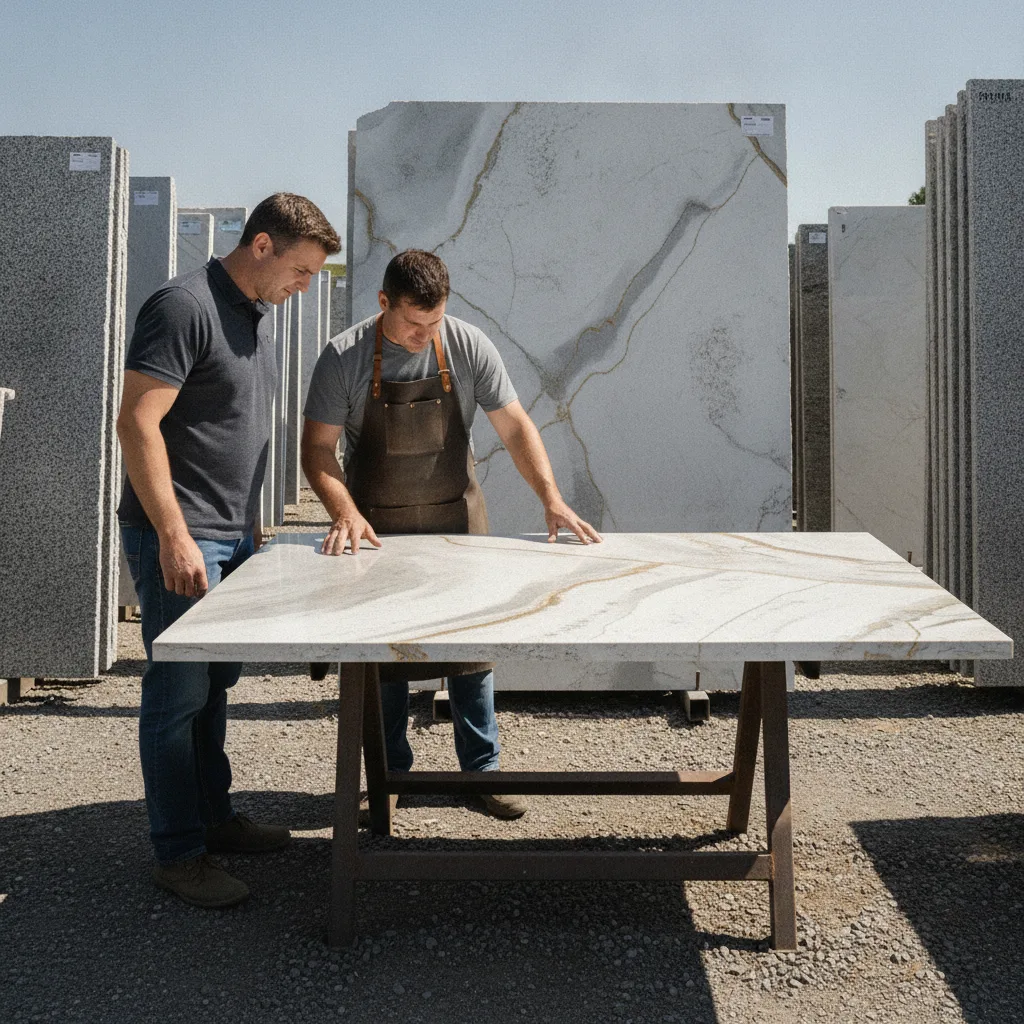
Taj Mahal quartzite has three honest trade-offs every buyer should know going in. First, it requires sealing every one to two years using a high-performance impregnating sealer. It is more porous than engineered quartz, which is non-porous by design. It's less porous than marble — meaning it's more forgiving of spills — but it is not maintenance-free. Skip the sealing schedule and staining becomes a real risk, especially around the sink and any area where oils or red sauces sit on the surface.
Second, natural fissures are part of the stone and they're worth understanding before you select your slab. Fissures are thin lines in the surface that look like hairline cracks but are a completely normal feature of natural stone formation — not damage, not a defect, not a fabrication error. Some homeowners notice them after installation and worry something went wrong. A knowledgeable fabricator should point these out during slab selection so you know exactly what you're buying and where the fissures will land in your kitchen layout.
Third, color and pattern vary significantly between slab lots, which matters most for large kitchens. For a kitchen that requires more than one slab, confirm your fabricator can pull from the same lot and plan the layout so veining flows in a way that reads intentional across the full countertop. A leaning toward more movement or more restraint is a personal preference — but the decision needs to be made at the slab yard, not after the countertops are installed and you realize the two slabs look like they came from different stones.
Mislabeling is the single biggest buyer risk with Taj Mahal quartzite countertops. Dolomitic marble and softer dolomite stones are regularly sold under the Taj Mahal name at slab yards — often described as 'soft quartzite,' which is not a real mineral category. Dolomite looks similar but behaves like marble: it etches from kitchen acids and dulls within five minutes of contact with lemon juice. You'd only discover the problem after installation, which is too late and too expensive to remedy without a full replacement.
Two quick field tests confirm authenticity. For the scratch test, drag a piece of glass or quartz across an inconspicuous area of the slab surface. Real Taj Mahal quartzite at 7 to 7.5 Mohs will scratch the glass without leaving a mark on the stone. Softer dolomite will scratch. For the etch test, drop a small amount of lemon juice or white vinegar on the slab surface and wait two to three minutes. Real quartzite won't react. Dolomite or marble will show a dull spot that appears immediately after you wipe the liquid away. A reputable fabricator should run both tests on request and should be completely comfortable doing so. If they push back, that hesitation tells you something important.
At Fox Granite, we stock inventory from vetted suppliers and we're glad to walk you through both tests on any slab you're considering. We've seen homeowners come to us after buying from a slab yard that couldn't answer basic questions about the stone's origin. Talking to a fabricator who knows this material — and can show you documentation of where it came from — is the most reliable way to avoid a costly mistake. The company you choose to fabricate your countertops matters as much as the slab you select.
If a slab yard or fabricator can't tell you the quarry region of origin for a Taj Mahal slab, or if they describe it as 'soft quartzite,' walk away. Genuine Taj Mahal quartzite is quarried in Ceará or Espirito Santo, Brazil. 'Soft quartzite' is not a real mineral category — it's often industry shorthand for dolomite or dolomitic marble sold to buyers who won't think to verify it.
Once you've confirmed the stone is genuine, select the specific slab — not just the material category. Taj Mahal quartzite's natural variation means the slab you approve in person is the slab you get. Mark it, photograph every section of it, and confirm with your fabricator exactly how the layout will be cut from that slab so the veining movement flows the way you want it across your countertops. For islands, this conversation matters most: a slab with long directional flow reads completely different depending on which way the grain runs relative to the island's long axis.
For edge profiles, eased and beveled edges keep the look clean and modern. Bullnose and half-bullnose soften the profile for a more traditional feel. Ogee edges add detail and work well on islands where the edge is visible from multiple angles. Your fabricator can show you edge profile samples in person — see them in the context of your slab's specific color rather than making the decision from a catalog or a phone screen.
Finish choice affects both look and maintenance. A polished finish brings out the full depth of Taj Mahal's color and movement and is the easiest to clean. A honed finish gives a soft matte look that reads warmer in the kitchen but shows fingerprints and watermarks more readily. A leathered finish adds texture and hides fingerprints well, though it can be harder to clean around the surface texture. Once your slab, edge, and finish are confirmed, your fabricator will schedule templating — typically a precision overlay measurement of your cabinet layout — and installation usually follows within one to two weeks.
Free
We bring samples to your home so you can see Taj Mahal quartzite against your actual cabinets, floors, and lighting before you commit to a slab — removing the guesswork that causes most post-installation regret
Taj Mahal quartzite at 3cm thickness weighs roughly 20 pounds per square foot. A 40-square-foot kitchen countertop runs about 800 pounds of stone. This is not a DIY project. Professional fabrication and installation is not optional — it protects the stone, your cabinets, and your investment. Do not plan to replace or move slabs yourself at any stage.
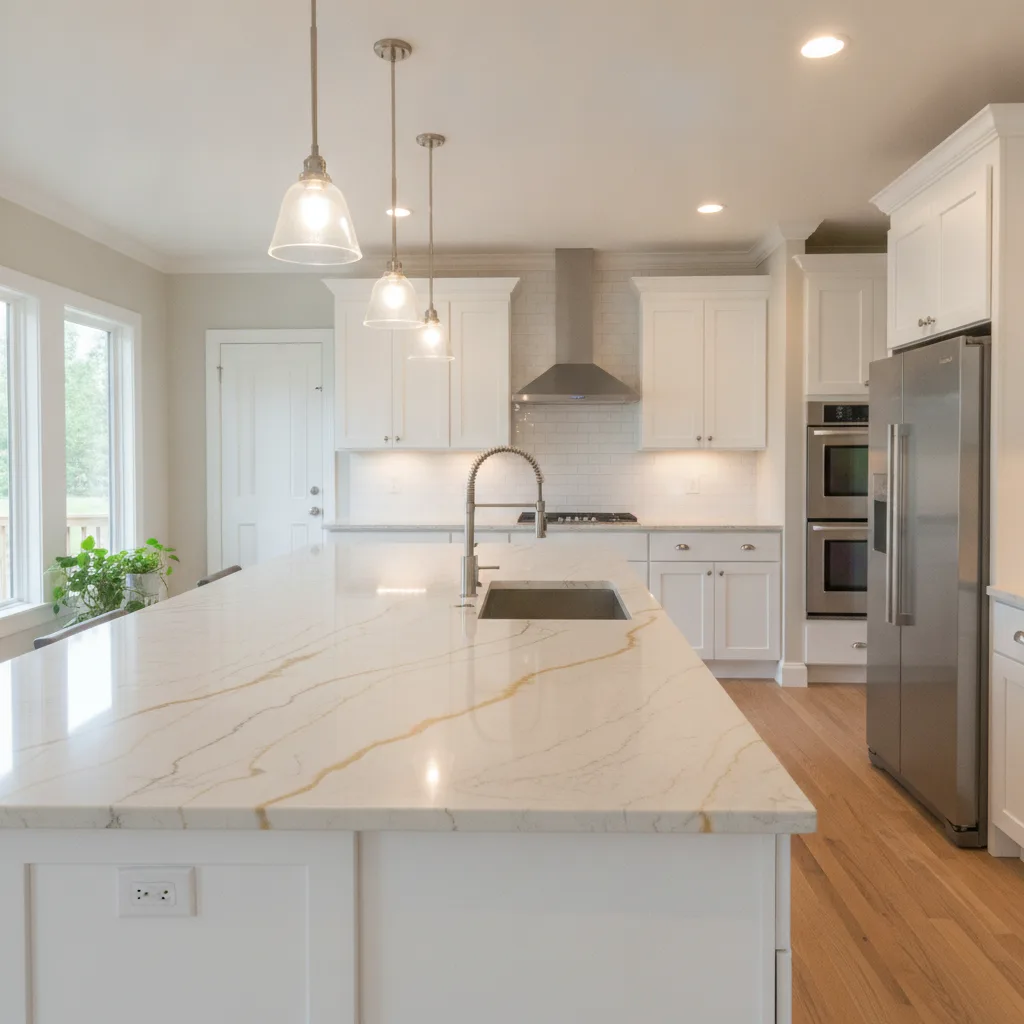
A 4-inch sample from a showroom tells you the color direction. It does not tell you how the veining moves, where the natural fissures land, or how the stone will look across 40 square feet of your kitchen. Always view and approve the full slab in person before fabrication begins. Once the fabricator cuts your countertops, what's done is done — there's no returning a slab that's already been templated and cut to your kitchen's layout. The decision you make at the slab yard is the decision you live with for the next 20 years.
When this process goes right, you end up with countertops that look better in your kitchen than any photograph suggested — because Taj Mahal quartzite's warmth and depth reveal themselves fully only in context, under your lighting, against your cabinets and floors. The goal of this guide is to help you get there without a mislabeled slab, a surprise fabrication bill, or a color you didn't expect. For Taj Mahal quartzite countertops in Austin, San Antonio, New Braunfels, and across the Central Texas corridor, Fox Granite fabricates in-house, works with vetted slab suppliers, and brings samples directly to your home so you can see the stone against your real kitchen before you spend a dollar. Call (512) 653-5541 or contact us online to schedule your free in-home consultation today.
Ready to get started? Contact Fox Granite today.


BY APPOINTMENT ONLY
1379 Wald Road
New Braunfels, TX 78132
Austin, San Antonio, Cedar Park, Kyle, New Braunfels, Del Valle, Elgin, Lago Vista, Shady Hollow, Onion Creek, Buda, San Marcos, Lockhart, Temple, Wimberley, Dripping Springs, Bee Cave, Lakeway, Leander, Anderson Mill, Jollyville, Spicewood Springs, Round Rock, Georgetown, Pflugerville, Manor, Taylor, Manchaca, Mountain City, Hutto, West Lake Hills, Bastrop, Liberty Hill, Driftwood, Sun City, Steiner Ranch.