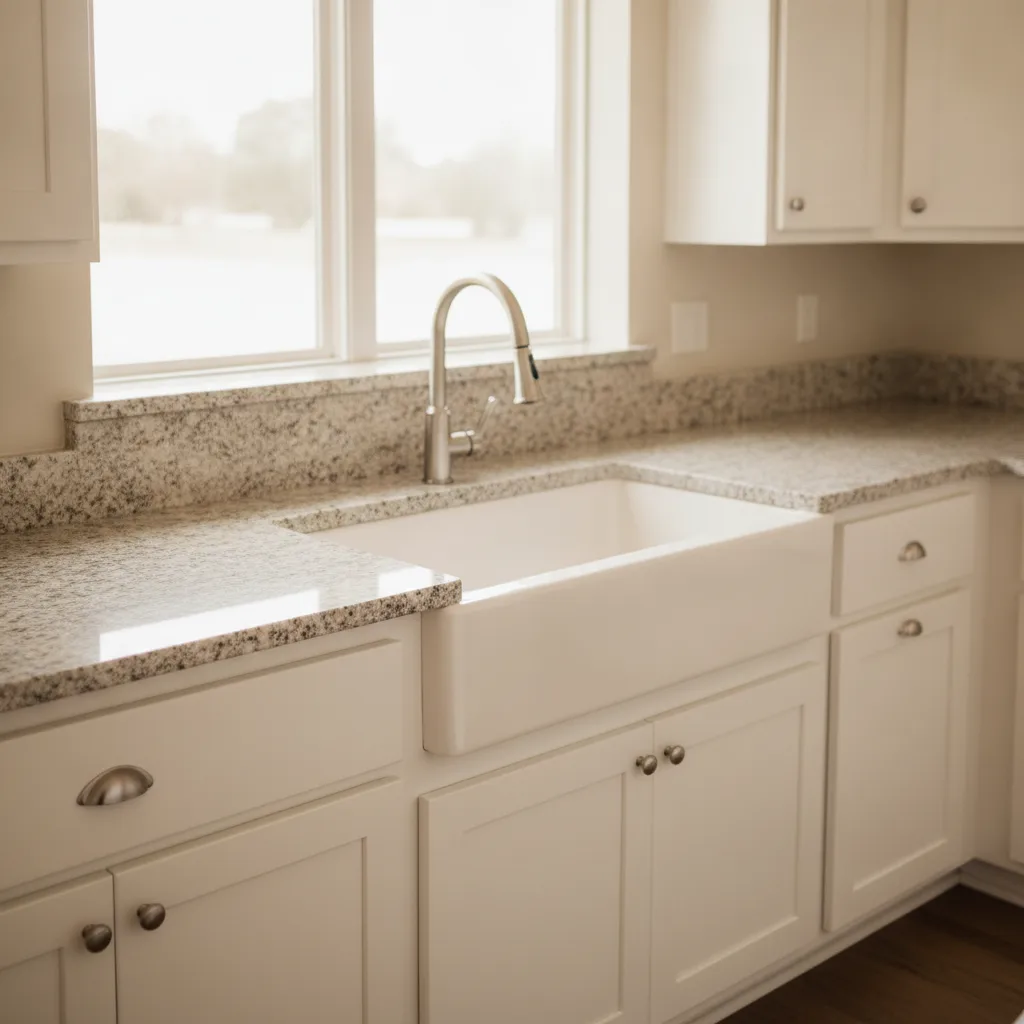
A kitchen countertop project in Central Texas costs $3,500–$6,500 installed for a typical 30–50 square foot kitchen, depending on material choice and edge profile. Before comparing slabs, homeowners need four numbers locked down: total square footage (measure each run in inches, multiply length by depth, divide by 144), material category (granite at $40–$100/sq ft, quartz at $50–$120/sq ft, quartzite at $70–$150/sq ft, or marble at $60–$150/sq ft installed), edge profile (eased is usually free; ogee adds $12–$30 per linear foot), and cutout count (sink and cooktop openings add $50–$150 each). Get those four answers before you walk into any showroom or call any fabricator, and your quotes will actually be comparable.
A kitchen countertop is the focal point of the room — and one of the most high-stakes purchase decisions in a kitchen remodel. Most Central Texas homeowners start the process backward: they fall in love with a slab at a showroom, ask for a price, and then discover the quote doesn't match their budget, their lifestyle, or what the fabricator down the street offered for "the same thing." This guide fixes that. Work through six steps in order — measure your square footage, match materials to your lifestyle, build a realistic budget using 2026 installed cost ranges, pick your edge profile, understand the maintenance reality for each material category, and then get a consultation — and you'll walk into any fabricator conversation ready to compare apples to apples. The process takes 20–30 minutes. Skipping it costs homeowners hundreds of dollars and weeks of regret.
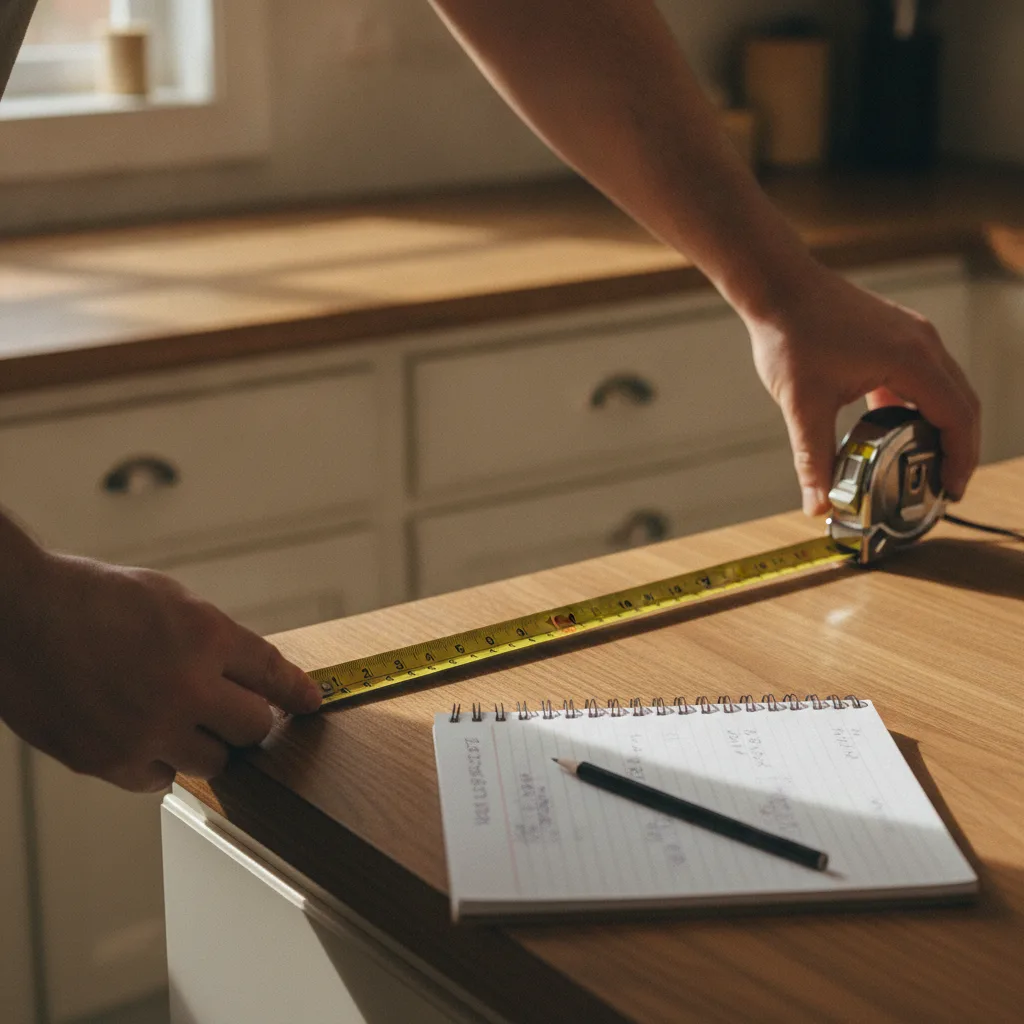
The single number that controls your entire countertop budget is square footage — and most homeowners don't know theirs before they start comparing countertop materials. A typical kitchen has 30–50 square feet of countertop surface. U-shaped kitchens often run 40–60 square feet. Standard countertop depth is 25–26 inches including overhang, so measure each counter run in inches, multiply length by depth, then divide by 144 to get square feet.
Quotes from different fabricators for the same kitchen can vary by 5–10 square feet — not because the countertops are different, but because measuring conventions differ. One fabricator may include the full depth with overhang; another may not. That gap translates directly into price differences that have nothing to do with material quality or craftsmanship. Lock down your own measurement before you call anyone.
Write down each counter run separately: the main perimeter, any island, and the peninsula if you have one. Add them up. That number — say, 42 square feet — becomes your comparison baseline. Every quote you receive should reference the same square footage. If two quotes differ by more than a few square feet, ask why before you assume one fabricator is cheaper.
$15–$30
Measure each counter run in inches — you need precision to the inch for an accurate square footage calculation
Free
Record each run's length and depth separately so you can verify fabricator measurements at quote time
Fabrication and installation labor adds $20–$40 per square foot on top of material costs. On a 42-square-foot kitchen, that's $840–$1,680 in labor alone — before a single slab is cut. Factor this in from the start so material prices don't mislead your budget.
Choosing a kitchen countertop based on appearance alone is the most common and most expensive mistake homeowners make. The wrong choice almost always reveals itself after installation — when the maintenance realities of a material collide with real daily life. Before you fall in love with a slab at the showroom, answer three questions: How hard do you cook? How messy is your household? And how much upkeep are you willing to do?
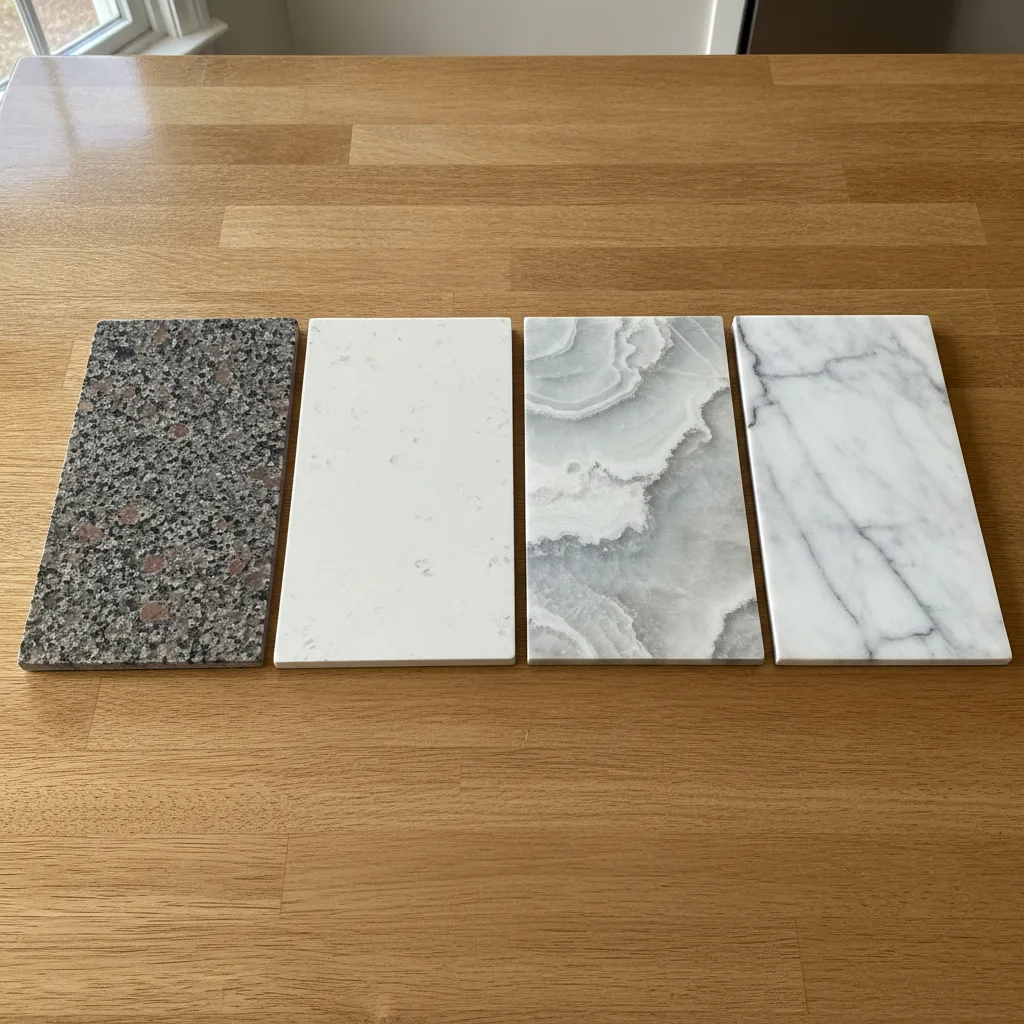
Granite is a natural stone that's scratch resistant and heat resistant, costs $40–$100 per square foot installed, and suits active kitchens well. It needs resealing every 1–5 years depending on slab porosity — lighter colors typically need more frequent attention than darker ones. Quartz is engineered, non-porous, and never requires sealing. It's scratch resistant and stain resistant, runs $50–$120 per square foot installed, and is the best-selling countertop material in the U.S. as of 2026. It's the lowest-maintenance stone option for families with kids or heavy daily use. One critical limitation: every major quartz manufacturer excludes outdoor use from their warranties due to UV degradation of the polymer resin. Don't put quartz outside.
Quartzite is natural stone — formed from sandstone under intense heat and pressure — and is frequently confused with engineered quartz. They are nearly opposites in origin and composition. Quartzite is often harder than granite, carries the visual appeal of marble, and costs $70–$150 per square foot installed. It's a strong choice for homeowners who want marble's look with better durability. Marble is the most high-maintenance option: it etches when acids like lemon juice, vinegar, or tomato contact the calcite in the stone. That's a chemical reaction, not a stain, and sealing cannot prevent it. Professional etch restoration costs $200–$600. Marble suits design-forward kitchens with disciplined upkeep — not households with kids or heavy cooking. Laminate countertops and butcher block countertops round out the budget end of the market. Laminate runs $10–$40 per square foot installed and works well for rental properties or tight budgets. Butcher block countertops add warmth and are DIY-friendly for handy homeowners, but wood surfaces require regular oiling and are not ideal near a sink long-term.
Quartzite and quartz sound alike but are almost opposites in origin. Quartzite is a natural stone quarried from the earth. Quartz (engineered) is a manufactured product made from stone particles and polymer resin. If a slab is labeled 'quartzite' but has a suspiciously uniform pattern, ask your fabricator to verify — misidentified slabs are more common than you'd think.
A typical kitchen countertop project in 2026 costs $3,500–$6,500 installed for 30–50 square feet of surface. That range covers material plus fabrication and installation labor ($20–$40 per sq ft). The national average sits around $3,138, but Central Texas kitchens with stone materials consistently land in the higher part of the range. Budget by material category, not by vague estimates, and build your floor and ceiling before you walk into any showroom.
Here's how the per-square-foot price math works in 2026, installed: granite runs $40–$100 per sq ft (premium slabs up to $140–$200); quartz runs $50–$120 per sq ft with mid-tier options most common at $60–$120; quartzite runs $70–$150 per sq ft; marble runs $60–$150 per sq ft with high-end slabs up to $250. On a 42-square-foot kitchen, that puts your material-plus-labor range at roughly $2,500–$6,300 depending on which stone you choose. Edge profile upgrades, sink cutouts, and any backsplash work add cost on top of that base. The U.S. countertops market is projected to reach $35.57 billion in 2026 — meaning homeowners are investing heavily, and fabricators are busy. Getting your budget locked before you shop gives you real negotiating clarity.
The 2025 Cost vs. Value Report puts a minor kitchen remodel at 113% ROI nationally — so a countertop upgrade is among the highest-returning home improvements you can make. That's a useful data point if you're weighing cost effectiveness before a home sale. But don't let ROI logic push you into a material or finish that doesn't suit your daily life. A marble countertop that etches and stains before you sell does not help your resale position.
Free
Multiply your sq ft by the per-sq-ft installed range for each material to build a realistic budget floor and ceiling before you get quotes
Sink cutouts add $50–$150 per opening depending on the fabricator. A kitchen with a main sink and a prep sink adds $100–$300 before you've chosen a faucet. Count your cutouts now — sink, cooktop, and any outlets — and include them in every quote request.
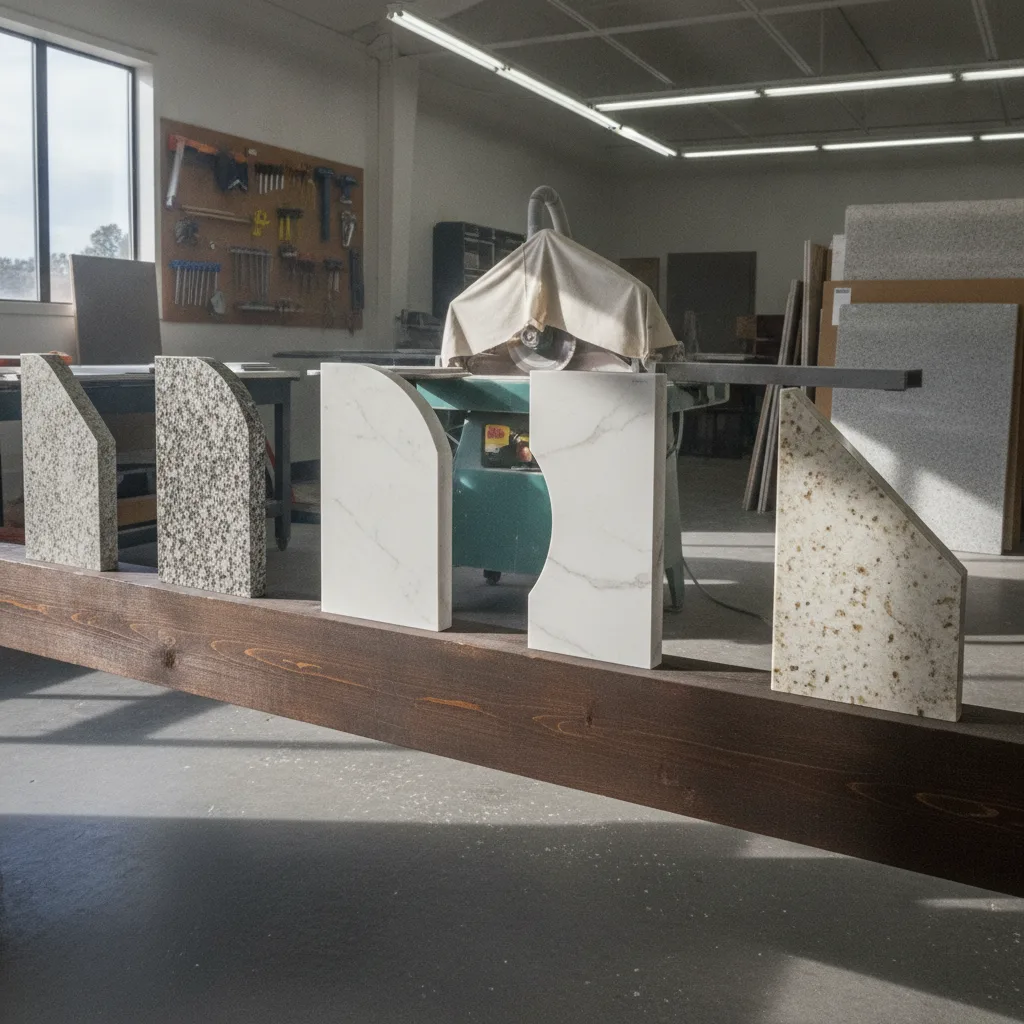
Edge profile is the detail most homeowners overlook until they're signing a contract — and it can add $200–$1,000 or more to a project. A typical kitchen has 20–35 linear feet of exposed countertop edge. The standard eased edge is usually included at no extra charge. Upgrade to a bullnose or half-bullnose and expect to pay $5–$15 per linear foot above that baseline. An ogee profile runs $12–$30 per linear foot. On 30 linear feet of exposed edge, ogee alone adds $360–$900 to your total.
All standard edge profiles are equally durable for kitchen use — the choice is purely aesthetic and about functionality for your household. Ogee and dupont profiles have recessed channels that collect crumbs and dried food, which matters if easy regular cleaning is a priority. A simple eased or beveled edge wipes clean in one pass. A bullnose is rounded and forgiving for households with kids. The most popular profiles at Fox Granite's New Braunfels showroom are eased, beveled, half-bullnose, and ogee — and seeing them in person on actual stone makes the selection much easier than reviewing photos online.
Decide your edge profile before you request quotes, and specify it by name in every quote request. If one quote includes eased and another includes ogee, you're not comparing the same project. This is one of the most common sources of budget shock when homeowners try to sort fabricators on price alone.
Your edge profile should complement your cabinet style. Shaker-style cabinets pair well with clean eased or beveled edges. More ornate raised-panel cabinets can handle the visual weight of an ogee. When in doubt, eased is the safe choice — it reads as modern, it's budget-friendly, and it cleans up fast.
Every countertop material has a maintenance profile. Knowing it before you buy is what separates homeowners who love their countertops five years in from those who regret the purchase. This is not about scare tactics — it's about matching material to lifestyle so you don't discover the reality post-installation.
Granite needs sealing every 1–5 years. Test yours with the water-bead method: pour a small amount of water on the surface. If it beads up, the sealer is holding. If it soaks in within a few minutes, it's time to reseal. A $20–$40 bottle of granite sealer handles the job in under an hour. Quartz needs no sealing at all — it's non-porous by design. Daily maintenance is mild soap and water. It's scratch resistant and stain resistant, making it the most practical choice for high-traffic kitchens. Quartzite's sealing needs vary by slab — ask your fabricator specifically about the slab you're selecting. Many quartzite varieties need less frequent sealing than granite and maintain their durability with minimal upkeep.
Marble is the exception that requires the most honest conversation. Acids etch marble — not by staining it, but by chemically reacting with the calcite and dulling the polished finish. Lemon juice, vinegar, tomato sauce, and wine all qualify. Sealing slows liquid absorption but cannot stop etching. A honed (matte) marble finish shows etch marks less visibly than polished marble, which is worth knowing if marble's appearance is non-negotiable for you. Butcher block countertops need regular oiling — every few months when new, annually once the wood is seasoned. Skip the oil and they dry out, crack, and warp. Laminate countertops are the easiest to maintain: mild soap and water, no sealing, no specialty products. They can't be refinished if scratched deeply, but affordability is their real advantage — laminate is the most budget-friendly option for homeowners who prioritize cost over durability and who find the balance between style and practicality in simpler surfaces.
The final step before choosing a fabricator is getting a quote that accounts for all four decisions: your square footage, your material, your edge profile, and your cutout count. A quote missing any of those variables will not reflect the real project cost. Lowball quotes almost always omit one of these line items, then add it back after you've committed. An itemized quote that details each of those factors separately is the standard — not a special request you need to seek out.
Fox Granite offers free in-home consultations with samples across Austin, San Antonio, and the Central Texas corridor. We bring material samples directly to your kitchen so you can see how each stone looks against your cabinets and in your actual lighting — not showroom lighting. Countertop colors read differently under natural light than they do in store under fluorescent lights. Our in-house fabrication team handles everything from templating through installation, so there are no handoffs to subcontractors and no surprise fees. We use a precision overlay template method and state-of-the-art stone-cutting software, which means what you approve is exactly what gets installed.
When you visit our New Braunfels showroom or schedule a consultation, bring your square footage number, your list of cutouts, and a photo of your cabinets. That's enough to get an accurate, all-in quote on the spot. We've completed over 10,000 projects across Central Texas since 2010 — and we've seen every version of the countertop buying process. The homeowners who come in ready with those details get through the process faster, with fewer surprises, and with more confidence in the choice they make.
Free
Bring material samples directly to your kitchen so you can evaluate stone colors and finishes against your actual cabinets before committing
Free to visit
See full slab selections and all edge profile options in person — photos online don't capture stone variation or texture accurately
If a quote doesn't specify the material, slab name or color, edge profile, square footage, and number of cutouts as separate line items, ask for an itemized version before signing. Vague quotes create disputes at installation. Transparent, itemized pricing is the standard — not a special request.
The most expensive countertop mistake in Central Texas isn't overpaying on price — it's choosing the wrong material for the way you actually use your kitchen. Marble that etches on a busy family countertop. Quartz installed outdoors and voiding the warranty. Granite resealed too late after years of soaking up cooking oils. Every one of those outcomes is avoidable with 20 minutes of honest thinking before you shop. Use this guide as your checklist, not a menu. Work through square footage, budget, material fit, and edge profile in order — then call us. We'll bring the samples to you.
For kitchen countertop fabrication and installation in Austin, San Antonio, Round Rock, New Braunfels, San Marcos, Georgetown, Cedar Park, and the surrounding Central Texas areas, trust Fox Granite. We're a family-owned team with over 15 years of experience, in-house fabrication, and a consumer-first process built to take the overwhelm out of a high-stakes decision. Contact us today to schedule your free in-home consultation — we'll bring the samples, answer your questions, and give you a transparent, all-in quote with no surprise fees.
Ready to get started? Contact Fox Granite today.


BY APPOINTMENT ONLY
1379 Wald Road
New Braunfels, TX 78132
Austin, San Antonio, Cedar Park, Kyle, New Braunfels, Del Valle, Elgin, Lago Vista, Shady Hollow, Onion Creek, Buda, San Marcos, Lockhart, Temple, Wimberley, Dripping Springs, Bee Cave, Lakeway, Leander, Anderson Mill, Jollyville, Spicewood Springs, Round Rock, Georgetown, Pflugerville, Manor, Taylor, Manchaca, Mountain City, Hutto, West Lake Hills, Bastrop, Liberty Hill, Driftwood, Sun City, Steiner Ranch.