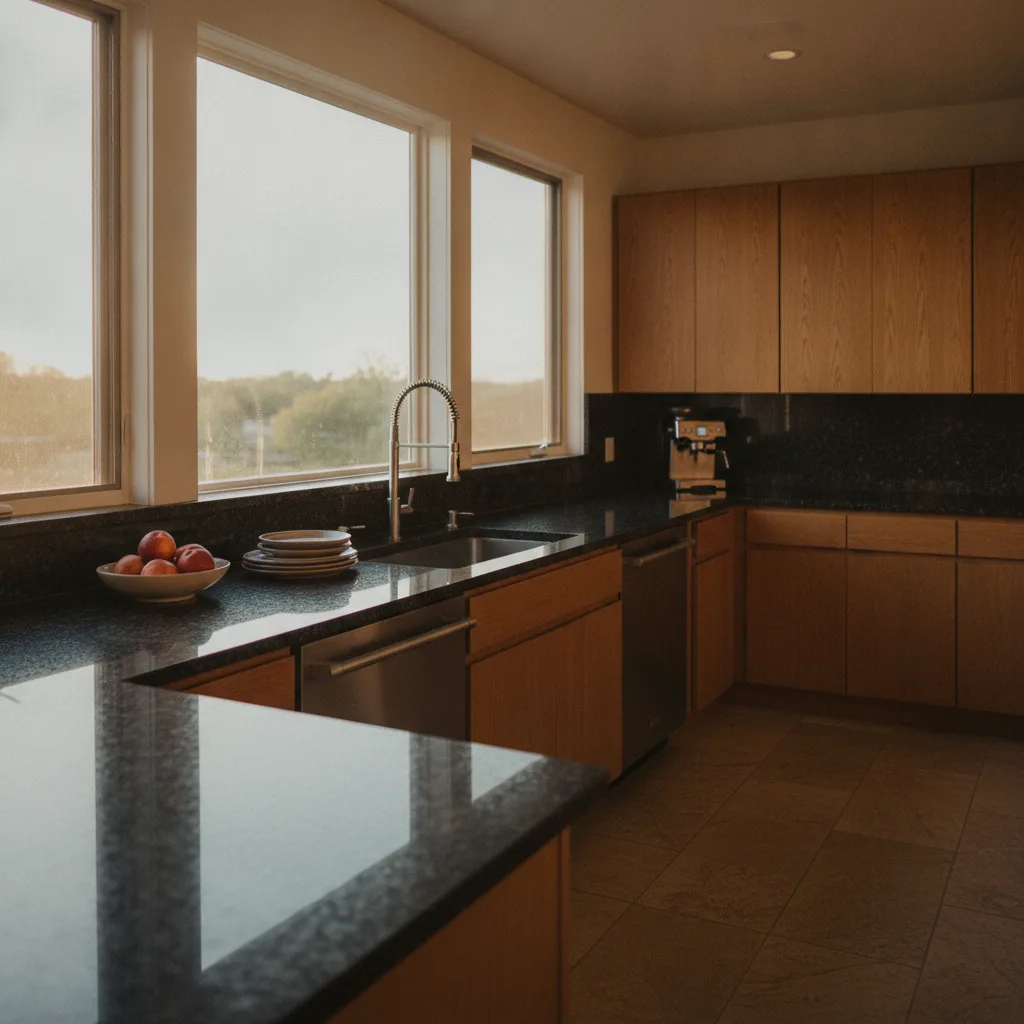
Austin TX granite countertops face a specific set of climate conditions: 123 days per year above 90°F, relative humidity of 64–71% year-round, and moderately hard water at 4.9 grains per gallon from Colorado River limestone geology. Granite handles Austin's heat with zero structural risk — it tolerates up to 1,200°F before damage. The real threats are sealant wear from humidity and hard-water mineral deposits near the sink. The fix is a 12-month resealing schedule (not the national 1–3 year default) and a targeted 8–10 month reseal cycle for the sink zone. For outdoor kitchens, skip engineered quartz entirely — UV breaks down its polymer resins within three months. Granite or quartzite are the correct outdoor choices in Austin TX.
Austin TX granite countertops face a climate that most national buying guides simply ignore. The numbers are specific: 123 days per year above 90°F, peak summer highs of 99°F in early August, year-round relative humidity averaging 64–71%, and tap water running at 4.9 grains per gallon of hardness from Colorado River limestone geology. That combination is not just uncomfortable to live in — it's a real performance filter for every countertop material you're considering. This guide walks Austin-area homeowners through exactly what that climate does to countertop surfaces, why granite is built to handle it, and the two care adjustments that protect a $2,000–$4,500 installation for 20–30+ years. If you have questions after reading, the Fox Granite team is easy to reach by phone, email, or through our contact form — and we offer free in-home estimates any day of the week.
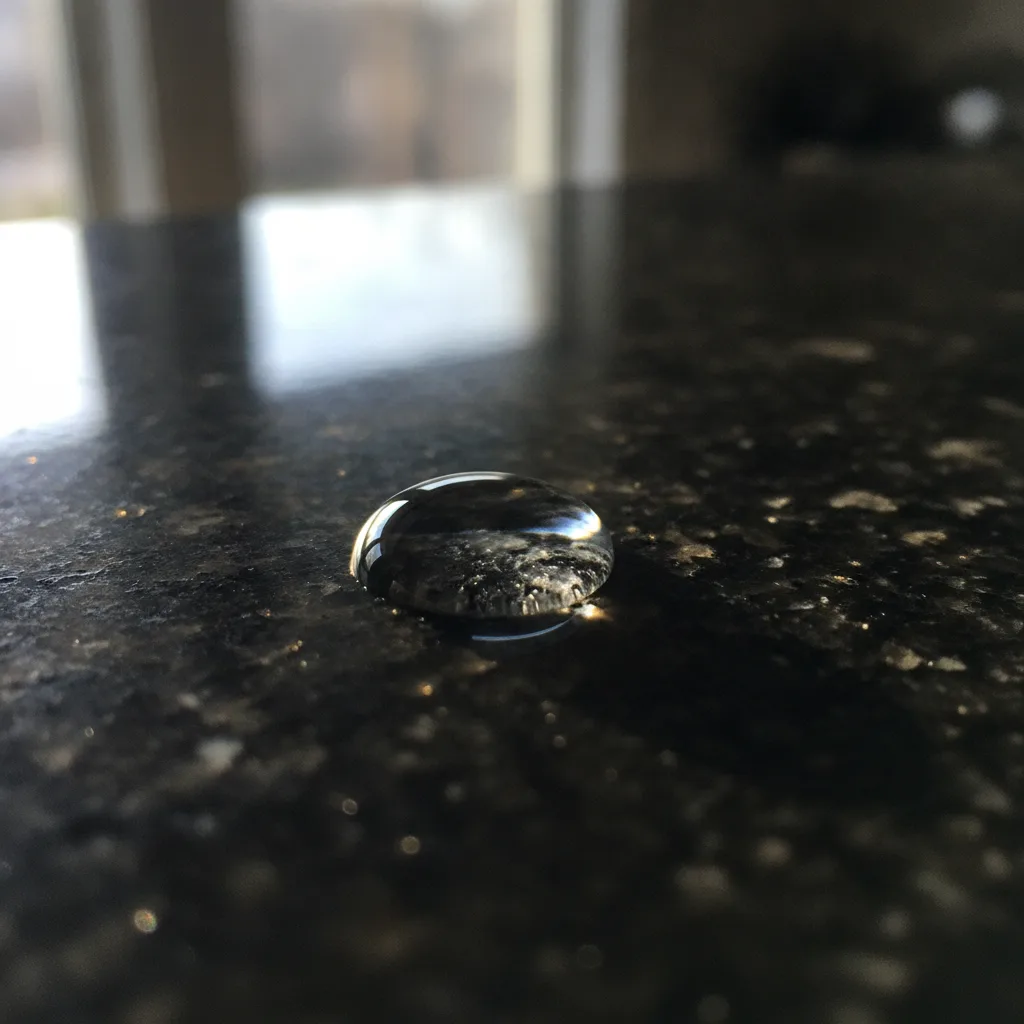
Austin's climate hits countertop surfaces with two forces that most homeowners underestimate: humidity and hard water working together, constantly. At 64–71% relative humidity year-round, granite surfaces in Austin kitchens are rarely fully dry between cooking sessions and cleanings. That persistent moisture exposure works into any unsealed or degraded pores in the stone and deposits minerals on the surface every time water evaporates — both effects accelerate faster here than in dry climates like Phoenix or Denver. Every day of that exposure adds up, and the cumulative toll on an improperly sealed slab shows up faster than most homeowners expect.
Austin's water hardness adds the second layer of stress. The Colorado River flows through Texas limestone geology, which puts Austin's tap water at 4.9 grains per gallon — classified as moderately hard. Every splash near your sink leaves a faint calcium carbonate film. Over weeks, that film dulls the finish around your faucet zone and breaks down the sealer faster than the rest of the slab. The sink area is always the first place Austin countertops show trouble.
Heat, by comparison, is the least dangerous of the three forces — for granite specifically. The stone itself tolerates ambient Texas temperatures without any structural risk. Understanding this hierarchy (humidity and hard water are the real threats; heat is the sealer's problem, not the stone's) is the starting point for every smart countertop decision in this market.
Granite is natural stone formed under geological heat and pressure that far exceeds anything a Texas summer can produce. Ambient surface temperatures — even outdoor slabs reaching 120°F in direct sun — pose zero cracking risk to the stone itself. Granite can withstand temperatures up to 1,200°F (649°C) before structural damage occurs. Austin's outdoor kitchen culture, with grills and smokers running at full output, does not stress the stone. It stresses the sealer on top of it.
That distinction matters for how you care for your countertops. Very hot pots or pans set directly on the surface strip the sealant at the point of contact, leaving porous granite underneath exposed and more vulnerable to staining from Austin's hard water and everyday kitchen spills. The solution is trivial — use a trivet — but the reason to use one is sealer protection, not stone protection. The natural stone itself is durable well beyond anything your kitchen produces.
Granite also holds color indefinitely under direct UV exposure, because it contains no synthetic components that sunlight can degrade. That UV stability is a critical advantage for Austin's 123 bright, hot days. Darker, denser slabs like Absolute Black or Black Galaxy are even more resistant to moisture penetration because their tighter crystalline structure limits porosity. If your kitchen sees heavy prep-area use near the sink, choosing a denser granite slab is one of the most practical design decisions you can make — it extends seal life and reduces the frequency of touch-up resealing in the wet zone.
Lighter-colored granites are generally more porous than darker varieties and may need sealing more frequently — especially in Austin homes with high humidity. Ask to see the porosity rating of any slab you're considering before you commit. Your fabricator should be able to pull that data for specific inventory in the showroom.
The national default for granite resealing is every 1–3 years. In Austin TX, that range does not apply. Most granite countertops in Central Texas kitchens need a fresh coat of sealer every 12 months because high humidity, constant air conditioning cycling, and hard-water mineral deposits accelerate sealant wear faster than in dry or temperate climates. Dense, dark granite varieties can sometimes stretch to 18–24 months between full reseal cycles. But for most slabs in an Austin kitchen — particularly lighter colors — plan on once a year.
The sink zone needs even more attention. Because Austin's 4.9 gpg water creates a constant wetting-and-drying cycle with calcium carbonate buildup, the area within six inches of your faucet may need resealing every 8–10 months — even if the rest of the slab is fine on a 12-month schedule. Test this zone first: place a few drops of water on the surface near the faucet. If they soak in within 10 minutes rather than beading up, reseal that area immediately. This is not a job that rewards procrastination — the time to act is before you see a stain, not after.
The two-hour job costs $40–$80 in quality materials and protects a $2,000–$4,500 installation for decades. Mark the annual reseal on your calendar the same day you schedule your HVAC service. Skipping the reseal is the single most common reason Austin homeowners run into staining and moisture problems — and once moisture penetrates unsealed pores, cleaning alone won't reverse the damage. Proactive sealing is far cheaper than professional stone restoration after the fact.
$25–$35 per bottle
Penetrating water-based sealer rated for high-humidity climates; one bottle covers a standard 40–50 sq ft kitchen countertop with two coats
$40–$55 per quart
Professional-grade penetrating sealer used by fabricators across Texas; preferred for denser slabs and outdoor granite surfaces where long-term sealer adhesion matters most
Do the water-droplet test every six months in the sink zone and every 12 months on the rest of the slab. Resealing an area that still has active sealer does no harm — but waiting until you see a stain means the sealer has already failed. In Austin's climate, early action always wins.
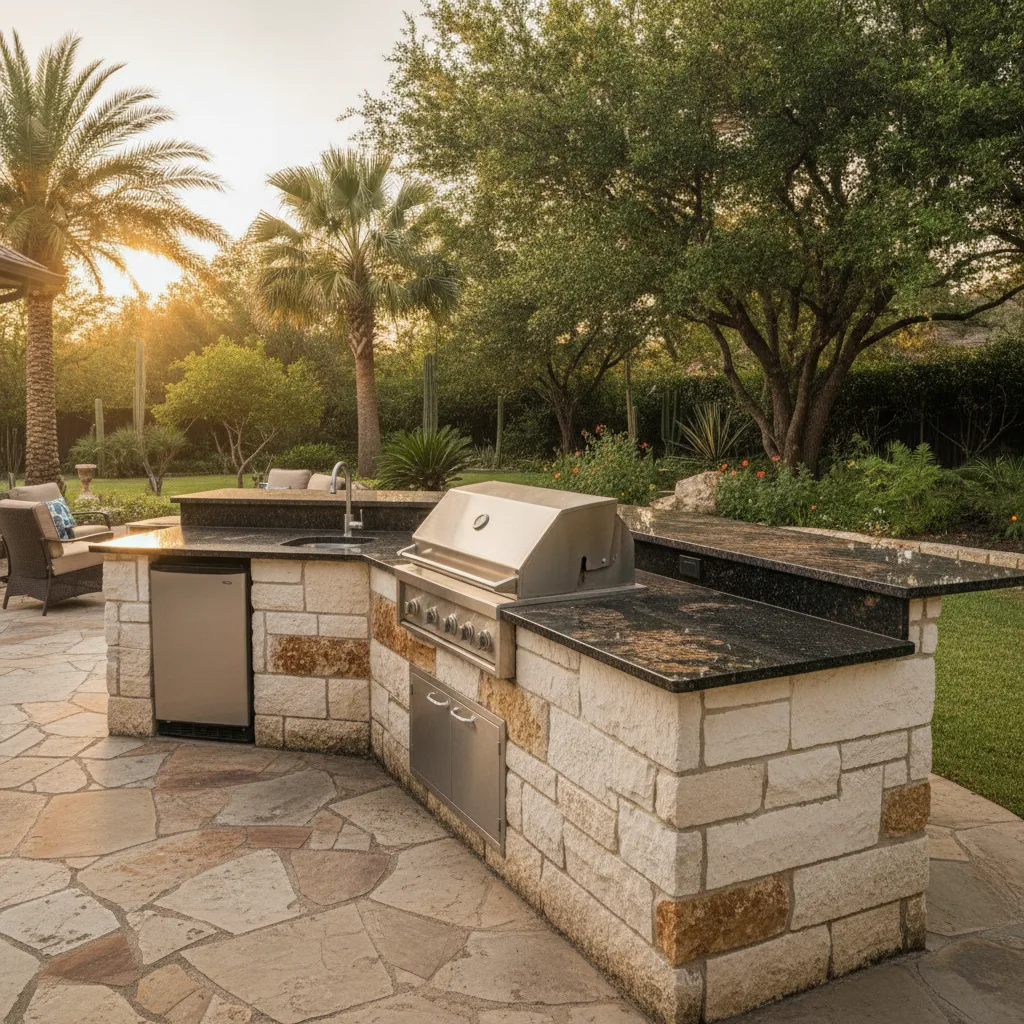
Austin's outdoor kitchen boom is where material choice mistakes cost homeowners the most money. The rule is simple: never install engineered quartz outdoors in Austin TX. Quartz countertops contain polymer resins that are not UV-stable. In a hot, sunny Texas climate, a white quartz countertop on an uncovered patio can show visible yellowing within three months of installation — and no major quartz manufacturer warrants outdoor use. That discoloration is permanent. No cleaning, sealing, or surface treatment reverses UV-degraded resin. You're looking at a full countertop replacement.
Granite is the proven outdoor countertop material for Austin and the surrounding Central Texas corridor. It's UV-stable because it's entirely natural stone with no synthetic binders to degrade. It's heat-resistant to 1,200°F — far beyond any grill or smoker output. When sealed on the recommended 12-month schedule, it handles Austin's humidity and rain without staining. Properly sealed outdoor granite countertops in Texas commonly last 20–30+ years, making them a sound investment for any outdoor living space.
Quartzite is the premium upgrade for outdoor spaces. At approximately 7 on the Mohs hardness scale — harder than granite — and with zero synthetic components, quartzite holds its color and surface integrity under prolonged direct sunlight better than any other countertop material available in 2026. The tradeoff is cost: quartzite runs $15–$70 more per square foot installed than comparable granite. For an uncovered outdoor kitchen or a south-facing countertop run that takes full afternoon Texas sun, that premium is worth the investment.
If your outdoor kitchen is covered or under a substantial pergola, granite is the cost-effective right choice. If it's fully exposed to direct sun year-round, quartzite's UV stability and extra hardness justify the premium. Discuss your specific outdoor setup with a fabricator before selecting a slab — the coverage situation changes the recommendation.
Selecting the right slab in Austin TX isn't purely an aesthetics decision — it's a performance decision shaped by your water chemistry and kitchen habits. Austin's moderately hard water at 4.9 gpg leaves calcium carbonate deposits near any wet zone, and those deposits show up most visibly on polished dark slabs and heavily textured light slabs. A honed or leathered finish hides mineral spotting better than a high-gloss polish on the same stone. If hard-water spots near the sink are a known frustration in your home, a leathered finish on a mid-tone granite slab eliminates most of the visual problem without changing the material.
For indoor kitchens, darker dense granites — Black Galaxy, Absolute Black, or dark blue-gray granites with tight patterns — offer the lowest porosity and the longest seal life. Lighter granites like White Ice or Colonial White are beautiful and remain popular in Austin kitchen design, but they require more frequent sealing and show hard-water spots more readily around the sink. Plan for that 8–10 month sink-zone reseal cycle if you go lighter. Either choice works well with the right expectations going in.
For bathroom vanity tops, marble quartzite both offer distinct advantages worth considering alongside granite. Marble offers elegance and natural veining patterns that many Austin homeowners find perfect for a spa-like design, but it is softer and more porous, so Austin's hard water and humidity demand strict sealing discipline in baths specifically. Quartzite in baths gives you the elegance of marble with dramatically better durability. Soapstone is another product worth a look for baths — it's non-porous by nature and never needs sealing, though its softer surface shows scratches more readily than granite. Granite and quartzite remain the lower-maintenance alternatives across both kitchens and baths if you want natural stone quality without the extra care commitment. Fox Granite's staff can walk you through the full selection at the New Braunfels showroom, where you view the exact slab — not a sample tile — before you commit to your project.
The fabricator you choose determines how well your custom countertops perform over time — not just how good they look on install day. For Austin TX granite countertops, that means working with a team that does in-house fabrication using precision templating, not a showroom that outsources cutting and installation to a separate crew. When fabrication and installation live under the same roof, tolerances are tighter, seams are cleaner, and there's one point of contact for any follow-up service. That craftsmanship matters especially in Austin's climate, where a poorly cut seam near a sink becomes a moisture entry point. If you have questions at any stage of the process — selecting slabs, choosing edging profiles, or scheduling installation — our staff responds by phone or email the same business day.
Fox Granite has been fabricating and installing countertops across Austin Texas, San Antonio, Round Rock, Cedar Park, Leander, Georgetown, New Braunfels, and the broader Central Texas corridor since 2010. We use the overlay template method for precision templating, cut every slab in-house with state-of-the-art stone-cutting software, and handle installation with our own crew — nothing is subcontracted. Our pricing is transparent and all-in with no surprise fees. We also offer free in-home consultations where we bring samples directly to you, so you can view how colors, edging styles, and finishes look in your actual lighting before you commit. Showroom visits are open by appointment, and our studio is stocked with granite, marble, quartzite, porcelain, and soapstone product lines across every price range.
A typical 40–50 sq ft kitchen at Level 1–2 granite runs $2,000–$4,500 all-in installed. The process from first contact to finished installation is built to be clear: free in-home estimate, showroom slab selection, precision templating, in-house fabrication, and professional installation — usually completed within a week of your template appointment. Builders, designers, and homeowners across Austin Texas and surrounding areas including Dripping Springs, Kyle, Buda, San Marcos, Pflugerville, and Schertz work with our team regularly. Contact us today — by phone, email, or our website form — to schedule your free in-home estimate and find the right natural stone for your space and your budget.
The two most common and expensive countertop mistakes Austin homeowners make are: following the national 1–3 year resealing schedule instead of Austin's 12-month reality, and installing engineered quartz outdoors where UV damage causes permanent yellowing within months. Both are avoidable. Annual sealing takes two hours and costs under $80 in materials. Choosing granite or quartzite for your outdoor kitchen instead of quartz costs nothing extra in planning — and saves you a full countertop replacement. If you're unsure where your existing countertops stand, the water-droplet test takes 10 minutes and tells you everything you need to know. Have questions? Send us an email or call the showroom — our staff is focused on giving you a clear, honest answer before you spend a dollar.
For Austin TX granite countertops, San Antonio, Round Rock, Cedar Park, Leander, New Braunfels, and the full Central Texas corridor, Fox Granite brings 16 years of local fabrication experience to every project. We know exactly what Austin Texas heat, humidity, and hard water demand from your slab — and we build that knowledge into every template, every cut, and every installation. When your countertops are properly matched to Austin's climate from day one, they perform beautifully for 20–30+ years without drama. Contact us today to schedule your free in-home consultation. We'll bring samples to your home, walk you through slab selection with confidence, and give you transparent all-in pricing — no surprises, no subcontractors, just quality craftsmanship built for this market. Our team is open Monday through Friday and on Saturdays by appointment; reach us by phone, by email, or by submitting a message through the contact form on our website.
Ready to get started? Contact Fox Granite today.


BY APPOINTMENT ONLY
1379 Wald Road
New Braunfels, TX 78132
Austin, San Antonio, Cedar Park, Kyle, New Braunfels, Del Valle, Elgin, Lago Vista, Shady Hollow, Onion Creek, Buda, San Marcos, Lockhart, Temple, Wimberley, Dripping Springs, Bee Cave, Lakeway, Leander, Anderson Mill, Jollyville, Spicewood Springs, Round Rock, Georgetown, Pflugerville, Manor, Taylor, Manchaca, Mountain City, Hutto, West Lake Hills, Bastrop, Liberty Hill, Driftwood, Sun City, Steiner Ranch.