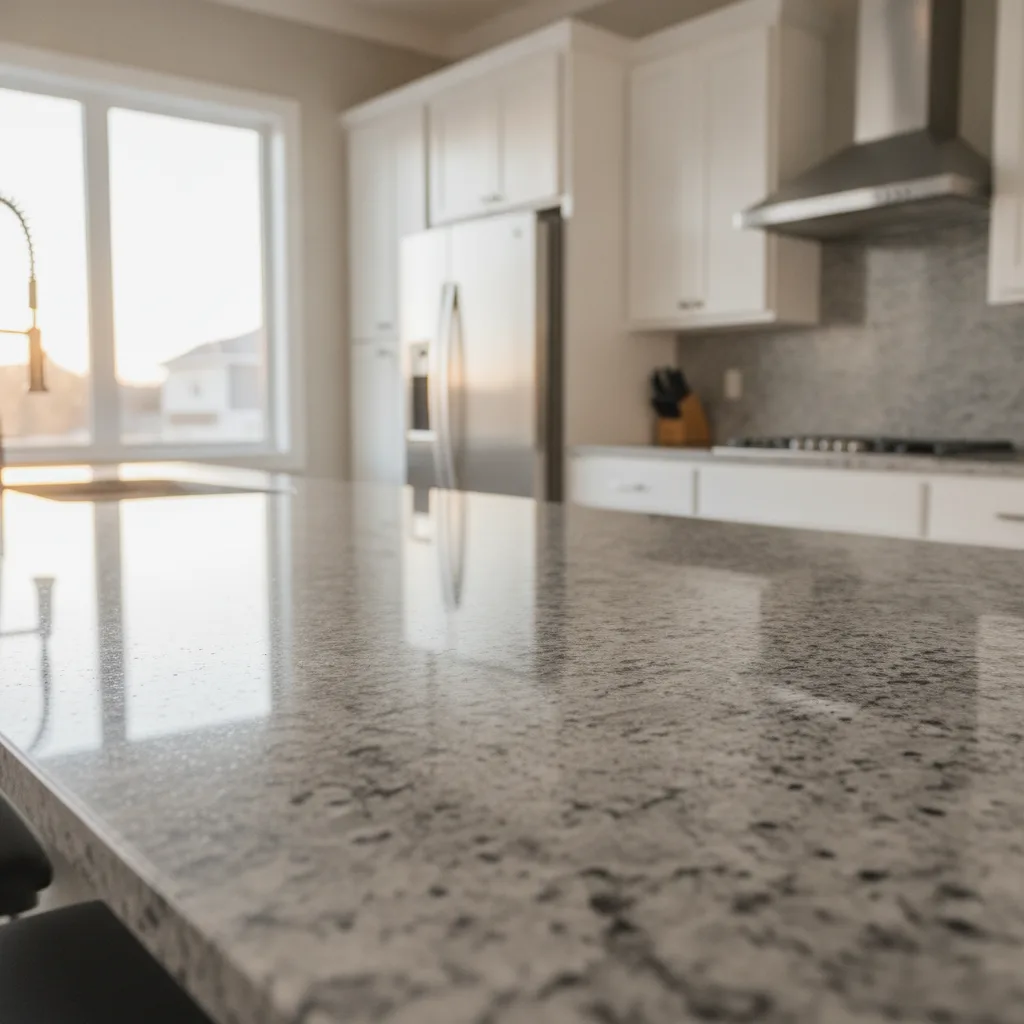
Gray granite countertops run $40 to $200 per square foot installed in 2026, depending on variety and slab rarity. Popular options range from budget-tier Alaska White and Viscount White ($40–$65/sq ft) to mid-range Steel Gray and Bianco Antico ($65–$120/sq ft) to premium Lennon and Blue Pearl ($150–$200/sq ft). Gray granite is extremely durable, heat resistant, and acid resistant — advantages quartz and marble cannot fully match. It needs sealing every one to three years, which most homeowners handle themselves in under an hour. As of 2026, granite still holds 15% of new countertop choices among renovating homeowners (2026 Houzz Kitchen Trends Study), and gray remains a timeless, practical choice when paired with updated cabinet colors and a coherent backsplash.
Gray granite countertops are the quietly practical choice that Central Texas homeowners keep coming back to — not because they chased every design trend, but because they didn't have to. Natural stone that scores 6 to 7 on the Mohs scale, shrugs off a hot pan, resists etching from vinegar and lemon juice, and cleans up with warm water and mild soap earns its place in a busy kitchen on performance alone. This guide walks you through six steps: understanding what gray granite actually is, learning the variety names before you walk into a slab yard, getting the real 2026 installed pricing, comparing it honestly against quartz and marble, pairing it with the right cabinet colors and finishes, and selecting and maintaining your specific slab. Plan on 30–45 minutes to work through it as a planning reference. Your actual countertop project from consultation to installation typically runs one to three weeks.
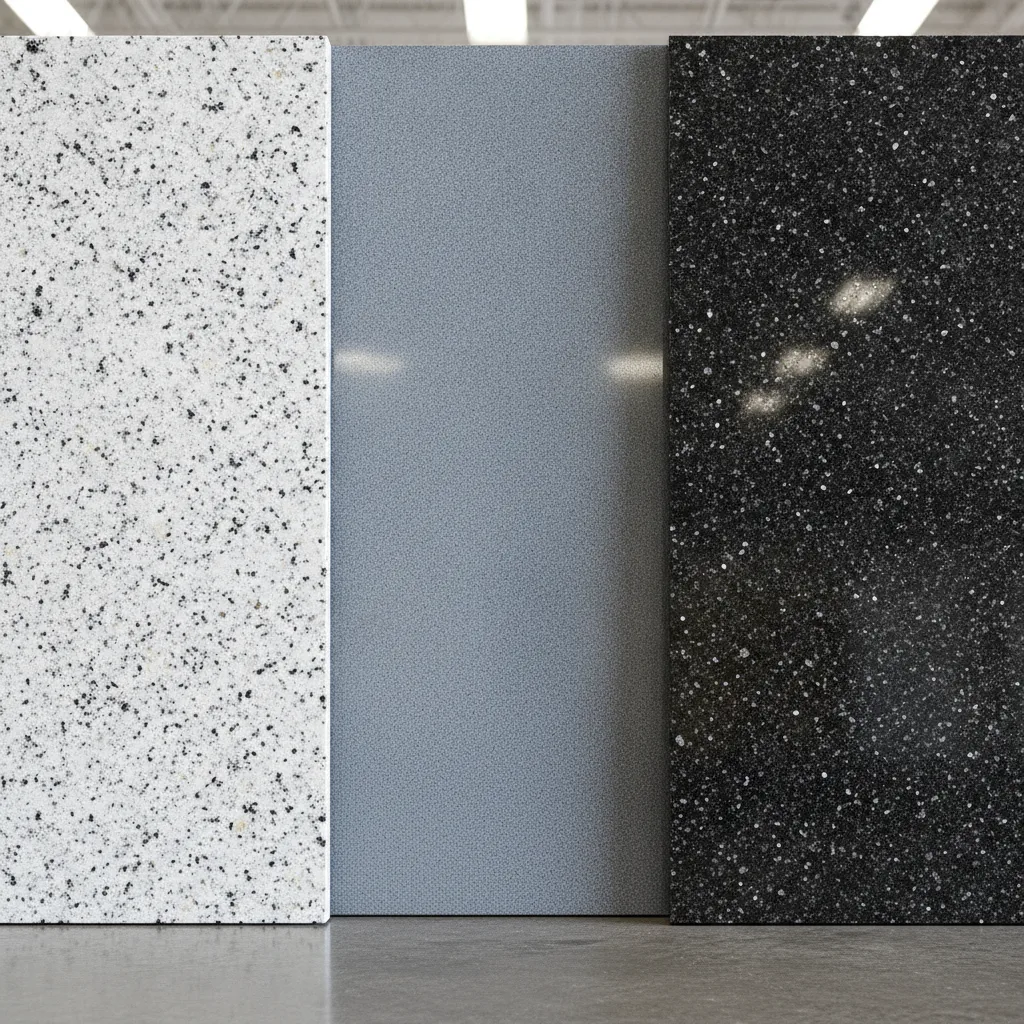
Gray granite countertops are not a single material — they're a family of igneous natural stone slabs that share a gray base but vary widely in undertone, movement, porosity, and price. Granite forms when magma cools slowly deep underground, producing a tight crystalline structure of quartz, feldspar, and mica. That structure is what gives granite its hardness: 6 to 7 on the Mohs scale, harder than most kitchen knife steel, and genuinely heat resistant in a way that engineered materials cannot match. Set a hot pan directly on granite and the stone handles it without complaint. Set that same pan on quartz, and the resin binders can discolor or crack — which is why every major quartz manufacturer excludes heat damage from its warranty.
Gray granite and gray quartzite are often confused at stone yards. Quartzite slabs like Silver Falls score around Mohs 7 and have a more translucent, veined appearance that can closely mimic marble. They typically cost more than comparable granite, and their natural beauty reads as elegant rather than bold. But here's the practical problem: many stones sold as quartzite are actually marble or a softer marble-quartzite hybrid. Before committing to a slab marketed as quartzite, ask the fabricator to run a scratch test — a knife should leave no mark on true quartzite. Gray granite, by contrast, is more consistently identified at the slab level and gives you predictable durability. Gray stone in general spans a wide hardness range, and knowing what you're actually buying before fabrication starts matters.
Gray granite also has a clear advantage over gray marble on acid resistance. Marble is a metamorphic rock whose calcium carbonate structure reacts with household acids — a splash of vinegar or a lemon wedge can etch the surface permanently. Granite's silicate mineral structure doesn't react that way. For a busy kitchen in Austin or San Antonio where coffee, citrus, and cooking oils are part of daily wear, that difference is meaningful. Soapstone is another natural stone option you'll see compared to gray granite — it's softer, nonporous, and develops a patina over time, but it scratches more easily and suits a very specific aesthetic that doesn't suit every kitchen. Gray granite is the more consistently durable option across the range of everyday kitchen demands.
Gray granite and gray quartzite serve similar design roles as a neutral stone, but they have meaningfully different pricing and porosity profiles. If a fabricator quotes you gray quartzite, verify it with a scratch test before you select. Some stones sold as quartzite are softer hybrids that behave more like marble — and they'll require more frequent resealing and more careful daily care than granite.
Gray granite colors span a vast array — from near-white silver slabs with barely any movement, to dark charcoal with metallic shimmer, to lighter gray varieties with strong linear veining that mimics marble. Knowing the common names before you walk into a stone yard saves time and prevents you from being upsold on a variety that doesn't fit your space. The same stone can sell under different names depending on the regional distributor, so always look at the physical slab rather than relying on a name alone. What one yard calls Steel Gray another may label Platinum Gray — the shades are close enough to confuse buyers who haven't done the research.
Budget-tier gray granite varieties, roughly $40–$65 per square foot installed, include Alaska White — a cool light gray with subtle speckle that reads clean and modern — and Viscount White, another subdued option popular in price-conscious remodels. Mid-range varieties at $65–$120 per square foot are where many homeowners land: Steel Gray is a medium blue-gray that's nearly solid with extremely low porosity; Bianco Antico is a warm pale gray with soft rose tones that bridges well with off-white and wood-tone cabinets; Black Pearl is dark charcoal with mica shimmer; Colonial White offers heavier veining with burgundy accents on a light gray-cream base; and Silver Cloud reads as a near-white silver with low movement and a quiet, sophisticated presence. Premium gray granites like Lennon — light gray with strong linear veining — and Blue Pearl — dark gray-blue with metallic shimmer — reach $150–$200 per square foot installed.
As of 2026, the flat blue-based cool gray that dominated kitchen design from roughly 2015 through 2024 is giving way to warmer, more nuanced gray tones — varieties with beige or brown undertones rather than purely cool tones. Bianco Antico and Colonial White are well-positioned for this shift because their warmer undertones feel current without requiring a cabinet repaint. Steel Gray, by contrast, is at its best paired with white or crisp contemporary gray cabinetry rather than warmer wood tones. If your kitchen leans warm, lean toward warm gray granite varieties to keep the palette cohesive.
Gray granite countertops run $40 to $200 per square foot installed in 2026, and that range is real — what you pay depends almost entirely on which variety you select and how rare the slab is. For a typical kitchen with 30–45 square feet of perimeter countertop, a budget-tier variety like Alaska White lands at $1,200–$2,900 fully installed. The same kitchen in mid-range Steel Gray or Bianco Antico runs $1,950–$5,400. Premium varieties like Lennon push that range to $4,500–$9,000 or higher. (Pricing sourced from SlabWise, July 2026, and confirmed against Angi's 2026 data.) Many homeowners find that mid-range gray granite delivers the best balance of visual impact and long-term value — you get the natural beauty of a one-of-a-kind slab without the exotic price premium.
Edge profiles add real cost on top of those slab and labor figures. A standard eased edge comes with the base price. Beveled, bullnose, and half-bullnose profiles typically add $10–$20 per linear foot; a complex ogee edge profile adds $20–$40 per linear foot. On a kitchen with 25 linear feet of exposed edge, choosing an ogee over a standard eased edge adds $500–$1,000 to the total. That's a meaningful line item to model before you fall in love with a profile at the yard. For darker gray varieties like Black Pearl, a polished bullnose plays up the mica shimmer beautifully. A flat eased edge on a lighter gray like Bianco Antico reads clean and modern without fighting the stone's pattern.
Finish choice also moves the price. A polished finish — high-gloss, mirror-like shine, the classic choice, easiest to wipe clean — is standard and carries no upcharge. A honed finish, smooth and matte, adds roughly $10–$20 per square foot according to 2026 Angi pricing data. A leathered finish, which uses diamond-tipped brushes to create a subtle dimpled texture that adds visual interest and hides fingerprints better than polished or honed, can add $15–$25 per square foot. On a kitchen island where people lean in and touch the surface constantly, the leathered finish earns its upcharge in daily practicality. Model finish cost into your total before you commit to a specific look at the yard.
Get an all-in quote that includes slab, fabrication, edge profile, finish, templating, installation, and any sink cutouts before comparing fabricators. A low per-square-foot number that excludes those line items will look very different once they get added. At Fox Granite, our pricing is transparent from the start so you know exactly what you're committing to before fabrication begins.
Gray granite and gray quartz countertops both work as a neutral tone foundation, but they have genuinely different performance profiles — and neither is right for everyone. Quartz is an engineered material: ground stone bonded with resin binders, making it non-porous and requiring zero sealing. It also offers consistent color across two slabs, which matters when you need a large kitchen island to match surrounding perimeter counters exactly. The tradeoff: those same resin binders discolor or crack under sustained high heat, which is why hot pans are a real liability on quartz surfaces. Every major quartz manufacturer excludes heat damage from its warranty, so if you or your household cooks heavily, that's a tradeoff worth understanding before you choose.
Gray granite is heat resistant in a way quartz simply is not. It also carries the natural beauty of a one-of-a-kind slab — no two pieces of granite are identical, which means the specific slab you pick at the yard is genuinely yours. That uniqueness is one of the core reasons many homeowners keep coming back to natural stone despite quartz's maintenance advantage. The maintenance tradeoff is straightforward: granite is porous and needs periodic sealing every one to three years, while quartz never does. For a busy household in Central Texas where someone is always cooking, granite's heat resistance is a practical advantage that shows up every single day.
Gray marble is another option homeowners compare when searching for a sophisticated, veined look. Marble is a metamorphic rock with timeless elegance and a softer, more refined veining pattern — but it etches with acid and scratches more easily than granite, and it requires more frequent resealing. Etching is permanent discoloration caused by acid reacting with the stone's calcium carbonate structure; it can't be wiped away. For a kitchen that sees daily wear — coffee spills, citrus juice, tomato sauce — gray granite is the far more practical choice. For a bathroom vanity where thermal stress is minimal and the surface sees gentler use, marble competes more fairly on durability. Gray granite's combination of durability, easy maintenance, and timeless appeal makes it the classic choice for high-use kitchen surfaces across Central Texas.
Gray granite is an incredibly versatile foundation that perfectly complements a wide range of cabinet colors — but undertone mismatches can make a kitchen feel muddy rather than intentional. Cool tones in Steel Gray work best with white, light gray, or navy cabinetry. Warmer tones in Bianco Antico and Colonial White bridge naturally with antique-white, linen, dark green, and warm wood-tone cabinets. Bringing your actual flooring sample to the stone yard is not optional — it's the single most important step in avoiding a costly undertone clash. Two slabs of gray granite that look similar under store lighting can read dramatically differently next to your specific floor color under natural light.
Backsplash choices either anchor or distract from gray granite's natural character. A simple white subway tile or a large-format off-white porcelain tile lets the stone carry the room without competing patterns fighting for attention. For darker varieties like Black Pearl or Blue Pearl, a light tile backsplash creates crisp visual contrast that makes the countertop pop. For lighter gray granite like Silver Cloud or Alaska White, a slightly textured or patterned backsplash can add warmth without overwhelming the stone. The goal is a coherent palette — one where each material feels like it belongs, not a collection of individually interesting pieces that compete for the eye.
Finish affects how the whole room feels, not just the surface of the countertop. A polished finish on Steel Gray produces a sleek, mirror-like shine that reads formal and contemporary. A honed finish on the same stone reads softer and more casual, with matte gray tones that suit transitional kitchens. A leathered finish adds more texture and visual interest while hiding daily fingerprints better than either alternative — it's particularly popular on darker gray varieties used for kitchen islands. One consideration worth flagging: honed finishes are more porous than polished and need more frequent resealing in a busy home. If routine care isn't something you want to think about often, polished is the more forgiving daily choice.
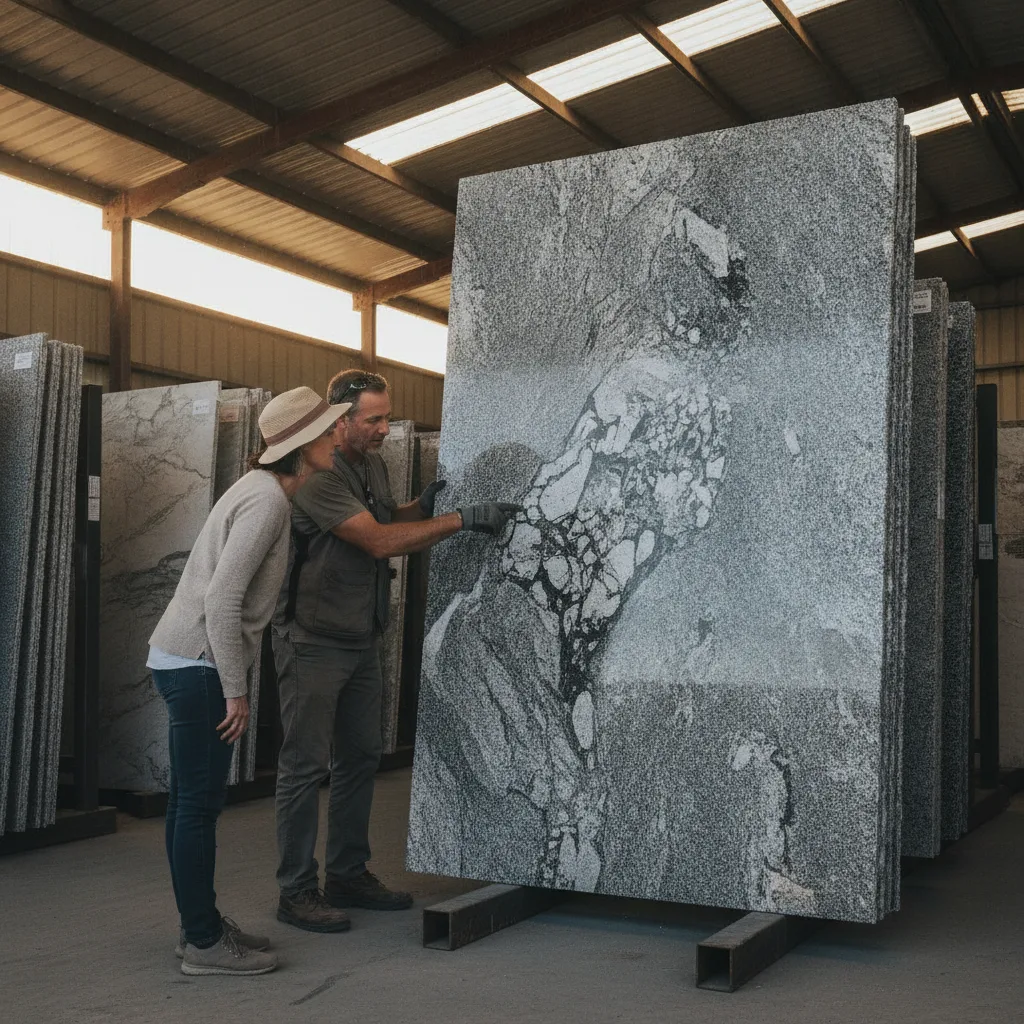
Always view and approve the specific slab you'll receive — not a sample tile. A tile shows one representative patch; full slabs show the entire movement, veining variation, and color shift from one end to the other. A good fabricator will tag your specific slab after selection so there's no confusion at fabrication time. Ask about seam placement before work starts: seams should never sit directly over a base cabinet opening, and on a busy-patterned gray granite, seam visibility varies significantly depending on how the fabricator aligns the pieces. The selection process itself is where most homeowners either land exactly what they envisioned or end up with a slab that looked better as a sample.
Once installed, proper sealing on a regular schedule is what keeps gray granite countertops looking sharp for decades. The water-drop test tells you when it's time: place a few drops of water on the surface and watch for a few minutes. If the water soaks in and darkens the stone, it's time to reseal. If it beads up and sits on the surface, your sealant is still doing its job. Most gray granites need resealing once every one to three years. Very dense varieties like Steel Gray may go three or more years. Most homeowners can handle resealing themselves in under an hour with a penetrating impregnating sealer — it's not a job that requires a professional unless the stone has been neglected for years and has absorbed staining that needs professional extraction.
Day-to-day care for gray granite countertops is simple: wipe spills promptly with warm water and a mild soap, avoid acidic cleaners like vinegar-based sprays, and use a cutting board rather than cutting directly on the stone. Granite is highly resistant to scratches — harder than your knife steel — so the countertop survives direct cutting. Your knife edges won't. Regular oiling is not required the way it is for butcher block, and that ease of routine care is one reason gray granite has been such a popular choice for busy households across Austin, San Antonio, New Braunfels, and the broader Central Texas region. Mid-tone gray granite also hides stains, fingerprints, and water spots better than very light or very dark stone, adding to its practical appeal for daily kitchen use.
$25–$45 per bottle
The standard for DIY granite resealing — penetrates below the surface rather than sitting on top, giving longer protection than topical sealers. One bottle typically covers 100–200 sq ft of countertop surface.
Never approve a gray granite order based on a small sample tile alone. The movement, veining, and color variation across a full slab can look dramatically different from the tile sample. Ask your fabricator to show you the full slab and tag it with your name before fabrication begins. At Fox Granite, we walk every customer through slab selection in person so there are no surprises at installation day.
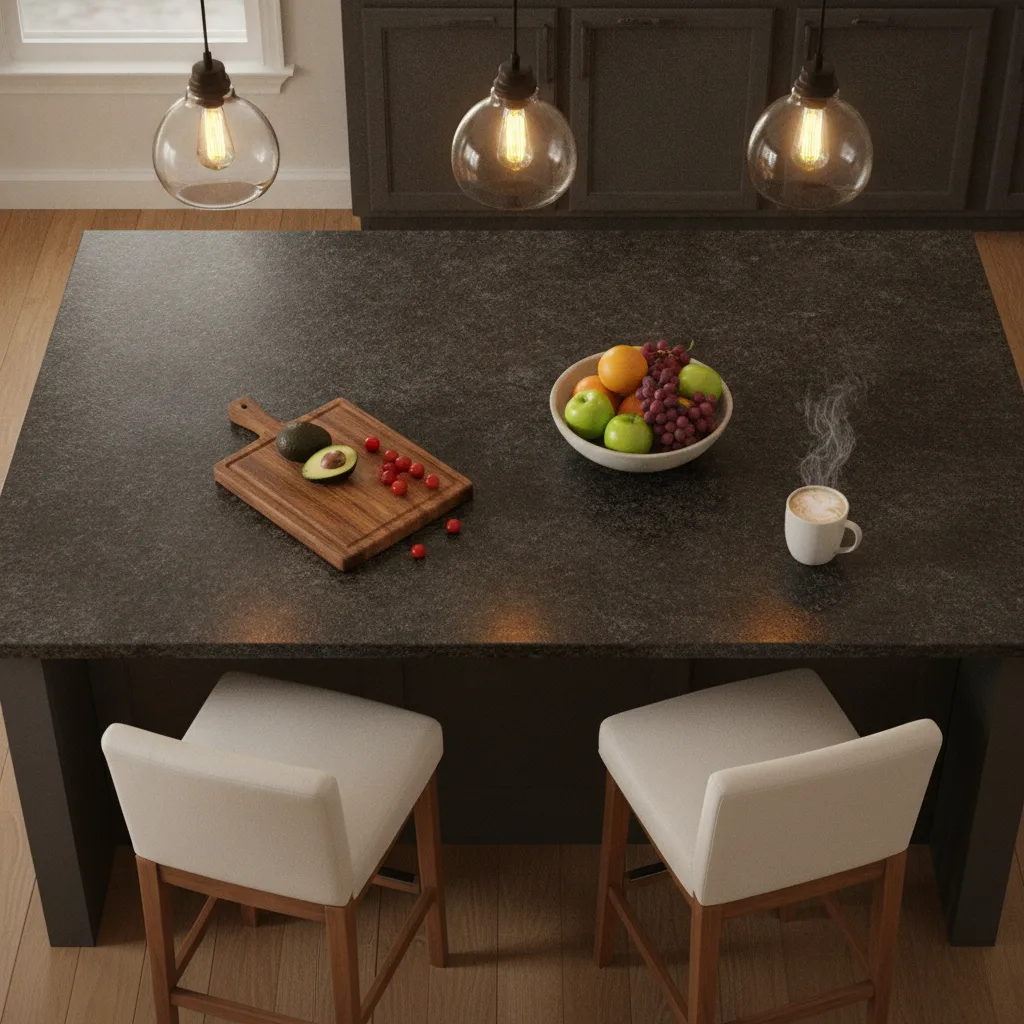
According to the 2026 U.S. Houzz Kitchen Trends Study, granite still represents 15% of new or upgraded countertop choices among renovating homeowners — the second most-selected natural stone category behind engineered quartz at 32%. What makes granite kitchens look dated in 2026 is not gray as a color. It's the busy brown-gold speckle varieties, orange-toned cabinets, ornate ogee edges paired with heavy patterned backsplashes, and an all-gray monochromatic scheme where every surface competes for attention. Quiet gray granite — a calm, neutral-tone slab paired with updated cabinet colors, a coherent backsplash, and good lighting — doesn't chase trends hard enough to look like it did, and won't age out when the pendulum swings again. The shift as of 2026 is toward warmer, more nuanced gray tones with beige undertones rather than purely cool blue-gray. Varieties like Bianco Antico and Colonial White are well-positioned. Flat, cold Steel Gray still works — just pair it with crisp white or contemporary gray cabinetry rather than warm wood tones, and it stays sharp.
When your gray granite countertops are installed and sealed, what you'll notice most is that the kitchen finally looks finished — the stone grounds the whole space without fighting the cabinets, flooring, or backsplash for dominance. That's exactly what a great neutral-tone natural stone should do. For gray granite countertops in Austin, San Antonio, New Braunfels, and across the Central Texas corridor, Fox Granite handles fabrication and installation in-house, offers all-in transparent pricing with no surprise fees, and walks every customer through full-slab selection in person. Contact us today to schedule your free in-home consultation and get your free estimate.
Ready to get started? Contact Fox Granite today.


BY APPOINTMENT ONLY
1379 Wald Road
New Braunfels, TX 78132
Austin, San Antonio, Cedar Park, Kyle, New Braunfels, Del Valle, Elgin, Lago Vista, Shady Hollow, Onion Creek, Buda, San Marcos, Lockhart, Temple, Wimberley, Dripping Springs, Bee Cave, Lakeway, Leander, Anderson Mill, Jollyville, Spicewood Springs, Round Rock, Georgetown, Pflugerville, Manor, Taylor, Manchaca, Mountain City, Hutto, West Lake Hills, Bastrop, Liberty Hill, Driftwood, Sun City, Steiner Ranch.