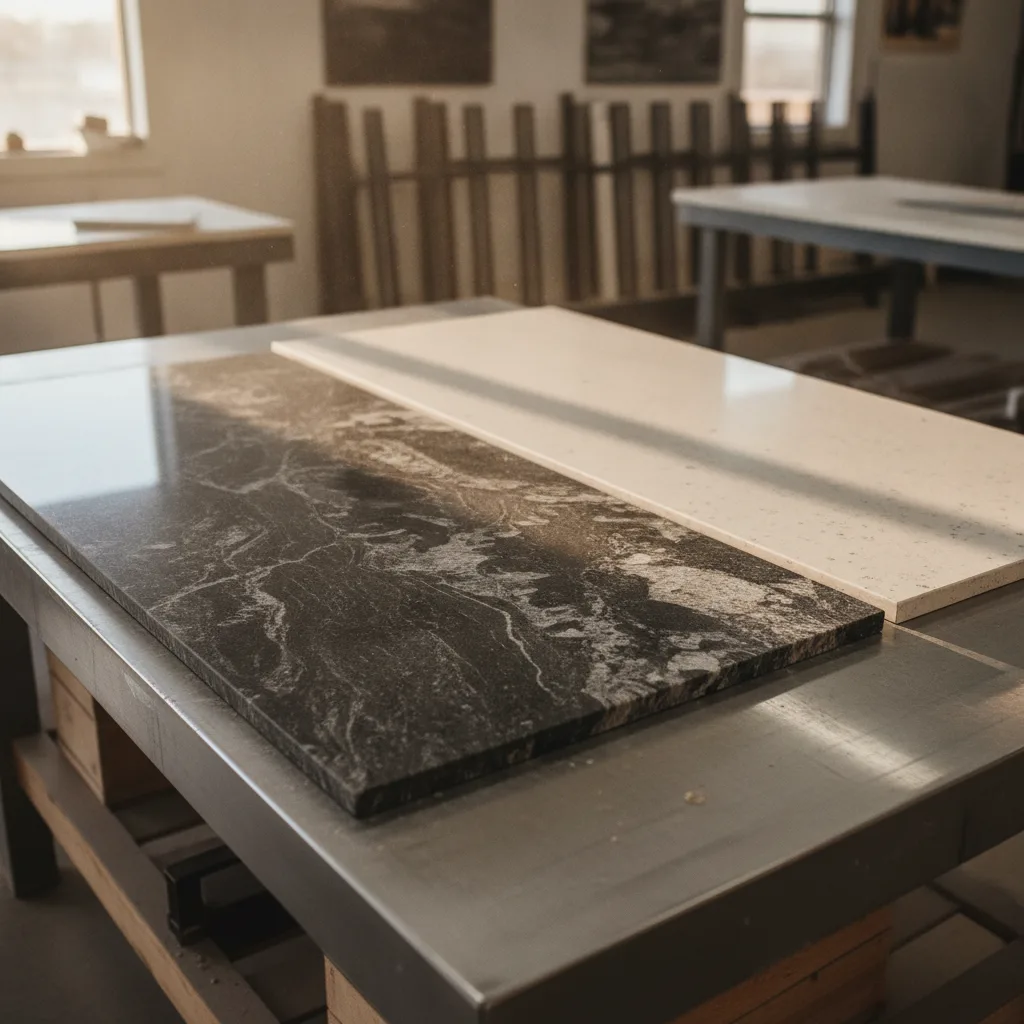
As of 2026, quartz holds 35–36% of the U.S. countertop market and wins for busy households that want a non-porous, low-maintenance surface that never needs sealing. Granite holds 21% of the market but wins clearly for heavy cooks who set hot pans directly on the counter (granite handles up to 1,200°F vs. quartz's 300–400°F limit), for outdoor kitchens where UV degrades quartz resin, and for homeowners who want one-of-a-kind natural stone character. Both quartz and granite countertops recoup 60–80% of installed cost at resale. The right choice depends on how your kitchen actually works — not which material is trending.
Granite vs. quartz countertops is the most common countertop decision homeowners face in 2026 — and most comparison articles get it wrong by picking a winner. Both quartz and granite are considered premium countertop materials that recoup 60–80% of installed cost at resale, both are extremely durable surfaces that last decades with proper care, and both are outstanding upgrades over laminate. The honest answer: quartz wins for busy households that want low-maintenance, non-porous surfaces with consistent colors and patterns; granite wins for heavy cooks, outdoor kitchens, and anyone who wants one-of-a-kind natural stone character. Here's the full, spec-level breakdown.
The low-maintenance engineered surface for busy households
The natural stone with unmatched heat resistance and one-of-a-kind character
Quartz countertops are engineered stone surfaces made from 90–93% crushed natural quartz bound with 7–10% polymer resin binders and pigments. That manufacturing process is the source of both quartz's biggest strengths and its most significant limitations. Because the composition is controlled in a factory rather than pulled from the earth, quartz delivers consistent colors and patterns that granite — quarried as individual slabs — simply cannot match.
The non-porous surface that results from this process is what makes quartz the low-maintenance countertop material it's become known as. Unlike natural stone, quartz resists stains from wine, coffee, and oil without any sealing at all. Bacteria and mold have nowhere to penetrate. Cleanup is mild soap and water. That's the core value proposition: a highly durable surface that works without thinking about it.
The resin binders that create this non-porous quality are also the source of quartz's two real weaknesses. First, high heat above 300–400°F scorches and discolors the resin permanently — a repair that can't be polished out. Second, UV light from direct sunlight degrades the resin over time, causing the surface to fade and discolor. This makes quartz the wrong material for outdoor kitchens or any counter exposed to direct sunlight. Inside a well-designed kitchen, though, quartz is an excellent choice for homeowners who want premium countertop materials with minimal upkeep.
Quartz fabrication takes roughly 10–15% less time than equivalent granite fabrication, which can translate to shorter project timelines. Installation follows the same process as granite: templating, cutting, polishing quartz edges, and securing the slab with adhesive. Edge profiles — from simple eased edges to detailed ogee profiles — vary depending on the fabricator and the homeowner's design preferences. Fox Granite fabricates quartz countertops in-house at our New Braunfels shop, which means you see the actual slab before it's cut.
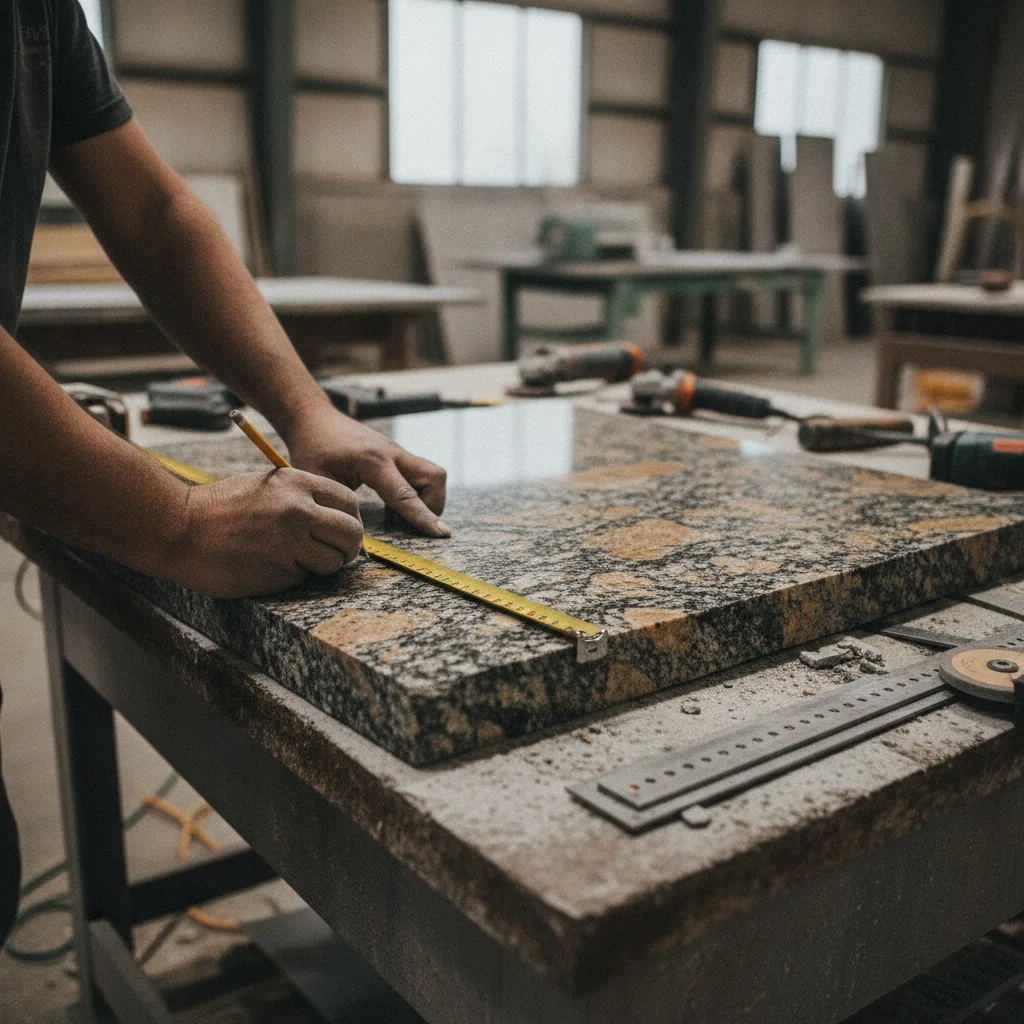
Granite is an igneous natural stone formed under intense pressure deep in the earth over millions of years. Each granite slab is quarried from the earth as a unique piece of stone — no two slabs from the same quarry are identical. The natural veining, mineral flecks, movement, and color variation are set by geology, not a manufacturing process. That's the source of granite's character: a polished granite surface has depth and life that no engineered stone surface has fully replicated.
Because granite is a porous material, it absorbs liquids unless properly sealed. A granite slab that is sealed correctly resists stains from wine, coffee, and oil effectively. One that isn't sealed — or was sealed incorrectly — is prone to absorbing acidic liquids, oil, and pigmented beverages that can stain permanently. Regular sealing every 1–3 years, at $15–$30 per application for a DIY sealer or $200–$400+ for professional service, is the maintenance reality of owning granite countertops.
Granite's physical properties make it highly durable in ways quartz cannot match. At 6–6.5 on the Mohs hardness scale, granite is slightly softer than quartz — but it handles high heat that would destroy a quartz surface. Direct sunlight doesn't affect it. Temperature swings outdoors don't crack it. The NAHB estimates granite countertops can last over 100 years with proper care and regular sealing — an asset that outlasts most of the homes it's installed in.
Granite countertop cost varies depending on stone grade more than quartz does, because rare colors and exotic patterns command real premiums. In Central Texas, Fox Granite sources Level 1 builder-grade granite at $40–$55/sq ft installed, Level 2 mid-range at $55–$80/sq ft, and Level 3 exotic slabs at $85–$150+/sq ft. That price range is wider than quartz because the raw material — the natural stone slab itself — varies in scarcity and character in ways a manufactured product does not.
| Dimension | Quartz | Granite |
|---|---|---|
| Maintenance & Sealing | Non-porous surface; never needs sealing — wipe clean with mild soap and water | Porous material; requires resealing every 1–3 years at $15–$30 per application (DIY) or $200–$400+ professionally |
| Heat Resistance | Resin binders begin to scorch and discolor above 300–400°F — always use trivets near the stove | Superior heat resistance up to 1,200°F; handles hot pans directly, though trivets are still a good habit |
| Hardness & Durability | 7 on the Mohs scale; slightly harder than granite, more chip-resistant in daily wear because it has no natural fissures | 6–6.5 on the Mohs scale; extremely durable but natural fissures can be a chip point under heavy impact |
| Cost (Installed) | $50–$150/sq ft installed; most kitchens land at $70–$100/sq ft; a 40 sq ft kitchen runs $3,000–$6,000 mid-range | $40–$200+/sq ft installed; Level 1 builder-grade starts at $40–$55/sq ft; a 40 sq ft kitchen runs $2,400–$4,000 mid-range |
| Appearance & Patterns | Engineered manufacturing process produces consistent, repeatable colors and patterns — no slab-to-slab variation | Every granite slab is one-of-a-kind; natural veining, mineral flecks, and movement vary between slabs from the same quarry |
| Stain Resistance | Non-porous surface resists stains from wine, coffee, and oil without sealing — spills wipe up easily | Resists stains when sealed correctly; unsealed or improperly sealed granite is prone to absorbing wine, oil, and acidic liquids |
| Outdoor Use | Not recommended outdoors — UV light degrades resin binders over time, causing discoloration and surface damage | The practical choice for outdoor kitchens; naturally resistant to UV, temperature swings, and direct sunlight |
| Resale Value | 60–80% of installed cost recouped at resale; viewed as the modern preferred option in $350K–$750K homes as of 2026 | 60–80% of installed cost recouped at resale; remains popular in higher-end traditional homes; can last 100+ years with proper care |
Granite has declined from 30% U.S. market share in 2020 to around 21% in 2026 — but 'outdated' is the wrong word. What's actually happening: quartz captured the low-maintenance, consistent-color market, and granite is finding a more defined niche. Younger homeowners under 40 are increasingly choosing quartz or quartzite, but granite remains popular in higher-end traditional homes and is still the only practical natural stone countertop for outdoor kitchens. The design professionals who still choose granite aren't behind the times — they're choosing it because their client needs heat resistance, natural beauty, or a one-of-a-kind slab that no engineered stone can replicate. Granite isn't going anywhere. It's just being chosen more deliberately.
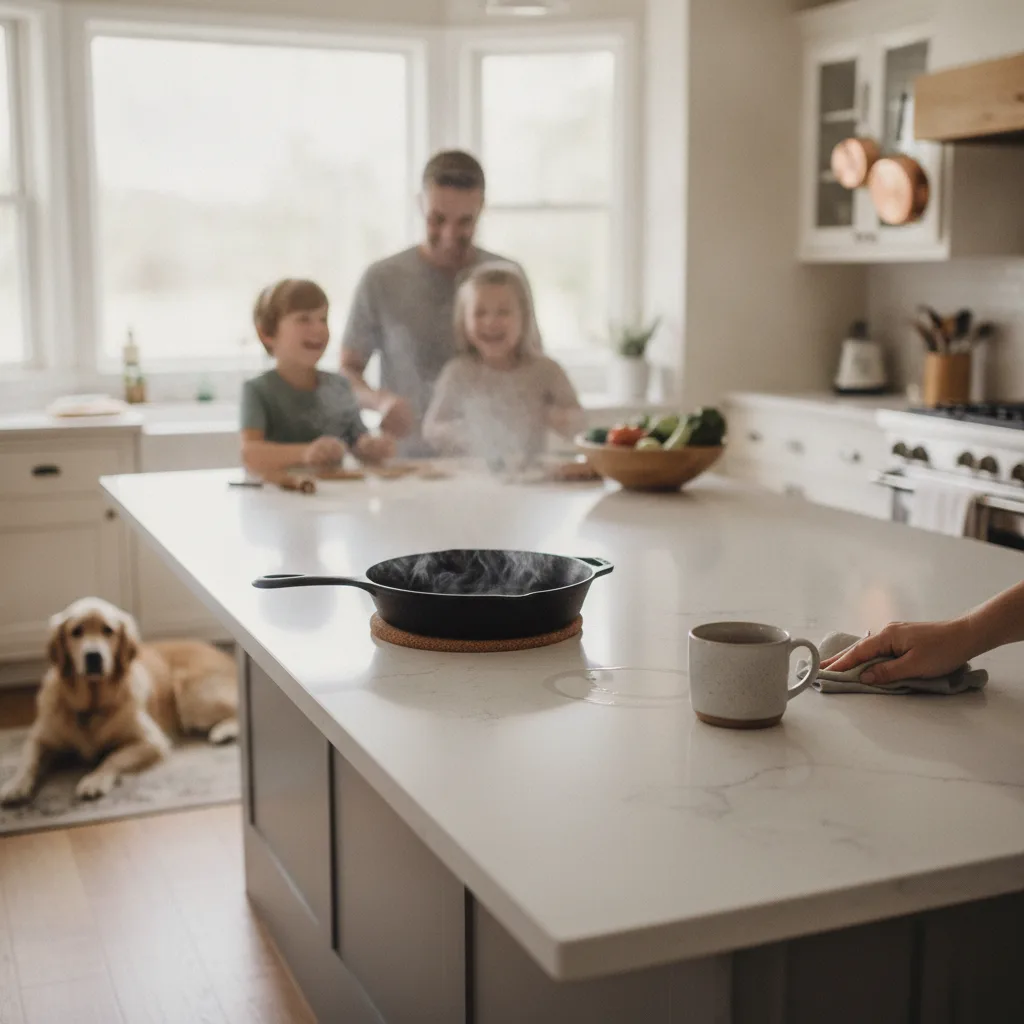
Quartz wins on practicality for busy households. If your kitchen sees frequent cooking, kids, or regular entertaining — and you want a surface that resists stains and bacteria without annual sealing — quartz is the right countertop material. Here's who should choose quartz:
Quartz holds 35–36% of the U.S. countertop market as of 2026 for a reason. It's the ideal choice for the household that wants premium countertop materials without the upkeep — a surface that looks polished, resists daily wear, and never asks anything of you.
Granite wins in the kitchen where real cooking happens — where hot pans land on the counter, outdoor spaces need a surface that survives the elements, and natural stone character matters as much as function. Here's who should choose granite:
Granite remains an outstanding countertop material for the right kitchen. Its natural beauty, superior heat resistance, and suitability for outdoor use make it the ideal choice for homeowners who cook hard, live outdoors, and want a stone surface with real character.
Using quartz and granite countertops together in the same kitchen is a real, practical option — not a compromise. The two materials complement each other when you match each one to the zone of your kitchen where its strengths matter most.
A common approach: granite for the perimeter counters near the stove and oven (where heat resistance matters most and the natural beauty of a granite slab can anchor the entire space), and quartz for the island or primary prep area (where a non-porous surface and consistent color patterns make daily cleanup faster and stain resistance is a daily need). Unlike natural stone that varies slab-to-slab, quartz delivers consistent color across the island no matter how many sections you need.
For Central Texas homeowners finishing a kitchen remodel and adding an outdoor kitchen or bar top, the combination is almost a natural fit. Granite goes outside where UV is a concern and direct sunlight is unavoidable. Quartz stays inside for the low-maintenance surfaces your family touches every day. Fox Granite fabricates and installs both materials in-house, so you're not coordinating two separate contractors — and you can see actual slabs of quartz and granite side by side at our New Braunfels showroom before you commit to either, or both.
Granite wins clearly in one situation: the kitchen where hot pans land directly on the counter. Because granite handles temperatures up to 1,200°F, it's the heat-resistant countertop material that heavy cooks and bakers actually want. Quartz scorches above 300–400°F due to its resin binders — that's a real risk next to a busy stove. If you pull sheet pans, cast iron, or a Dutch oven straight from the oven and put hot cookware on the surface without thinking, granite is your material.
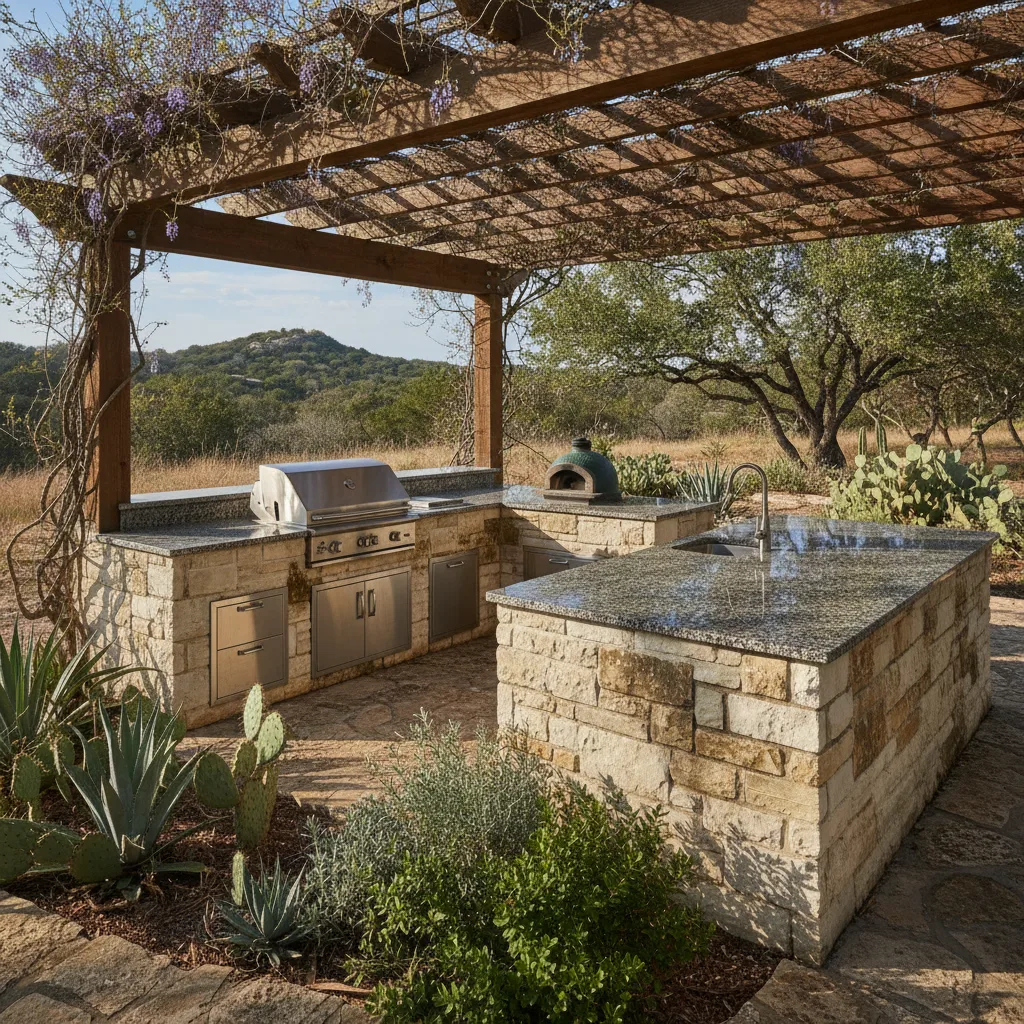
Granite also wins for outdoor kitchens without question. UV light degrades quartz resin over time, causing discoloration and surface damage that can't be repaired. Granite is naturally resistant to direct sunlight and temperature swings, making it the only practical choice between the two materials for any countertop exposed to the elements. And for homeowners drawn to natural stone's character — the one-of-a-kind natural veining, the mineral flecks, the depth and story that no engineered stone fully replicates — no quartz slab tells the same story a granite slab does. Add the lower entry-level cost (Level 1 granite starts at $40–$55/sq ft installed in Central Texas), and granite remains an outstanding countertop material for the right kitchen.
Using both quartz and granite countertops in the same kitchen is a real option — and one that makes sense when you think about how each zone of your kitchen actually functions. A common approach: granite for the perimeter counters near the stove and oven (where heat resistance matters most and the natural beauty of a granite slab can anchor the whole room), and quartz for the island or prep area (where a non-porous surface and consistent color make daily cleanup faster and stain resistance is built in).
For Central Texas homeowners finishing a kitchen remodel and adding an outdoor kitchen or bar top, the combination is a natural fit. Bring granite outside where UV is a concern, and keep quartz inside for the low-maintenance surfaces your family touches every day. At Fox Granite, we fabricate and install both materials in-house, so you're not coordinating two separate contractors. We can show you actual slabs of quartz and granite side by side at our New Braunfels showroom before you commit to either — or both.
Quartz is the right countertop material for households that want a surface that works without thinking about it. Because quartz is non-porous — made from 90–93% crushed natural quartz bound with resin binders and pigments — it never needs sealing. No annual sealing appointment, no $15–$30 DIY sealer every 1–3 years, no worry about whether the granite was sealed correctly before wine or coffee hit it. For families with kids, frequent cooks, or anyone who wants stain resistance built into the surface itself, quartz wins on day-to-day practicality. The non-porous surface also resists bacteria and mold in ways that porous natural stone cannot without regular sealing.
The consistent colors and patterns quartz offers are a real advantage for larger kitchens. Unlike natural stone, where two slabs from the same quarry can look noticeably different, quartz's manufacturing process produces repeatable results across every section of counter, every island top, and every bathroom vanity top in the house. As of 2026, quartz holds 35–36% of the U.S. countertop market — the largest share of any single material — and 78% of design professionals surveyed by the NKBA expect it to be the preferred countertop surface going forward. That's not a trend; it's where the market has settled for busy households who want premium countertop materials without the upkeep.
The quartz vs. granite decision comes down to how your kitchen actually works, not which material looks better in a magazine. If you cook hard, set hot pans down without thinking, have an outdoor kitchen, or want a one-of-a-kind natural stone slab with natural veining that no engineered surface can replicate — choose granite. If you want a stain-resistant, non-porous surface with consistent colors across every section, zero maintenance quartz, and the confidence that you'll never worry about whether it was sealed correctly — choose quartz. Both are highly durable, both recoup 60–80% at resale, and both are outstanding countertop materials in the right kitchen.
For granite vs. quartz countertops in Austin, San Antonio, New Braunfels, and across Central Texas, Fox Granite has fabricated and installed both materials in-house since 2010 — over 10,000 projects. We'll show you actual slabs of quartz and granite at our New Braunfels showroom so you can see the differences in color, pattern, veining, and surface quality before you decide. Contact us today to schedule your free in-home consultation, or call (512) 653-5541 to get your free estimate.
Ready to get started? Contact Fox Granite today.


BY APPOINTMENT ONLY
1379 Wald Road
New Braunfels, TX 78132
Austin, San Antonio, Cedar Park, Kyle, New Braunfels, Del Valle, Elgin, Lago Vista, Shady Hollow, Onion Creek, Buda, San Marcos, Lockhart, Temple, Wimberley, Dripping Springs, Bee Cave, Lakeway, Leander, Anderson Mill, Jollyville, Spicewood Springs, Round Rock, Georgetown, Pflugerville, Manor, Taylor, Manchaca, Mountain City, Hutto, West Lake Hills, Bastrop, Liberty Hill, Driftwood, Sun City, Steiner Ranch.