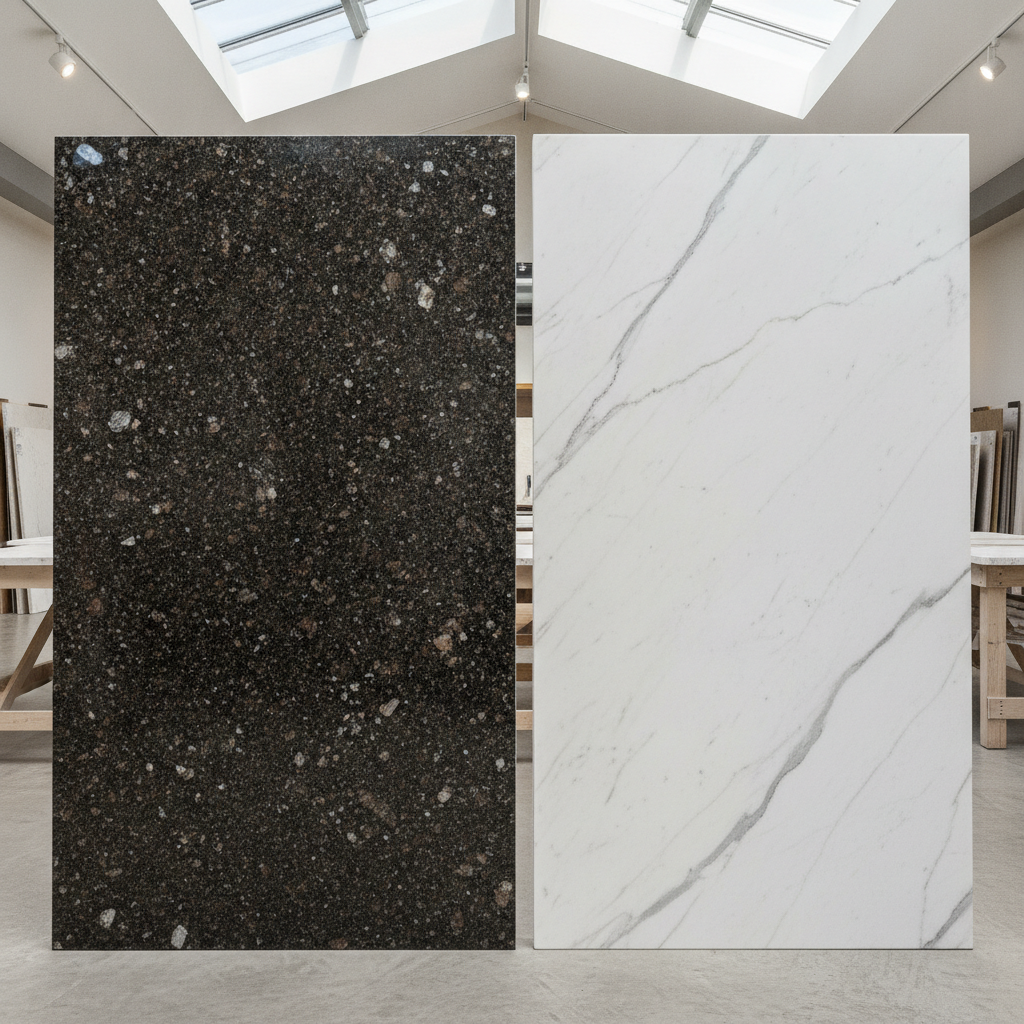
Granite is the better choice for most kitchen countertops in 2026. It rates 6–7 on the Mohs scale versus marble's 3–4, resists acidic foods without etching, and only needs resealing every 12–18 months. Installed cost runs $40–$175 per sq ft, with a typical 35 sq ft kitchen landing at $2,800–$5,000. Marble countertops offer head-turning veining and elegance that granite cannot replicate, but marble etches chemically when lemon juice, wine, vinegar, or tomato sauce contacts its calcium carbonate surface — no sealer stops that reaction. Marble belongs in bathroom vanities, fireplace surrounds, and baking stations. For a busy kitchen, granite wins on durability, lower maintenance, and broad resale appeal.
The most important thing to know before choosing between granite and marble countertops is this: marble etching is a chemical reaction, not a stain, and no sealer prevents it. Lemon juice, vinegar, wine, and tomato sauce all react with the calcium carbonate in marble's surface, leaving a dull spot that is technically damage to the stone itself. Granite does not etch. That single difference drives most of the practical guidance in this comparison — and it is why marble and granite belong in different spaces depending on how you actually live. Both are beautiful natural stone materials with 50-plus-year lifespans. But they are not interchangeable, and the wrong choice in the wrong kitchen is a regret most homeowners would rather skip.
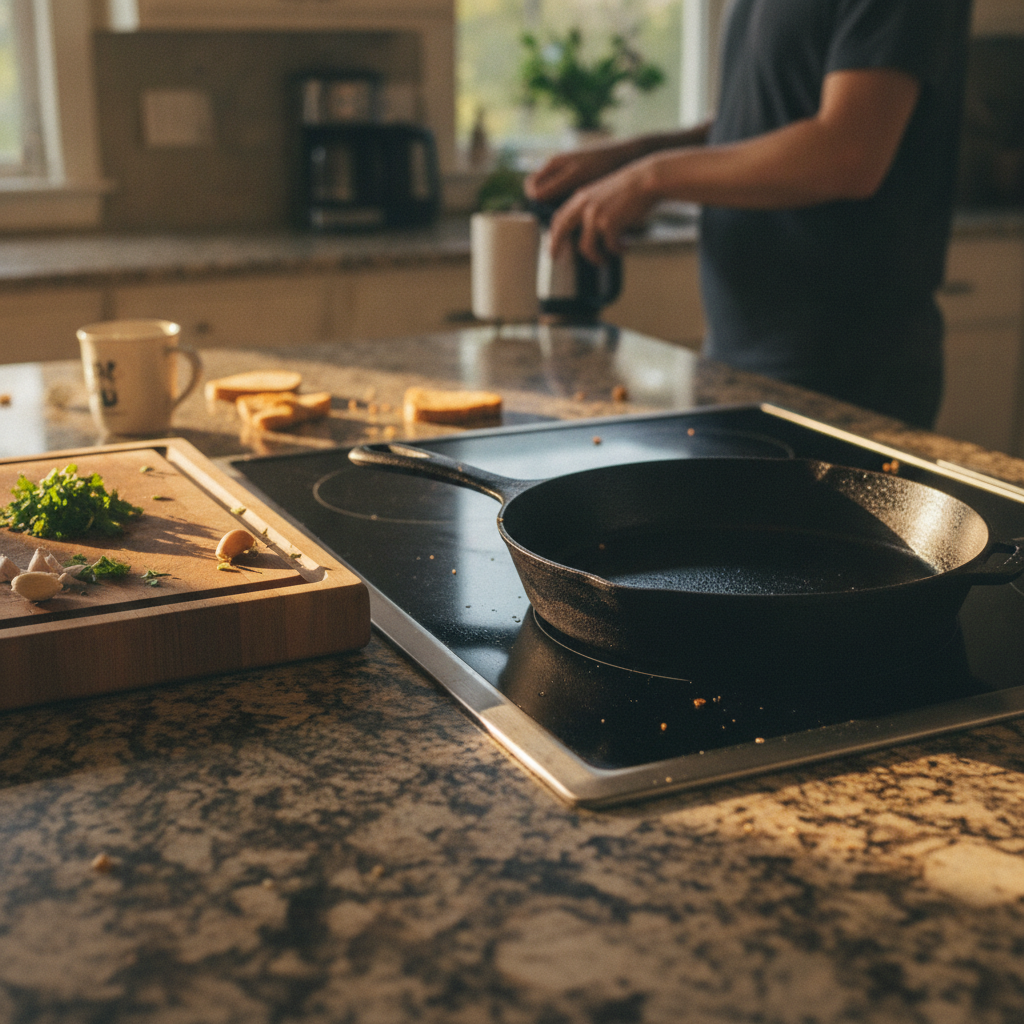
The hardworking natural stone that handles real kitchen life without constant attention.
The head-turning natural stone that rewards mindful homeowners with timeless elegance.
Granite is an igneous rock formed when molten magma cools slowly deep in the earth, crystallizing into an interlocked structure of feldspar, quartz, mica, and other minerals. That formation process produces a surface rated 6–7 on the Mohs scale — hard enough that a standard kitchen knife blade will not leave scratches. Cast iron, stainless pans, ceramic dishes: none of them threaten granite counters the way they threaten marble's softer surface.
Granite countertops are a porous stone, so liquids can work their way in over time if the surface is left unsealed. But the sealing schedule is manageable: every 12–18 months for most slabs, and 18–24 months for denser dark varieties. Clean up spills with mild soap and water, avoid abrasive cleaners, and skip the harsh chemicals. That is essentially the full maintenance requirement for a granite kitchen counter that performs reliably for decades.
The etch-resistance is what separates granite from marble in a busy kitchen. Acidic foods — lemon juice, vinegar, tomato sauce, wine — sit on granite without triggering any chemical reaction. A porous stone without etch risk means the main maintenance task is preventing stains by keeping the sealer current, not worrying about every drip of citrus. For households that cook every night, that distinction matters more than almost any aesthetic consideration.
Granite comes in various colors and patterns depending on its mineral composition — from jet black to creamy white, with dramatic speckled patterns and bold variation across slabs. The polished finish granite achieves during fabrication holds up for decades without the patina development that occurs with marble over time. Many homeowners value that consistency: the surface looks the same at year 15 as it did on installation day.
Marble is a metamorphic rock formed when limestone — itself made largely of calcium carbonate — is subjected to intense heat and pressure deep in the earth over millions of years. That transformation gives marble its signature flowing veins, elegant appearance, and naturally cool surface temperature. It also leaves marble with a Mohs hardness of 3–4, which makes it softer than granite, more susceptible to scratches, and chemically reactive to acids.
The etching issue is the central reality of marble kitchen countertops. A lemon juice splash wiped up in under 5 seconds may cause minimal damage; 30 seconds of contact can leave a visible dull spot. The reaction dissolves a thin layer of calcium carbonate from the stone's surface, and no sealant fully stops it. Sealing marble regularly helps prevent stains from oils and liquids soaking in, but etching happens at a chemical level that sits below what any sealer can address. This is not a defect in the fabrication or the sealer — it is the nature of the material.
Where marble genuinely excels: baking stations, bathroom vanities, fireplace surrounds, and backsplashes. Marble stays naturally cool, which is a real practical advantage for pastry dough. Bathroom countertops see far less acidic food contact than kitchen counters, making marble a suitable and beautiful choice for that space. Fireplace surrounds take advantage of marble's aesthetic without putting the surface through food contact at all.
Some homeowners genuinely love the patina that develops on marble over years of use. The surface slowly takes on character — soft variations in the polish, subtle shifts in the veining appearance — that reads as lived-in rather than worn. That aesthetic is a real thing, and it suits certain design sensibilities well. But it is a choice to embrace, not an accident to be surprised by. Going into a marble purchase with clear expectations about higher maintenance needs and patina development is the difference between satisfaction and regret.
| Dimension | Granite | Marble |
|---|---|---|
| Hardness & Scratch Resistance | 6–7 on the Mohs scale — resists knife scratches and daily kitchen wear | 3–4 on the Mohs scale — softer surface can scratch with regular use |
| Cost to Install (2026) | $40–$175/sq ft installed; most kitchens run $2,800–$5,000 for 35 sq ft | $65–$250/sq ft installed; Carrara starts at $75–$150, Calacatta can run 3–4x more |
| Maintenance & Sealing | Reseal every 12–18 months; dense dark granites can stretch to 18–24 months | Reseal every 6–12 months in a busy kitchen; high-traffic use may call for every 3–6 months |
| Stain & Etch Risk | Porous stone — can absorb liquids if unsealed, but does not etch from acidic foods | Etches chemically when acidic substances contact the surface — no sealer fully prevents this |
| Heat Resistance | Heat resistant; won't burn under normal cooking use — trivets recommended to protect the sealer | Heat resistant; stays naturally cool, great for pastry prep — trivets recommended to avoid thermal shock |
| Long-Term Durability | 50+ year lifespan with proper maintenance; requires less ongoing intervention to reach it | 50+ year lifespan is achievable, but demands regular maintenance and occasional professional restoration |
| Aesthetics & Look | Bold, varied patterns from molten magma minerals — maintains its original polished finish for decades | Distinctive veining from metamorphic rock transformation — develops a natural patina over time |
| Resale Value | Broad buyer appeal — recognized as durable natural stone; strong mid-to-high resale performer in most markets | Niche appeal — attracts design-focused buyers; stronger in luxury markets than in general resale |
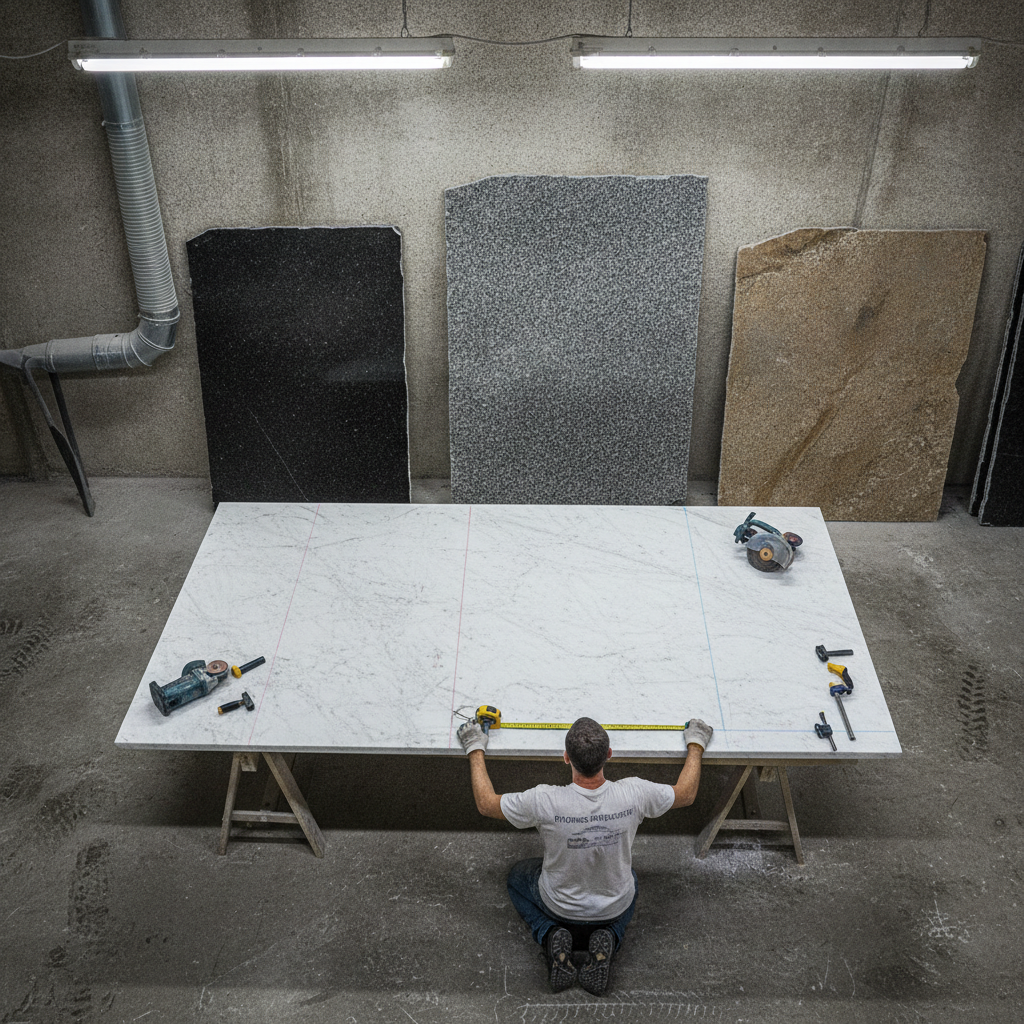
Marble etching is not a stain — and that distinction matters more than most people realize before they buy. When acidic substances like lemon juice, wine, vinegar, or tomato sauce contact marble's calcium carbonate surface, they trigger a chemical reaction that dissolves the stone itself, leaving a dull spot. A sealer slows liquid absorption and can help prevent stains, but it does not create a barrier against that chemical reaction. Properly sealed marble still etches. That is a lifestyle decision, not just a maintenance schedule — and it is the single most important thing to understand before choosing marble for a busy kitchen countertop.
Granite is the right choice for most kitchens, and especially for any household where cooking happens regularly and acidic foods are part of daily life. The combination of scratch resistance, etch immunity, and a relatively low maintenance sealing schedule makes granite countertops a practical decision that holds up over decades without constant attention.
Granite countertops are not glamorous in the way marble is, but they are honest. They do exactly what they promise for a long time with careful cleaning and regular maintenance sealing. For a busy Central Texas kitchen, that reliability is worth more than a dramatic vein pattern.
Marble earns its place in the right application. The elegance it brings to a bathroom vanity, a fireplace surround, or a dedicated baking station is something granite simply cannot replicate. But going in without a clear understanding of the higher maintenance needs — and the etching reality — is how homeowners end up disappointed.
Marble countertops reward homeowners who go in with eyes open. Choose the right space, commit to the maintenance schedule, wipe spills immediately, clean with a neutral pH solution instead of abrasive cleaners — and marble delivers a timeless look that holds genuine elegance for decades.
Many Central Texas homeowners get the best outcome by using granite and marble in different parts of the same home based on what each space demands. This is not a compromise — it is good design thinking. Granite and marble are each excellent materials; they just belong in different applications.
Quartz countertops are worth a mention here too. If you want a completely non-porous surface that never needs sealing, quartz is a strong option for kitchen countertops — though it can fade with prolonged UV exposure in outdoor kitchens, and it lacks the natural stone character that granite and marble both offer. Quartzite is another option that combines marble's veined appearance with hardness closer to granite's, though it tends to carry a higher price tag and is still a porous stone that requires sealing. The point is that the natural stone category is not a binary choice, even if granite and marble are the two most common starting points.
At Fox Granite, we routinely help homeowners spec granite counters for the kitchen and marble for the bathroom vanities, a powder room, or a fireplace surround in the same project. The result gives you durability where your home works hardest and elegance where the material can shine without taking a beating.
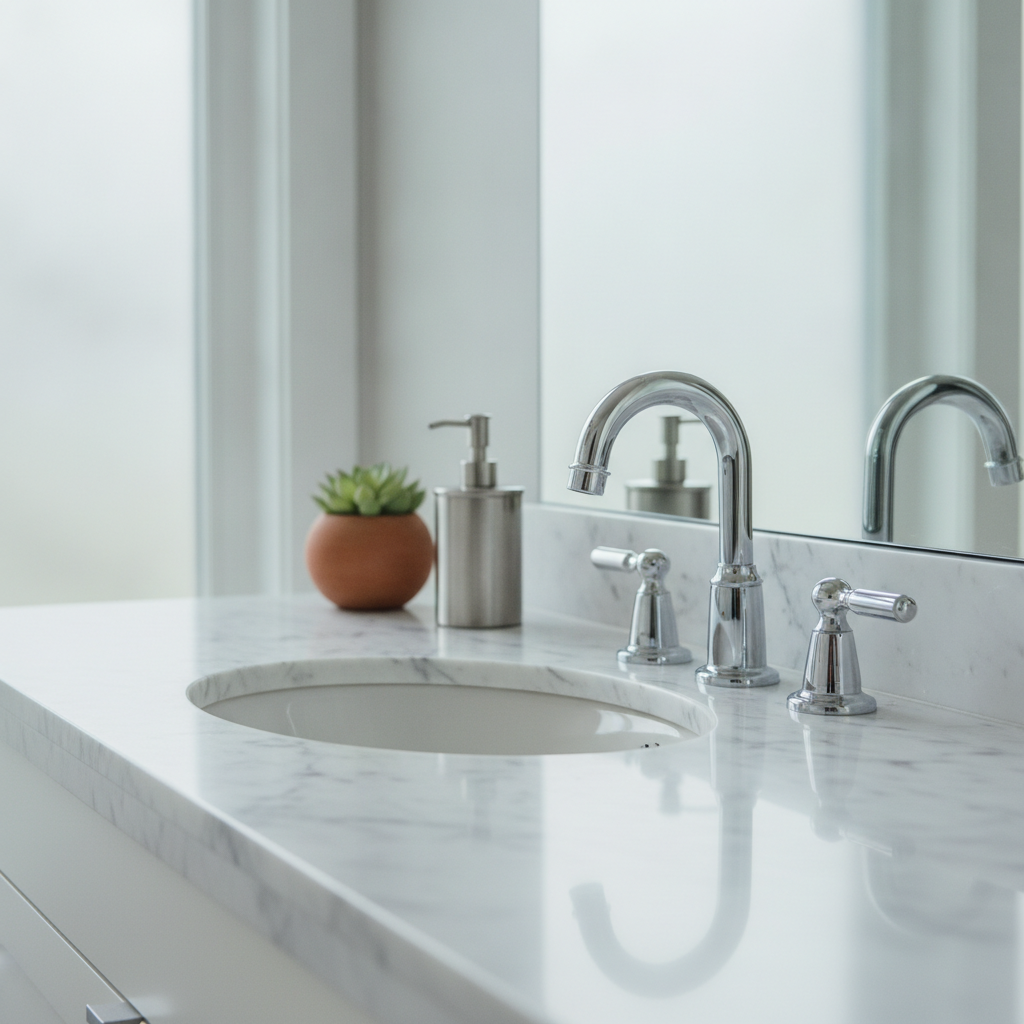
Marble countertops earn their place in the right application. Bathroom vanities are the clearest win — the visual payoff of marble's distinctive veining in that space is hard to argue with, and the lower acidic food contact makes the etching risk far more manageable than in a kitchen. Fireplace surrounds and backsplashes take full advantage of marble's elegant appearance without putting the surface through food contact at all.
Dedicated baking stations are another strong use case. Marble stays naturally cool, which is a genuine practical advantage when working with pastry dough or butter-based preparations. A marble baking section on a kitchen island — away from the stove and the primary sink — gives you that cool surface benefit while limiting the material's exposure to the acidic spills that cause etching.
Marble is a metamorphic rock formed when limestone, made largely of calcium carbonate, is subjected to intense heat and pressure deep in the earth. That origin gives marble its signature flowing veins and soft, elegant appearance. Some homeowners genuinely embrace the patina that develops over time, seeing the character that comes with wear as part of the material's story. If that mindset fits how you live, and the space is right, marble can be a beautiful, lasting choice — provided you go in with clear expectations about maintenance.
The most practical approach for many Central Texas homeowners is to use granite and marble in different parts of the same home based on what each space demands. Put granite countertops in the kitchen — near the stove, the primary sink, and the main prep area — where scratch resistance, lower sealing frequency, and etch-proof durability matter most. Then use marble in the bathroom vanities, as a fireplace surround, or on a dedicated baking section of a kitchen island where it stays cool and sees less acidic food contact.
This approach lets you spec new countertops for each space based on actual use patterns rather than picking one material and applying it everywhere. Your kitchen island where the kids do homework gets granite. The guest bathroom vanity that sees light daily use and no lemon juice gets marble. The result is a home where each material performs at its best.
Both granite and marble are beautiful natural stone materials that can last 50 years or more with proper care. Using each where it performs best means you get the durability of granite where your kitchen works hardest, and the timeless elegance of marble where it can shine without taking a beating. At Fox Granite, we stock both and can bring samples to your home so you can see exactly how each slab looks in your actual light before you commit to anything.
For a high-traffic Central Texas kitchen where cooking happens every night, granite is the clear better choice. At 6–7 on the Mohs scale, it shrugs off the kind of daily wear — sliding cast iron, cutting near the edge, kids doing homework at the island — that would leave visible scratches on marble's softer 3–4 rated surface. A kitchen knife will not scratch granite. It will scratch marble.
Granite is also the right call for households that cook with acidic foods regularly. Lemon juice contact for 30 seconds can leave a visible dull spot on marble — not from staining, but from a chemical reaction between the acid and the calcium carbonate in the stone. No sealer stops that. Granite, being an igneous rock formed from molten magma and composed of feldspar, quartz, mica, and other minerals, does not etch. Seal it every 12–18 months, clean with mild soap and water, avoid abrasive cleaners, and it performs reliably for decades.
For resale value in most Central Texas markets, granite is also the safer bet. Buyers recognize it as durable natural stone, it appeals across a broad range of buyer profiles, and it signals quality without the niche-market dependence that marble carries. If you want a kitchen countertop that handles everything your household throws at it and adds straightforward value at resale, granite countertops are the choice.
The marble vs granite countertops debate ultimately comes down to a lifestyle question more than an aesthetics one. Both materials are durable, beautiful, and capable of lasting 50-plus years in the right conditions. Granite is suitable for any kitchen that sees regular cooking and acidic food contact; marble is suitable for lower-traffic spaces where its elegance can carry the day without being tested by constant use. Neither is a bad material — they just belong in different places.
For granite countertops, marble countertops, and every natural stone option in between, trust Fox Granite. We are a family-owned Central Texas fabricator with over 15 years of experience and more than 10,000 completed projects — and we do everything in-house, from templating to installation, with no subcontractors and no surprise fees. Not sure which material fits your kitchen and your life? We will bring samples to your home for free so you can see granite and marble side by side in your own light before you decide anything.
Contact us today to schedule your free in-home consultation, or visit our showroom in New Braunfels. Call (512) 653-5541 to get started.
Ready to get started? Contact Fox Granite today.


BY APPOINTMENT ONLY
1379 Wald Road
New Braunfels, TX 78132
Austin, San Antonio, Cedar Park, Kyle, New Braunfels, Del Valle, Elgin, Lago Vista, Shady Hollow, Onion Creek, Buda, San Marcos, Lockhart, Temple, Wimberley, Dripping Springs, Bee Cave, Lakeway, Leander, Anderson Mill, Jollyville, Spicewood Springs, Round Rock, Georgetown, Pflugerville, Manor, Taylor, Manchaca, Mountain City, Hutto, West Lake Hills, Bastrop, Liberty Hill, Driftwood, Sun City, Steiner Ranch.