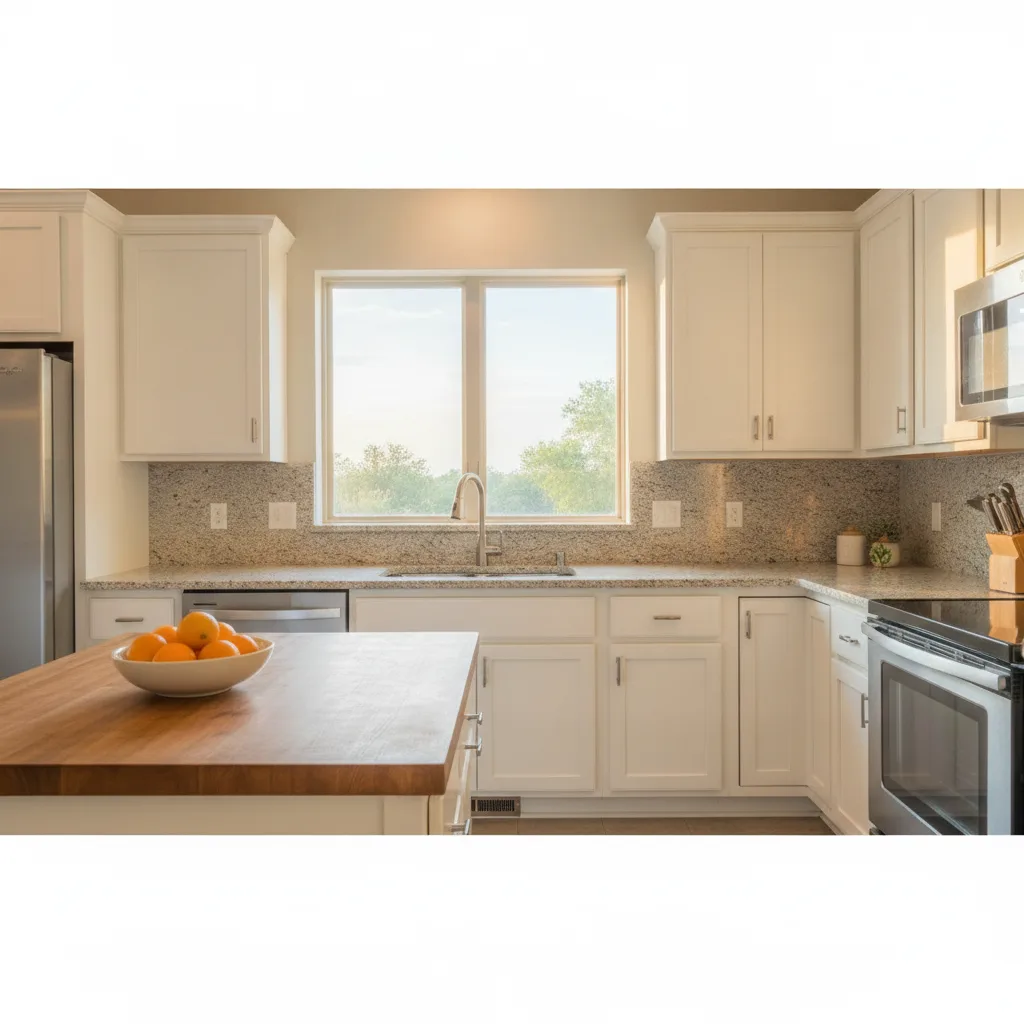
Granite countertops cost more upfront — $2,200–$4,600 installed for a typical 40-square-foot kitchen versus $600–$2,000 for laminate — but granite wins the cost-per-year comparison decisively. Entry-level granite at $3,000 lasting 50 years costs roughly $60 per year. Laminate at $1,250 lasting 15 years under heavy kitchen use costs about $83 per year. Add a 60–100%+ resale ROI in the Central Texas market versus 20–40% for laminate, and the upgrade math favors granite for any homeowner planning to stay put 3 or more years. Laminate makes sense for rentals, flips, and utility spaces — not for a primary kitchen you cook in and plan to sell.
Granite vs. laminate countertops is really a question about sticker price versus true cost — and most people only look at one of those numbers. Laminate runs $600–$2,000 installed on a 40-square-foot kitchen; entry-level granite runs $2,200–$4,600. The gap looks large until you divide it by years of use. At that point, granite is actually the more affordable material for anyone planning to live in their home more than three years. Here's the full comparison, with specific numbers, so you can make the call that fits your situation.
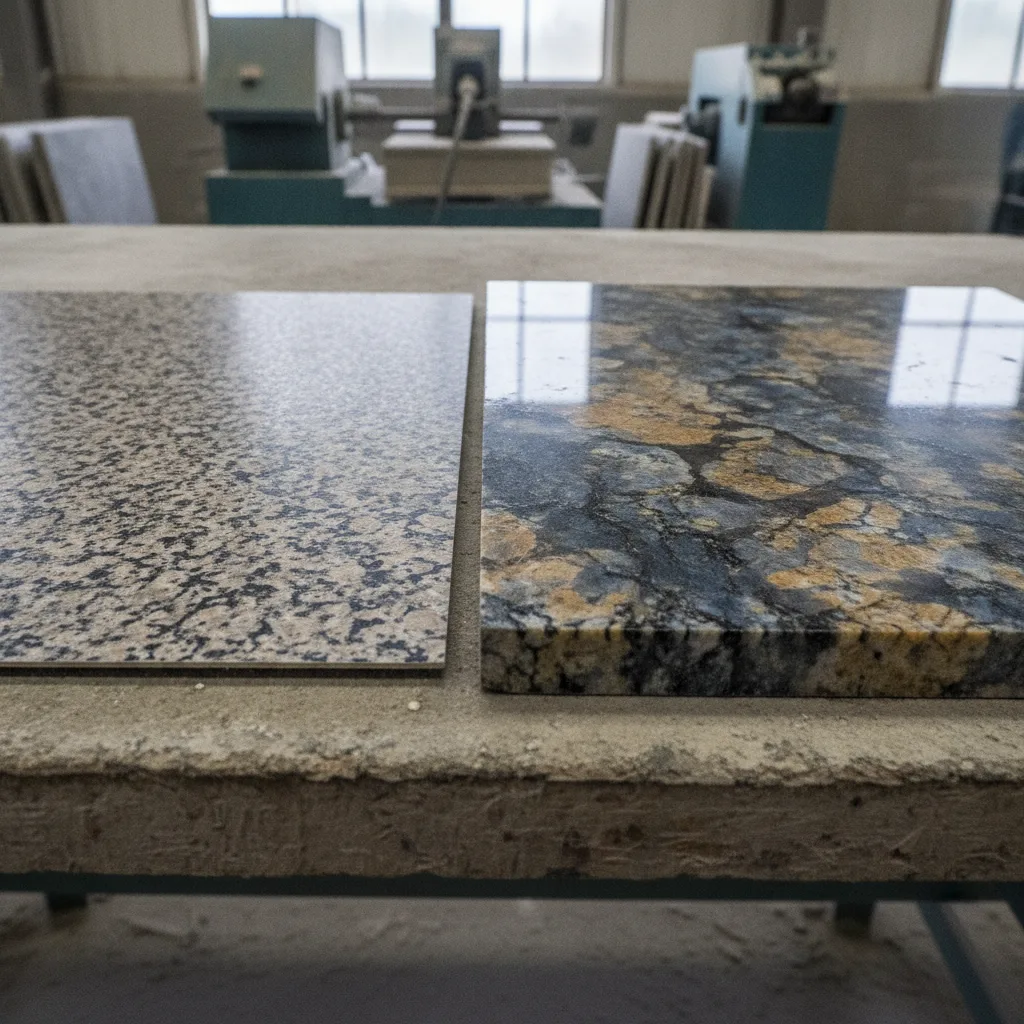
Low upfront cost, limited lifespan
Higher sticker price, lower cost per year
Laminate is a printed paper decorative layer — less than 1mm thick — bonded with melamine resin over a particleboard core. That construction is what makes it affordable and what limits its durability. Brands like Formica and Wilsonart have done a lot to close the visual gap: modern laminate comes in realistic stone and wood textures that look fine in listing photos and pass a quick scan. They won't fool a real person who looks closely at the depth and variation of natural stone, but for a rental kitchen or a utility bathroom, they do the job.
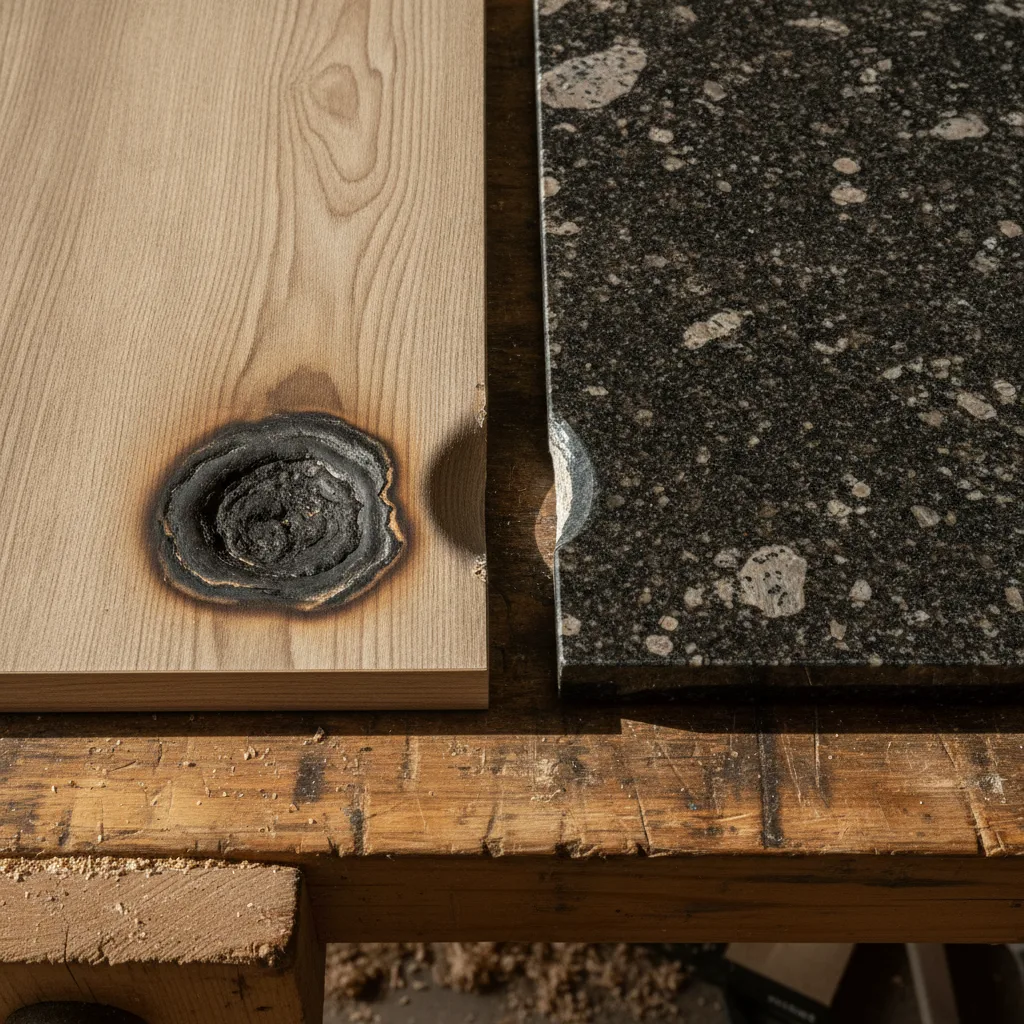
The performance ceiling is low. Laminate scratches easily because the decorative surface has no meaningful hardness — it's paper, not stone. Hot pans left directly on the surface burn and scorch it, and that damage is irreparable. The particleboard core is porous, so any moisture that penetrates at seams or around the sink causes the substrate to swell, warp, and separate from the decorative layer. Once any of those things happen, you replace the countertop — you don't repair it.
Laminate's actual lifespan under heavy kitchen use is 10–15 years. With careful handling and light use, Angi rates it at 20–30 years. The difference between those two numbers is how often you cook, whether you use cutting boards and trivets consistently, and whether you stay vigilant about seam moisture. Most active family kitchens don't qualify for the 30-year scenario. Plan to replace it at least once over the life of the average mortgage — which adds real cost to the equation that the sticker price doesn't show.
Granite kitchen countertops are quarried natural stone, and that material difference explains every performance advantage. Granite rates 6–7 on the Mohs hardness scale, meaning it resists scratches from everyday kitchen use — knives, pots, ceramic dishes. It handles high temperatures without scorching, warping, or discoloring, which is the single biggest advantage over laminate in a working kitchen. A hot cast-iron skillet set directly on granite won't cause permanent damage. The same move on laminate burns a mark that can't be sanded or polished out.
Granite countertops require sealing roughly once a year to maintain stain resistance. That's about 15 minutes of work — wipe the sealer on, let it absorb, wipe off the excess. Outside of that, they're easy to clean with warm water and mild dish soap. Avoid harsh acids or abrasive scrubbers, and you won't have issues. Chips and cracks from impact can be professionally repaired and polished back, which means a granite kitchen countertop that takes damage doesn't automatically need full replacement the way a burned or swollen laminate surface does.
The durability picture over decades is genuinely different between these two materials. Granite can last 50, 75, even 100 years with proper care. That's why the cost-per-year math shifts so sharply in granite's favor past the 3-year mark. You're not just buying a beautiful surface — you're buying a surface you won't need to think about replacing for the rest of the time you own the home. That's a quality of life difference that the sticker price comparison doesn't capture.
As of 2026, granite holds 27.9% of the U.S. countertop market by revenue (Grand View Research), and the broader natural stone market is valued at $16.4 billion and growing at 6.1% annually. Quartz, marble, and quartzite round out the natural stone and engineered stone segment. All of them — granite, quartz, marble — dramatically outperform laminate on durability and resale. The shift in homeowner preference away from laminate and toward natural stone is well established and continuing.
| Dimension | Laminate | Granite |
|---|---|---|
| Installed Cost (40 sq ft kitchen) | $600–$2,000 (Angi avg: $1,251) | $2,200–$4,600 (entry Level 1–2 granite) |
| Cost Per Year of Use | ~$83/yr (15-yr heavy use) to $63/yr (20 yr) | ~$60/yr at 50 years; less than $40/yr lifetime |
| Lifespan | 10–15 yrs under heavy use; up to 30 yrs with care | Up to 100 years with proper sealing |
| Scratch Resistance | Low — decorative layer scratches easily; no repair possible | High — 6–7 Mohs hardness; scratch-resistant surface |
| Heat Resistance | Poor — burns and scorches from hot pans; irreparable damage | Strong — heat-resistant; won't warp or scorch from cookware |
| Repairability | Not meaningfully repairable once burned or chipped through | Chips and cracks can be professionally repaired and polished |
| Maintenance Required | No sealing needed; avoid moisture at seams (causes swelling) | Seal once per year (~15 minutes); wipe clean daily |
| Resale ROI | 20–40% cost recoup; can detract value in mid-to-upper neighborhoods | 60–75% nationally; 60–100%+ in Central Texas market |
Low advertised granite prices routinely exclude templating, fabrication, delivery, edge profiling, and old countertop removal. A "$49/sq ft" quote commonly lands at $92/sq ft or more once every line item is added. At Fox Granite, we quote all-in pricing upfront — no surprise fees at installation. That transparency is one of the biggest reasons Central Texas homeowners choose us over other fabricators. Get a free estimate and see the real number before you decide.
Laminate makes financial sense in a specific set of circumstances. Outside of those situations, the cost-per-year math and the resale picture both argue against it for a primary kitchen.
In those situations, modern laminate from Formica or Wilsonart delivers a clean, affordable surface that looks fine and functions adequately. Just be honest about what it is: a short-to-medium-term solution that you'll replace, not a permanent install.
For any homeowner planning to stay put 3 or more years, cooking in their kitchen regularly, or selling in a competitive market, granite wins the comparison on every metric that matters past the purchase price.
Entry-level granite at $2,200–$3,000 all-in brings you into natural stone at a price point that's closer to laminate than most people expect. The gap between the two materials is smaller than the sticker price suggests — and the difference in what you get is enormous.
Some homeowners renovate in phases, and that's a reasonable plan. If you're doing a full kitchen overhaul but the laundry room or a secondary bathroom can wait, keeping laminate in lower-visibility spaces while putting granite in the kitchen is a smart split. The kitchen countertop is the surface buyers see, appraisers note, and your family uses every single day. It earns the upgrade first.
What we'd caution against: spending laminate money on kitchen countertops while planning to install granite later. Laminate removal adds cost to a future project, and you'll have lived with the limitations — the burns, the swelling at seams, the surface you can't repair — in the room you use most. If the kitchen budget is tight, a Level 1 or Level 2 granite slab can get you into natural stone for closer to $2,200–$3,000 all-in. The difference between laminate and entry granite is smaller than thousands of homeowners assume when they first start pricing countertops.
The comment we hear most often after a granite install: 'I wish we'd done this sooner.' The things people love about granite — the color depth, the feel, the fact that they can set a hot pan down without thinking about it — are things laminate simply cannot replicate. Plan your renovation budget to get granite in the kitchen first, and finish the lower-priority spaces in whatever material fits what's left.
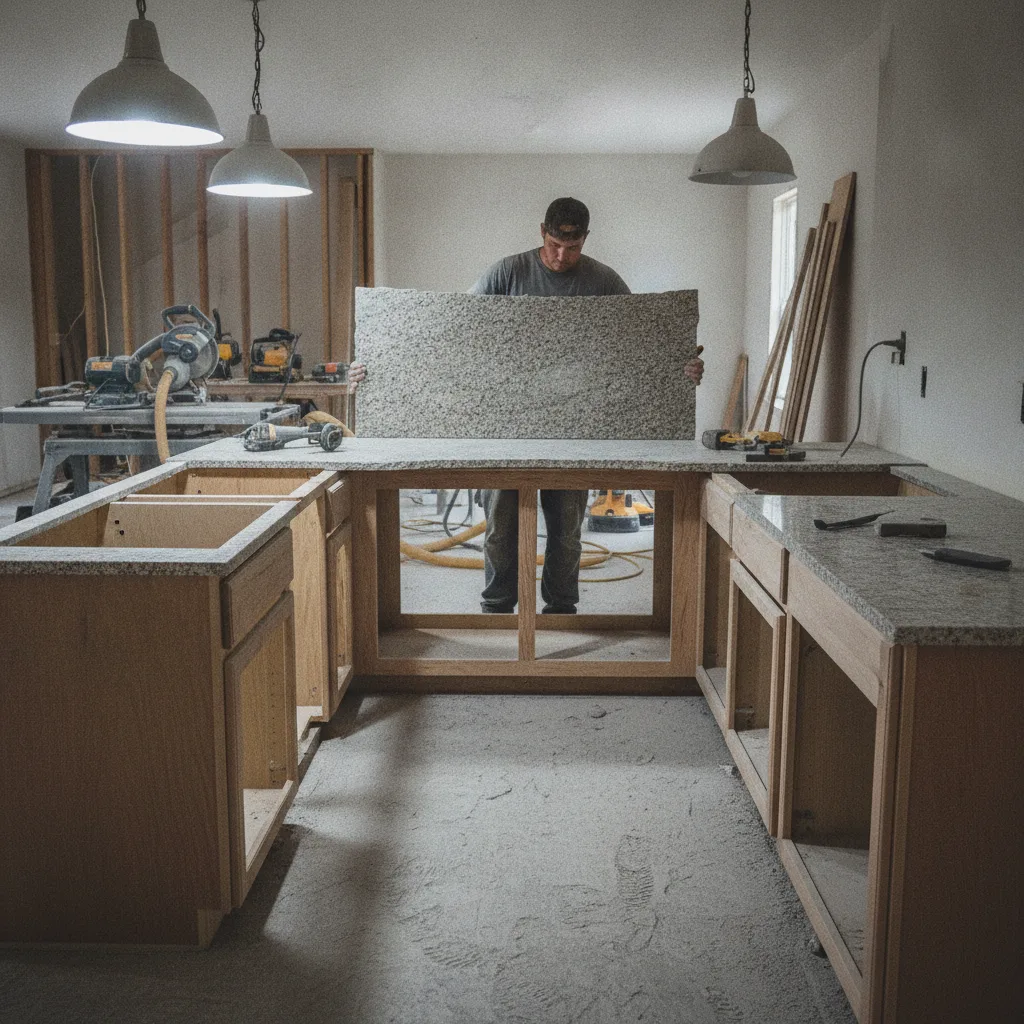
For any Central Texas homeowner planning to stay put 3 or more years, granite countertops win the cost-per-year comparison — and it's not close. Entry-level granite at $3,000 lasting 50 years costs roughly $60 per year. Laminate at $1,250 lasting 15 years under heavy kitchen use costs about $83 per year. You pay less per year for granite, and you get a surface that handles high temperatures, resists scratches, and adds measurable value when you sell.
In the Texas market as of 2026, granite projects averaging $2,800–$5,200 are estimated to add $4,500–$8,000 or more in home value — a 60–100%+ ROI. Laminate returns 20–40% at best, and in mid-to-upper neighborhoods it can actually lower buyer perception of the home. If you're in Austin, San Antonio, New Braunfels, or anywhere along the Central Texas corridor, granite is the countertop choice that works both for daily life and for the eventual sale.
Some homeowners renovate in phases — and that's a perfectly reasonable plan. If you're doing a full kitchen overhaul but the laundry room or a secondary bathroom can wait, keeping laminate in lower-visibility spaces while putting granite in the kitchen makes financial sense. The kitchen countertop is the surface buyers see, appraisers note, and your family uses every single day. It earns the upgrade first.
What we'd caution against is spending laminate money on kitchen countertops while planning to install granite later. Laminate removal adds cost to a future project, and you'll have lived with the limitations — the burns, the swelling at seams, the surface you can't repair — in the room you use most. If the kitchen budget is tight right now, our free in-home consultation can help you find a Level 1 or Level 2 granite slab that gets you into natural stone for closer to $2,200–$3,000 all-in. The gap between laminate and granite is smaller than most people expect.
Laminate makes the most sense when the project horizon is short and the property is at the lower end of the price spectrum. A landlord refreshing a rental unit, a flipper targeting entry-level buyers, or a homeowner finishing a utility space can get a clean, functional surface for $600–$2,000 on a 40-square-foot kitchen. Modern laminate brands like Formica and Wilsonart have closed the visual gap with realistic stone textures — they won't fool a real person who looks closely, but they look fine in listing photos.
The key is being honest about what laminate is: a printed paper layer bonded with melamine resin over particleboard. It's not forgiving of burns, heavy use, or moisture at the seams. If your situation is short-term, the budget is the budget, and the kitchen won't see hard daily cooking, laminate can absolutely do the job. Just plan to replace it in 10–15 years — and don't expect it to add anything meaningful at resale. For a primary kitchen in a home you plan to live in and eventually sell, granite is the more affordable choice when you run the full math.
The granite vs. laminate countertops question has a clear answer for most Central Texas homeowners: granite is the better investment as soon as the timeline extends past 3 years. It costs less per year, handles the real demands of a working kitchen, and returns 60–100%+ in the resale market. Laminate is an awesome solution for the right situation — rentals, flips, utility spaces, short-term holds. It is not the right call for a kitchen you plan to cook in, live with, and sell.
The countertop material you choose affects how you use your kitchen every day, not just what a buyer thinks on a showing. Burns you can't fix, seams you have to baby, surfaces that chip through to bare particleboard — those are quality-of-life costs that don't show up in a price-per-square-foot comparison. Granite removes those problems entirely. Agree with that trade-off, and the budget question becomes: how do I find the best entry-level granite for my kitchen, not whether to buy granite at all.
For granite vs. laminate countertops questions, cost-per-year math, and honest guidance on which material fits your home and your budget, trust Fox Granite. We've completed over 10,000 countertop projects across Austin, San Antonio, New Braunfels, and the Central Texas corridor — and we'll give you a straight answer, not a sales pitch. Contact us today to schedule your free in-home consultation, or visit our New Braunfels showroom to see the slabs in person. Call (512) 653-5541 or get your free estimate online.
Ready to get started? Contact Fox Granite today.


BY APPOINTMENT ONLY
1379 Wald Road
New Braunfels, TX 78132
Austin, San Antonio, Cedar Park, Kyle, New Braunfels, Del Valle, Elgin, Lago Vista, Shady Hollow, Onion Creek, Buda, San Marcos, Lockhart, Temple, Wimberley, Dripping Springs, Bee Cave, Lakeway, Leander, Anderson Mill, Jollyville, Spicewood Springs, Round Rock, Georgetown, Pflugerville, Manor, Taylor, Manchaca, Mountain City, Hutto, West Lake Hills, Bastrop, Liberty Hill, Driftwood, Sun City, Steiner Ranch.