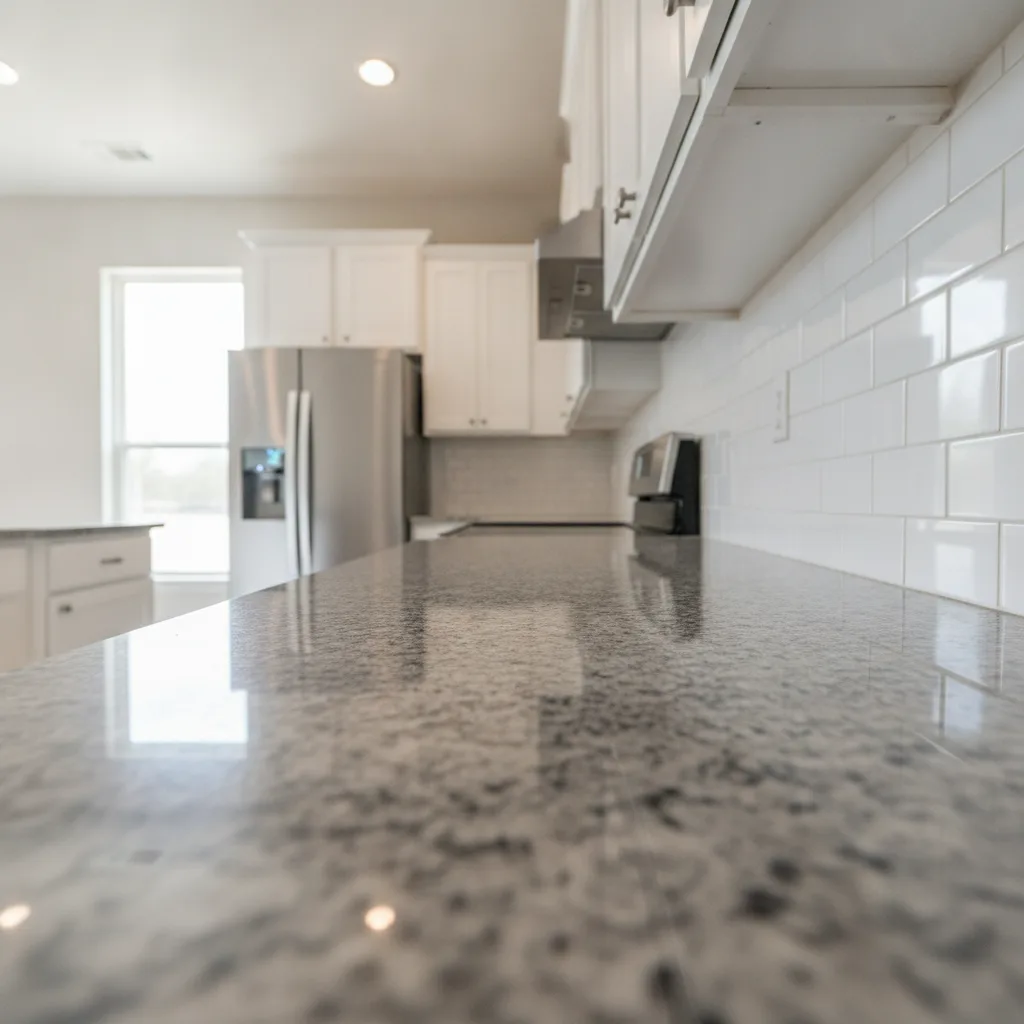
Granite countertops and a backsplash do not need to match — they need to complement each other. The design rule is simple: granite is already doing the visual work with its natural color variation, movement, and flecks. The backsplash responds to the stone rather than competing with it. Three strategies cover almost every kitchen: Match (same material or color family), Coordinate (pull a secondary tone from the granite's flecks), or Contrast (an opposite or neutral tone that makes the stone pop). Coordinate is the most common successful approach. The biggest practical rule: always select and template your countertop first, then choose and install the backsplash — getting the sequence backward risks a costly tear-out.
Granite countertops with backsplash planning is one of the most anxiety-producing decisions in a kitchen remodel — and the most misunderstood. The short answer: your backsplash does not need to match your granite countertops. It needs to complement them. There is no design law requiring identical materials, the same color family, or even the same finish. The one rule that matters is that your backsplash should respond to the stone, not compete with it. This 6-step guide gives you a concrete framework: read the granite first, pick a pairing strategy, choose a tile format, understand the real cost range, and sequence the project correctly so you don't end up paying for a tear-out. Most homeowners work through this decision in 30–60 minutes once they have a slab selected. The guide applies to every kitchen style — modern, farmhouse, contemporary, country — and every common granite variety sold in Central Texas.
Granite countertops and the backsplash do not need to match — but the backsplash must complement the stone. There is no design rule requiring identical materials or colors. The only rule that matters: your backsplash should respond to the granite, not compete with it. Granite is already the star of the room. It has natural color variation, movement, and flecks that shift under different light throughout the day. Adding a backsplash that duplicates those same patterns creates noise. The better approach is letting the granite lead and choosing a backsplash that plays a supporting role — pulling out a tone, adding subtle texture, or providing clean contrast.
Three pairing strategies cover almost every kitchen. Match: same material or same color family, including a granite slab backsplash cut from the same stone as your countertop. Coordinate: pull a secondary or quiet color already visible in the granite's flecks — not the dominant shade, but a tone that appears in the quieter areas of the slab. Contrast: use an opposite or neutral tone that frames the stone and makes it pop. Coordinate is the most common successful approach and works in almost every style of kitchen. Contrast works best when the granite itself is calm and low-movement. Matching via a full granite backsplash slab is a premium move that signals elegance and sophistication — and comes with a higher price tag.
One pairing principle holds across all three strategies: polished granite counters with a matte backsplash tile, or matte granite counters with a glossy or glass tile backsplash. The sheen contrast creates visual interest without adding competing pattern. This finish contrast alone gives life to pairings that would otherwise read as flat — and it works in modern kitchens with flat panel cabinets as readily as it works in farmhouse or country styles.
If your granite has high movement — bold veining, dramatic swirls, or multiple competing colors — skip the Contrast strategy entirely. A statement backsplash against busy stone creates visual conflict that most homeowners describe as feeling 'off' without being able to say exactly why.
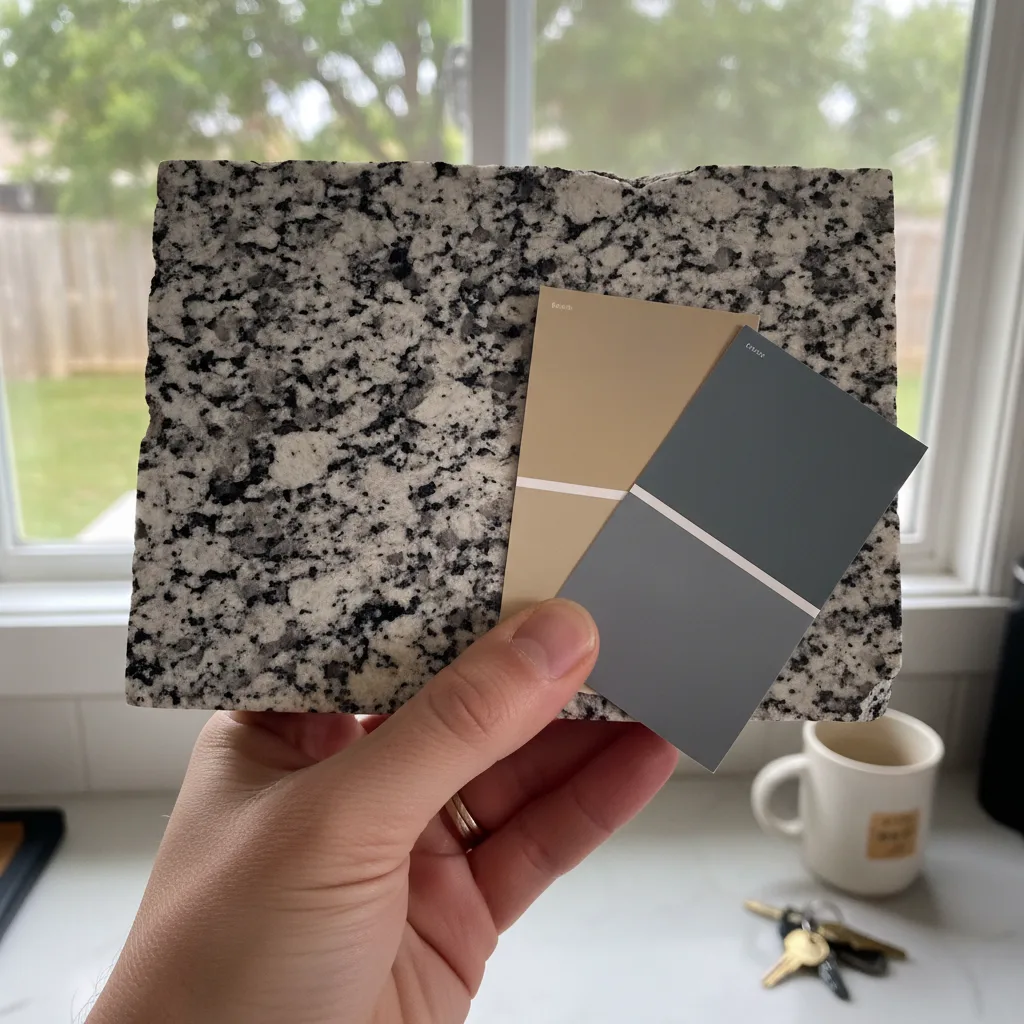
Getting undertones wrong is the single most common kitchen design mistake with granite countertops. A cool-toned backsplash tile against warm granite creates subtle tension that most homeowners cannot name directly — the kitchen just feels unsettled. Undertone identification comes before any tile shopping. Hold a white piece of paper next to your granite slab in natural light at a window. Ask yourself: does the stone pull warm (brown, gold, cream, red flecks) or cool (gray, blue, green, silver)? This two-minute test prevents the most expensive regret in kitchen remodels.
Gray granite countertops almost always read cool — a warm beige tile backsplash fights them visually. White granite countertops can read warm or cool depending on the variety: Bianco Romano pulls cool, Colonial Cream pulls warm. Gold granite countertops and brown-toned stones need warm-toned backsplash tiles to stay cohesive. White countertops made from white granite with strong gray veining are cool-dominant and pair best with tiles in white, pale gray, or cool-toned natural stones. Identifying which category your slab falls into takes the guesswork out of the tile store.
Movement level is the second variable, and it is equally important. Low-movement granite — solid black granite countertops like Absolute Black or Steel Grey — is calm enough to handle almost any backsplash tile, including a statement backsplash with pattern or texture. High-movement granite needs restraint: simple tile shapes, neutral tones, and minimal grout lines. The busier the stone, the quieter the backsplash wall should be. This is a rule, not a preference — and it applies whether your kitchen has white cabinets, gray cabinets, or wooden cabinets.
Free (ask your fabricator)
Seeing the actual stone under your kitchen's natural light beats any digital photo or showroom comparison — undertones shift dramatically between lighting environments.
Free at most paint stores
Hold warm and cool paint cards next to your slab at a window to quickly confirm which undertone family the granite belongs to.
Your granite's movement level and your kitchen cabinets together determine which pairing strategy fits. Kitchen cabinets cover more wall space than any other element in the room — white cabinets, gray cabinets, and flat panel cabinets each shift what the backsplash needs to accomplish. The backsplash sits between those two dominant surfaces and must work with both simultaneously.
For high-movement granite with white cabinets or light-colored wooden cabinets, use the Coordinate strategy. Pick one quiet color that already appears in the stone — not the dominant color, but a secondary shade visible in the flecks or the quieter zones of the slab. A soft gray backsplash tile or a warm cream subway tile against Giallo Ornamental granite, for example, creates harmony without being too matchy. Keep grout the same tone as the tile to minimize grid lines on the wall and let the granite stay dominant. This approach works across modern, farmhouse, and country kitchen styles.
For low-movement or solid-color granite — black granite countertops, gray granite, white granite countertops with minimal veining — all three strategies are available. Black granite countertops like Absolute Black look sharp against crisp white backsplash tile, a classic contrast that holds across both modern and contemporary design and works well alongside stainless steel appliances or black appliances. Gray granite countertops pair well with a white backsplash or a pale glass tile that adds brightness to the space. With gray cabinets and gray granite, introduce a white backsplash to break the monotony and keep the kitchen from reading heavy. When paneled appliances are in the mix, a clean, minimal tile in white or light neutral tones preserves the built-in, furniture-like aesthetic those appliances create.
Skip the 4-inch granite kick that was popular in the early 2000s. A thin strip of the same granite between the countertop edge and the backsplash tile looks dated in 2026 and interrupts the visual flow from counter to wall. Go full tile or go full slab — the half-measure rarely reads as intentional.
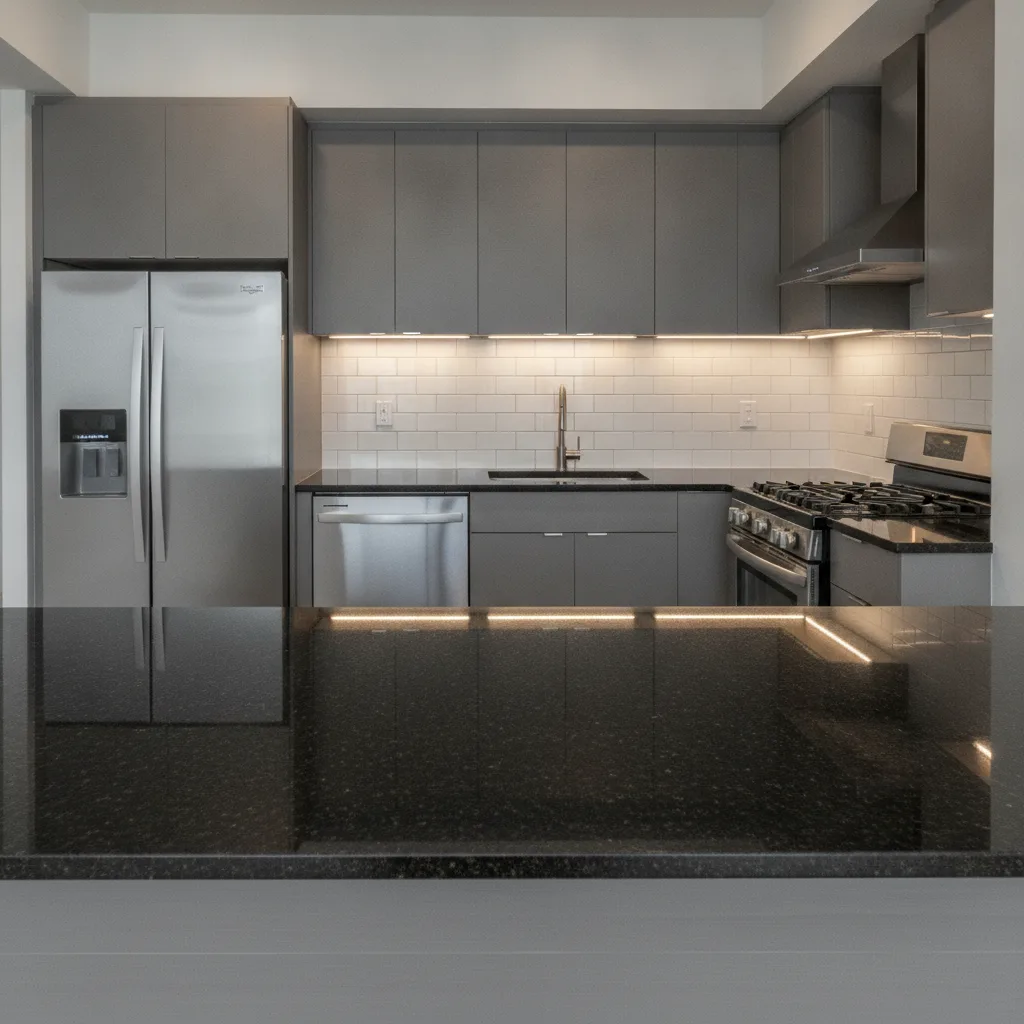
Tile format controls how much visual activity the backsplash adds to the room — and that changes the calculus entirely when your granite is busy. Subway tile remains the most popular backsplash tile for granite countertops because its clean lines let the stone stay dominant while giving the wall a polished, timeless finish. The classic 3x6 subway in white or a neutral shade is the safest choice for high-movement granite in any kitchen cabinet style. It creates elegance without competing, and it holds its value across kitchen design trends.
Larger-format tiles — 12x24 or bigger — look quieter because they minimize grout lines on the wall. They work well in modern kitchens with flat panel cabinets and simple profiles, and they give a clean look that suits contemporary design. Smaller formats — mosaic tiles, small subway, zellige — introduce more grid lines and visual movement. Against low-movement granite or white granite countertops with calm veining, that added texture creates depth and visual interest. Against high-movement granite, it competes and reads as chaotic. Match the tile's visual energy to the inverse of the stone's visual energy.
Glass tiles add brightness and bounce light around the kitchen — a good choice for smaller kitchens with limited window space, or for pairing with gray granite countertops to keep the room from feeling dark. Porcelain tile offers durability and comes in formats that mimic natural stones or create a clean look without the maintenance of real stone tile. For a farmhouse sink setup or a country-style kitchen with wooden cabinets and warm floors, a handmade ceramic or zellige tile adds texture and warmth without fighting the granite. The rich, varied surface of zellige provides visual interest at the wall level while letting polished granite counters stay the featured element in the space.
A standard kitchen backsplash covering 35 sq ft costs $480–$1,500 installed for most tile options, with most projects landing around $1,000 according to 2026 Angi data. Ceramic tile is the most affordable backsplash material: $1–$10 per sq ft for materials, $2–$10 per sq ft for labor, and $11–$60 per sq ft all-in. Natural stone tile runs $15–$65 per sq ft installed. Glass tiles land at $20–$60 per sq ft installed. Backsplash labor ranges from $5–$20 per sq ft, and complex patterns like herringbone or mosaic add 10–20% to total project cost because of the extra cutting and layout time involved.
A granite slab backsplash — using the same stone as your countertop — is a different category entirely. Expect $50–$100 per sq ft installed for a standard 18-inch granite backsplash, or $1,200–$5,000 total for a typical kitchen. A full-height slab backsplash running floor to ceiling costs $2,000–$8,000 depending on the stone and complexity. The tradeoffs are clear: no grout lines to scrub or seal, a continuous flow of natural pattern from countertop to wall or even ceiling, and strong resale value in mid-to-upper-tier kitchen remodels. As of 2026, full-height slab backsplashes are one of the strongest trending features in Austin and San Antonio kitchen projects, driven by the large-scale veining granite varieties selling strongly across Central Texas.
Using a remnant cut from your own countertop slab keeps the stone pattern continuous and often costs less than sourcing new slab material — ask your fabricator about remnant availability at the time of countertop purchase. The downside of any slab backsplash: repairs are more complex than tile. Matching the original quarry lot years later is not always possible, so a chip or crack in a slab backsplash is harder to remedy than replacing a cracked tile. For most homeowners, the inspiration for choosing slab over tile backsplash material comes down to maintenance simplicity and visual cohesion — both of which slab delivers.
$50–$100 per sq ft installed
Using a remnant cut from your own slab keeps the stone pattern continuous and often costs less than purchasing new slab material from the yard.
$11–$60 per sq ft installed
The most cost-effective backsplash tile for granite countertops — neutral, timeless, and available in every finish, size, and shade.
$15–$65 per sq ft installed
Stays within the natural stone family for a cohesive look at a fraction of the full slab backsplash cost.
The single most preventable mistake in a kitchen remodel is installing the backsplash before the countertop is templated. A backsplash installed too early risks being torn out and redone once the countertop template reveals the precise wall dimensions, outlet placements, and finished countertop height. That is a costly redo on both materials and labor — typically $300–$700 in additional tile labor alone, before accounting for replacement tile and grout.
The correct order is: select and install countertops, complete the templating appointment, then begin backsplash selection and installation. Backsplash decisions are typically finalized at or after the template appointment. At that point, you have exact measurements, you can see the actual countertop material installed in your kitchen, and you can hold tile samples against the real slab under your actual kitchen light — near a window, under your pendant lights, and under whatever task lighting sits above your island or counters. Seeing those combinations in your real space is the single best tool for confirming that undertones match and shades work together before any tile is purchased.
At Fox Granite, our free in-home consultations bring real slab samples directly to your home so you can see exactly how granite countertops interact with your cabinet colors, flooring, and natural light before you commit. Once your countertop is installed, we also help you think through backsplash pairings based on what we know about your specific stone and your kitchen's interiors. We have completed over 10,000 countertop projects across Central Texas since 2010, and the most common remodel regrets we hear are about backsplash decisions made before the countertop template — not after.
Do not tile over an existing backsplash to save removal cost if your countertop is being replaced. Countertop installation requires access to the bare wall, and tiling over old tile adds thickness that can create a misaligned finished edge where the countertop meets the wall. Remove the old backsplash first.
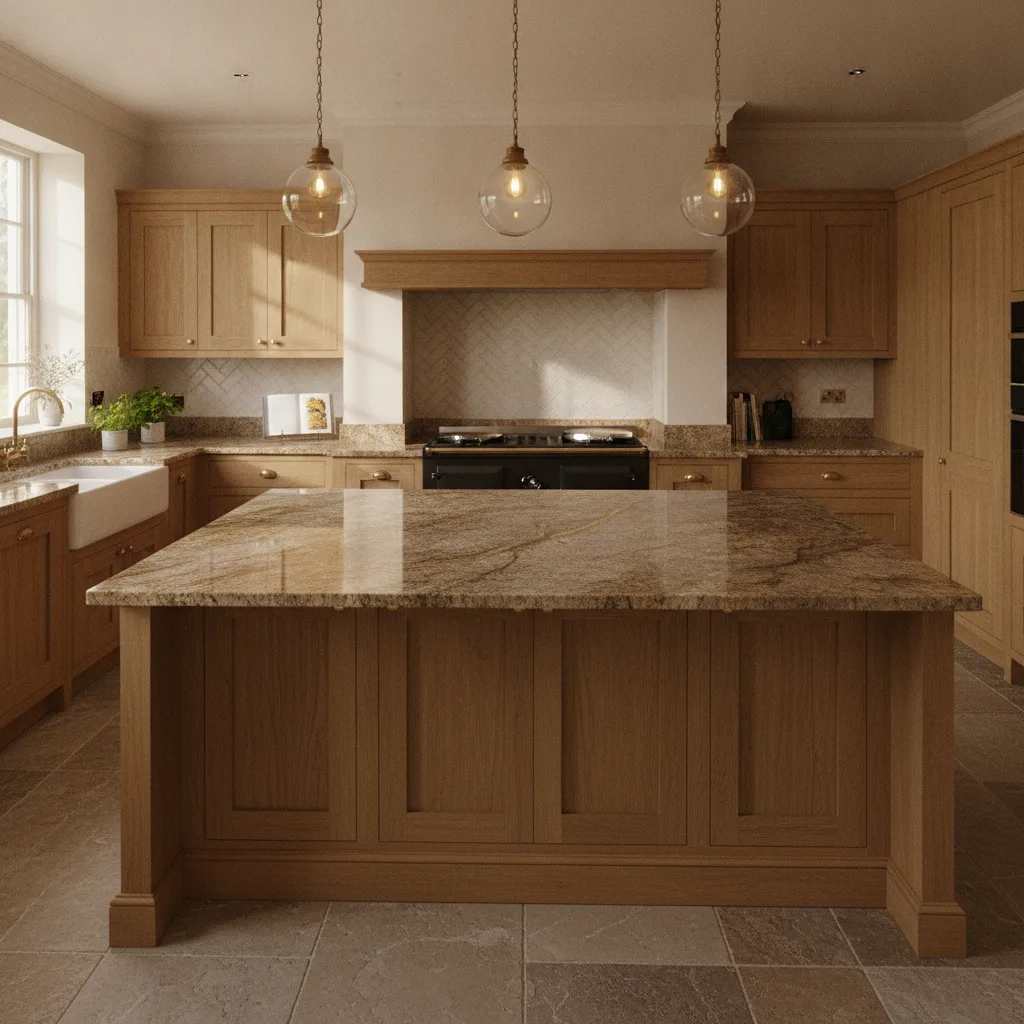
1. Choosing the backsplash before the countertop is templated. Granite countertops cover far more visual area and represent a bigger investment — always choose the stone first, then respond to it with tile. 2. Matching undertones incorrectly. A cool gray backsplash tile against warm brown granite creates tension that most people feel but cannot name. Check undertones under natural light at a window before buying. 3. Pairing a busy backsplash with high-movement granite. Two competing patterns on one wall create visual noise that no amount of nice kitchen cabinets can fix. When the stone is dramatic, keep the backsplash tile simple and neutral. 4. Installing the 4-inch granite kick. That thin strip of countertop granite between the counter edge and the backsplash tile dates the kitchen instantly and interrupts the visual flow from counter to wall. Skip it — go full tile or full slab.
A well-paired granite countertop and backsplash combination adds cohesion, resale value, and daily satisfaction to your kitchen for decades. The framework is straightforward: read the stone's undertone and movement level first, pick a strategy that responds to those variables, choose a tile format that supports the strategy rather than competing with it, and protect both investments by getting the sequence right. For granite countertops with backsplash planning in Austin, San Antonio, New Braunfels, and across Central Texas, Fox Granite brings the slab samples to you. Schedule your free in-home consultation today, or visit our New Braunfels showroom to see the full granite selection in person — and make your backsplash decision with the real stone in hand.
Ready to get started? Contact Fox Granite today.


BY APPOINTMENT ONLY
1379 Wald Road
New Braunfels, TX 78132
Austin, San Antonio, Cedar Park, Kyle, New Braunfels, Del Valle, Elgin, Lago Vista, Shady Hollow, Onion Creek, Buda, San Marcos, Lockhart, Temple, Wimberley, Dripping Springs, Bee Cave, Lakeway, Leander, Anderson Mill, Jollyville, Spicewood Springs, Round Rock, Georgetown, Pflugerville, Manor, Taylor, Manchaca, Mountain City, Hutto, West Lake Hills, Bastrop, Liberty Hill, Driftwood, Sun City, Steiner Ranch.