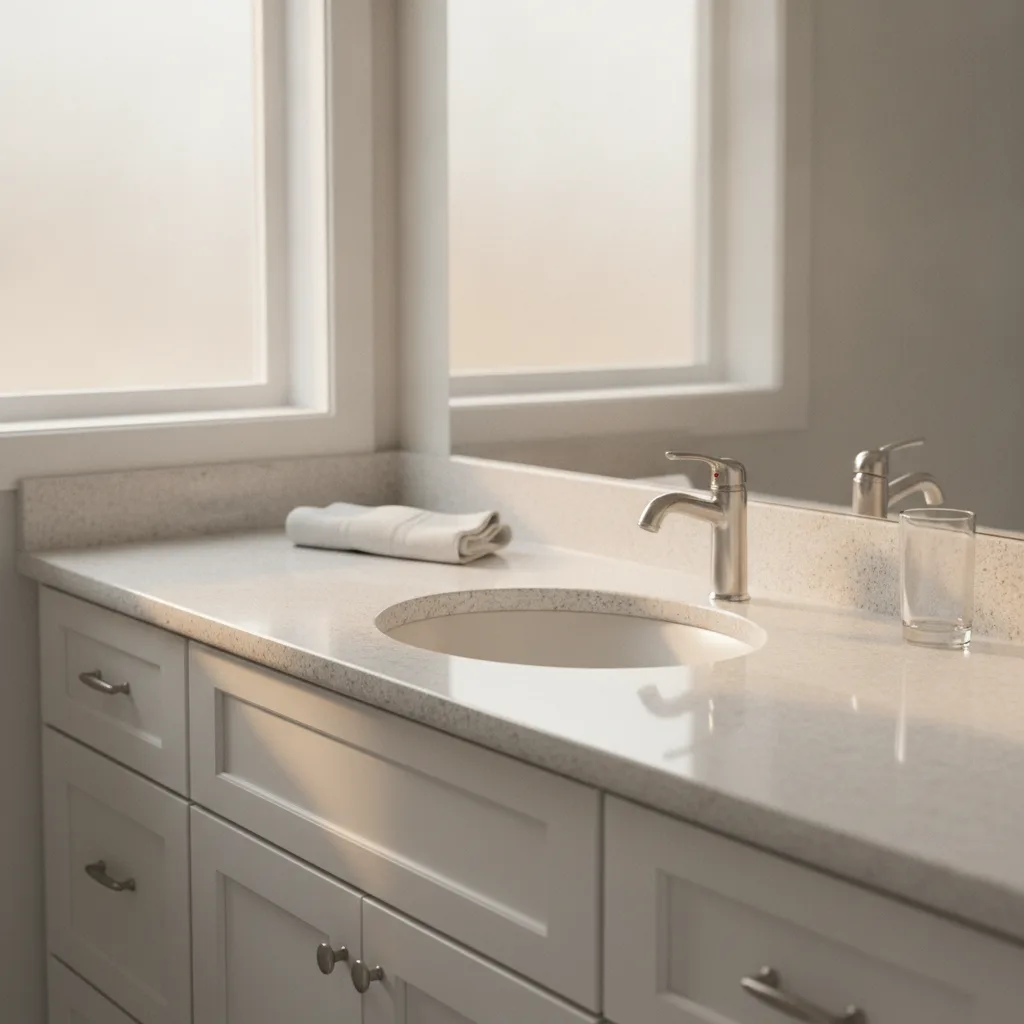
Granite is a genuinely good choice for bathroom vanity countertops. It handles heat from curling irons and hair straighteners better than quartz, resists everyday scratches, and outlasts marble on stain resistance. The main tradeoff is periodic sealing — roughly every one to three years — which quartz skips entirely. As of 2026, installed costs run $400–$1,800 for most standard vanities, making granite the value option compared to quartz at similar quality levels. The heavy speckled patterns from the early 2000s do look dated, but quieter colors like Alaska White, Steel Gray, and Absolute Black in leathered or honed finishes look current and perform exceptionally well. If your cabinet base is level and you're willing to seal once a year, granite is hard to beat for a bathroom vanity.
Granite bathroom countertops are a genuinely durable, heat-resistant option for a vanity — and as of 2026, they're often the better value compared to quartz at the same quality level. The question most Central Texas homeowners are really asking isn't whether granite works in a bathroom. It's whether it works for their bathroom: their cabinet color, their maintenance tolerance, their design goals, and their budget. This guide walks through the decision in six steps, from raw performance facts to color selection to what a finished project actually costs.
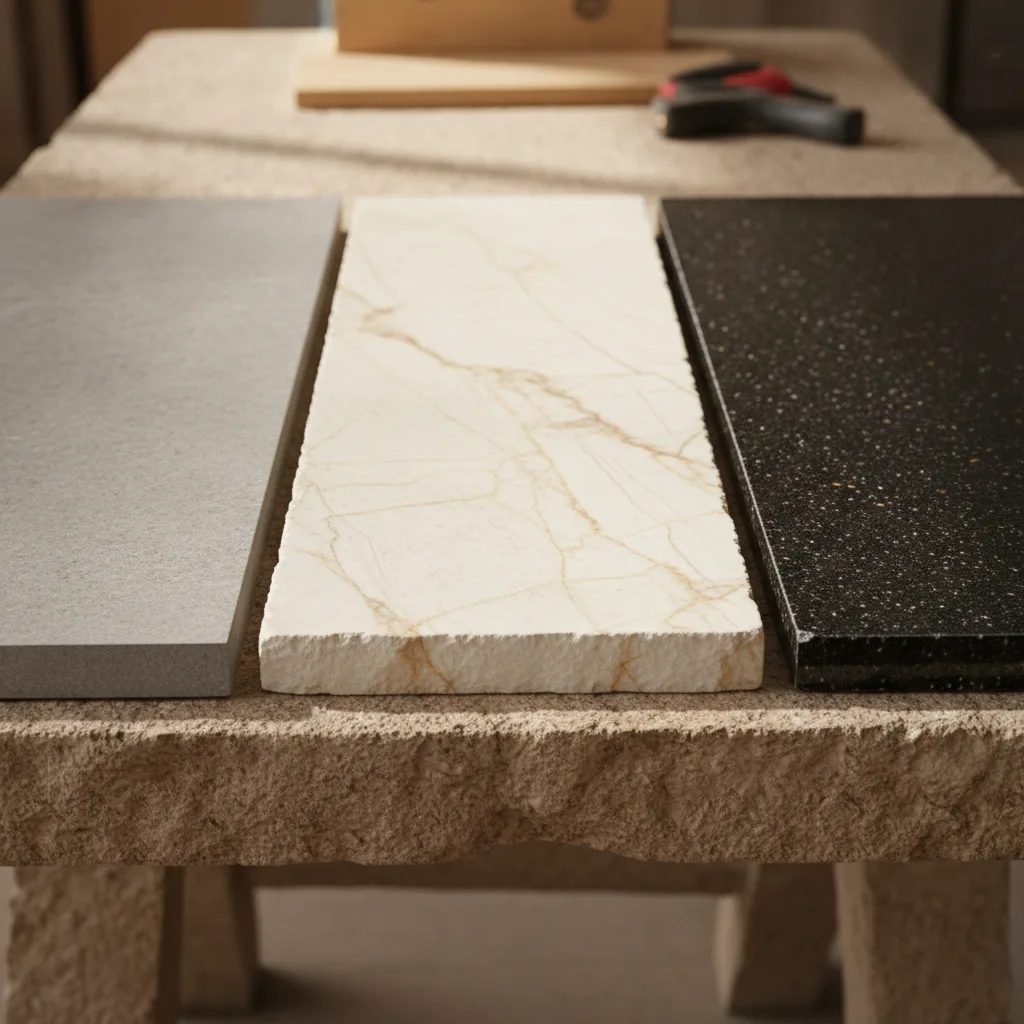
Granite is genuinely well-suited for bathroom countertops — it handles heat from curling irons and hair straighteners better than most engineered stones, resists everyday scratches, and is more stain-resistant than marble. Those are the facts that matter most for a vanity, where hot styling tools land on the surface daily and water pools around the sink. Quartz wins on one front: it's non-porous and needs no sealing. But granite handles heat up to 480°F without damage (Motor City Granite), which is an advantage quartz cannot match in a bathroom setting.
The tradeoff you do have to accept with granite is periodic sealing. Because it's a porous natural stone, it needs to be resealed every one to three years depending on use. That's not a heavy burden — a typical reseal takes under an hour — but it's a maintenance step quartz skips entirely. If you want zero maintenance, quartz is your material. If you're fine with a quick annual check and an occasional reseal, granite holds up for 20 to 30 years or more with proper care. The functionality you get in return — exceptional heat tolerance, scratch resistance, and a surface that looks better with age — makes that tradeoff worth it for most homeowners.
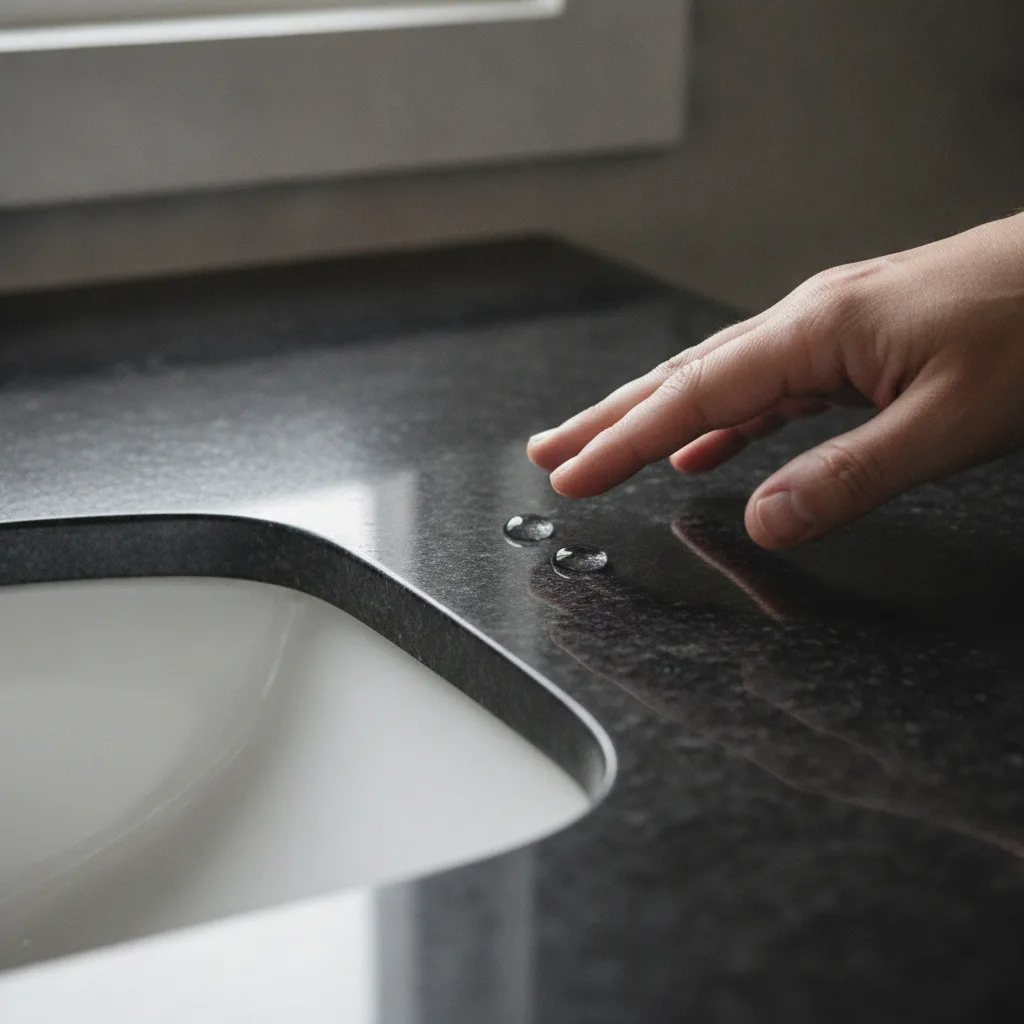
One useful check: the water-bead test. Drop a small amount of water on your granite surface. If it beads up, your sealer is doing its job. If the water darkens the stone and soaks in, it's time to reseal. It's the simplest way to stay ahead of sealing without guessing at a schedule.
Granite beats quartz on heat resistance and cost at comparable quality levels. Quartz beats granite on maintenance (no sealing required) and consistency of appearance. Marble loses to both on stain and etch resistance in a bathroom environment — it's beautiful, but it's the highest-maintenance of the three materials.
Granite isn't outdated — the busy, heavily speckled patterns popular in the early 2000s are what read dated today. The material itself is performing better than ever in design circles. As of 2026, the direction in home design has shifted toward natural, organic surfaces that look authentic and vary visually (Nova Tile and Stone). That's exactly what granite offers, especially in leathered or honed finishes that look nothing like the glossy, high-contrast slabs of two decades ago.
The colors and finishes driving granite's current relevance are quieter and more monolithic than the patterns that gave it a bad reputation. Leathered blacks, soft matte grays, and warm creams can hold their own in any modern or transitional bathroom. The stone carries real sophistication when the slab selection is done thoughtfully — which is exactly why visiting a showroom or seeing physical samples matters before you commit. No two granite slabs are exactly alike, so a vanity can feel genuinely custom without complicated design work. That uniqueness — the fact that your countertop won't look like your neighbor's even if you order the same color — is the clearest advantage granite holds over engineered quartz, which is manufactured to look consistent from slab to slab.
The most popular granite colors for bathroom vanities as of 2026 are neutral whites, warm grays, and deep blacks — chosen because they act as neutral bases that work with virtually any cabinet color. Specific slabs that show up repeatedly on trend lists include Colonial White, Alaska White, Viscount White, Steel Gray, Black Galaxy, and Absolute Black (Fox Granite, 2026). These aren't trendy for the sake of it; they're durable design choices that hold up visually for the long term and don't compete with other finishes in the room.
Finish matters as much as color when you're choosing granite for a bathroom. A polished finish is the most common and reflects light well, which can help a small space feel larger. A honed finish gives a matte, softer look that doesn't show water spots as readily — a real practical advantage near a sink. A leathered finish sits between the two: it has texture, hides minor smudges, and is gaining traction with homeowners who want natural material to look and feel like natural material. Any of these finishes can be applied to the same slab, so the color options and finish decisions are separate choices you make during slab selection.
If you want to explore design ideas without committing to a full slab purchase, ask your fabricator about remnant slabs. A single-sink vanity typically needs just 5 to 15 square feet of stone, and fabricators often have remnants from larger kitchen projects that are exactly that size. At Fox Granite, remnant slabs can bring the installed cost down to the $30–$45 per square foot range — a smart move on a bathroom project where the total square footage is small.
Free to visit
See physical granite slabs in person — color and pattern read very differently on a screen versus in your actual bathroom light conditions.
Free
Fox Granite brings samples to your home so you can see how colors interact with your existing cabinets, flooring, and lighting before making a final slab decision.
For bathroom vanities, a simple eased edge is usually the best starting point. It keeps the focus on the stone itself, doesn't make the vanity look visually heavy, and pairs well with any cabinet style from modern to transitional. It's also the most affordable edge option — typically included in the base fabrication price — which matters when you're already working with a smaller total project budget.
Upgraded edge profiles like bullnose, beveled, half-bullnose, or ogee cost $10–$40 or more per linear foot above the base price. On a standard 48-inch vanity with two exposed edges, that can add $40–$100 to your project total. That's not a budget-breaker, but it's worth knowing before you fall in love with an ogee profile during your consultation. The practical guidance: choose an edge that complements the rest of your bathroom's design language. A sharp beveled edge reads modern; a bullnose edge reads traditional; ogee reads formal. Match the edge to the room, not to what looked good at someone else's house.
In a bathroom, less is usually more with edge profiles. A busy edge on a small vanity can feel over-designed. Save the decorative profiles for kitchens where the countertop is a larger visual element in the room.
The safe daily choice for granite countertops is a pH-neutral stone cleaner or mild dish soap and water. That handles routine cleaning without degrading your sealer. The question that comes up constantly is whether Clorox Disinfecting Wipes are safe — and the answer is nuanced. Clorox's own website says their wipes can be used on sealed granite. Most stone fabricators and industry sources push back on routine use because the citric acid and bleach compounds in those wipes degrade the sealer over time and can dull the finish. The operative word in Clorox's guidance is 'sealed.' A one-time use in a pinch won't ruin your countertop. Making it your daily wipe-down choice will shorten your sealer's life and eventually affect the surface.
For stains, the approach depends on what caused them. Water spots and soap scum respond to a stone-safe cleaner and a soft cloth. Oily stains — lotion, makeup, hair product residue — may need a poultice made from baking soda and water applied for a few hours. Scratches from everyday bathroom use are uncommon on granite because the material is harder than most objects that come into contact with it, but no surface is scratch-proof. A deep gouge from dropping something sharp can be repaired; a granite professional can fill and polish the area so it's barely noticeable.
The simplest maintenance rule: clean up spills promptly, avoid acidic cleaners like vinegar or lemon-based sprays, and check your sealer status once a year with the water-bead test. That's the full maintenance picture for granite bathroom countertops.
Granite bathroom countertops run $40–$100 per square foot installed for standard residential projects, working out to roughly $400–$1,800 total for a typical vanity (Slabwise, July 2026). Entry-level granite in colors like Uba Tuba, Santa Cecilia, or Colonial White installs for $40–$55 per square foot in most markets. Premium or exotic slabs push past $120 per square foot. One thing most homeowners don't expect: fabricator minimums. Most shops charge $300–$500 regardless of how small the job is, which can push the effective per-square-foot cost on a small single-sink vanity above what you'd pay for the same material in a larger kitchen project. That's not a bait-and-switch — it reflects the fixed labor cost of templating, cutting, and installing even a small piece.
Compared to quartz at the same quality level, granite runs $10–$30 per square foot less (Slabwise, 2025–2026). Entry quartz installs for $55–$80 per square foot; entry granite comes in at $40–$60. That gap makes granite the better value at comparable quality tiers, especially for a bathroom project where the total square footage is small. Where the value comparison really shifts in granite's favor is on remnant slabs — a 10-square-foot bathroom vanity is a perfect candidate, and fabricators are often glad to move remnant inventory from completed kitchen projects.
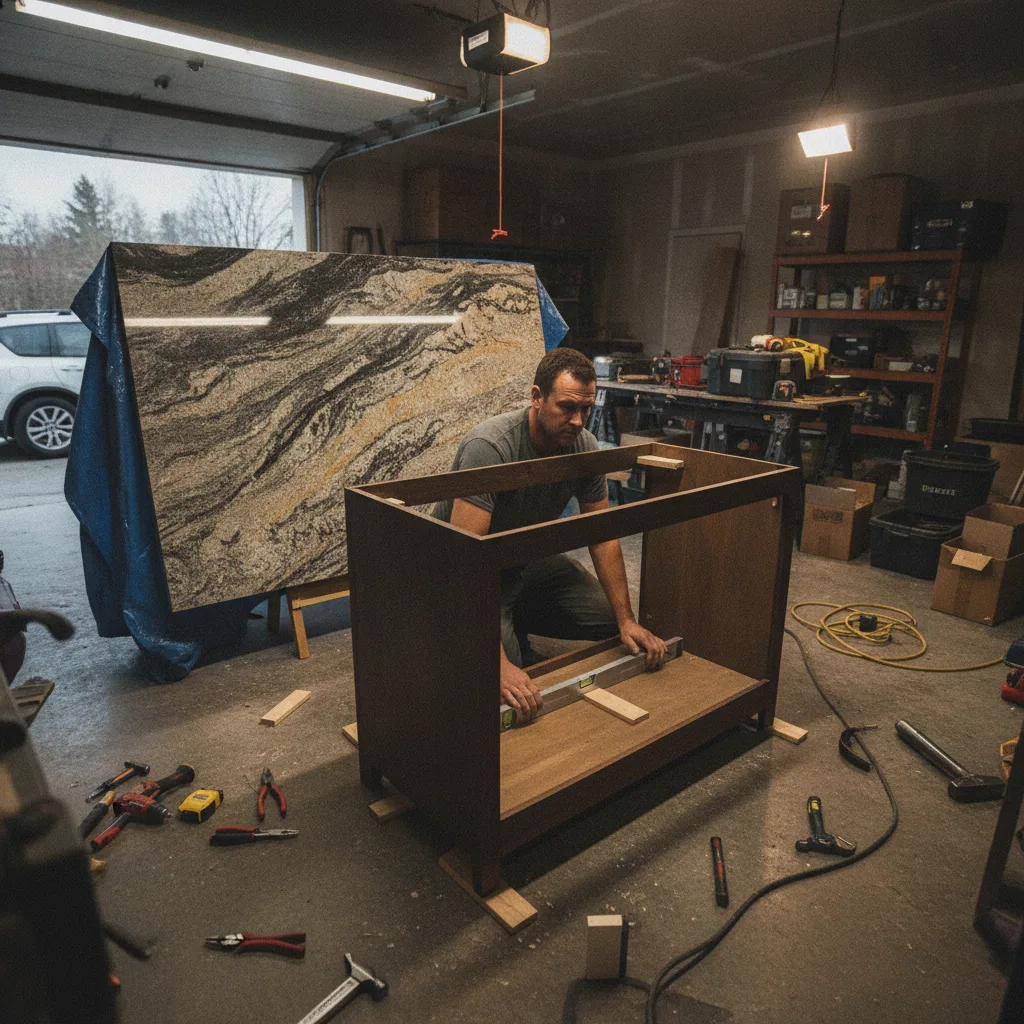
One installation detail that matters more than most homeowners realize: your vanity cabinet must be dead level and shimmed correctly before the granite top goes on. A 3 cm granite vanity top at 24 by 48 inches weighs around 90 to 100 pounds. If the cabinet base isn't perfectly level, the slab can crack across a seam or at the sink cutout over time — not immediately, but within months or years of daily use. This is why professional installation isn't optional for slab granite. Fox Granite handles templating and installation in-house, using the overlay template method and state-of-the-art stone-cutting software to ensure the fit is exact before anything is cut.
Always confirm whether your fabricator's quote includes templating, fabrication, edge profiling, sink cutout, and installation — or whether those are line-item additions. Fox Granite's pricing is all-in with no surprise fees, so you know the total cost before the project starts.
A granite vanity top weighs 90–100 pounds for a standard 24x48 slab. If your cabinet base isn't perfectly level and shimmed before installation, the slab can crack at the sink cutout or along a seam — sometimes weeks after install, sometimes months later. This is the single most preventable failure in a bathroom granite project. A professional installer will check for level, shim where needed, and secure the top correctly. If a quote seems surprisingly low and doesn't mention templating or on-site prep, ask exactly what it includes before you sign anything.
When the project is built right — the right slab chosen in person, the cabinet base confirmed level, and the installation handled by a professional with in-house fabrication — granite bathroom countertops reward you with a surface that looks better than engineered stone and lasts longer than most of the other materials on the market. For granite bathroom countertops in Austin, San Antonio, New Braunfels, and across Central Texas, Fox Granite has completed over 10,000 countertop projects since 2010. We fabricate everything in-house, offer free in-home consultations with samples, and quote all-in with no hidden fees. Contact us today to request a consultation, or visit our New Braunfels showroom to find the right slab for your vanity.
Ready to get started? Contact Fox Granite today.


BY APPOINTMENT ONLY
1379 Wald Road
New Braunfels, TX 78132
Austin, San Antonio, Cedar Park, Kyle, New Braunfels, Del Valle, Elgin, Lago Vista, Shady Hollow, Onion Creek, Buda, San Marcos, Lockhart, Temple, Wimberley, Dripping Springs, Bee Cave, Lakeway, Leander, Anderson Mill, Jollyville, Spicewood Springs, Round Rock, Georgetown, Pflugerville, Manor, Taylor, Manchaca, Mountain City, Hutto, West Lake Hills, Bastrop, Liberty Hill, Driftwood, Sun City, Steiner Ranch.