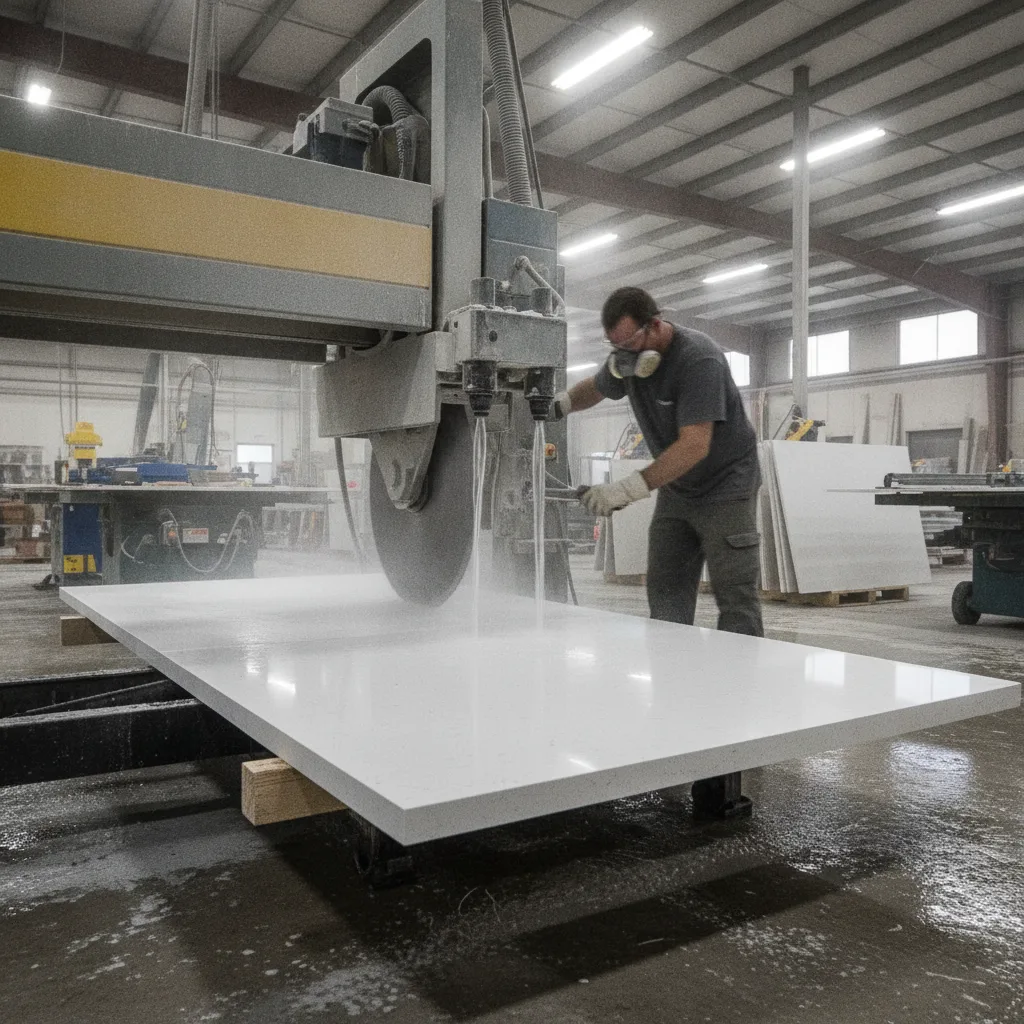
Cutting quartz countertops requires quartz-specific diamond blades with a medium-hard bond matrix (50–80 mesh for ripping, 120–140 mesh for finish cuts), mandatory wet cutting at 2–3 liters per minute, bridge saw feed rates 10–20% slower than granite, pre-drilled corner relief holes before every sink cutout, and a seven-step edge polishing sequence from 50 to 3000 grit. A shop using granite blades, dry-cutting quartz, or skipping grit steps can crack a slab worth $300–$800. As of 2026, quartz holds roughly 40% of the US countertop market — any serious fabricator needs the right tools and process, not just a granite setup applied to a different material.
Cutting quartz countertops is not the same job as cutting granite — and that gap in difficulty is exactly why two quotes for the same kitchen can differ by 15% with no obvious explanation. Engineered quartz is 90–94% ground natural quartz crystal bonded with polymer resin, and that resin changes everything about how the material behaves under a blade. The wrong diamond blade bond matrix, a feed rate dialed for granite, or a single dry cut can chip the edges, melt the surface finish, or crack a slab worth $300–$800. This post walks through the six steps a professional fabricator follows to cut quartz countertops correctly — blade selection, wet cutting setup, feed rate, sink cutouts, and edge polishing — so you can evaluate any shop's process before you sign a contract.
Engineered quartz is 90–94% ground natural quartz crystal bonded with 6–10% polymer resin under heat and vibration — and that resin is the reason cutting quartz countertops is a fundamentally different job than cutting granite. Granite is a solid natural stone with a predictable crystal structure. When you cut it, it fractures cleanly along those crystal planes. Quartz has no such structure. The resin-crystal interface creates stress lines that shear unevenly the moment a blade deflects even slightly.
Quartz sits at Mohs hardness 7. Most granite lands at 6–7. Marble sits at 3–5. So quartz is at least as hard as granite — sometimes harder — while also being brittle in a completely different way because of the resin matrix. A blade, feed rate, or water flow dialed in for granite will chip the edges of a quartz slab, smear resin onto the blade, or crack the piece outright. That is not operator error. It is physics. The durability that makes quartz countertops so appealing in a kitchen is the same property that makes cutting them unforgiving.
As of 2026, engineered quartz accounts for roughly 40% of the US countertop market. That market share means any serious fabricator needs quartz-specific skills and tools as a baseline — not a granite setup they occasionally press into service on quartz jobs. The community of shops that treat quartz as a specialty rather than a standard offering is shrinking fast, and homeowners comparing quotes deserve to know which category their fabricator falls into.
If a fabricator quotes your quartz job at the exact same price per square foot as granite with no explanation, ask whether they have quartz-specific diamond blades and a wet cutting setup. Most reputable shops charge a 10–20% per-square-foot premium for quartz to cover tooling wear and the slower, more precise process the material requires.
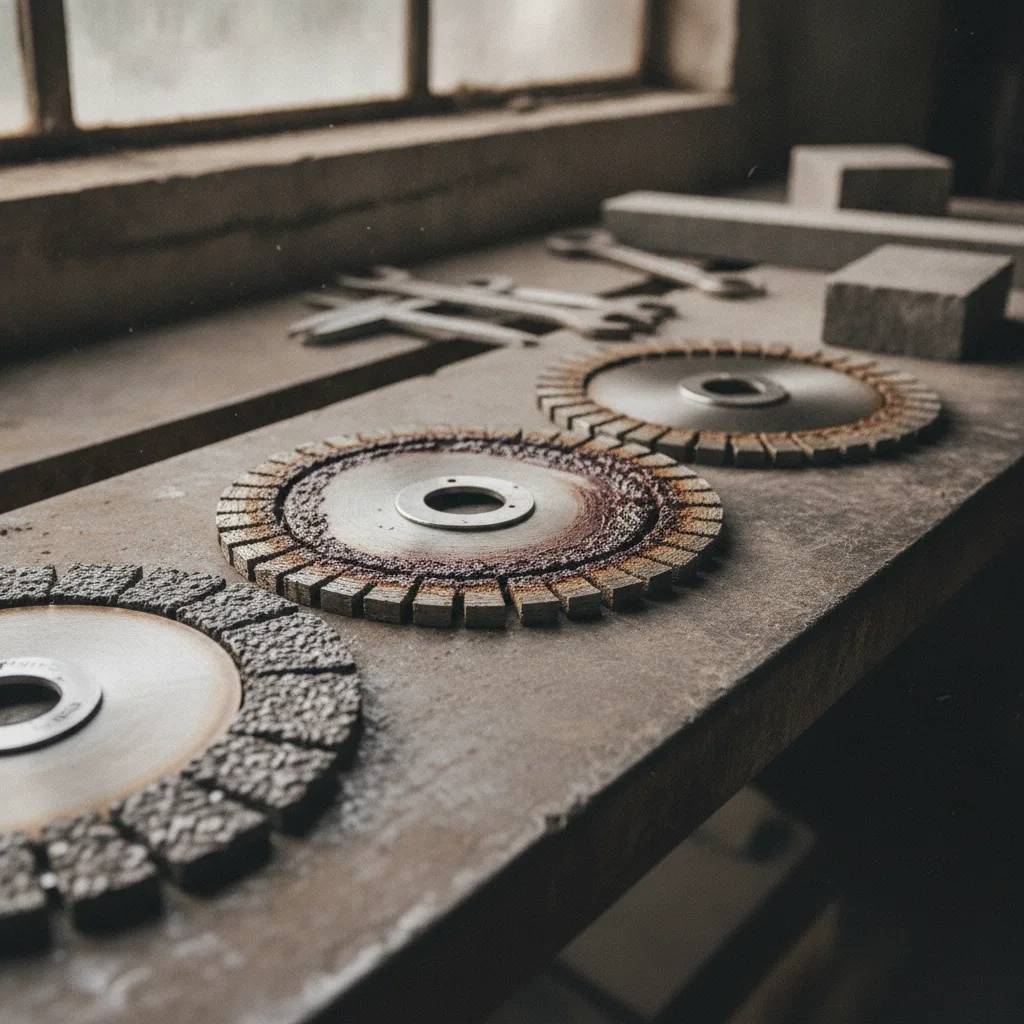
The correct diamond blade grit for cutting quartz countertops is 50–80 mesh for ripping cuts and 120–140 mesh for finish cuts. Granite fabricators typically run a 60-grit segmented or continuous-rim blade as a general-purpose standard — and that blade will not perform correctly on quartz. The difference is not just grit. It is bond matrix hardness.
Quartz requires a medium to medium-hard diamond blade bond matrix. A bond that is too soft wears out fast against quartz's abrasive crystals. A bond that is too hard glazes over — the diamonds get buried without exposing fresh cutting edges, so the blade stops cutting and starts burning. That glazed blade then generates excess heat, which melts the resin binder in the quartz slab and ruins the cut edge. Segment size matters too: 20–25mm segments give the best balance of cutting speed and edge quality on quartz.
For sink cutouts and curved cuts, a diamond blade on a wet angle grinder or a core drill bit is the right tool — not a straight-cut circular saw blade forced through an interior corner. The grinder gives the precision needed at tight radii; the core bit handles corner relief holes. Both require continuous water flow. A circular saw with a diamond blade and a straight edge guide is acceptable for straight field cuts, but only with wet cutting — never dry. Access to the right blade type at the start of the job determines whether the cut edge is smooth or needs costly rework.
$80–$220
Ripping cuts on 3cm quartz without glazing, smearing resin, or chipping the edge
$90–$250
Final cut passes where edge smoothness and chip-free lines are critical
$30–$80
Drilling corner relief holes before sink cutouts — the single most important chip-prevention step
White or gray smearing on a cut edge means the resin is melting. If the blade feels like it is sliding rather than cutting, it has glazed over. Both are signs the wrong blade or bond hardness is in use — stop and swap before continuing or you risk cracking the slab.
Wet cutting is not optional for quartz — it is mandatory. A water flow of 2–3 liters per minute directed at the blade-slab interface from both sides of the blade does two things: it keeps the polymer resin from melting onto the blade, and it suppresses silica dust below OSHA's permissible exposure limit of 50 micrograms per cubic meter of air as an 8-hour time-weighted average. Dry cutting quartz generates silica dust at concentrations well above that threshold. California banned dry cutting of engineered stone with 40% or more crystalline silica in 2024 — and quartz countertops are well above that threshold. Texas has not enacted the same ban, but OSHA's federal silica standard applies nationwide.
Granite can be dry-cut in many field situations because it has no polymer resin binder. Quartz cannot. A wet saw with a hose system feeding the blade continuously is the baseline requirement. On a bridge saw, the water delivery system must be checked before every quartz cut — a blocked nozzle mid-cut can ruin the slab and expose the operator to hazardous dust within seconds. That hose connection is not a convenience feature; it is safety infrastructure.
If you are evaluating a fabricator, ask whether they run a closed-loop water recirculation system. Shops cutting significant quartz volume manage slurry carefully — both for quality and for environmental compliance. A shop that dry-cuts quartz or eyeballs water flow is cutting corners on quality and worker safety simultaneously. That corner-cutting shows up in the finished product as chipped edges, hazy surfaces, and discolored seams.
$15,000–$80,000+ (shop equipment)
Maintains 2–3 L/min water flow at the blade for the full cut length — required for resin cooling and silica dust control
$150–$400
Field-use or detail cuts where a bridge saw cannot reach; hose connection keeps dust suppressed and resin cool
Bridge saw feed rates for cutting quartz must run 10–20% slower than for comparable granite thickness. For 3cm quartz, the target is 6–10 feet per minute depending on blade type and water flow. Push faster and the blade deflects — that tiny deflection is all it takes to create an uneven shear through the resin-crystal matrix, chipping the underside of the slab or cracking it entirely. Precision at the feed rate level is not a preference; it is a fabrication specification.
Before the blade touches the quartz slab, mark the cut line clearly and clamp the slab securely to the table. The slab must not shift during the cut. Even 1–2mm of movement on a straight cut can create a step in the edge that requires additional finishing passes. Use a straight edge guide clamped parallel to the marked line to keep the saw tracking true. Marking and clamping take five minutes. Fixing a miscut or chipped edge takes far longer — and replacing a cracked slab is a $300–$800 lesson.
A circular saw with a quartz-rated diamond blade can make straight cuts in the field, but it requires a straight edge guide, consistent pressure, and the wet cutting setup described in Step 3. A handheld circular saw without water flow is not a compliant or reliable tool for cutting quartz countertops — it creates silica dust exposure risk and produces inferior edge quality that requires extra finishing passes to smooth.
Operators who push quartz through a bridge saw at granite speeds to save time are the leading cause of chipped or cracked slabs on the shop floor. A single ruined 3cm quartz slab costs $300–$800 to replace. The time saved by rushing never covers that loss.
Sink cutouts are the highest-risk operation in quartz fabrication, and the process is non-negotiable: drill a relief hole at each internal corner with a diamond core bit before making any straight cuts. The corners of a sink opening concentrate stress. Without a pre-drilled relief hole, the blade's exit point at each internal corner creates a crack initiation site. That crack can run across the full width of the slab before you finish the cut — destroying a piece worth far more than the time saved by skipping the drill step.
After the four corner holes are drilled, make the straight cuts connecting them — three sides first, then support the center piece by hand or with a suction cup lifter before completing the fourth cut. Lower the cutout piece straight down slowly. Do not twist or pry it. Twisting transmits torque through the quartz slab and can crack it along the resin stress lines described in Step 1. This is the step where attempting a DIY sink cutout most frequently goes wrong — the slab cracks on the fourth cut because the center piece was not properly supported.
A professional fabricator charges $50–$150 per sink cutout. That fee covers the core drill bit, the controlled plunge cuts, the time to support the drop-in piece, and the experience to do it without cracking a slab worth $300–$800. The math is straightforward: the risk of a DIY attempt at cutting quartz countertops for sink openings is rarely worth the savings.
$30–$80
Pre-drilling corner relief holes before sink straight cuts — eliminates the crack initiation site at every internal corner
$25–$60
Supporting the cutout piece on the fourth cut so it lowers straight down without twisting or torquing the slab
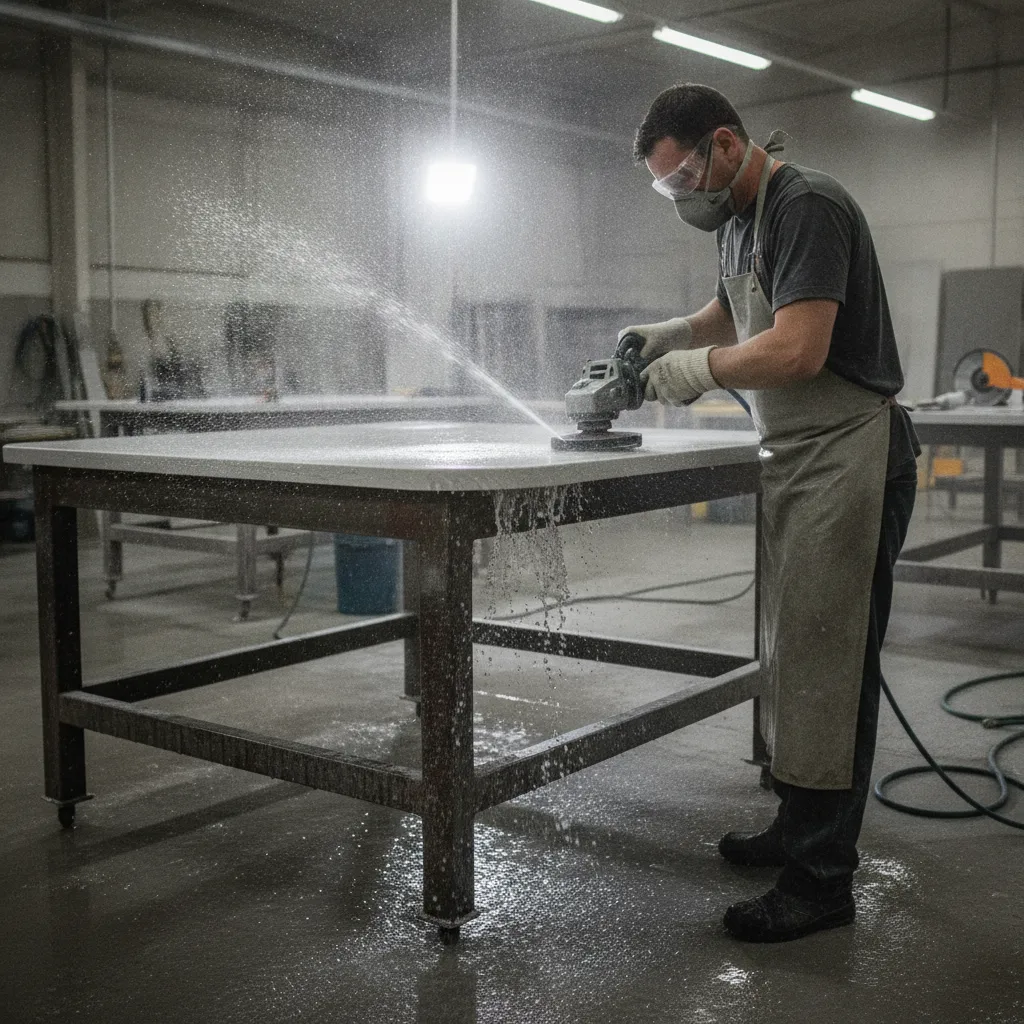
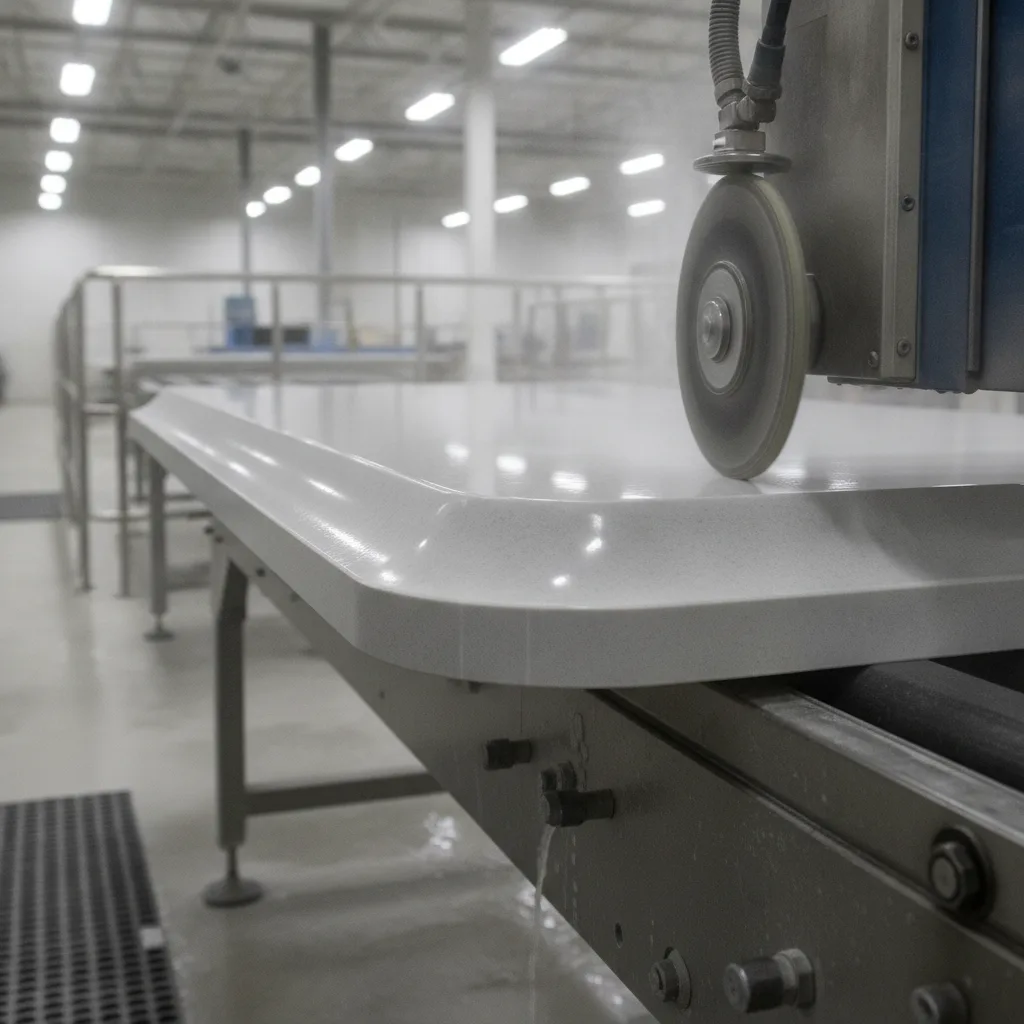
CNC edge polishing of quartz runs a seven-step grit progression: 50, 100, 200, 400, 800, 1500, then 3000. Skipping grits does not save meaningful time — it leaves micro-scratches from the previous grit that the next grit cannot fully remove. The result is a dull or hazy edge profile instead of a smooth, polished finish. This shows up most visibly on white and light-gray quartz where any surface inconsistency catches the light. Beginning the polishing sequence correctly at 50 grit and running every step in order is the only reliable path to a polished edge.
Overheating during polishing is just as damaging as under-polishing. High heat from rushing through the lower grits can discolor the resin binder, permanently altering the color at the edge. That yellowing or browning is immediately obvious against the face of the countertop — and it cannot be polished out after the fact. Maintaining consistent pressure, speed, and water flow at every grit step is what separates a shop with CNC polishing equipment from one finishing edges by hand with an angle grinder and a pad set.
Edge profiles — eased, beveled, bullnose, half-bullnose, ogee — each require the same full grit sequence but with different CNC toolpath geometry. A polished ogee on quartz takes longer than on granite because the resin requires more careful heat management at every curved pass. Fabricators with CNC polishing equipment and quartz-specific programming produce consistently better edge quality than shops doing it manually. If a fabricator cannot describe the grit sequence they run on edges, that is the question to ask before you sign off on the job. Installers who trim edges in the field after the countertop is on the cabinets are working outside the controlled shop environment — and edge quality suffers for it.
$20,000–$100,000+ (shop equipment)
Runs the full 50–3000 grit sequence with controlled pressure and speed, eliminating the heat buildup that discolors resin binder
$150–$400 grinder + $40–$120 pad set
Manual edge polishing option for field work or small shops; requires operator skill to avoid heat discoloration at each grit stage
Going from 200 grit directly to 800 grit leaves scratches the 800 pad cannot remove. You will end up back-tracking to 400 anyway — and if you do not, the edge will look scratched under direct light. Run every step in sequence the first time and the finishing process takes less total time than restarting.
Ask any fabricator you are considering four direct questions before signing a contract. Do you have quartz-specific diamond blades with a medium-hard bond matrix? Do you run wet cutting on all quartz work with 2–3 liters per minute at the blade? Do you pre-drill corner relief holes before every sink cutout? And do you run the full 50–3000 grit polishing sequence on edges? A shop with proper in-house quartz fabrication capability will answer all four without hesitation. A shop that dry-cuts quartz, uses granite blades on quartz slabs, or skips grit steps to save time is the shop most likely to crack your $300–$800 slab — and charge you for the replacement. For quartz countertop fabrication and installation in Austin, San Antonio, New Braunfels, and across Central Texas, Fox Granite has completed over 10,000 projects using state-of-the-art in-house stone-cutting equipment. Schedule your free in-home consultation: call (512) 653-5541 or contact us online, and we will walk you through material selection, show you samples, and give you a transparent all-in price with no surprise fees.
When cutting quartz countertops goes right, you get clean straight cuts, chip-free edges, a smooth polished profile, and a sink opening that does not have a hairline crack running toward the back wall. That outcome requires the right diamond blade bond matrix for each cut type, mandatory wet cutting at 2–3 liters per minute, feed rates dialed back from granite norms, pre-drilled corner relief holes, and a seven-grit polishing sequence run without shortcuts. Homeowners who understand this process are better equipped to evaluate fabricator quotes, ask the questions that reveal shop capability, and avoid the costly surprise of a cracked slab. Join the many Central Texas homeowners who have chosen Fox Granite for exactly that reason — start with a free consultation and see the difference that proper in-house fabrication makes from the first template measurement through the final polished edge.
Ready to get started? Contact Fox Granite today.


BY APPOINTMENT ONLY
1379 Wald Road
New Braunfels, TX 78132
Austin, San Antonio, Cedar Park, Kyle, New Braunfels, Del Valle, Elgin, Lago Vista, Shady Hollow, Onion Creek, Buda, San Marcos, Lockhart, Temple, Wimberley, Dripping Springs, Bee Cave, Lakeway, Leander, Anderson Mill, Jollyville, Spicewood Springs, Round Rock, Georgetown, Pflugerville, Manor, Taylor, Manchaca, Mountain City, Hutto, West Lake Hills, Bastrop, Liberty Hill, Driftwood, Sun City, Steiner Ranch.