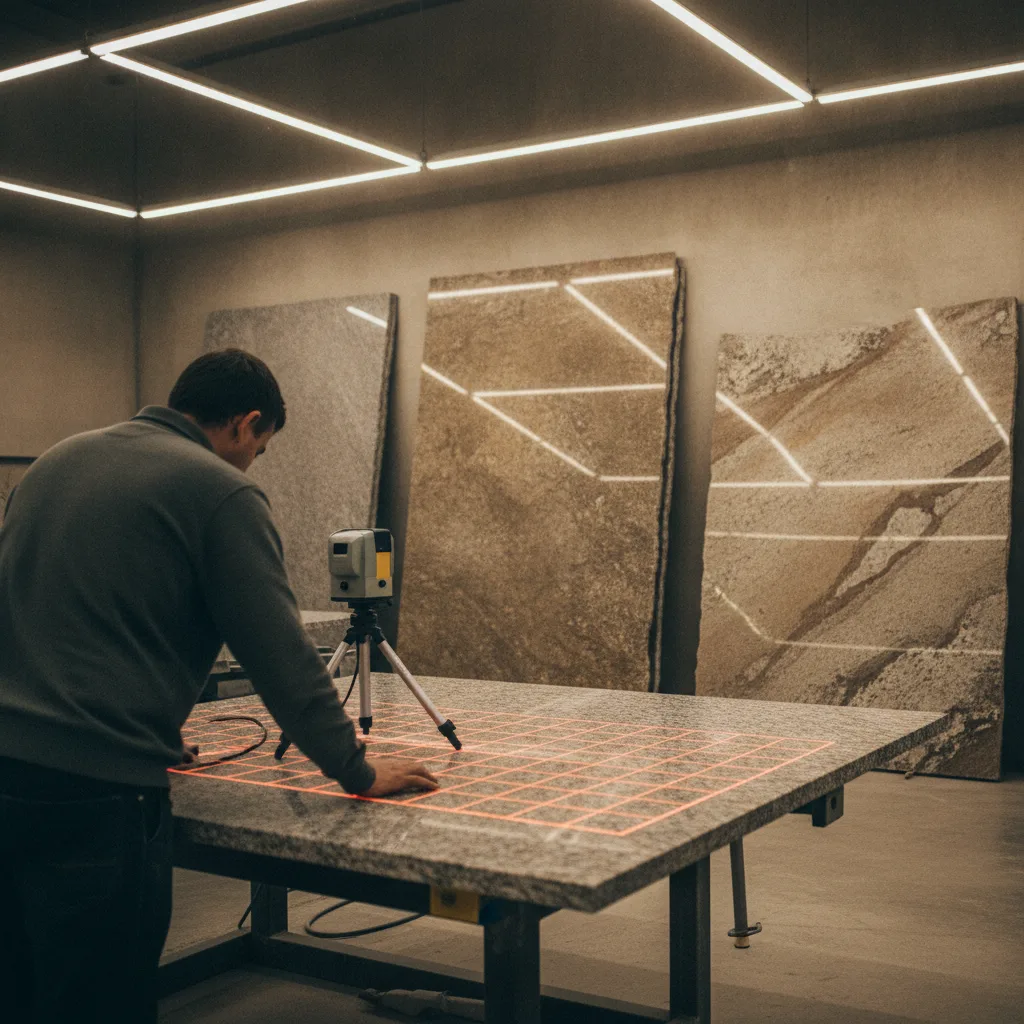
A custom countertop starts as a raw slab that a fabricator measures, templates, cuts, and finishes to your kitchen's exact dimensions — nothing is pre-sized at a factory. Prefab granite and quartz countertops arrive pre-cut to fixed standard sizes (typically 96 inches long by 25.5 inches deep) with two edge options and 10 to 20 color patterns. Custom fabrication runs $50 to $200 per sq ft installed; prefab runs $10 to $40. For a 40- to 60-sq-ft kitchen, that's $2,400 to $5,000 for mid-grade custom granite versus $400 to $2,400 for prefab — but prefab guarantees visible seams on any island wider than 26 inches and locks you into whatever the factory decided for edge profiles, colors, and finish.
Custom countertops run $50 to $200 per sq ft installed; prefab options run $10 to $40. That price gap tells part of the story, but not all of it. The real difference between custom and off-the-shelf countertops is fit, finish, and selection — and for most Central Texas kitchens with islands, L-shaped runs, or any cabinet layout beyond a straight 8-foot wall, prefab simply doesn't fit the space. This guide walks through exactly what makes a countertop truly custom, where off-the-shelf countertops fall short, how the fabrication process works from template to install, and how to get started on your next project with a free estimate. Reading time: 15 to 20 minutes. Project timeline: 2 to 4 weeks from signed contract to installation day.
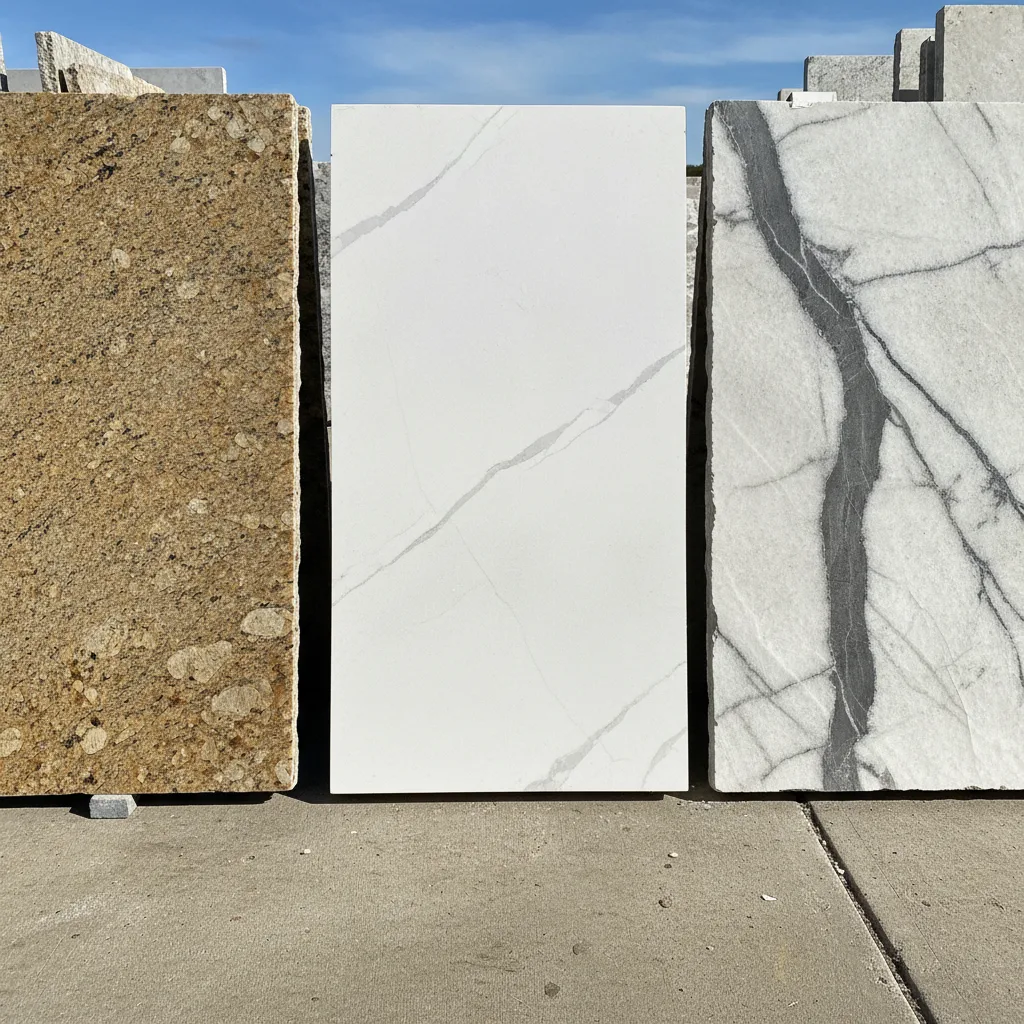
A custom countertop starts as a raw slab that a fabricator measures, templates, cuts, and finishes to your kitchen's exact dimensions — nothing is pre-sized at a factory. That single fact separates custom fabrication from every off-the-shelf option on the market, including big-box prefab granite, prefab quartz countertops, and laminate post-form strips sold by the linear foot.
Prefabricated countertops are cut at the manufacturer to fixed standard sizes — most commonly 96 inches long by 25.5 inches deep — and sold ready to set. They come with one or two edge options (usually eased or a simple bevel), 10 to 20 color patterns at most big-box stores, and no ability to account for walls that aren't perfectly square or cabinet runs that exceed 8 feet without a visible seam. The laminate category follows the same logic: post-form laminate strips arrive pre-shaped, pre-edged, and pre-finished in fixed dimensions from the manufacturer.
The word 'custom' gets used loosely in marketing, so watch for it. True custom fabrication means your fabricator buys a full slab, templates your space, programs a CNC saw to your specific cuts, profiles your chosen edge, and installs the finished piece — all sized for your home and no one else's. If a countertop arrives pre-cut in a box, it is not custom, regardless of what the label or the salesperson says.
Solid surface materials like HI-MACS (acrylic solid surface) and Corian can be fabricated to custom sizes and are sometimes positioned as a middle-ground option between prefab laminate and stone. They score lower on durability than granite or quartz — softer, less heat-resistant, and more prone to scratching — so review the tradeoffs carefully if a salesperson brings them up as a 'custom' alternative to natural stone.
Prefab countertops cost 40 to 60 percent less per square foot than custom slab work — roughly $10 to $40 per sq ft installed versus $50 to $200 for custom stone — and that price gap is real. For a rental property, a tight-budget laundry room, or a perfectly straight 8-foot kitchen run with standard 25-inch cabinet depth, prefab can be a reasonable call. The value is there, in the right context.
The problem shows up the moment your kitchen gets more complicated. Prefab pieces max out at about 26 inches wide. Most kitchen islands need 36 to 42 inches of depth. That gap guarantees a visible seam — and prefab seams tend to show more than custom seams because the factory polish on two separate pieces won't always match, and the joint is harder to pull tight without professional clamps and color-matched epoxy. Seams on a kitchen island are the most common source of buyer regret in prefab installations, and they're not fixable after the fact without starting over.
Color and pattern selection is another hard limit. Big-box stores carry roughly 10 to 20 patterns in prefab granite or prefab quartz. A slab yard offers hundreds. If you picture a specific stone for your dream kitchen — a warm Venetian Gold granite, a dramatic quartzite with bold veining, a soft Calacatta marble look — you won't find it in a prefab section. You'll choose it from a full slab at a supplier, and your fabricator will cut it precisely to your kitchen's dimensions.
Free to $10
Sketch your countertop runs to scale before any shopping trip so you can spot immediately whether prefab pieces can cover your layout without forcing a seam in a visible location.
Custom countertop fabrication follows five defined stages: cabinet inspection, templating, slab selection, precision CNC cutting, and installation. A mistake at templating compounds at cutting, which is why experienced fabricators treat that first shop visit — when they map your exact kitchen — as the most critical step of the whole project. Every dimension feeds directly into the CNC program; there is no margin for guesswork.
Templating uses a precision overlay method or a digital laser system like a Prodim Proliner (which costs fabricators $15,000 to $50,000 per device) to measure your space to within a fraction of a millimeter. That data feeds directly into the CNC bridge saw program at the shop. The CNC bridge saw itself runs $30,000 to $150,000 new; CNC edge profiling machines run $50,000 to $250,000. Stone fabrication shops operate on material margins of 40 to 60 percent to cover that overhead — equipment depreciation, diamond blades at $300 to $800 each, rent on 3,000 to 8,000 sq ft of shop space — and that investment is what produces a countertop that fits on the first try.
Shop production for a standard residential kitchen typically runs 3 to 7 business days after templating. Template day usually lands 3 to 5 business days after you sign the contract. Total timeline from signed contract to installation day is 2 to 4 weeks at most shops. Complex edge profiles or multiple cutouts — like an undermount sink plus a cooktop cutout — can add 3 to 5 days. Plan your kitchen remodel schedule around that window before you order cabinets or schedule a plumber.
Ask your fabricator where your slab's seam will fall before cutting begins. Custom fabricators plan seam placement for the least visible spots — away from the sink, away from sightlines from the living area — and use color-matched epoxy to minimize the joint. Prefab installers work around wherever the pre-cut pieces happen to land.
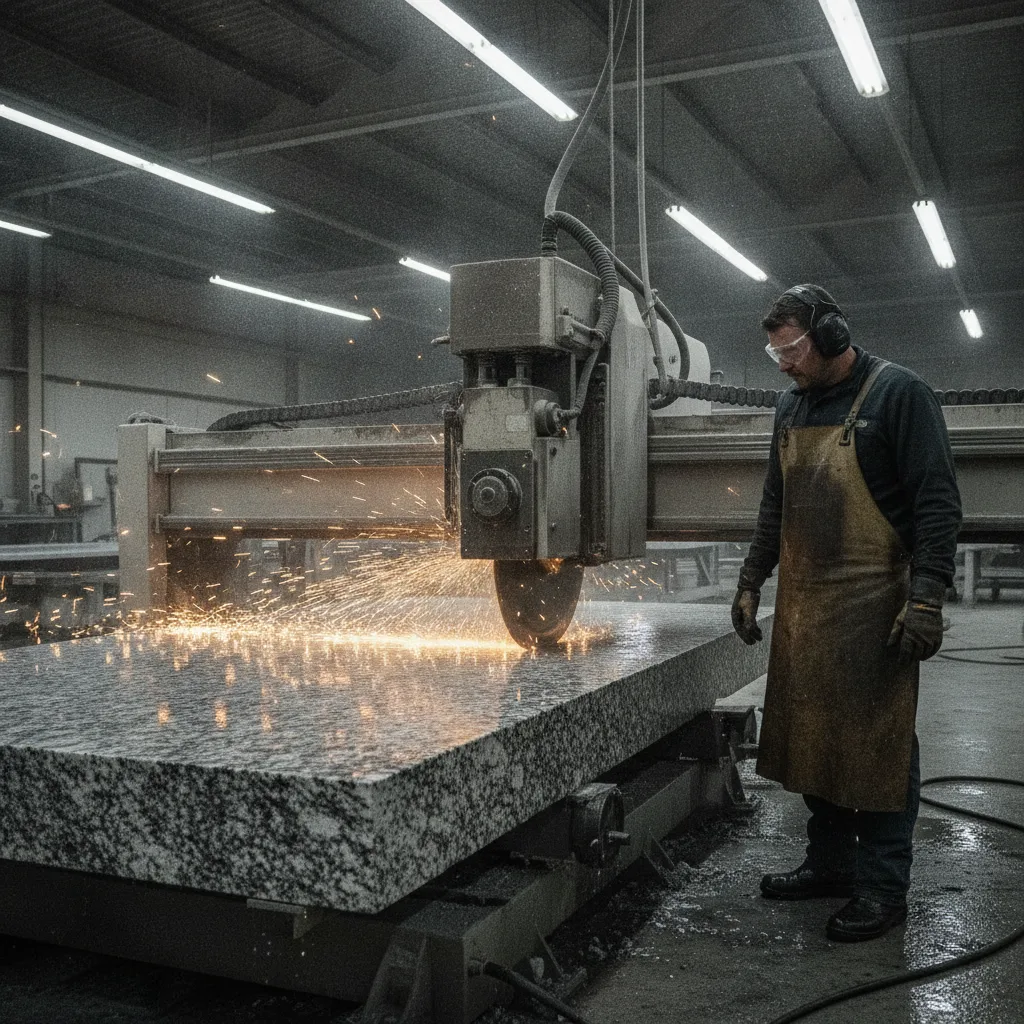
Custom granite countertops run $50 to $110 per sq ft installed and remain the most popular choice in Central Texas kitchens for good reason: granite scores 6 to 7 on the Mohs hardness scale, making it scratch-resistant and heat-resistant, and it needs resealing only every 1 to 3 years. A typical kitchen project covering 40 to 60 square feet lands at $2,400 to $5,000 installed for mid-grade granite, with an additional $500 to $1,500 for a premium or exotic slab. Material accounts for roughly 35 to 50 percent of that installed price; labor, templating, and shop overhead make up the rest.
Custom quartz countertops run $55 to $120 per sq ft installed. Quartz is an engineered stone — roughly 90 to 95 percent ground quartz bound with resin — which makes it a non-porous solid surface that needs no annual sealing. It is a strong choice for bathrooms, high-traffic kitchens, and families who want clean counters without a maintenance schedule. Custom quartzite runs $70 to $200 per sq ft installed and delivers natural stone beauty closer to marble but with harder durability. Marble and quartzite marble-look stones run $75 to $200 per sq ft and are best suited for lower-traffic surfaces or homeowners who understand that material's care needs before they commit.
Laminate countertops — post-form strips from a big-box store — sit outside the custom stone category entirely. They cost $10 to $40 per sq ft installed, show wear faster than stone, and cannot be refinished. They are worth mentioning here because some homeowners compare them to stone on price alone without accounting for durability and longevity differences. The global countertops market was valued at $157.7 billion in 2025, and the materials driving that value are natural and engineered stone — not laminate. Browse any modern kitchen design and the reason is immediately obvious.
Edge profile is where custom countertops separate most visibly from off-the-shelf options: an ogee, a half-bullnose, a waterfall edge, or a beveled profile all require a fabricator's CNC profiling machine, and none of those styles come on prefab pieces. Prefab offers eased (flat) or a basic bevel. If you've pictured a specific edge in your dream kitchen — or if your interior designers have specified one — custom fabrication is the only path. As of 2026, rounded profiles like the half-bullnose and double roundover are trending for family homes, and waterfall edges are the dominant statement choice for modern kitchen islands.
Slab selection and vein placement are equally personal. When you visit a slab yard or showroom, you are choosing a specific piece of stone — not a color category. Two slabs of the same granite variety can look dramatically different. Fabricators who offer book-matching (opening two consecutive slabs from the same block like a book so veining mirrors across a seam) add 1 to 3 hours of fabrication time and require buying two slabs, but the result is a kitchen design feature that no prefab product can replicate. That kind of detail is what turns a kitchen countertop into a decor anchor.
Sink cutouts are a practical custom detail that add $50 to $150 per cutout for an undermount sink, cooktop, or faucet hole, cut precisely to your sink model. Compare that to prefab: an undermount sink requires you to find a piece that happens to accommodate your sink's dimensions — or cut it yourself, which risks cracking the stone. The complete cost of custom fabrication, edge profiling, and cutouts still produces a finished surface that fits, looks right, and lasts for decades.
The single best first move for any homeowner considering custom countertops in Austin, San Antonio, or the surrounding Central Texas area is a free in-home consultation. A fabricator visits your space, reviews your cabinet layout, discusses countertop materials and edge options, and gives you an all-in price estimate with no hidden fees added after templating. That number should cover material, fabrication, edge profiling, sink cutout, sealing, and installation. Get it in writing before you sign anything. A stress-free process starts with pricing transparency on day one.
If your project is a small bathroom, laundry room, or bar top, ask your fabricator about remnant slabs. Remnant pieces are leftover cuts from larger jobs, fully custom-fabricated to your exact dimensions, but priced 30 to 60 percent below full-slab pricing. It is a legitimate way to get genuine custom stone work at a lower entry point — not a compromise on quality. You can visit the shop, browse the remnant selection, and find something beautiful that fits your space and your budget at the same time.
As of 2026, the dominant kitchen countertop design trend is personalization: a specific stone, a custom edge profile, colors and patterns that reflect how you actually cook and live. That trend is only achievable through custom fabrication. Off-the-shelf pieces offer a shortcut on price and timeline, but they lock you into whatever the factory decided. For a home you are staying in, that trade-off rarely feels like a win two years later — and the upgrade to custom is often smaller in dollar terms than homeowners expect once they review a real all-in estimate.
Free
A Fox Granite team member brings samples to your home, measures your space, and walks you through material and edge options with transparent, all-in pricing and no surprise fees after templating.
Rental properties with tight renovation budgets, simple straight-run kitchens under 8 feet wide, and secondary laundry rooms are the clearest fits for prefab. If you are staying in the home, if you have an island, or if your cabinet run exceeds 8 feet, custom fabrication is almost always the better long-term choice. The perfect fit for your kitchen comes from a fabricator who measures your space — not from a box that ships from a factory.
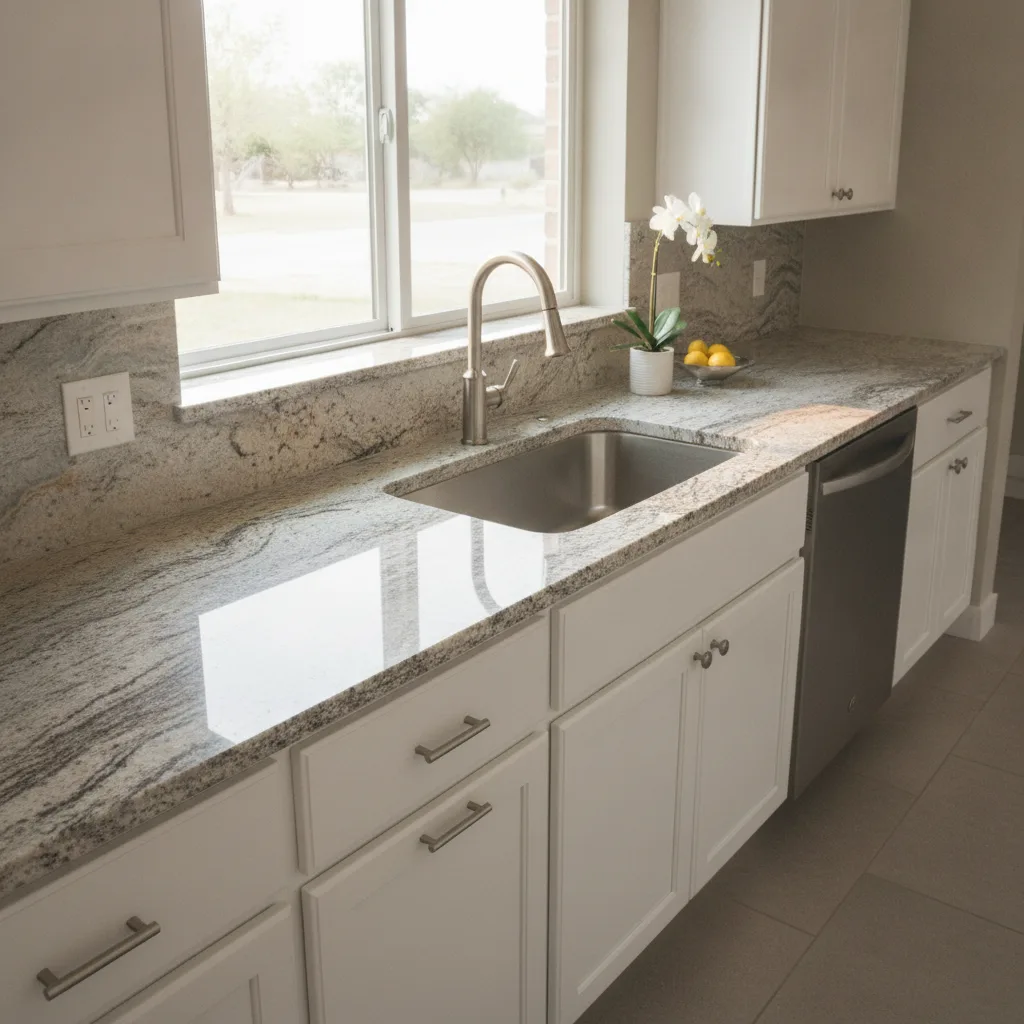
Prefab countertops look like a deal on paper — $10 to $40 per sq ft versus $50 to $200 for custom stone. But that comparison doesn't account for the visible seam across your island, the two edge choices you're stuck with, or the limited selection of colors and patterns at a big-box store. For most Central Texas kitchens with islands, L-shaped runs, or any non-standard cabinet depth, prefab doesn't just cost less — it fits less. Get a real, all-in estimate from a custom fabricator before you decide. The gap may be smaller than you expect, and the result will be with you for decades.
For custom countertops in Austin, San Antonio, New Braunfels, and the surrounding Central Texas area, Fox Granite brings in-house fabrication, transparent pricing, and a free in-home consultation that puts real stone samples in your kitchen before you commit. We have completed over 10,000 projects across locations throughout Central Texas, and every one starts with a conversation about your space, your materials, and your budget — not a box size from a factory catalog. Contact Fox Granite today to schedule your free estimate and get your next project started.
Ready to get started? Contact Fox Granite today.


BY APPOINTMENT ONLY
1379 Wald Road
New Braunfels, TX 78132
Austin, San Antonio, Cedar Park, Kyle, New Braunfels, Del Valle, Elgin, Lago Vista, Shady Hollow, Onion Creek, Buda, San Marcos, Lockhart, Temple, Wimberley, Dripping Springs, Bee Cave, Lakeway, Leander, Anderson Mill, Jollyville, Spicewood Springs, Round Rock, Georgetown, Pflugerville, Manor, Taylor, Manchaca, Mountain City, Hutto, West Lake Hills, Bastrop, Liberty Hill, Driftwood, Sun City, Steiner Ranch.